
Sri Krishnadevaraya — Emperor of Vijayanagara at Its Zenith


Sri Krishnadevaraya was the greatest ruler of the Tuluva dynasty of the Vijayanagara Empire and one of the most celebrated emperor-kings of medieval Bharat. He ruled from 1509 to 1529 CE, during the period when Vijayanagara reached its greatest combination of territorial power, military strength, economic prosperity, monumental architecture and literary achievement.
UNESCO describes Vijayanagara as reaching its apogee under Krishna Deva Raya, whose reign transformed Hampi into one of the grandest capitals of the sixteenth-century world.
His reign combined:
imperial expansion
strong administration
agriculture and irrigation
international commerce
temple construction
Vaiṣṇava devotion
patronage of multiple Hindu traditions
Telugu, Kannada, Tamil and Sanskrit scholarship
and an extraordinary flowering of arts and literature.
Krishnadevaraya was simultaneously:
Emperor
military commander
administrator
temple patron
poet
scholar
and:
one of the principal builders of Vijayanagara’s cultural golden age.
The Vijayanagara Empire
The Vijayanagara Empire had been founded in the fourteenth century in the Tungabhadra region.
Its capital eventually became:
Vijayanagara
whose surviving ruins are now known as:
Hampi.
The empire was founded by Harihara and Bukka and passed successively through the:
Sangama dynasty
Saluva dynasty
Tuluva dynasty
and later the:
Aravidu dynasty.
By Krishnadevaraya’s accession in 1509, Vijayanagara had already existed for more than 170 years.
His achievement was not founding the empire.
It was taking an already powerful kingdom and raising it to:
its political and cultural peak.
The Tuluva Dynasty
Krishnadevaraya belonged to the:
Tuluva dynasty.
His father was:
Tuluva Narasa Nayaka.
Narasa Nayaka had become one of the most powerful military figures in Vijayanagara during the turbulent period following the decline of the Saluva rulers.
He effectively protected and stabilised the imperial state.
Krishnadevaraya therefore inherited both:
a dynasty
and
a military-political system created through his father’s rise.
His Elder Brother — Vira Narasimha
Narasa Nayaka’s son:
Vira Narasimha Raya
preceded Krishnadevaraya on the throne.
Vira Narasimha died in:
1509.
Krishnadevaraya then succeeded him.
The transition placed a relatively young ruler at the head of an empire facing major challenges on several fronts.
Accession — 1509
Krishnadevaraya became emperor in:
1509 CE.
His formal coronation occurred shortly afterward.
His reign is conventionally given as:
1509–1529.
Government of India historical material identifies him as the greatest of Vijayanagara’s rulers and describes the empire as reaching the zenith of its glory and prosperity under him.
An Empire Surrounded by Rivals
Krishnadevaraya did not inherit a peaceful political environment.
His empire faced challenges from:
Gajapati Kingdom of Odisha
controlling important Andhra territories.
Bijapur
under the Adil Shahi dynasty.
Golconda
under the Qutb Shahi rulers.
other Deccan Sultanates
emerging from the fragmentation of the Bahmani state.
rebellious regional chiefs
inside or around Vijayanagara territory.
His first objective therefore had to be:
stabilisation.
The Capital — Hampi


Hampi stood along the:
Tungabhadra River
in present-day Karnataka.
Its natural landscape was extraordinary:
granite hills
massive boulder fields
river valleys
fertile plains
and naturally defensible terrain.
The Vijayanagara rulers integrated this landscape with:
forts
temples
markets
palaces
roads
reservoirs
canals
and ceremonial architecture.
Today more than:
1,600 surviving remains
have been identified across the World Heritage area.
Vijayanagara Reaches Its Apogee
UNESCO explicitly states:
the city reached its apogee under Krishna Deva Raya.
His reign therefore represents the highest phase of the imperial capital’s development.
Foreign travellers visiting Vijayanagara described a metropolis filled with:
markets
palaces
temples
merchants
horses
jewels
and enormous populations.
The city was one of the great urban centres of sixteenth-century Asia.
A Sacred Capital
Hampi was not merely an imperial city.
It was also a sacred landscape associated with:
Virupaksha
a form of Shiva,
and with the sacred goddess:
Pampa.
UNESCO’s study of Vijayanagara records that the region had already been an important pilgrimage landscape centuries before the imperial capital developed there.
The later Vijayanagara kings therefore built their political capital around:
an already sacred geography.
Krishnadevaraya’s Early Challenge — Ummattur
One of Krishnadevaraya’s early political challenges came from powerful chiefs around:
Ummattur.
These territories lay in southern Karnataka.
The rebellion threatened Vijayanagara’s control of strategically important areas.
Krishnadevaraya suppressed the challenge and strengthened imperial control across the southern part of the kingdom.
This allowed him to turn toward much larger conflicts elsewhere.
Srirangapatna and Southern Karnataka
The campaigns around southern Karnataka strengthened Vijayanagara authority around:
Srirangapatna
Mysore region
and the Kaveri basin.
Regional chiefs remained important within the imperial structure, but the emperor’s victory demonstrated that:
provincial authority remained subordinate to Vijayanagara sovereignty.
The Great Eastern Campaign
Krishnadevaraya’s longest and most ambitious war was fought against:
Prataparudra Deva
the powerful Gajapati ruler of Odisha.
The Gajapati kingdom controlled large portions of:
Odisha
coastal Andhra
and important inland fortresses.
Among the territories Vijayanagara sought to recover were:
Udayagiri
and:
Kondavidu.
Historical sources divide Krishnadevaraya’s eastern war into a series of major stages.
Udayagiri Campaign
In approximately:
1513
Krishnadevaraya began the siege of:
Udayagiri.
The fortress was extremely difficult to capture because of its strong natural position and defensive works.
The campaign lasted for roughly:
a year or more.
Udayagiri eventually fell to the Vijayanagara army.
Historical sources identify this as the first major phase of Krishnadevaraya’s campaign against the Gajapati territories.
Krishna Image from Udayagiri
After the capture of Udayagiri, Krishnadevaraya brought an image of:
Bala Krishna
to Vijayanagara.
He subsequently constructed a major temple complex at the capital to house the deity.
India’s official Incredible India portal dates the Krishna Temple at Hampi to:
1513 CE
and states that it commemorated Krishnadevaraya’s victory over Udayagiri.
Krishna Temple of Hampi


The:
Krishna Temple
became one of the great monuments of imperial Vijayanagara.
The complex contained:
sanctuary
mandapas
gopura
subsidiary shrines
market street
and sacred architecture integrated into the wider urban plan.
The temple demonstrates how Krishnadevaraya converted:
military victory
into:
sacred royal commemoration.
Victory → Temple → Memory
The political logic was powerful:
imperial campaign
↓
victory
↓
sacred image transferred
↓
temple constructed
↓
victory permanently remembered.
Thus architecture became a historical record.
More than five centuries later, the Krishna Temple still preserves the memory of the Udayagiri campaign.
Kondavidu
Following Udayagiri, Krishnadevaraya advanced farther into Andhra.
The next major objective was:
Kondavidu.
The campaign passed through or captured several important forts including:
Vinukonda
Bellamkonda
Nagarjunakonda
and other strategic positions.
Kondavidu fell in:
1515.
Historical records state that important members of the Gajapati political establishment were taken prisoner, including Virabhadra, a son of Prataparudra.
Kondapalli
Krishnadevaraya’s forces then moved toward:
Kondapalli.
The fortress controlled strategically important territory near the Krishna River.
Its capture further shifted the balance of power in coastal Andhra toward Vijayanagara.
A Telugu inscription dated:
4 May 1516
records Vijayanagara administration in the Kondapalli region following Krishnadevaraya’s campaigns.
Advance Toward Kalinga
The emperor’s forces continued northward.
Campaign traditions associate the advance with:
Rajahmundry
Simhachalam
and eventually territory approaching:
Cuttack,
the Gajapati capital.
The objective was no longer simply recovering one lost fortress.
Krishnadevaraya was imposing Vijayanagara power across much of the eastern Deccan.
Peace with Prataparudra
Eventually the long war ended through a political settlement.
Prataparudra and Krishnadevaraya reached peace.
The post-war settlement established a more stable frontier between their kingdoms.
Later tradition also connects the settlement with a dynastic marriage.
The essential strategic result was clear:
Vijayanagara had restored and expanded its position across Andhra.
Tirupati After Victory
Krishnadevaraya repeatedly visited:
Tirumala-Tirupati
during and after his campaigns.
The surviving temple inscriptional tradition records multiple royal visits and major gifts made by:
Krishnadevaraya
Tirumaladevi
and Chinnadevi.
These included:
gold
jewels
villages
and ritual endowments.
His patronage of Sri Venkateswara became one of the best documented devotional relationships of his reign.
Sri Venkateswara
Krishnadevaraya was particularly devoted to:
Sri Venkateswara
of Tirumala.
His religious worldview was closely connected with:
Sri Vaishnavism.
Yet Vijayanagara royal patronage under him was not confined exclusively to one temple or one sectarian tradition.
His government supported a broad sacred landscape across southern Bharat.
Krishnadevaraya and His Queens at Tirumala
One of the most recognisable historical representations associated with him depicts:
Krishnadevaraya
together with his queens:
Tirumaladevi
and:
Chinnadevi.
These royal donor images preserve the monarch as:
devotee
rather than only warrior-emperor.
The combination reflects a fundamental feature of Vijayanagara kingship:
imperial authority + temple devotion.
The Raichur Doab
The most famous western conflict of Krishnadevaraya’s reign concerned:
Raichur.
The region between the:
Krishna River
and
Tungabhadra River
is known as the:
Raichur Doab.
Its fertile land and strategic location made it one of the most contested territories in Deccan history.
Vijayanagara and northern Deccan states had fought over it for generations.
Why Raichur Mattered
Control of the Doab offered:
fertile agricultural land
strategic fortresses
access to river routes
prestige
and a buffer between competing empires.
Raichur Fort itself had exceptional defensive importance.
Whoever controlled the Doab could project power toward either:
Vijayanagara
or
Bijapur.
Battle of Raichur — 1520
The conflict culminated in:
1520.
Krishnadevaraya confronted the forces of:
Ismail Adil Shah of Bijapur.
Raichur district’s official history dates the decisive campaign to:
19 May 1520
and records Vijayanagara’s victory and capture of Raichur.
This became one of the defining victories of Krishnadevaraya’s reign.
Why Raichur Was So Important
The victory demonstrated that Vijayanagara could defeat one of the strongest Deccan states in a major open campaign.
It strengthened Krishnadevaraya’s reputation throughout southern India.
Following the victory:
Raichur remained under Vijayanagara control until 1565.
Thus the outcome lasted considerably longer than the emperor himself.
Domingo Paes
A particularly valuable source for Krishnadevaraya’s period is the Portuguese traveller:
Domingo Paes.
Paes visited Vijayanagara around the time of the Raichur campaign.
His account provides descriptions of:
the emperor
the capital
court ceremonies
military forces
markets
and imperial wealth.
Because he actually saw Vijayanagara during Krishnadevaraya’s reign, his observations are among the most important eyewitness sources for the empire at its height.
Portuguese Observers and Vijayanagara
Other Portuguese writers, especially:
Fernão Nuniz,
also preserved extensive accounts of Vijayanagara history.
These reports provide an outside perspective on a society known otherwise through:
inscriptions
temples
Telugu literature
Kannada records
and royal traditions.
The combined evidence allows Krishnadevaraya’s empire to be reconstructed from multiple independent historical traditions.
Relations with the Portuguese
The Portuguese captured:
Goa
in 1510.
Their arrival changed western Indian Ocean politics.
Krishnadevaraya maintained diplomatic and commercial relationships with Portuguese authorities rather than treating them simply as permanent enemies.
Vijayanagara was particularly interested in overseas commerce and imported:
high-quality horses
which remained strategically valuable within Deccan military systems.
The official Vijayanagara district history notes that commerce between Portugal and Vijayanagara became important to both sides.
Horses and International Trade
The Deccan did not naturally produce enough of the particular warhorses desired by major armies.
Horses were imported from regions including:
Arabia
Persia
and other western markets.
Ports therefore became strategically important.
A maritime merchant could indirectly influence land warfare.
The chain was:
overseas trade
↓
horses imported
↓
imperial cavalry
↓
military strength.
Krishnadevaraya understood this connection between:
commerce and state power.
Vijayanagara as a Commercial Empire
The imperial economy connected:
agriculture
craft production
mining
textiles
temple centres
inland markets
and maritime ports.
Merchants travelled through Vijayanagara dealing in:
horses
precious stones
textiles
spices
metals
and other goods.
UNESCO states that the remains of Hampi reveal both the political status and enormous economic prosperity of Vijayanagara.
Markets of Hampi
Many major temple complexes at Hampi were associated with long:
bazaar streets.
These commercial avenues combined:
temple + pilgrimage + commerce.
Pilgrims needed:
food,
flowers,
cloth,
jewellery,
animals,
ritual goods
and accommodation.
Thus sacred centres also became economic centres.
Irrigation and Agricultural Power
A huge capital and powerful army required enormous agricultural production.
The Vijayanagara state therefore invested heavily in:
reservoirs
canals
tanks
and water channels.
UNESCO describes Hampi’s sophisticated hydraulic technologies and the integration of agricultural and urban water systems into the landscape.
Water Engineering at Hampi
The Tungabhadra supplied the capital with a major natural water source.
Engineers developed channels capable of directing water toward:
agricultural land
temple tanks
urban areas
and reservoirs.
The landscape around Hampi still preserves:
aqueducts
channels
tanks
and other hydraulic remains.
This water system helped sustain a metropolitan capital in a seasonally dry environment.
Agriculture as State Power
Krishnadevaraya’s imperial system depended upon:
farmers.
The political equation was:
irrigation
↓
cultivated land
↓
harvest
↓
revenue
↓
soldiers
↓
temples
↓
imperial government.
A king could conquer territory, but only productive agriculture could sustain that territory permanently.
Administration
Krishnadevaraya inherited and strengthened the Vijayanagara administrative system.
Territory was organised through units often described as:
Mandala
large province or region.
Nadu
district-level territory.
Sthala
smaller administrative division.
Grama
village.
The emperor stood at the summit of this structure, supported by ministers, provincial commanders, revenue officials and village institutions.
Saluva Timmarusu — Appaji
One of the most famous figures in Krishnadevaraya’s administration was:
Saluva Timmarusu
often affectionately associated with the title:
Appaji.
He served as a principal minister and adviser.
Timmarusu played major roles in:
administration
diplomacy
and imperial campaigns.
The partnership between:
emperor + capable minister
became one of the defining relationships of the reign.
The Amara-Nayaka System
The Vijayanagara state relied heavily upon:
Amara-Nayakas.
These were military-administrative chiefs who received rights over designated territories.
In exchange, they were expected to:
collect revenue
maintain troops
and provide military service when required.
The system allowed a very large empire to mobilise substantial forces without every soldier being permanently maintained directly from the central capital.
Nayakas and Regional Power
The system had major advantages.
A Nayaka knew his territory and could mobilise resources locally.
But it also created a long-term political risk:
powerful regional commanders could become increasingly independent.
During Krishnadevaraya’s strong reign the emperor was able to keep these chiefs within the imperial hierarchy.
Later weaker rulers found this much harder.
Krishnadevaraya as Political Thinker
Krishnadevaraya was not simply a ruler who left government to ministers.
His own literary work:
Amuktamalyada
contains substantial reflections upon:
kingship and statecraft.
The work shows that he thought seriously about:
the responsibilities of rulers
administration
and relations between ruler and subjects.
Government educational material explicitly identifies Amuktamalyada as containing ideas of statecraft.
The King’s Responsibility
The political philosophy associated with Krishnadevaraya emphasises that prosperity ultimately depends upon:
good government.
The ruler should understand:
agriculture
taxation
officials
security
and the condition of ordinary subjects.
This places his kingship inside the larger Bharatiya tradition of:
Rājadharma.
Rājadharma
Rājadharma understands political authority as:
responsibility.
The king receives power but must use that power to maintain:
justice
security
economic prosperity
religious institutions
and social order.
Krishnadevaraya’s combination of imperial expansion and administrative writing demonstrates that he understood both dimensions of kingship:
conquest
and
governance.
Krishnadevaraya the Poet
One of the most exceptional aspects of his reign is that the emperor himself was a major literary figure.
His greatest surviving work is:
Amuktamalyada
written in:
Telugu.
The President of India has described Amuktamalyada as a Mahakavya, combining spiritual and worldly themes in an elaborate poetic style.
Amuktamalyada
The title is traditionally connected with:
“the one who wore and then offered the garland.”
Its central devotional story concerns:
Andal
the great Tamil Vaiṣṇava saint,
and:
Vishnuchitta / Periyalvar.
This is culturally significant.
A Vijayanagara emperor writing in:
Telugu
created a major literary work centred upon a:
Tamil Śrī Vaiṣṇava devotional tradition.
The work therefore embodies the multilingual cultural world of southern Bharat.
Andhra Bhoja
Krishnadevaraya acquired the famous literary title:
Andhra Bhoja.
The comparison evokes King Bhoja, remembered as a legendary patron of scholarship and literature.
Krishnadevaraya earned the association because he was both:
poet
and:
patron of poets.
Government of India material describes him as a great patron of Telugu and Sanskrit literature.
Golden Age of Telugu Literature
Krishnadevaraya’s period is frequently called:
the Golden Age of Telugu Literature.
The Government of India has specifically highlighted the extraordinary literary production associated with his court.
His patronage helped turn Vijayanagara into one of the principal centres of Telugu literary culture.
Bhuvana Vijayam
His literary court became associated with:
Bhuvana Vijayam.
The image is of a royal scholarly assembly containing some of the finest poets of the Telugu language.
At the centre stood the emperor:
himself a poet.
Around him developed the celebrated tradition of the:
Aṣṭadiggajas.
Aṣṭadiggajas — Eight Literary Titans
Government of India material identifies the famous eight as:
- Allasani Peddana
- Nandi Timmana
- Madayyagari Mallana
- Dhurjati
- Ayyalaraju Ramabhadrudu
- Pingali Suranna
- Ramarajabhushanudu
- Tenali Ramakrishna.
The title:
Aṣṭadiggajas
literally evokes eight great elephants supporting the eight directions.
The poets were imagined as:
pillars supporting the literary world.
Allasani Peddana
Perhaps the most celebrated was:
Allasani Peddana.
He became associated with the title:
Andhra Kavita Pitamaha
—“grandfather/father figure of Telugu poetry.”
His most famous work is:
Manu Charitramu.
Peddana’s poetry became one of the defining achievements of the Vijayanagara literary age.
Nandi Timmana
Another great poet was:
Nandi Timmana.
His major work:
Parijataapaharanamu
is based upon the famous Krishna-Parijata narrative.
The text became an important example of the:
Telugu prabandha
tradition.
Dhurjati
The poet:
Dhurjati
was strongly associated with:
Sri Kalahasti.
His famous work:
Kalahasti Mahatmyamu
celebrates the sacred importance of Kalahasti and Shiva.
His presence at Krishnadevaraya’s court demonstrates that the emperor’s literary patronage extended well beyond his own personal Vaiṣṇava devotion.
Tenali Ramakrishna
Perhaps the most famous in popular memory is:
Tenali Ramakrishna.
Historical Tenali Ramakrishna was a Telugu poet associated with works including:
Panduranga Mahatmyamu.
Later generations surrounded him with countless stories of wit and cleverness.
The folk character:
Tenali Rama
therefore grew from an actual literary personality at the Vijayanagara court.
Multilingual Imperial Culture
Krishnadevaraya’s patronage was not limited to Telugu.
Government of India sources emphasise that he supported:
Telugu
Kannada
Tamil
and:
Sanskrit
scholars.
This reflects the actual geography of his empire.
Vijayanagara governed regions containing speakers of all these languages.
His court therefore became:
multilingual.
Sanskrit Works
Krishnadevaraya is also credited with Sanskrit compositions.
Among works associated with him is:
Jambavati Kalyanam.
Other texts are named in later literary traditions, though not all survive securely in the same form.
His reputation as a scholar therefore extended across:
Telugu and Sanskrit.
Architecture Under Krishnadevaraya
The emperor’s reign left an enormous architectural footprint.
The official Vijayanagara district history associates his period with monuments including:
Krishna Temple
Ugra/Lakshmi Narasimha
and extensive building activity throughout Hampi.
UNESCO likewise identifies the Krishnadevaraya period as an architectural high point.
Raya Gopuras
One of the great architectural signatures of Vijayanagara was the:
Raya Gopura
—the enormous monumental gateway tower of South Indian temple complexes.
UNESCO specifically notes that the monumental Raya Gopura became a landmark of South Indian architecture and associates its major development with monuments attributed to Raja Krishna Deva Raya.
These towers changed the visual character of temples across southern Bharat.
Virupaksha Temple
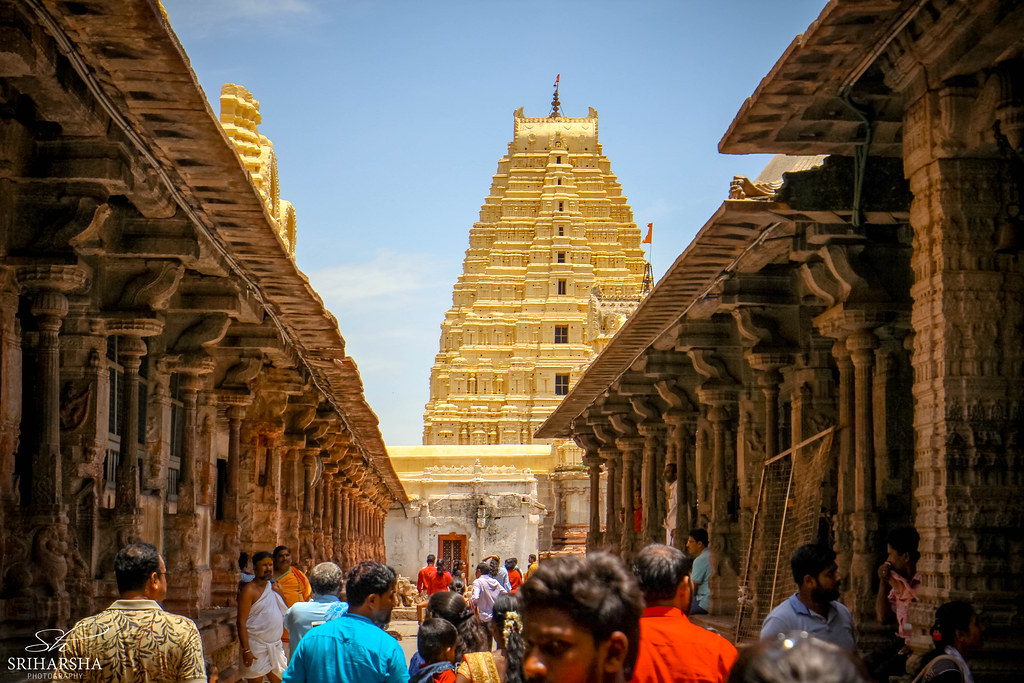
The:
Virupaksha Temple
was already ancient by Krishnadevaraya’s lifetime.
Instead of replacing it, Vijayanagara rulers expanded and monumentalised it.
Krishnadevaraya’s reign contributed important additions to the sacred complex.
The temple remains a living place of worship today.
Thus Hampi is simultaneously:
archaeological capital
and:
continuing sacred landscape.
Vittala Temple

The:
Vittala Temple Complex
represents one of the supreme achievements of Vijayanagara architecture.
UNESCO describes it as the most exquisitely ornate structure at Hampi and the culmination of Vijayanagara temple architecture.
Its complex contains:
mandapas
gopuras
bazaar street
water structures
and the celebrated:
Stone Chariot.
Stone Chariot
The famous Hampi Stone Chariot is actually:
a shrine to Garuda
fashioned in the form of a monumental stone ratha.
UNESCO specifically identifies the structure as a:
granite chariot-shaped Garuda shrine.
It has become one of the most recognisable symbols of:
Karnataka
and:
Vijayanagara civilisation.
Hazara Rama Temple
The:
Hazara Ramachandra Temple
stood within Hampi’s royal centre.
Karnataka Tourism’s Hampi research portal identifies it as the palace temple and notes that it was extended during Krishnadevaraya’s period.
Its walls contain extensive reliefs depicting episodes from:
the Ramayana.
The temple therefore connected:
imperial court
with:
Rāma’s ideal kingship.
Ramayana and Imperial Kingship
This symbolism would have been particularly powerful.
Rāma represented:
dharma
legitimate sovereignty
protection of subjects
and the ideal ruler.
A Ramayana-covered temple within the royal enclosure therefore did more than illustrate an epic.
It presented:
sacred kingship as a model for imperial kingship.
Lakshmi Narasimha
Another extraordinary monument at Hampi is the monumental:
Narasimha image.
The official district history includes the Ugra Narasimha among the major monuments associated with Krishnadevaraya’s age.
Narasimha—the fierce avatāra of Vishnu—represented:
divine power used to destroy adharma.
The imagery suited the imperial religious culture of Vijayanagara.
Nagalapura
Krishnadevaraya also developed an urban extension traditionally known as:
Nagalapura
named after his mother:
Nagaladevi / Nagalamba.
This illustrates another feature of royal construction:
architecture preserving dynastic memory.
The imperial capital became filled with monuments remembering:
victories
deities
parents
and royal legitimacy.
Religion Under Krishnadevaraya
Krishnadevaraya was principally:
Vaiṣṇava.
Sri Venkateswara occupied an especially important place in his personal devotion.
Yet his empire patronised:
Vaiṣṇava
Śaiva
Jain
and other established religious institutions.
Government historical material characterises him as personally devout while respecting multiple traditions.
Virupaksha and Venkateswara
His sacred geography therefore connected:
Virupaksha at Hampi
with:
Venkateswara at Tirumala.
One represented the ancient sacred identity of the imperial capital.
The other became one of the emperor’s strongest personal devotional centres.
This combination demonstrates how Vijayanagara kingship could operate across multiple Hindu traditions.
The Emperor as Temple Patron
Temple patronage performed several functions simultaneously.
It expressed:
bhakti
but also supported:
priests
musicians
craftsmen
markets
landholders
pilgrims
and agricultural settlements.
A royal temple donation was therefore simultaneously:
religious patronage
and:
economic policy.
Hampi’s Urban Planning
UNESCO describes Hampi as an extraordinary integration of:
sacred centres
royal complexes
defensive architecture
residential settlements
markets
and hydraulic engineering.
This was a planned imperial landscape.
A visitor approaching Vijayanagara would move through:
agricultural zone
↓
fortifications
↓
suburban settlements
↓
bazaars
↓
sacred complexes
↓
royal centre.
A Cosmopolitan City
Foreign visitors encountered people from different parts of:
Bharat
Persia
Arabia
and the wider Indian Ocean commercial world.
Hampi’s architecture itself reflects this cosmopolitanism.
UNESCO notes that while its sacred architecture was overwhelmingly Dravidian, some secular structures incorporated architectural forms associated with:
Indo-Islamic design.
Vijayanagara therefore combined strong Hindu imperial identity with a complex multicultural urban society.
Economic Prosperity
Krishnadevaraya’s military achievements are inseparable from his economy.
A vast imperial army could exist only because the state commanded:
land revenue
trade
agricultural surplus
port customs
and productive craft centres.
Foreign accounts of Vijayanagara repeatedly emphasised the city’s wealth.
UNESCO likewise identifies the archaeological remains as evidence of an extraordinarily prosperous political society.
Diamonds and Precious Stones
The Vijayanagara world had access to famous mineral-producing regions.
Precious stones entered:
court consumption
temple donations
and international trade.
Descriptions of Vijayanagara markets helped create the later image of Hampi as a city where extraordinary wealth could be publicly displayed.
The Emperor and His Subjects
Krishnadevaraya’s political philosophy placed considerable emphasis upon the ruler understanding the material welfare of the kingdom.
A powerful emperor required:
prosperous subjects.
This is one reason irrigation, agricultural revenue, roads and markets were not secondary issues.
They were:
foundations of sovereignty.
Krishnadevaraya’s Model of Empire
The system can be represented as:
Strong central emperor
↓
Ministers and Nayakas
↓
Forts and provincial centres
↓
Irrigation
↓
Agriculture
↓
Tax revenue
↓
Army
↓
Trade and ports
↓
Temples and cultural patronage
↓
Imperial legitimacy.
The greatness of the reign came from making these elements reinforce one another.
His Principal Queens
Two queens repeatedly associated with Krishnadevaraya are:
Tirumaladevi
and:
Chinnadevi.
They appear in royal religious patronage and the Tirumala inscriptional tradition.
Royal women were therefore participants in:
imperial temple patronage
rather than merely invisible members of the palace household.
The Succession Problem
One of the most tragic difficulties of Krishnadevaraya’s later reign involved succession.
He attempted to secure the future of the empire through his young son:
Tirumala Raya.
The prince died while still young.
The episode destabilised the final years of the emperor’s reign.
Timmarusu’s Fall
The death of the young heir produced a severe crisis at court.
Krishnadevaraya came to suspect that his long-serving minister:
Timmarusu
or members of Timmarusu’s family had been implicated.
The resulting punishment destroyed one of the strongest political partnerships of the emperor’s career.
This episode shows that even the golden age of Vijayanagara contained:
intense dynastic insecurity.
Final Years
Krishnadevaraya’s health declined toward the end of the 1520s.
He died around:
1529 CE.
He was succeeded by his brother:
Achyuta Deva Raya.
His death ended approximately:
twenty years
of one of the most powerful reigns in southern Indian history.
The Empire After Him
Vijayanagara remained a major power after Krishnadevaraya.
It did not collapse immediately.
Achyuta Raya ruled afterward, followed eventually by the political dominance of:
Aliya Rama Raya.
But Krishnadevaraya’s death marked the end of the particular combination of:
military dominance + political authority + cultural brilliance
that characterised his reign.
Talikota Came Decades Later
It is important to keep the chronology clear.
Krishnadevaraya died around:
1529.
The catastrophic:
Battle of Talikota
occurred in:
1565.
Therefore he did not witness the destruction of the capital.
Hampi continued to function as an imperial metropolis for more than three decades after his death.
UNESCO identifies Talikota as the event that led to the city’s devastating sack in 1565.
Major Campaigns
| Campaign | Approximate period | Result |
|---|---|---|
| Ummattur campaign | early reign | Southern rebellion suppressed |
| Udayagiri | 1513–14 | Fort captured |
| Kondavidu | 1515 | Major Gajapati stronghold captured |
| Kondapalli | c.1515–16 | Vijayanagara authority extended |
| Kalinga campaign | 1510s | Gajapati power pushed northward; peace concluded |
| Raichur | 1520 | Major victory over Bijapur; Raichur captured |
Major Monuments Connected With His Age
| Monument | Importance |
|---|---|
| Krishna Temple | Commemorated Udayagiri victory |
| Virupaksha additions | Continued monumentalisation of ancient Hampi shrine |
| Vittala complex | Peak of Vijayanagara temple architecture |
| Stone Chariot | Iconic Garuda shrine |
| Hazara Rama Temple additions | Royal Ramayana temple |
| Narasimha image | Monumental Vaiṣṇava sculpture |
| Nagalapura | Urban development associated with his mother |
Krishnadevaraya at a Glance
| Category | Details |
|---|---|
| Name | Sri Krishnadevaraya |
| Dynasty | Tuluva |
| Empire | Vijayanagara |
| Father | Tuluva Narasa Nayaka |
| Predecessor | Vira Narasimha Raya |
| Reign | 1509–1529 |
| Capital | Vijayanagara / Hampi |
| Principal minister | Saluva Timmarusu |
| Major eastern rival | Prataparudra Gajapati |
| Major western rival | Ismail Adil Shah of Bijapur |
| Great victory | Raichur, 1520 |
| Major devotional centre | Tirumala Venkateswara |
| Literary masterpiece | Amuktamalyada |
| Literary title | Andhra Bhoja |
| Famous court tradition | Aṣṭadiggajas |
| Successor | Achyuta Deva Raya |
Timeline of Krishnadevaraya
| Year | Event |
|---|---|
| 1509 | Becomes ruler of Vijayanagara |
| Early reign | Consolidates southern territories and suppresses challenges |
| 1510 | Portuguese capture Goa; commercial relations grow |
| 1513 | Major Udayagiri campaign begins |
| 1514 | Udayagiri captured; Tirumala pilgrimage follows |
| 1515 | Kondavidu captured |
| 1515–16 | Kondapalli and eastern territories brought under Vijayanagara control |
| 1510s | Kalinga campaign against Prataparudra |
| 1513 onward | Krishna Temple and major Hampi construction |
| 1520 | Victory at Raichur |
| 1520s | Vijayanagara at imperial height |
| 1529 | Krishnadevaraya dies |
| After 1529 | Achyuta Deva Raya succeeds him |
| 1565 | Hampi later devastated after Talikota |
The Geographical Shape of His Power
Krishnadevaraya’s imperial world linked:
Hampi
political capital
↓
Southern Karnataka
internal consolidation
↓
Raichur
northern strategic frontier
↓
Andhra
Udayagiri, Kondavidu and Kondapalli
↓
Eastern coast
access to productive and commercial regions
↓
Kalinga frontier
conflict and eventual settlement with Gajapati power
↓
western ports and Goa
international commercial connections.
The empire therefore united:
Deccan interior + eastern coast + western commercial networks.
What Made His Reign a Golden Age?
Krishnadevaraya’s reign is called a golden age because several forms of power peaked simultaneously.
Military
Vijayanagara defeated major rivals and expanded its influence.
Political
The emperor maintained authority over powerful regional Nayakas.
Economic
Agriculture and overseas commerce supported extraordinary wealth.
Engineering
Irrigation systems supported both rural production and the huge capital.
Architectural
Hampi reached its monumental peak.
Religious
Temples across southern Bharat received royal patronage.
Literary
Telugu literature underwent an extraordinary flowering.
Intellectual
The king himself was an author and political thinker.
Very few reigns combine all these features at the same moment.
Emperor and Poet
This remains one of Krishnadevaraya’s most unusual characteristics.
A ruler who had campaigned at:
Raichur
Udayagiri
Kondavidu
and deep into the eastern Deccan
also sat down and composed:
Amuktamalyada.
The contrast is extraordinary:
battlefield emperor
and:
devotional poet.
Yet within the classical Bharatiya ideal of kingship, these did not need to be contradictory.
The ideal ruler could master:
Śastra
the instruments of political power,
and:
Śāstra
knowledge, literature and learned tradition.
His Civilisational Legacy
Krishnadevaraya’s impact extended far beyond the borders of his empire.
The architecture developed under Vijayanagara influenced temples throughout:
Karnataka
Andhra
Tamil Nadu
and other regions.
UNESCO specifically notes the spread of Vijayanagara architectural forms throughout southern India.
His literary patronage transformed Telugu literature.
His monuments transformed Hampi.
His political victories transformed the balance of power in the Deccan.
And his religious patronage remains physically visible at sacred centres centuries later.
From Warrior to Patron
His reign can be visualised as:
Tuluva prince
↓
Emperor — 1509
↓
internal consolidation
↓
Udayagiri victory
↓
Krishna Temple
↓
Kondavidu and eastern expansion
↓
settlement with the Gajapatis
↓
Raichur victory — 1520
↓
Vijayanagara at imperial zenith
↓
irrigation and commercial prosperity
↓
monumental Hampi
↓
Amuktamalyada
↓
Aṣṭadiggajas
↓
enduring cultural golden age.
Why Krishnadevaraya Matters
Krishnadevaraya was not great because of one battle.
Raichur alone does not explain him.
Nor does Amuktamalyada alone.
Nor the temples of Hampi.
His greatness lies in combining all of them.
He could command an empire while writing poetry.
He could conquer a fortress and commemorate that victory through sacred architecture.
He could patronise Telugu literary giants while supporting Sanskrit, Kannada and Tamil learning.
He could maintain a deeply Hindu imperial culture while conducting pragmatic commerce and diplomacy with foreign merchants.
He could understand the power of the army while recognising that the army ultimately depended upon:
water + agriculture + trade + revenue.
That is why UNESCO does not merely describe Hampi as flourishing under him.
It states that Vijayanagara reached its:
apogee
during the reign of Krishna Deva Raya.