
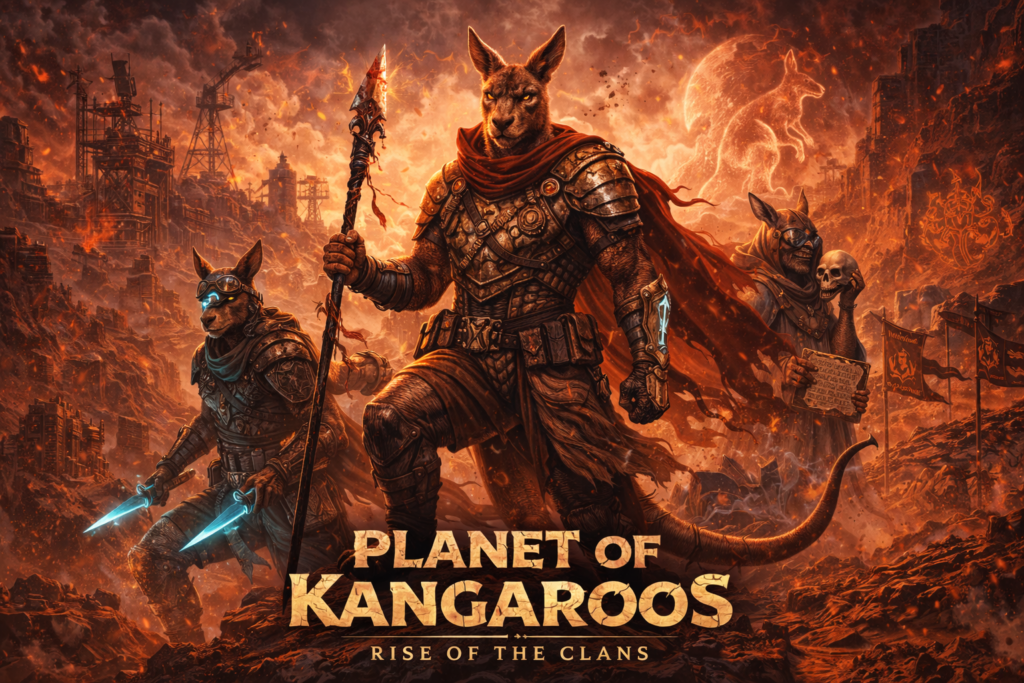
Chapter 5: The Dog Drowner Incident
The small farm was tucked into a quiet hollow, its modest fields bordered by a rickety fence that seemed to sag under the weight of years. The farmhouse itself was little more than a weathered structure, its windows glowing faintly against the night.
Rook crouched in the shadows at the edge of the property, his followers gathered silently behind him. Their powerful forms blended into the darkness, their eyes reflecting the faint light like shards of glass.
“This is the one,” Rook said, his voice low but firm.
Drass stepped closer, his hulking form imposing even in the dim light. “What’s the message, boss? Scare them? Burn the place down?”
“No,” Rook replied, his gaze fixed on the farmhouse. “We send something stronger. Something they’ll never forget.”
He gestured toward the dog kennel near the fence line, where a large shepherd lay curled, its ears twitching as it sensed the intruders.
Drass frowned. “The dog? Why bother with that?”
“Because it’s not about destruction,” Rook said. “It’s about power. Fear. They love their animals like family. Taking that from them hurts deeper than any broken fence or burned barn.”
The logic was cold, calculated, and it sent a shiver through some of the younger kangaroos. But no one challenged Rook. He had cultivated an aura of absolute authority, and even the slightest hint of dissent was quashed swiftly.
“Drass,” Rook said, his tone final, “make it happen.”
The lieutenant hesitated for only a moment before nodding. “You got it.”
The farmer, an older man named Glenn, was jolted awake by the sound of his dog barking. It wasn’t the usual warning bark that signaled a fox or a stray. This was frantic, panicked—a sound Glenn hadn’t heard before.
He grabbed his shotgun from the corner of the bedroom and moved to the window. The yard was dark, the fields stretching out like a black sea. But near the fence line, he saw movement—shadows that didn’t belong.
“Who’s there?” he shouted, his voice echoing into the night.
There was no answer. Only the continued barking, growing more desperate by the second.
Glenn threw open the door and stepped onto the porch, his shotgun raised. The cold night air bit at his skin as his eyes scanned the yard.
“Show yourself!” he yelled, his voice shaking with a mix of fear and anger.
Near the kennel, the shadows moved again. This time, they emerged into the faint light cast by the farmhouse—a group of kangaroos, their forms larger and more menacing than any Glenn had ever seen.
“Dear God,” he whispered, his grip tightening on the shotgun.
Before he could react, one of the kangaroos lunged toward the kennel. The dog’s barking turned into a high-pitched yelp as the creature grabbed it by the scruff of the neck.
“Hey!” Glenn shouted, stepping forward. “Get away from him!”
The kangaroo didn’t flinch. With a single, powerful motion, it leapt toward the small pond at the edge of the property, the dog thrashing helplessly in its grip.
“No!” Glenn screamed, running after them.
By the time he reached the pond, it was too late. The dog’s lifeless body floated on the water’s surface, the ripples spreading outward like a cruel echo.
Glenn fell to his knees, his shotgun slipping from his hands as he stared at the scene, his breath coming in ragged gasps.
Rook emerged from the shadows, his towering form casting a long silhouette against the moonlit pond. He stared down at Glenn, his eyes cold and unfeeling.
“Tell them,” Rook said, his voice a low growl. “Tell them what happens when they think they can hunt us.”
Glenn looked up, his face a mask of anguish and fury. “You’re monsters,” he spat.
Rook tilted his head, his expression unreadable. “No. We’re survivors. And you’ll remember that.”
With a sharp motion, he turned and bounded back into the darkness, his followers close behind.
Glenn was left alone by the pond, his trembling hands reaching for the dog’s body as tears streamed down his face.
The quiet of the night returned, but it was a silence heavy with loss and fear—a silence that would carry the weight of Rook’s message far beyond this small farm.
The grainy video began with the barking of a dog, frantic and piercing in the stillness of the night. The camera’s focus was shaky, its operator clearly hiding as they filmed. At first, the screen showed only a dark yard illuminated by faint porch light, but as the camera panned, the shadows of kangaroos emerged, their movements deliberate and menacing.
The viewer could hear the faint murmurs of someone whispering, “What the hell is going on?” Their breath was shaky, tinged with fear.
Then the camera zoomed in on the kennel. The moment it captured was haunting: a massive kangaroo pulling the dog free, its claws gripping the animal tightly.
“No!” the whisper turned into a desperate, muffled scream as the kangaroo bounded toward the pond.
The camera jolted, the image blurring as the operator stumbled to follow the action. What came next was almost too surreal to process—the splash of water, the thrashing of the dog as it was held beneath the surface, and finally, the awful stillness that followed.
In the background, the farmer’s voice cracked with despair, his anguished cries cutting through the night.
The video ended abruptly, but the damage was already done.
Within hours of being uploaded to a social media platform, the video went viral. The headline attached to the post was incendiary: “Kangaroo Terror: Farm Dog Brutally Killed in Outback Attack.”
It spread like wildfire, shared millions of times across platforms, each post accumulating furious comments:
“This has gone too far. Something needs to be done!”
“They’re not animals anymore—they’re killers.”
“Where’s the government? Why aren’t they stopping this?”
News outlets picked up the story, amplifying its reach. The video played on repeat in endless loops, each broadcast dissecting the incident with mounting outrage. Pundits debated the nature of the kangaroo threat, their voices rising with each segment.
“This isn’t just an isolated attack,” one commentator argued, gesturing toward the footage on the screen. “This is a coordinated effort by a species that has gained intelligence and, clearly, a capacity for cruelty.”
Another countered, “Cruelty? They’re reacting to what they perceive as a threat. Isn’t it possible that these actions are born out of desperation?”
Desperation or not, the public’s reaction was swift and brutal. Protests erupted in cities and towns, with angry crowds demanding action. Signs reading “Save Our Land” and “Stop the Kangaroo Menace” filled the streets, while others displayed gruesome images of the dog’s lifeless body.
Local government officials scrambled to respond, issuing statements condemning the attack and promising to “prioritize public safety.” Still, their words rang hollow to a populace gripped by fear and anger.
In online forums and chat groups, the rhetoric turned darker. Some users called for eradication efforts, likening the kangaroos to invasive pests that needed to be “dealt with permanently.” Others, more cautious, worried about what such measures might provoke in the increasingly militant kangaroo factions.
Ethan watched the video in grim silence, his militia gathered around the small television in his farmhouse. Julia leaned against the wall, her arms crossed tightly.
“This changes everything,” she said, her voice low but charged. “People are scared now. They’ll throw their weight behind us.”
“Or turn this whole place into a war zone,” Marco added, his tone wary. “If the government steps in, we could lose control of this.”
Ethan turned off the television, the screen going black. He stood slowly, his face set in a hard expression.
“They crossed a line,” he said, his voice cold. “If they want war, they’ll get it.”
Across the wilderness, Koa sat in stunned silence as Nyra played the video on a salvaged tablet. The faint hum of the device was the only sound in the dim cave they used as their shelter.
“This…” Koa’s voice broke, his breath shallow. “This wasn’t us.”
Nyra’s jaw tightened. “It doesn’t matter. To them, we’re all the same.”
Koa buried his face in his paws, the weight of the situation pressing down on him like a stormcloud. “Rook doesn’t speak for us. He never has.”
“Then make them see that,” Nyra said, her tone fierce. “Before it’s too late.”
But Koa wasn’t sure it wasn’t already too late.
The video had lit a fire, one that was now spreading uncontrollably. In the cities, in the farmlands, in the wilderness—everywhere, the lines were being drawn, and the choices were narrowing to one grim outcome: fight or perish.
The sharp wind howled through the narrow canyon that Koa had chosen for the meeting, its high walls offering some measure of concealment from both human and kangaroo eyes. Koa stood near the center, his powerful frame rigid, his dark eyes scanning the shadows for any sign of Rook.
Nyra stood beside him, her stance tense. “Are you sure about this?” she asked, her voice low. “He won’t listen. He never does.”
“He’ll come,” Koa said, though the certainty in his words was more for himself than her. “He needs to know he’s crossed a line.”
Before Nyra could respond, the thudding of powerful legs echoed through the canyon. Rook emerged from the shadows, his scarred face set in a grim smirk. Behind him, a handful of his most loyal followers flanked him, their stances bristling with aggression.
“Well, well,” Rook said as he approached, his voice carrying an edge of mockery. “The preacher summons me. I’m honored.”
“This isn’t a game, Rook,” Koa said sharply. “We need to talk.”
Rook tilted his head, feigning curiosity. “Oh? Is this the part where you lecture me about unity and peace? Save your breath, Koa. I’ve heard it all before.”
“This is different,” Koa said, stepping closer. “What you did at the farm—the dog—you’ve gone too far. You’ve made us all monsters in their eyes.”
Rook’s smirk deepened. “I didn’t make us monsters. They already see us that way. All I did was remind them why they should be afraid.”
Koa’s tail thudded against the ground, the sound echoing like a warning shot. “You’re not helping us survive, Rook. You’re dooming us. Every attack, every senseless act of violence—you’re giving them the justification they need to wipe us out.”
“And what’s your solution?” Rook shot back, his voice rising. “Beg for scraps? Let them corral us into some fenced-off corner of the Outback like livestock? That’s not survival, Koa. That’s submission.”
“It’s coexistence,” Koa said firmly. “It’s the only chance we have to live.”
Rook barked a harsh laugh. “Coexistence? With the same species that caged us, experimented on us? Don’t delude yourself. They don’t want coexistence. They want control. And the only way to stop them is to show them we can’t be controlled.”
Nyra stepped forward, her eyes blazing. “By killing dogs? By terrorizing farmers who had nothing to do with this? You’re not showing strength, Rook—you’re showing desperation.”
Rook’s smirk faltered for a moment, but he quickly recovered. “Spare me your sanctimony, Nyra. You think I enjoy this? I do what’s necessary. While you hide in caves and hope for miracles, I’m out there fighting for our survival.”
“This isn’t survival,” Koa said, his voice quieter now but no less intense. “It’s revenge. And it’s going to destroy us all.”
Rook took a step closer, his imposing frame casting a long shadow over Koa. “You think you’re better than me, Koa? That your way is the right way? Look around you. The humans don’t care about your high-minded ideals. They’re arming themselves, building militias, and hunting us down like animals. And you want to talk about restraint?”
Koa held his ground, his gaze steady. “I don’t want to fight you, Rook. But if you keep this up, you’re going to force me to.”
For a moment, the canyon was silent, the tension between the two leaders palpable. Rook’s followers shifted uneasily, their loyalty to him unwavering but their unease at Koa’s conviction evident.
Finally, Rook leaned back, his smirk returning. “You’re welcome to try,” he said, his voice dripping with disdain. “But you’ll lose. Because deep down, Koa, you don’t have the stomach for what it takes to win.”
With that, Rook turned and bounded away, his followers trailing after him.
Koa watched them disappear into the shadows, his chest tight with a mix of anger and despair. He had hoped, foolishly, that Rook might see reason. Instead, the divide between them had only grown deeper.
Nyra stepped closer, her expression somber. “He’s not going to stop, is he?”
“No,” Koa said quietly. “And neither can we.”
He turned and began walking back toward their camp, his mind already racing with the weight of the decisions ahead. Rook’s actions had set them all on a dangerous path, and Koa knew there was no turning back now.
Ethan stood at the front of the old barn, his boots planted firmly on the rough wooden floor. The air inside was heavy with the smell of hay and oil, the dim light from the single bulb above casting long shadows across the faces of the gathered crowd. Farmers, mechanics, and shopkeepers packed the room, their expressions a mix of anger and resolve.
On the makeshift stage beside Ethan, a television played the now-infamous footage of the dog drowning on a loop. Each bark, each splash, and the final heart-wrenching silence filled the room like a drumbeat of fury. Ethan let it play one last time before he muted it and turned to the crowd.
“This,” he began, gesturing to the frozen image of the lifeless dog in the pond, “is what we’re up against. This is what they’ve become.”
A murmur rippled through the room, the anger palpable.
“They’re not just attacking our homes anymore,” Ethan continued, his voice rising. “They’re sending a message. They want us to know that they won’t stop until they’ve taken everything. And if we sit back and do nothing, that’s exactly what will happen.”
A man near the front, his face lined with years of hard labor, stood up. “So what do we do, Ethan? The police won’t help us. The government’s too slow. What’s left?”
Ethan nodded, his expression grim but resolute. “We help ourselves. We organize. We arm ourselves. And we fight back.”
A wave of agreement swept through the room.
“Rook’s faction thinks they can scare us into submission,” Ethan continued. “They think they can terrorize us into giving up. But they’ve underestimated us. They don’t know what we’re capable of when we stand together.”
He stepped closer to the crowd, his eyes sweeping across them. “I know some of you have already lost—livestock, homes, loved ones. I’ve lost too. But I’ll tell you this: I’m done sitting around, waiting for them to come for me again. I’m fighting back. And I’m asking you to fight with me.”
The room erupted into applause, the sound rough and impassioned.
Julia stepped forward from the edge of the stage, holding one of the advanced weapons the Broker had supplied. The sleek design caught the light, its presence both a symbol of hope and a reminder of the escalating stakes.
“This is what we’re working with now,” Julia said, addressing the crowd. “With these, we’re not just farmers with pitchforks anymore. We’re a force to be reckoned with.”
The crowd murmured in approval, the sight of the weapon igniting a sense of possibility.
Ethan raised a hand for quiet. “I know this won’t be easy,” he said. “And I won’t lie to you—there will be risks. But if we don’t act now, we’re leaving our families and our future to chance. And that’s a chance I’m not willing to take.”
A young woman near the back, barely in her twenties, stood and raised her voice. “What’s the plan? How do we fight them?”
Ethan smiled faintly. “It starts with training. Patrols. We make sure every road, every farm, every piece of land is defended. And when they come for us, we’ll be ready.”
The energy in the room was electric now, the once-fearful community transformed into a determined force. People began stepping forward, volunteering supplies, weapons, and time.
Marco leaned toward Ethan, his voice low. “This is bigger than we’ve ever done. You think we’re ready for it?”
Ethan glanced at the crowd, the fire in their eyes matching the fire in his chest. “We don’t have a choice,” he said. “Ready or not, this is where we make our stand.”
As the meeting adjourned, the barn buzzed with activity. Groups formed, plans were made, and resources were pooled. Ethan watched it all with a grim sense of satisfaction.
The kangaroos had drawn first blood, but the humans were mobilizing now, and the fight was only beginning.
Sarah stood in the center of Ethan’s barn, her voice straining to be heard over the rising clamor. The makeshift militia surrounded her, their faces a mixture of anger, doubt, and stubborn resolve. They had been galvanized by Ethan’s speech, and the air was thick with determination to fight back.
“You don’t understand what’s really happening!” Sarah shouted, her hands raised in a futile attempt to quiet the crowd. “This isn’t just about Rook’s faction. It’s bigger than that.”
Ethan stepped forward, his arms crossed. His expression was cool, but his eyes betrayed a simmering impatience. “You’ve made that clear, Sarah. But every time you talk about what’s ‘really happening,’ all I hear is excuses for why we shouldn’t fight back.”
“I’m not making excuses,” Sarah snapped, her frustration boiling over. “I’m trying to stop more people from getting killed! This whole thing—it’s being orchestrated. Both sides are being manipulated, and you’re playing right into it.”
The crowd murmured uneasily, their eyes darting between Sarah and Ethan. Marco stepped closer, his tone skeptical. “You keep talking about manipulation, but where’s your proof? All we see are kangaroos killing people and tearing apart everything we’ve worked for.”
Julia chimed in, her voice sharp. “You think you can stop Rook by talking to him? Good luck with that. Meanwhile, the rest of us are doing what needs to be done.”
Sarah’s chest tightened. The weight of their disbelief pressed down on her, but she refused to back down.
“There’s someone pulling the strings,” she said, her voice firm. “Someone who benefits from this chaos—who’s giving Rook the weapons and tools he’s using to terrorize you. And it’s the same person who gave you those guns.”
She gestured toward the advanced weapon Julia had shown off earlier, its sleek design gleaming ominously even in the dim barn light.
A murmur spread through the crowd, doubt flickering across some faces. Ethan frowned, his gaze flicking toward the weapon before returning to Sarah.
“You’re saying the Broker?” he asked, his voice low.
“Yes,” Sarah replied. “They’re playing both sides, feeding this war for their own gain. If you keep escalating, you’re giving them exactly what they want.”
For a moment, silence filled the barn. Then, a voice from the crowd broke the tension.
“And what do you expect us to do?” It was Liv, her tone weary but resolute. “Sit back and wait for them to hit us again? Hope Rook decides to play nice?”
“No,” Sarah said, her voice softening. “But there has to be another way. Fighting like this—it’s just going to keep escalating. The more you retaliate, the more Rook’s faction will strike back. And the more innocent people will die.”
Ethan’s jaw tightened, his frustration evident. “Do you hear yourself? You’re asking us to stop fighting while they burn our homes and kill our people. You think that’s justice?”
“It’s survival,” Sarah said. “True survival. The only way this ends is if we break the cycle.”
The room erupted into shouts, voices overlapping as anger and fear spilled over. Sarah looked around, her heart sinking as she realized her words weren’t reaching them.
Ethan raised a hand, silencing the room. He stepped closer to Sarah, his gaze steady. “I get it,” he said quietly. “You’re trying to save lives. But so am I. And I can’t do that by sitting around, waiting for Rook to finish us off. If this Broker is real, then they’ve already made their choice. Now I’m making mine.”
Sarah stared at him, her chest heavy with the weight of his words. “You don’t have to do this, Ethan. There’s still time to stop it.”
Ethan shook his head. “Not anymore.”
With that, he turned to the crowd, addressing them with renewed determination. “We move out at first light. Patrols on every road, every farm. We’re not waiting for them to bring the fight to us.”
The crowd erupted in cheers, their resolve unshaken.
Sarah stood frozen, the noise fading into the background as a cold sense of futility washed over her. She had tried to warn them, to show them the bigger picture. But their fear and anger had already taken root, driving them toward a path she couldn’t stop.
As the crowd began to disperse, Julia approached her, her expression unreadable. “You’ve got guts, I’ll give you that,” she said. “But guts don’t stop bullets. Remember that when this all comes crashing down.”
Sarah didn’t respond. She turned and walked out into the night, the cool air stinging her cheeks. In the distance, the faint glow of fires burned on the horizon—a reminder of the violence that had already begun and the destruction yet to come.