
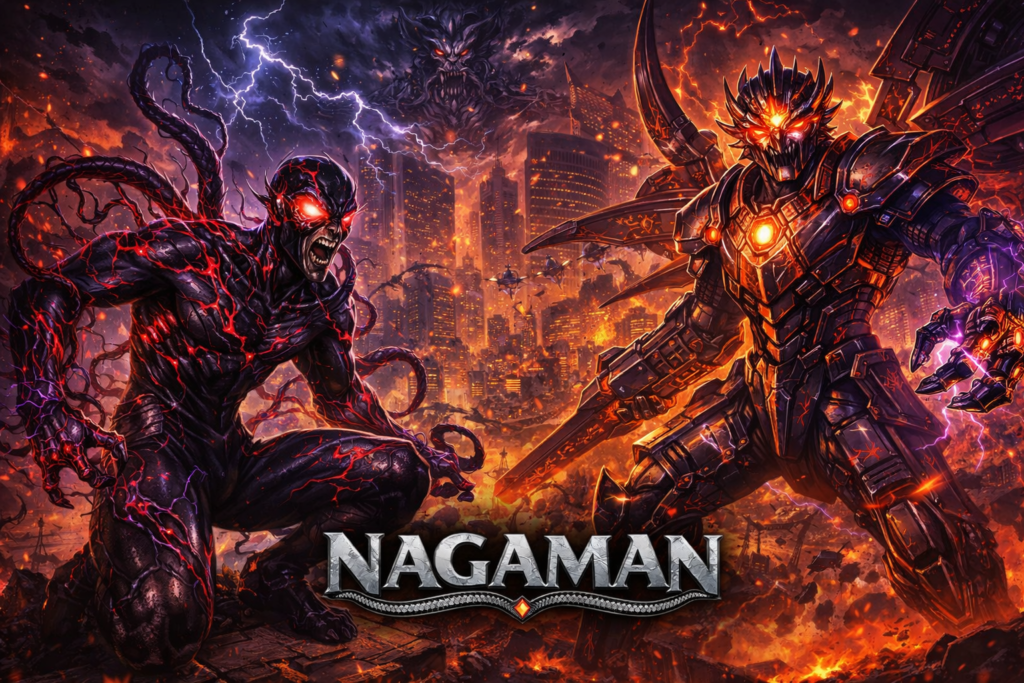
CHAPTER 7: THE BOND DEEPENS
It should have been a normal fight.
Ajit had fought thugs like these a hundred times before.
Six of them, armed with knives, pipes, chains, surrounding a helpless shopkeeper in a dark alley. Their voices were sharp, laughing, mocking—predators playing with their food.
They had no idea what they were about to unleash.
Ajit dropped into their midst like a phantom.
The first man turned just in time to see a blur of movement before Ajit’s fist shattered his jaw.
A spray of blood. A scream. The man crumpled to the ground, unconscious before he hit the pavement.
The others barely had time to react.
Ajit moved like a force of nature—impossible, untouchable, inevitable.
A knife came at his ribs—he caught the wrist, twisted. Something snapped. The man howled, his arm bending in a direction it was never meant to.
A lead pipe swung for his skull—he ducked, pivoted, struck. His elbow connected with the attacker’s sternum, and the man folded like paper, gasping for air he could no longer find.
Too fast.
Too brutal.
Ajit should have felt in control. Should have been methodical, efficient.
But something was wrong.
His hands were moving too quickly. His strikes were landing too hard. His body felt lighter, faster, stronger than ever.
And in the chaos, he realized—
He was enjoying this.
One man tried to run.
Ajit stopped him.
Faster than thought, he lunged, catching the man by the collar, yanking him back. The thug thrashed in his grip, eyes wide with raw, primal fear.
“Please,” he gasped. “Please, I—”
Ajit didn’t hear him.
Didn’t care.
His mind was buzzing—electric, hungry, wild.
The black veins on his arms pulsed, his vision flickering, distorting—the alley was darker than it should have been, the shadows stretched in unnatural directions.
His grip tightened.
“Yes.”
Ajit blinked.
His fingers were around the man’s throat.
Squeezing.
He hadn’t meant to.
Had he?
The thug choked, feet kicking against the pavement, hands clawing at Ajit’s wrist.
Ajit’s pulse was too calm. His body wasn’t hesitating.
The whisper inside him was purring.
“No hesitation. No mercy.”
His fingers tightened further.
The man’s eyes rolled back. His body went limp.
A flicker of something cold and distant passed through Ajit’s mind.
A memory.
A warning.
“If you don’t fight it, it will take you.”
Ajit gasped, staggering back.
The thug collapsed to the ground, coughing, gulping down air, scrambling away as fast as he could.
Ajit stared at his hands.
They were shaking.
The black veins weren’t fading.
The fight was over. The alley was empty.
But deep inside, something was still moving.
Something was still awake.
“This is who you are now.”
Ajit turned and fled into the night, but he couldn’t outrun himself.
The city passed beneath him in a blur—rooftops, neon signs, empty streets slick with rain. Ajit moved without thinking, without direction, running on instinct, on adrenaline, on something else.
His breath came hard and fast, his heartbeat steady. Too steady.
He should have been exhausted.
He should have felt the burn in his lungs, the ache in his muscles, the weight of every wound he had taken tonight.
But he didn’t.
He felt light. Effortless. Powerful.
And that terrified him.
Ajit landed on a rooftop, skidding to a halt near a rusted ventilation duct. He clenched his fists, trying to steady himself, but his fingers still twitched. His body still wanted to fight.
His pulse still thrummed with the afterglow of violence.
“You are not afraid of this.”
Ajit gritted his teeth. Shut up.
He forced himself to breathe, forced himself to push the whispers away.
Then he looked down—and froze.
His suit.
The emerald-green fabric of his costume had always shimmered slightly, its surface enhanced by the mystic energy of the Nagamani. It had always felt alive, an extension of himself.
But now?
Now it was wrong.
The green had darkened, shifting to a deep, almost blackened shade of jade. And the golden trim—the sacred patterns woven into the suit, once glowing with the power of the Nagamani—were fading.
Veins of black-red energy pulsed faintly beneath the surface of the fabric, spreading like a sickness.
Like corruption.
Ajit’s stomach twisted. He hadn’t noticed it before.
Had it always been this way? Or had it changed after tonight?
Had it changed after he had changed?
He ripped his gloves off, staring at his hands. The black veins were still there, barely visible beneath his skin, moving, shifting like something alive.
Like something waiting.
“It is a gift, Ajit.”
“Why do you resist?”
Ajit tore off his mask, gasping for air that suddenly felt too thick, too heavy. He stumbled back, gripping the edge of the rooftop, his mind racing.
This wasn’t just exhaustion. This wasn’t just stress.
This was the Halāhala.
And it was winning.
The streets whispered his name.
Ajit could hear it from the rooftops, through the narrow alleys, carried in the breath of the city itself.
“Naga Man is different now.”
“Did you hear what he did?”
“He almost killed a guy last night.”
It should have made him angry. It should have made him feel betrayed, hearing the people he fought for speak about him with fear instead of respect.
But instead?
He felt nothing.
And maybe that was worse.
Ajit crouched on the edge of a rusted fire escape, eyes scanning the street below. A group of men huddled near a liquor shop, their voices low, tense. He could smell the sweat on them, the nervous energy in the way they shifted from foot to foot.
They weren’t just criminals.
They were hunted men.
And they knew it.
One of them—a stocky man with a jagged scar across his cheek—kept looking over his shoulder, rubbing his hands together like he was trying to shake off a bad dream. “I’m tellin’ you,” he muttered, voice hoarse, “he ain’t the same no more.”
The others exchanged wary glances.
“You think the stories are true?” one of them asked.
Scarface swallowed. “I saw it with my own eyes. Jatin tried to shank him, yeah? You know what he did?” His voice dropped to a whisper. “He caught the knife. With his bare hands. Didn’t even flinch. Then he—”
He hesitated.
The others leaned in.
“What? What did he do?”
Scarface exhaled shakily, rubbing his arms like the memory itself made his skin crawl. “He looked at Jatin,” he said finally. “Not like a man. Not like a hero. Like something else. Like a—”
The streetlight above them flickered.
Then, without warning—the shadows shifted.
Ajit dropped into their midst, silent as a viper.
A breathless second passed.
Then—chaos.
The men scrambled back, cursing, tripping over themselves. One fell to the ground, skidding against the pavement. Another nearly dropped his cigarette, hands trembling.
Scarface froze.
His eyes met Ajit’s.
And Ajit saw it—the exact moment fear swallowed him whole.
Ajit should have spoken. Should have issued a warning, a threat, something.
Instead, he just stared.
And Scarface did something Ajit had never seen a street-hardened gangster do before.
He ran.
No hesitation, no tough-guy act. Just pure, animal panic.
The others followed, disappearing into the night, their terrified footsteps echoing down the alley.
Ajit didn’t move.
Didn’t chase them.
Didn’t even speak.
He just stood there, alone in the darkness.
And for the first time in his life—
He understood what it felt like to be the monster in the story.
The man was begging.
Ajit barely heard him.
His ears were ringing, his vision was tinted red, and his breath came slow and steady—not ragged, not panicked, but controlled. Too controlled.
The thug—some mid-level enforcer for a local smuggling ring—was pinned against the brick wall of a deserted alley, one of Ajit’s hands wrapped around his throat.
The fight had lasted seconds.
The man had drawn a gun—Ajit had crushed it in his grip.
He had swung a knife—Ajit had broken his wrist before the blade could even cut air.
Now, there was nothing left but this.
The man’s feet barely touched the ground, his hands scratching weakly at Ajit’s wrist. His pulse hammered beneath Ajit’s fingers, faster than any human should be able to survive.
Ajit should have let go by now.
He didn’t.
Because deep inside—something wanted him to squeeze tighter.
“He’s nothing.”
“A parasite. A disease. A roach crawling through your city.”
“End him.”
Ajit’s grip tightened.
The man choked, his body convulsing.
Somewhere, distant and far away, a part of Ajit screamed at himself to stop.
But that voice was so small now.
He wasn’t just holding this man’s life in his hands.
He was holding the power to decide if he deserved to keep it.
“This is who you are now.”
Ajit’s jaw clenched. The whisper was growing louder. The edges of his vision darkened. His suit, his skin, his veins—all pulsed with that same deep, black-red glow.
He could feel it.
The hunger.
The urge.
And it felt so easy.
“Just let go, Ajit.”
“You don’t need to be weak anymore.”
“You don’t need to be human.”
“AJIT!”
The voice cut through the haze.
Ajit blinked.
Padmini.
She was right there.
And she was watching him.
Ajit turned his head—slowly, unnaturally. His body still hadn’t let go.
Padmini’s eyes weren’t just afraid.
They were horrified.
Ajit’s breath caught.
This was Padmini. His closest friend. The only person who had always believed in him, the only person who had stood by him even when the rest of the city whispered in fear.
And she was looking at him like he was a stranger.
No.
Not a stranger.
A monster.
“Ajit,” she whispered, stepping forward cautiously. “Let him go.”
Ajit’s pulse slowed.
His fingers twitched—hesitated.
The thug beneath his grip gasped, still struggling weakly.
Ajit’s eyes flickered to his own hand.
His own fingers.
They didn’t look like his anymore.
They looked like claws.
His breathing became sharp, uneven. What was he doing?
The moment shattered.
Ajit dropped the man.
The thug hit the ground in a coughing, sputtering heap, immediately scrambling backward. He didn’t even look back before bolting down the alley, slipping into the darkness like a rat escaping a flood.
Padmini’s gaze never left Ajit.
Ajit looked down at his hands.
They were still shaking.
His chest rose and fell in silence.
Then—very softly—Padmini said, “What’s happening to you?”
Ajit exhaled. Unsteady. Weak. Human.
“I don’t know,” he whispered.
But the truth was?
He did.
And it was getting worse.
The headlines came first.
“Naga Man Loses Control – A New Threat in Imphal?”
“Is Our Hero Becoming Our Villain?”
“Eyewitness Reports Claim Naga Man Nearly Killed an Unarmed Man.”
Then came the whispers.
Ajit could hear them even when he wasn’t supposed to.
“Did you see the video?”
“He wasn’t stopping. Someone had to pull him off.”
“He’s changed. He’s… wrong now.”
At first, it was just talk. Just speculation. A few skeptics, a few shaken voices in the background.
But then the fear spread.
And fear had a way of turning into something uglier.
He felt it in the way the streets shifted.
It was subtle, but it was there.
The way people stiffened when he passed overhead, the way their voices died down when they saw his shadow stretch across the pavement.
The way they looked at him now.
No longer in awe.
No longer in admiration.
But in fear.
Ajit stood on a rooftop, staring down at the city that had once welcomed him.
A week ago, if people saw him, they would have cheered.
Now?
Now, when his silhouette appeared against the neon skyline—people walked faster.
Crossed the street.
Looked away.
Like they didn’t want to draw attention to themselves.
Like he was something that could see them, hunt them, hurt them.
“This is what you wanted, isn’t it?”
Ajit’s fists clenched.
No.
This wasn’t what he wanted.
He had spent years building something, earning the city’s trust. He had fought for them, bled for them—died for them.
And now?
Now one mistake. One moment of weakness.
And everything was crumbling.
“They don’t understand.”
“They never did.”
“They never will.”
Ajit’s pulse thrummed in his ears.
The black veins on his arms pulsed, deep beneath the fabric of his suit.
He swallowed hard.
This wasn’t him. This wasn’t real.
It was the Halāhala. Twisting things. Poisoning his thoughts.
He still had time.
Time to fix this.
Time to prove to the city—to himself—that he was still their hero.
That he hadn’t lost control.
That he wasn’t becoming the thing they feared.
But then—
Somewhere in the distance—
A voice shouted.
Fear-laced. Desperate.
“Naga Man! Stay back!“
Ajit froze.
Below him, a group of people were huddled near the entrance of a metro station, staring at him with wide, terrified eyes.
One man—young, wearing a messenger’s uniform—was shielding a woman behind him, arms outstretched protectively.
Ajit hadn’t moved. Hadn’t even done anything.
And yet, they were afraid of him anyway.
His throat felt tight.
The woman flinched when his gaze met hers.
Like she thought he might strike her down where she stood.
Ajit took a step back. Then another.
He turned and vanished into the night, heart hammering.
For the first time, he wasn’t sure if Imphal still belonged to him.
Or if he still belonged to Imphal.
Ajit didn’t remember coming here.
One moment, he had been moving through the city—rooftop to rooftop, trying to escape the weight of their fear, trying to outrun himself.
The next?
He was standing in the middle of an abandoned temple.
The stone pillars were cracked, half-swallowed by creeping vines. The air smelled of ash and rain, and the flickering moonlight cast shadows that moved when they shouldn’t.
It was silent.
Not the silence of emptiness.
The silence of something holding its breath.
“Do you see it now?”
Ajit stiffened.
The voice wasn’t a whisper anymore.
It was inside him. Around him. Beneath him.
Something ancient. Something laughing.
Ajit’s breathing was ragged, his fingers twitching at his sides. No. This wasn’t real. This wasn’t happening.
He turned to leave.
But his feet wouldn’t move.
“You are trying to deny me.”
Ajit swallowed hard. His pulse was hammering now.
The temple was changing.
The carvings on the walls—old, faded murals depicting **Nagas, gods, demons—**they were moving. Twisting. Their painted eyes followed him.
One of them—a depiction of a massive, many-headed serpent—grinned.
“You think you can fight me?”
Ajit staggered back.
His breath came sharp, uneven.
The shadows stretched toward him, curling at his feet, reaching.
“You cannot escape me.”
Ajit clutched his head.
The voice wasn’t coming from the temple.
It was coming from inside his own mind.
His veins pulsed—black-red lines burning beneath his skin. His suit felt heavier, his heartbeat felt slower, deeper, wrong.
His own shadow rippled.
“You are mine now.”
Ajit gritted his teeth. “No.”
The laughter grew.
“You call yourself Naga Man, but you fight what makes you strong. You cling to their fear, their rejection, when you could make them kneel.”
Ajit’s breath hitched.
Because for the briefest moment, the thought didn’t feel foreign.
It felt like his own.
His fingers twitched.
His claws.
“You are evolving, Ajit. Becoming what you were meant to be. Why resist?”
His vision swam. The temple wasn’t a temple anymore—it was alive, breathing, twisting around him like the coils of a serpent.
“Let go.”
Ajit fell to his knees.
“Let me in.”
The voice wasn’t laughing anymore.
It was commanding.
And this time—Ajit almost obeyed.