
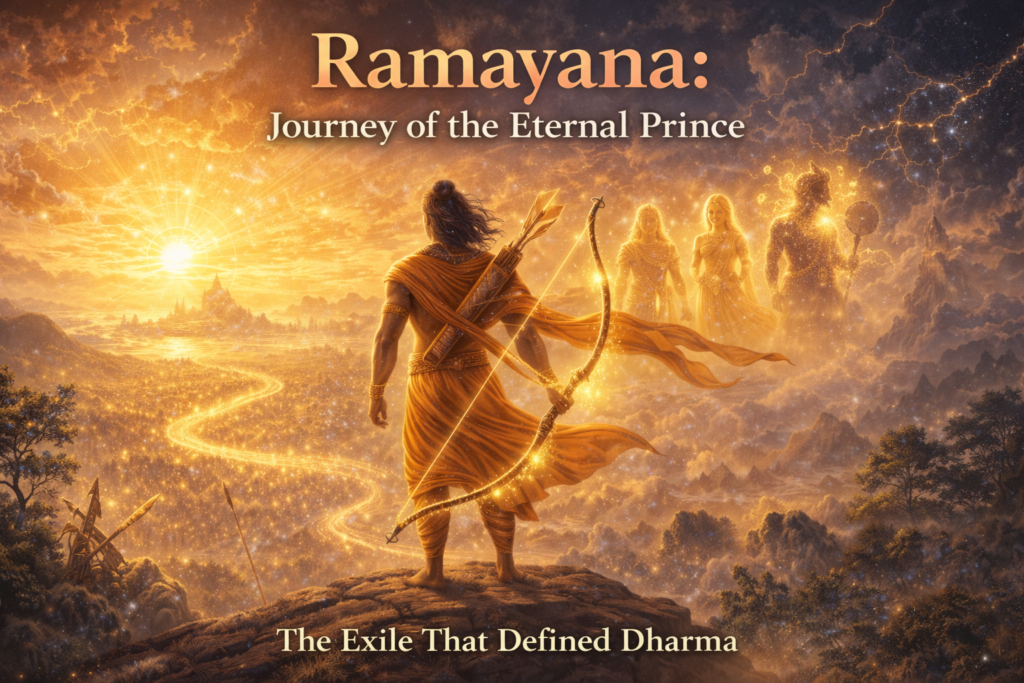
The forests of Dandaka stretched vast and untamed, filled with the cries of birds, the rustling of trees, and the shadows of unseen dangers. It was here that Rama, Sita, and Lakshmana made their dwelling, a simple hut of leaves. Their days were marked by simplicity—gathering fruit, offering prayers, walking under the canopy of the great trees. Yet even in the wilderness, their lives were radiant with dignity.
But the forest was not empty. Beyond the rivers and hills, Rakshasas—demons of fearsome power—roamed freely, disturbing the sages and threatening the innocent. Among them was Surpanakha, sister of the mighty Ravana. She was fierce, cunning, and restless, wandering the forests in search of satisfaction.
One day, as she came upon Rama’s dwelling, she saw him. His form shone like a pillar of light, his face calm, his eyes deep with compassion and strength. For a moment, desire seized her heart. She approached him boldly, casting aside all shame, and said, “O Rama, you are the most handsome man I have ever seen. Your wife is unworthy of you. Leave her, and take me instead. I will serve you, I will give you pleasure, I will make you master of the world.”
Rama smiled gently, but firmly. “O lady, your words are misplaced. I am bound to Sita, my wife. Love is not for barter, nor loyalty for exchange. Go to Lakshmana—he is young and unmarried. Perhaps he will accept you.”
Surpanakha turned to Lakshmana, but he too laughed. “I am Rama’s servant. How can I accept you when he has not? Return to your own kind, for this path is not for you.”
Humiliated, her desire turned to fury. Her eyes burned with rage. She rushed at Sita, claws extended, intending to harm her. But Lakshmana, swift as lightning, drew his blade and struck, cutting off her nose and ears. Surpanakha shrieked in pain, her cries echoing through the forest as she fled, bloodied and vengeful.
Her humiliation was not silent. She ran to her brothers, Khara and Dushana, mighty Rakshasas who ruled nearby. Enraged by her tale, they gathered armies to destroy Rama. Yet when they attacked, Rama stood firm. With his bow, he struck down thousands, his arrows flying like fire, his calm unbroken. Khara and Dushana fell, their strength no match for dharma guided by discipline.
But Surpanakha’s revenge was not complete. Her wounded pride drove her further—to Lanka, to her brother Ravana, king of demons. And thus began the chain of events that would lead to one of the most pivotal trials of the Ramayan.
Not long after, as the days passed in peace, a golden deer appeared near the hut. Its form glistened like molten gold, its eyes sparkled like jewels, its movements entrancing. It leapt gracefully, drawing Sita’s gaze. She turned to Rama and said, “My Lord, I have never seen such beauty in the forest. If we could capture it, it would bring delight. Please, fetch it for me.”
Rama looked upon the deer, and though his heart was wise, his love for Sita was deep. “Very well,” he said, “I will pursue it. But beware, Sita, this forest is full of deceit. Stay within, and let Lakshmana guard you.”
He set forth, chasing the golden form through the trees. Yet the deer was no deer—it was Maricha, a Rakshasa in disguise, sent by Ravana to lure Rama away. Rama pursued, the deer darting further, shimmering like illusion itself. At last, Rama struck it down with an arrow. As it fell, Maricha cried out in Rama’s voice: “Lakshmana! Sita! Help me!” His cry, though false, pierced the air like a blade.
Back at the hut, Sita heard the cry and trembled. “Lakshmana, your brother is in danger. Go to him at once!”
Lakshmana shook his head. “No, noble Sita. I know my brother’s strength. No force in this forest can harm him. That cry was not his—it is deceit.”
But fear clouded Sita’s heart. Her love turned to anguish. “Do you not care for your brother? Will you let him perish while you stand idle? Perhaps you wish him gone, so that you may claim me for yourself!”
Lakshmana’s heart shattered at her words. With folded hands, he said, “I go, though my soul trembles at leaving you unguarded. May the gods protect you.” And with that, he departed into the forest.
The trap was complete. With Rama and Lakshmana away, Ravana approached. But that tale belongs to the next chapter.
Here, we pause to reflect on the lessons hidden in these events.
Surpanakha represents uncontrolled desire—desire that blinds judgment, that turns love into obsession, and obsession into rage. When rejected, she sought to destroy what she could not possess. In her fall, we see how lust without restraint becomes destruction.
The golden deer represents illusion—the glittering promises of the world that seem beautiful, yet hide danger. Sita’s request was not wrong—her desire was innocent, but unchecked desire opened the door to disaster. Even love, when blinded by longing, can lead us astray.
Maricha’s cry represents deception—the voice of illusion that mimics truth. How often in our lives do we hear false voices, fears disguised as truth, temptations disguised as needs? Lakshmana knew the cry was false, yet even he was forced by emotion to leave his duty. It reminds us that even the wise can stumble when pressed by the voices of fear and doubt.
The lesson is clear: desire, illusion, and deception are the greatest weapons of adharma. They do not attack openly with swords and arrows. They enter quietly through the heart—through temptation, through longing, through fear. And when they succeed, even the strongest can falter.
In our lives, Surpanakha is the temptation that seeks to distract us from truth. The golden deer is the glittering illusion of wealth, pleasure, or recognition that draws us from our path. Maricha’s cry is the voice of fear that convinces us to abandon wisdom. Each one leads us away from dharma, away from duty, away from peace.
The path of Rama teaches us vigilance. To see beauty, but not be blinded by it. To feel desire, but not let it master us. To hear fear, but not let it dictate our choices. True strength is not in denying desire, but in mastering it. Not in rejecting beauty, but in discerning truth.
Rama pursued the deer not out of weakness, but out of love. Sita longed for it not out of greed, but out of innocence. Lakshmana left not out of folly, but out of devotion. Yet even the noblest hearts can stumble when illusion and fear intertwine. That is why vigilance is eternal.
So ask yourself: what is your golden deer? What illusion glitters before your eyes, drawing you from your true path? What false voice cries out, luring you away from your duty? And when temptation whispers, will you see through it, or will you be deceived?
The story of Surpanakha and the golden deer is not an ancient tale alone. It is the daily battle of every soul. To master it is to walk the path of dharma. To fail is to open the door to suffering.
As you reflect, remember: not every glitter is gold. Not every voice is truth. Not every desire is dharma. Wisdom lies in discernment, and strength lies in restraint.
If this story touched your heart, if it reminded you that your struggles are preparing you for something greater, support this journey of dharma with a symbolic donation of eleven dollars. And unlock Dharma Vault, claim it through the link in the description.