
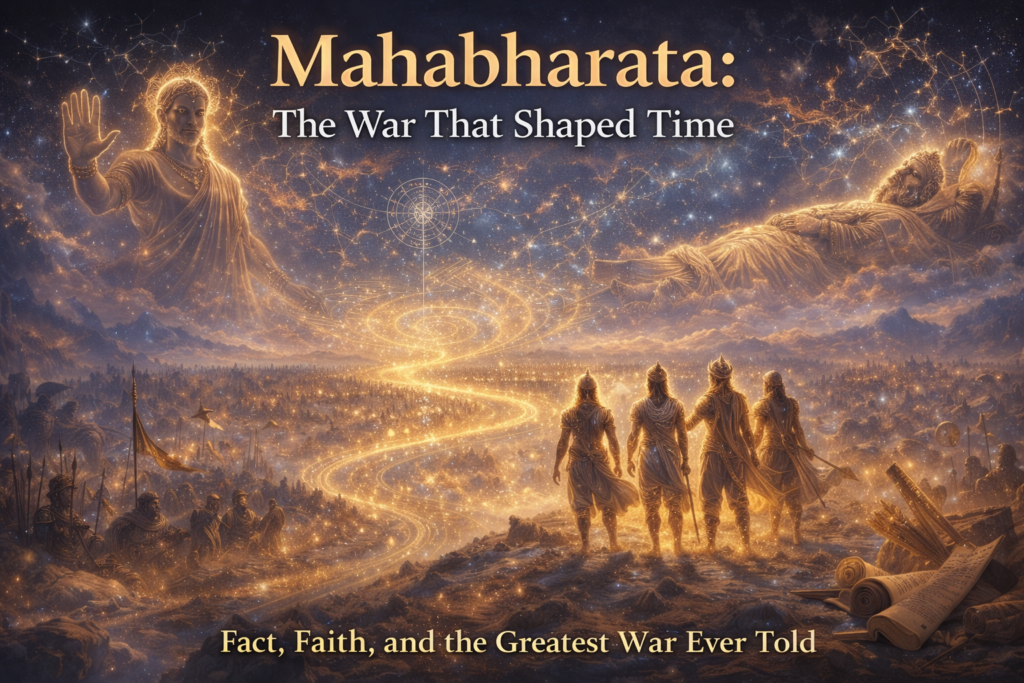
The years of exile weighed heavily on the Pandavas, but they did not waste them. Hardship became their training ground, loss became their teacher. Among them, Arjuna, the son of Indra, felt the deepest burden. He knew that when the time of war came, it would not be fought with ordinary bows or earthly arrows. The Kauravas had gathered allies and armies beyond counting. Drona, Karna, Bhishma, Ashwatthama — all stood as towering mountains before him. To face them, Arjuna would need more than skill. He would need divine weapons, celestial knowledge, strength not of man but of gods.
Arjuna resolved to undertake tapasya, the fierce discipline that burns weakness and awakens divine power. Leaving his brothers in the forest, he journeyed into the Himalayas, where the silence of the peaks tests the heart as much as the body. Clad in bark, armed with his bow, he stood in solitude. Day by day, he prayed, meditated, and restrained his senses. His breath became steady, his body lean, his mind sharp as steel. The gods watched, for tapasya draws the gaze of heaven.
One day, as Arjuna stood deep in meditation, a hunter approached, carrying a bow. The hunter was no ordinary man — it was Lord Shiva himself, testing the resolve of the Pandava. At that moment, a wild boar charged toward Arjuna. Both he and the hunter released arrows at once, and the beast fell dead, pierced by both shafts.
“Mine is the kill,” declared Arjuna.
“No,” said the hunter, “the beast is mine.”
Words turned to challenge, and challenge turned to battle. Arjuna loosed arrows that blazed like fire, but the hunter’s bow struck them down like twigs. Arjuna fought with fury, his skill unmatched, yet the hunter matched him at every move. At last, his quiver emptied, Arjuna grasped his bow as a club and charged forward. The hunter caught it easily, breaking it as though it were straw.
Exhausted, humbled, Arjuna paused. He realized no mortal could defeat him so. With folded hands, he prayed: “O Lord Shiva, forgive me. I did not recognize you.” In that instant, the hunter’s form dissolved, and before Arjuna stood Mahadeva himself, the great god of destruction, calm and smiling.
“You have pleased me with your courage and persistence,” Shiva said. “Take from me the Pashupatastra, the weapon of annihilation. Use it only when no other path remains, for its power is beyond measure.”
Thus Arjuna, through humility and devotion, gained his first divine weapon. His tapasya had borne fruit, and yet it was only the beginning.
The gods themselves now came to him. Indra, his divine father, took him to the heavens, where Arjuna beheld wonders beyond imagination. Celestial music filled the air, apsaras danced, and the halls of Indra shone brighter than the sun. But Arjuna was not dazzled by pleasure — he had come for strength. Indra gave him the Vajra’s blessings, and the Devas bestowed upon him weapons that blazed with light: the thunderbolt, the discus, the conch, the mace. From Varuna, he gained the noose; from Agni, the flaming spear; from Yama, the staff of death. Every god placed in his hands a piece of eternity.
Yet even in heaven, trials awaited. The apsara Urvashi, enchanted by Arjuna’s radiance, approached him with desire. But Arjuna bowed respectfully and said, “O revered one, you are of the lineage of my ancestors. To me, you are as a mother. How can I see you otherwise?” Urvashi, humiliated, cursed him: “For your refusal, you shall one day lose your manhood and live among women.” But Indra comforted his son, saying, “Fear not. This curse will serve you in the future, protecting you in exile.” Thus even a curse became a hidden blessing.
In the heavens, Arjuna also received music and dance from Chitrasena, the Gandharva. For a warrior must not only master weapons, but also art, for art tempers pride and awakens the soul. Thus Arjuna learned grace to balance his power.
Years passed, and Arjuna returned to earth, carrying divine weapons and celestial wisdom. His body was the same, but his spirit shone brighter. He had been tested by hunger, by battle, by gods themselves, and he had prevailed.
But more than weapons, Arjuna gained clarity. He saw that strength without dharma is destruction. The Pashupatastra, the Vajra, the divine bows — all were meaningless if used for pride. They were entrusted to him not to glorify himself, but to protect dharma when adharma rose. This is the eternal lesson of his tapasya: power is not for the self. Power is a responsibility, a burden to be carried for the good of the world.
The Pandavas, seeing his return, rejoiced. Draupadi’s eyes filled with hope. Bhima roared with pride. Yudhishthira bowed in gratitude. For they knew that with Arjuna armed in divinity, the balance of Kurukshetra had shifted. The Kauravas had numbers, wealth, and allies. But the Pandavas had tapasya, devotion, and the favor of the gods.
In our own lives, too, we are called to tapasya. Not always in forests or mountains, but in the daily discipline of work, patience, and focus. The hunter we battle is not Shiva in disguise, but our own pride, our own impatience, our own weakness. Each time we bow with humility, each time we rise with persistence, we too gain weapons — not of steel, but of wisdom, courage, and resilience.
Arjuna’s journey tells us: do not fear hardship. Do not curse exile. Use it. Burn away comfort in the fire of discipline. Seek not pleasure but power, not for vanity but for responsibility. The gods do not give weapons to those who seek glory. They give them to those who seek dharma.
So when your battle comes — and it will — ask yourself: have you done your tapasya? Have you trained your hands, your mind, your spirit? Have you faced your hunter, your pride, your weakness, and bowed before truth? For only then will you be ready to hold the Pashupatastra of your life.
Arjuna returned from the heavens not as a warrior only, but as a protector of dharma. His tapasya was the turning of the tide, the assurance that when Kurukshetra dawned, the Pandavas would not stand with only mortal arms, but with the blessings of heaven itself.
If this story moved you, if it reminded you that greatness lies in choice, not birth, support this journey of dharma with a symbolic donation of eleven dollars. support this journey of dharma with a symbolic donation of eleven dollars. And unlock Dharma Vault, claim it through the link in the description.