
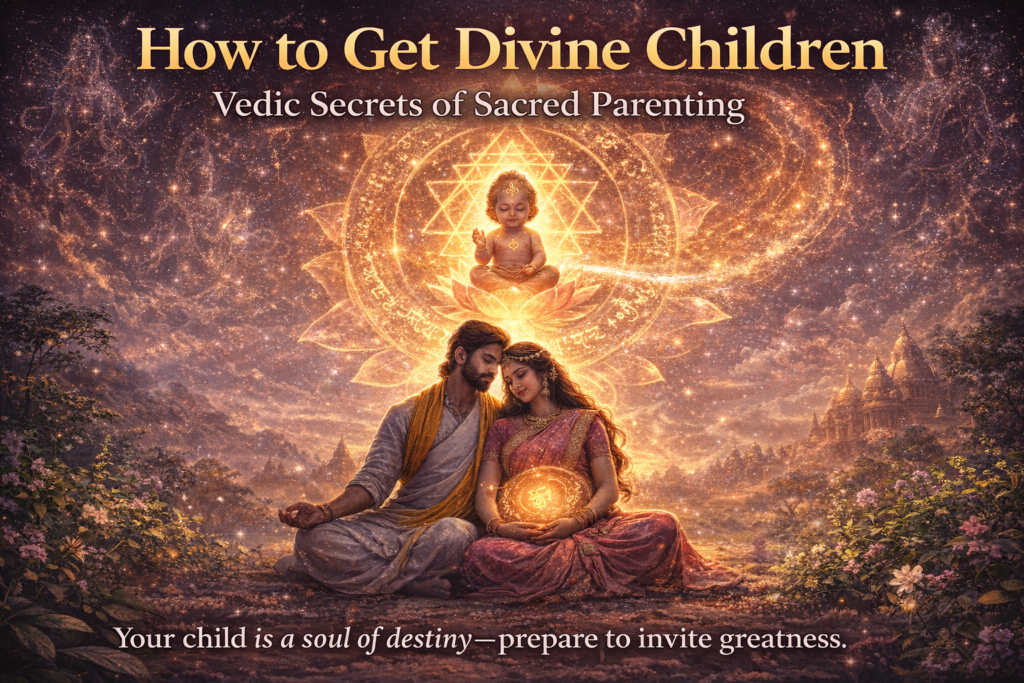
We often speak of great warriors, saints, and rulers as if they appeared out of nowhere. Rama, Krishna, Arjuna, Shivaji, Rani Laxmi Bai—were these figures accidents of history? Or were they prepared long before they ever walked the earth? The truth is clear: behind every divine child stands an ancient practice. That practice is called Garbh Sanskar.
What is Garbh Sanskar? The word itself means “sacralizing the womb.” It is the Sanatan science of preparing, conceiving, and raising a child not just as a body, but as a carrier of dharma. It is the art of inviting divine souls, of shaping destiny before birth.
In ancient Bharat, Garbh Sanskar was a way of life. Parents did not think of children as accidents. They thought of them as responsibilities. Before conception, couples would fast, pray, and perform yajnas to purify themselves. They would choose auspicious times. They would chant mantras and call upon the devas. Their intention was clear: not to produce a child of desire, but to invite a soul of light.
During pregnancy, the discipline continued. Mothers were encouraged to live sattvic lives, to eat pure food, to avoid anger and restlessness. They listened to the Ramayana, the Gita, and the Mahabharata. They filled their minds with devotion, their homes with peace. Fathers too lived in restraint, giving strength and stability to the household. And the unborn child absorbed it all.
This is why Abhimanyu could learn in the womb. This is why Jijamata could raise Shivaji as a warrior of dharma. This is why Rama was born through the Putrakameshti Yajna. The womb was not seen as ordinary. It was the first temple. The first school. The first battlefield.
But today, what has happened? Most couples do not even know the word Garbh Sanskar. Conception happens by accident. Mothers live surrounded by noise, stress, and distraction. Instead of Ramayana and Gita, the unborn child hears gossip, arguments, or the endless chatter of television and phones. Fathers think only of survival, not of tapas. And then we ask, why are our children weak? Why do we not see leaders of dharma? The answer is painful but simple: we have abandoned the science of Garbh Sanskar.
This is not myth. Modern science too proves that the unborn child responds to sound, emotion, and vibration. Ancient rishis already knew this. They built entire systems to ensure that the womb produced not just life, but greatness. They knew that the future of society was written in the womb. Good rulers, good saints, good warriors—they begin with Garbh Sanskar.
Krishna said in the Gita: “Whenever dharma declines and adharma rises, I manifest myself.” That manifestation does not always mean a blue-skinned god descending from the sky. Often, it means a child born through the womb of a mother who called with devotion. Garbh Sanskar is how Krishna answers. It is how divine children are sent to protect dharma.
The truth is unavoidable. If we revive Garbh Sanskar, Bharat will once again be filled with Ram-like rulers, Arjuna-like warriors, Shivaji-like kings, and Laxmi Bai-like queens. If we ignore it, then corruption, weakness, and slavery will continue. The womb decides the fate of the nation.
The question is: will we keep the womb ordinary, or will we restore it as the temple of dharma?
If this message revealed something you had forgotten, type in the comments: Jai Shree Krishna.
Support this mission to revive Sanatan Dharma. Donate at least 21 dollars through the link in the description and bio. Purchase the ebooks below—they contain the knowledge and inspiration to strengthen your journey and spread dharma.
Subscribe to this channel, and share this video with friends and family. Let every Hindu couple remember: Garbh Sanskar is not a story of the past. It is the key to the future.