
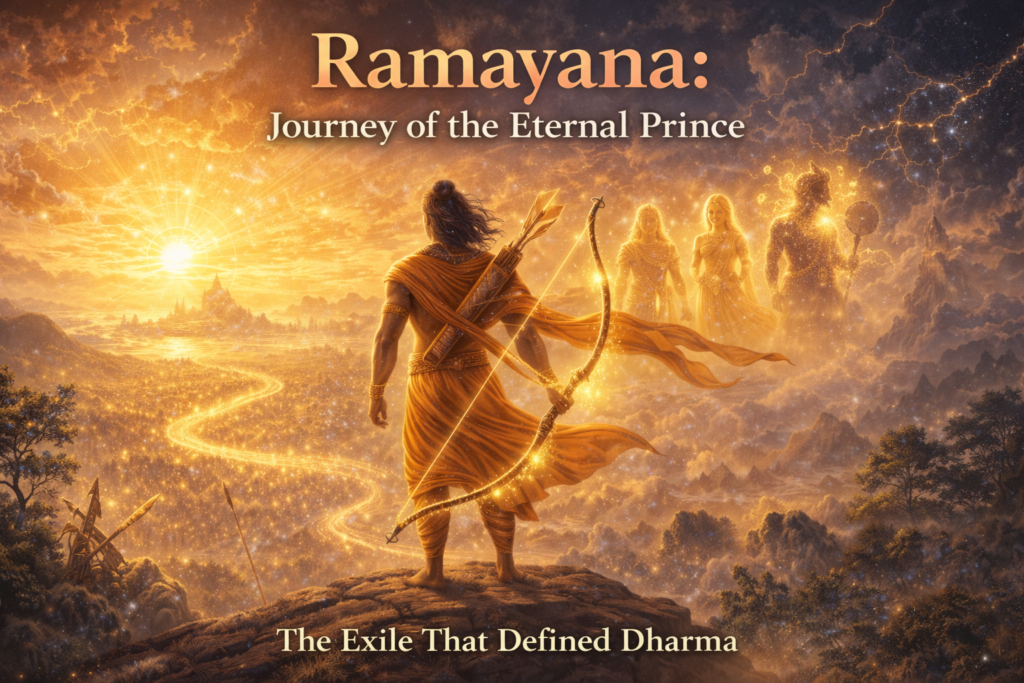
Ayodhya was radiant. Its streets were adorned with flowers, its people rejoiced, and its palace resounded with music and laughter. For King Dasharatha, who had once mourned for an heir, life now seemed full. His sons were grown, noble and strong. Rama, in particular, shone like the sun—beloved by the people, admired by sages, and destined for greatness.
The time had come to crown him as the heir apparent, the Yuvaraja of Ayodhya. Ministers gathered, citizens prepared, and joy overflowed like the Ganga in flood. Rama’s coronation was not simply the hope of a father—it was the dream of a kingdom. For the people saw in him not only a prince, but a leader of righteousness, one who would guide them with truth and compassion.
Yet destiny, in its mysterious ways, had prepared another test. And this test would not be of weapons or of strength, but of the heart.
Dasharatha had three queens: Kausalya, Kaikeyi, and Sumitra. Each loved him, each shared his joys and sorrows. Of them, Kaikeyi had once been his favorite. In youth, she had saved his life on the battlefield, guiding his chariot when enemies rained arrows upon him. Out of gratitude, Dasharatha had promised her two boons—gifts she could claim at any time. For years she had kept them unused, like arrows waiting in a quiver.
But now, as Ayodhya celebrated Rama’s coronation, a shadow crept into the palace. Kaikeyi’s maid, Manthara, envious and cunning, poisoned her mind with whispers. “If Rama is crowned, Kaikeyi, your own son Bharata will be cast aside. You will be forgotten, Kausalya will rise, and your place will diminish. Why let another take what your son deserves?”
Kaikeyi wavered. She loved Rama, she loved Dasharatha, and yet the poison of fear and pride sank deep. That night she entered the chamber of anger, the kopa-bhavan, where queens went when grievances consumed them. Lying upon the floor, she cast off her ornaments and waited.
When Dasharatha came, joyful to share the news of Rama’s coronation, he found her cold and distant. Alarmed, he asked: “What troubles you, my queen?”
Kaikeyi reminded him of the boons he had promised. The king, smiling, assured her she could ask anything—wealth, jewels, lands. But her request was a thunderbolt. “First boon: let Bharata be crowned king. Second boon: let Rama be exiled to the forest for fourteen years.”
Dasharatha’s heart shattered. He staggered, struck as though by a weapon. His lips trembled. His voice broke. “You speak of my death, Kaikeyi. What crime has Rama committed? Why would you tear the heart from my chest?”
But Kaikeyi was resolute, her heart hardened by Manthara’s words. “You are a king, bound by your promise. If you do not grant this, your word is meaningless.”
All night the king wept, pleading, begging, cursing his fate. He tried to sway her, to remind her of Rama’s virtues, of his love for Bharata. But Kaikeyi did not yield. And as dawn approached, the king lay broken, unable to move, crushed by his own vow.
The news spread through the palace like fire through dry grass. Ministers whispered, servants wept, and the air grew heavy with sorrow.
And then came Rama. Summoned to his father’s chamber, he entered with calm dignity, his face serene. He saw Dasharatha trembling, unable to speak, his tears falling like rain. He saw Kaikeyi, firm and unyielding. And he asked with gentle voice: “What troubles my father? Why does my mother look so stern?”
Kaikeyi told him everything. She did not soften her words. She spoke of the two boons, of Bharata’s coronation, of Rama’s exile for fourteen years.
The room fell silent. Dasharatha’s sobs echoed like thunder. The court itself seemed to hold its breath.
And Rama… smiled.
Not the smile of arrogance, nor of defiance, but the calm smile of one who accepts destiny. He bowed before Kaikeyi, touched her feet, and said: “So be it. If this pleases you, O Mother, then I accept. If this fulfills the promise of my father, then it is my duty. What greater honor can a son have than to uphold his father’s word?”
The court gasped. Ministers who had expected protest wept at his composure. Dasharatha tried to rise, crying: “No, my son, I cannot bear it. Without you, I shall die.” But Rama placed his hands upon his father’s head, soothing him. “Father, your word is dharma. If I must go, I go with joy. Do not grieve, for I carry your honor with me.”
This is the greatness of Rama. To him, exile was not punishment, but duty. Where others saw loss, he saw opportunity—to uphold truth, to prove dharma, to protect the sanctity of a promise. In that moment, Rama revealed the heart of leadership: that the ruler’s path is not comfort, but sacrifice.
When Sita heard of the exile, she too resolved to follow him. “Wherever you go, I go,” she said. “Your dharma is my dharma. The forest shall be my palace, your exile my joy.” Lakshmana too declared he would never leave Rama’s side. Thus, in sorrow was born a bond even stronger than before—of family walking together into trial.
What does this episode teach us? It teaches that life will not always honor our plans. Joy can turn to sorrow in a single night. Promises can break us. The people we love may betray us, or fall prey to fear. Yet in such moments, greatness is measured not in resistance, but in acceptance.
Rama did not complain. He did not argue. He did not curse Kaikeyi, nor blame fate. He accepted with dignity, showing the world that even the harshest blow can be met with calmness. His strength was not in the sword, but in the serenity of his heart.
In our own lives, we too face exiles—moments when what we hoped for is denied, when doors close, when betrayal strikes, when dreams collapse. Most of us protest, rage, or sink into despair. But Rama shows another way: accept with grace, walk forward with dignity, and let trials become training.
Kaikeyi’s boon seemed like a curse, but it was the beginning of Rama’s true greatness. For had he remained in Ayodhya, perhaps his life would have been easy, but it would not have become immortal. It was exile that revealed his leadership. It was hardship that revealed his strength. It was loss that revealed his compassion.
So too in our lives: the very trials we resist may be the doors to our destiny. The disappointments we curse may be the preparation for our victories. To accept them with calmness is to transform pain into power.
Dasharatha’s sorrow soon ended his life. The king who could conquer armies could not endure separation from his beloved son. Yet Rama walked forward, not weighed by grief, but lifted by duty. He carried not only his father’s honor, but the hopes of his people, into the wilderness of destiny.
This is the lesson of Kaikeyi’s boon. Life will demand sacrifices. Duty will demand obedience. And sometimes, the cost will seem unbearable. But if we accept with dignity, if we face exile without complaint, we awaken within ourselves the true strength of kingship.
As you listen to this, reflect on your own life. What hardship are you resisting? What exile are you afraid to walk into? Remember Rama. Smile at fate, even when it strikes. Walk with calmness, even when the road darkens. For in the end, it is not comfort that makes you great—it is sacrifice.
If this story touched your heart, if it reminded you that your struggles are preparing you for something greater, support this journey of dharma with a symbolic donation of eleven dollars. And unlock Dharma Vault, claim it through the link in the description.