
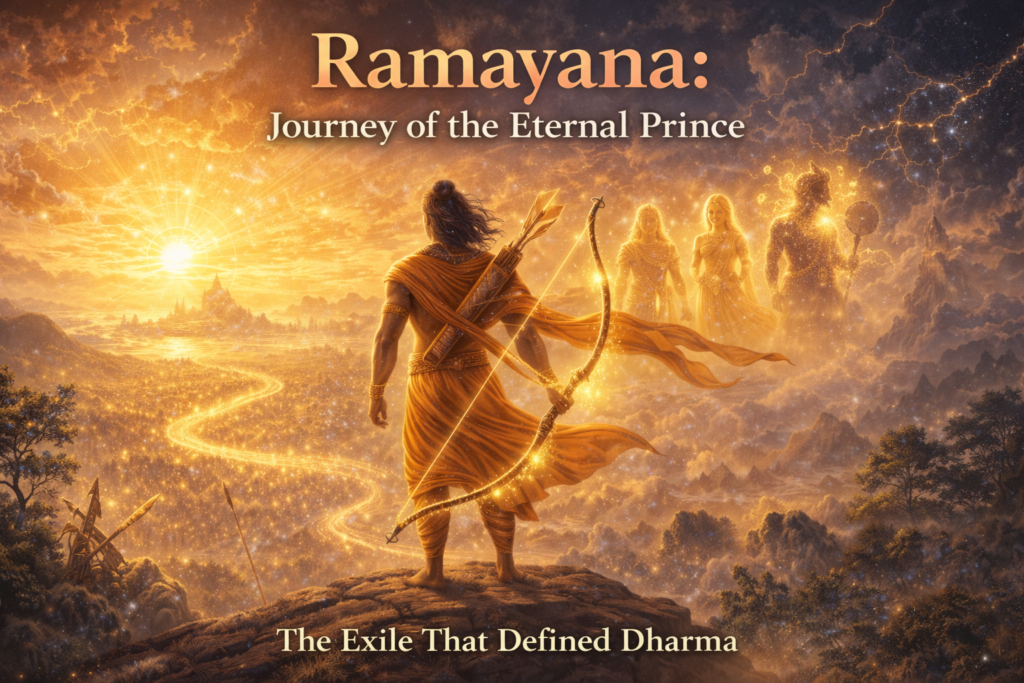
The years passed, and Rama’s name grew in strength and reverence. In the forests, he had shown valor. In the gurukul, he had shown discipline. In the courts of sages, he had shown humility. Ayodhya rejoiced in the promise of its prince. Yet destiny was preparing a new chapter—one that would not only test Rama’s skill but also reveal the meaning of love, not as passion, but as dharma itself.
The stage for this chapter was not Ayodhya, but Mithila—the kingdom ruled by King Janaka, a sovereign whose wisdom was spoken of across Bharat. Janaka was no ordinary monarch. He was a philosopher king, a ruler whose heart was devoted not to power, but to truth. His daughter, Sita, was the jewel of his house. Born of the earth itself, she was discovered as an infant when Janaka ploughed the fields during a sacred ritual. Pure, radiant, and divine, Sita grew to embody grace, strength, and compassion.
Her beauty was unmatched, but her greatness lay not merely in her form—it lay in her soul. She was gentle, yet unyielding in principle. She was soft in speech, yet fierce in her devotion to righteousness. She was, in truth, Rama’s equal, though they had not yet met.
King Janaka had vowed that Sita would only marry the one who could prove his strength, his discipline, and his worthiness. In his palace rested a bow that no man could string, the bow of Lord Shiva, a relic of immense power. Kings from across the land came to Mithila, each hoping to win Sita’s hand by lifting and stringing the bow. Yet one by one, they failed. Even the greatest warriors stumbled before its weight. The bow stood as a silent judge, declaring that true strength was not yet present among them.
It was during this time that Vishwamitra brought Rama and Lakshmana to Mithila. Having protected the sage’s sacrifice, they now traveled with him to broaden their learning. When Rama entered the city, the people of Mithila felt a presence unlike any they had known. His walk carried humility, yet his bearing radiated majesty. His eyes were soft, yet filled with power. The citizens whispered: “Is this the one destined for our princess?”
In the palace courtyard, the challenge was announced. The bow of Shiva was brought forth, massive, shining, revered. The suitors who had once boasted fell silent in its shadow. Rama approached, not with arrogance, but with serenity. He bowed first to the bow itself, honoring the divine. Then, with calmness in his heart, he placed his hands upon it.
The weight that had crushed others felt like nothing in Rama’s grasp. With a steady breath, he lifted the bow as if it were a garland of flowers. And then, in one fluid motion, he drew the string. The sound that followed was not of string but of thunder. The bow broke in two, echoing across the kingdom, sending shivers through the earth. The court gasped, the kings trembled, and Janaka’s eyes filled with awe.
For in that moment, the test was complete. Rama had proven not only his strength, but his destiny.
Sita entered, her eyes meeting Rama’s for the first time. She carried a garland of flowers, her hands trembling not from fear, but from the weight of sacred union. As she stepped toward him, the world itself seemed to pause. For this was not the meeting of two souls—it was the union of dharma and shakti, of righteousness and strength, of purpose and devotion. She placed the garland around Rama’s neck, and as she did, their partnership was sealed.
The wedding that followed was no ordinary celebration. It was a festival of heaven and earth. The gods themselves are said to have showered flowers from the skies. Sages blessed the union, kings marveled at its majesty, and the people rejoiced as if their own hearts had been wed to hope. Rama and Sita, hand in hand, embodied the highest truth: that marriage is not built upon desire alone, but upon dharma—walking together on the path of righteousness, through ease and through exile, through triumph and through trial.
Sita’s love for Rama was not the love of dependence. It was the love of strength. She was not a shadow that followed him, but a flame that walked beside him. When Rama chose exile, Sita chose it too, not because she was compelled, but because her dharma was bound to his. When Rama faced despair, Sita’s courage was the light that steadied him. In her, we see the power of a partner whose devotion is not blind but awakened, whose love uplifts rather than weakens.
Rama’s love for Sita was not the love of possession. It was the love of reverence. He saw her not as property, but as his equal, his companion in duty. In every word he spoke to her, there was respect. In every act, there was care. In him, we see the model of a leader who treats love not as ownership, but as partnership.
What does this union teach us today? It teaches that true relationships are not built on fleeting attraction or selfish need. They are built on shared purpose, on dharma. Love is not measured in how much you can take from another, but in how much you can walk together toward truth.
In our age, relationships often stumble because they are built on desire without discipline, on passion without purpose. The Ramayan shows us another way. A way where love strengthens both souls, where each partner becomes the other’s anchor and wings.
Sita teaches us that love means standing firm, even in adversity. Rama teaches us that love means honoring and respecting the one beside you. Together, they show us that the highest form of love is partnership in dharma—a union that uplifts the world.
Think of your own life. Who stands beside you? Do your relationships lift you closer to truth, or pull you into illusion? Do you treat love as a selfish demand, or as a sacred partnership? To follow the example of Rama and Sita is to make every bond a force of righteousness, every union a step toward dharma.
Their marriage was not the end of their trials—it was the beginning. For love tested by comfort is unproven, but love tested by fire becomes eternal. When exile came, Sita walked the forests without hesitation. When abduction came, she endured with dignity. Their union was not fragile, because it was founded not on desire, but on shared dharma.
This is the lesson for us: love that is true will endure storms, because it is rooted in purpose greater than the self.
As you reflect on this chapter, let it inspire you to see relationships in a new light. Whether as partners, friends, or family, let your bonds be built on mutual respect, shared values, and devotion to a higher truth. That is the way of Rama and Sita. That is the way of dharma.
If this story touched your heart, if it reminded you that your struggles are preparing you for something greater, support this journey of dharma with a symbolic donation of eleven dollars. And unlock Dharma Vault, claim it through the link in the description.