
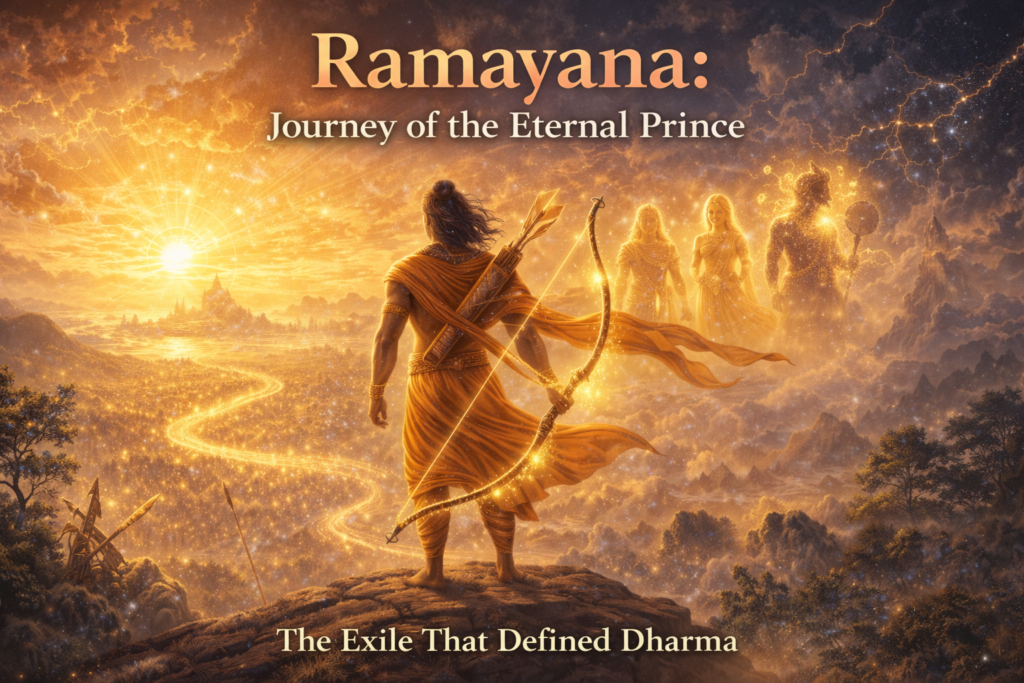
The cries of newborns had long since faded into the sounds of laughter and footsteps echoing across Ayodhya’s palaces. Rama and his brothers—Bharata, Lakshmana, and Shatrughna—had grown beyond infancy, their childhood marked not by indulgence but by preparation. For in Ayodhya, the sons of Dasharatha were not merely princes destined for luxury. They were heirs to responsibility, guardians of a kingdom, and symbols of hope for generations to come.
Even as children, the four brothers were inseparable. Bharata’s calm wisdom balanced Lakshmana’s fiery spirit. Shatrughna’s loyalty kept harmony among them. And Rama, the eldest, carried himself with a grace that even the sages admired. His presence was like the stillness of a river at dawn—calm, yet hiding depths of power. His eyes reflected compassion, but behind them lay a resolve unshakable even in youth.
It was customary in those times that even princes were not raised solely within the palace walls. Knowledge was not gifted by birthright. It had to be earned. And so the young Rama and his brothers were entrusted to the care of the revered Guru Vashishta, the family’s sage and spiritual guide.
The gurukul was not adorned with marble or gold. It was simple, rooted in the forest, built of humility. Here, the princes awoke before sunrise, bathed in cold waters, and offered prayers as the first light touched the horizon. Their days began not with command, but with service. They gathered wood, drew water, and swept the ashram grounds. Princes or not, every student was equal.
Rama accepted these duties without complaint. He understood, even as a child, that greatness is not measured in crowns or thrones, but in discipline. In every act of service, his heart grew stronger, his humility deeper. When his hands carried water, he carried it as if serving his people. When he swept the ashram floor, he swept away ego and pride.
The education they received under Vashishta was vast. They studied the Vedas, the sacred hymns that revealed the mysteries of creation. They learned philosophy, the principles of governance, the sciences of time, medicine, and astronomy. They mastered the art of speech, learning to speak truth with clarity, to inspire with words, and to soothe with wisdom. For a king must not only rule by law—he must guide by example.
But perhaps the most rigorous of their lessons was in the art of archery. For archery was not merely the skill of bow and arrow—it was the discipline of body, mind, and soul. Rama excelled with the bow as if born with it in his hand. His movements were precise, his focus unbroken. When he drew the string, he became one with the arrow. His aim was never distracted, for he saw beyond the target—he saw the purpose.
Lakshmana, ever at Rama’s side, matched his brother with fiery determination. His devotion was so strong that even in exhaustion he would not rest unless Rama did. Bharata and Shatrughna too honed their skills, each bringing balance and harmony to the bond they shared. Together, they became not just brothers, but a force united by love, discipline, and responsibility.
Yet their training was not limited to skill. It was a training of character. Vashishta often told them: “The strength of a king is not in the weapons he carries, but in the values he lives by. Without truth, your arrows will miss their mark. Without humility, your power will destroy you. Without compassion, your victories will be hollow.”
Rama absorbed these lessons with reverence. He listened more than he spoke, and when he spoke, his words carried the weight of wisdom beyond his years. He treated his teachers with the same devotion he showed his parents, and his friends with the same respect he gave his brothers. In every act, he was already becoming the Rama the world would one day revere.
As the years passed, another sage entered their lives—Vishwamitra, once a mighty king himself, who had renounced his throne to pursue the path of rishihood. Vishwamitra came to Dasharatha with a request. Demons were disturbing his yagna, disrupting his spiritual practices, and no ordinary warriors could withstand them. He asked that Rama and Lakshmana accompany him into the forests to protect the sacrifice.
Dasharatha trembled at the thought. His sons were still young, untested in real battle. How could he send them against demons? Yet Vishwamitra assured him: “Do not doubt, O King. Rama is no ordinary child. He is born for greatness. Trust him, for in him lies the strength of the gods.”
And so Rama and Lakshmana set out with the sage, their bows in hand, their spirits firm. This journey marked the first step into the wider world, where discipline would be tested by danger.
As they walked beside Vishwamitra, he taught them the mantras and astras—celestial weapons bound by divine knowledge. Each mantra, when mastered, could summon the power of the elements—fire, wind, water, lightning. Vishwamitra saw in Rama the perfect vessel for these powers. For Rama did not learn with arrogance. He received each teaching with humility, vowing never to misuse them.
The test soon came. The demoness Tataka, fierce and monstrous, terrorized the forests. Her roars shook the trees, her presence struck fear into the hearts of villagers. Vishwamitra pointed to Rama: “This is your trial. Destroy her and free the land from fear.”
Rama hesitated for a moment—not from fear, but from compassion. “She is a woman,” he thought. “Even if she is a demon, is it right to slay her?” Vishwamitra’s words cut through his doubt: “Dharma does not look at form. To protect the innocent is your duty. Mercy toward the wicked is cruelty toward the weak.”
Hearing this, Rama steadied his heart. He drew his bow, arrows blazing like fire. With precision and calm, he struck Tataka down, her terror ended, the forests freed. This was his first victory, not only over a demon, but over doubt within himself. He learned that dharma sometimes demands hard choices, that true compassion means protecting the many even at the cost of the few.
From that day, Rama’s fame spread. Not as a prince of Ayodhya alone, but as a warrior of dharma. Villagers spoke his name with reverence. Sages blessed him. And Lakshmana, ever at his side, shone with equal valor, proving that loyalty itself is a weapon of strength.
This chapter of Rama’s youth reveals a profound truth: discipline is not a chain—it is a key. It unlocks the highest potential within us. Rama’s greatness was not an accident of birth. It was forged in the fires of discipline, humility, and responsibility.
In our own lives, we too face demons. Some are visible—temptations, addictions, distractions. Others are hidden—fear, anger, pride, doubt. Like Rama, we must learn to face them, not with hesitation, but with clarity of purpose. Discipline is our bow. Faith is our arrow. And responsibility is our aim.
The gurukul of Vashishta may be far from us in time, but its lessons are eternal. Rise early. Serve with humility. Speak truth. Train your mind and body. Respect your teachers. Protect the weak. These are not ancient customs—they are the foundations of leadership, the pillars of strength.
Every time you resist temptation, you are like Rama refusing arrogance. Every time you act with discipline, you are like Lakshmana standing steadfast. Every time you serve without pride, you are like Bharata bowing to dharma. Every time you protect another, you are like Shatrughna preserving harmony.
This is the essence of Rama’s early life. The path to greatness is not paved with ease. It is built with discipline, responsibility, and the courage to face trials.
As you listen to this, ask yourself: what demons in your life must you face? What discipline must you embrace? What responsibility have you delayed? Rama’s journey tells us that no one is too young, too weak, or too ordinary to begin. The path of dharma opens the moment you take your first step with sincerity.
Let Rama’s childhood remind you: greatness is not born—it is built. And every act of discipline you choose today prepares you for the victories of tomorrow.
If this story touched your heart, if it reminded you that your struggles are preparing you for something greater, support this journey of dharma with a symbolic donation of eleven dollars. And unlock Dharma Vault, claim it through the link in the description.