
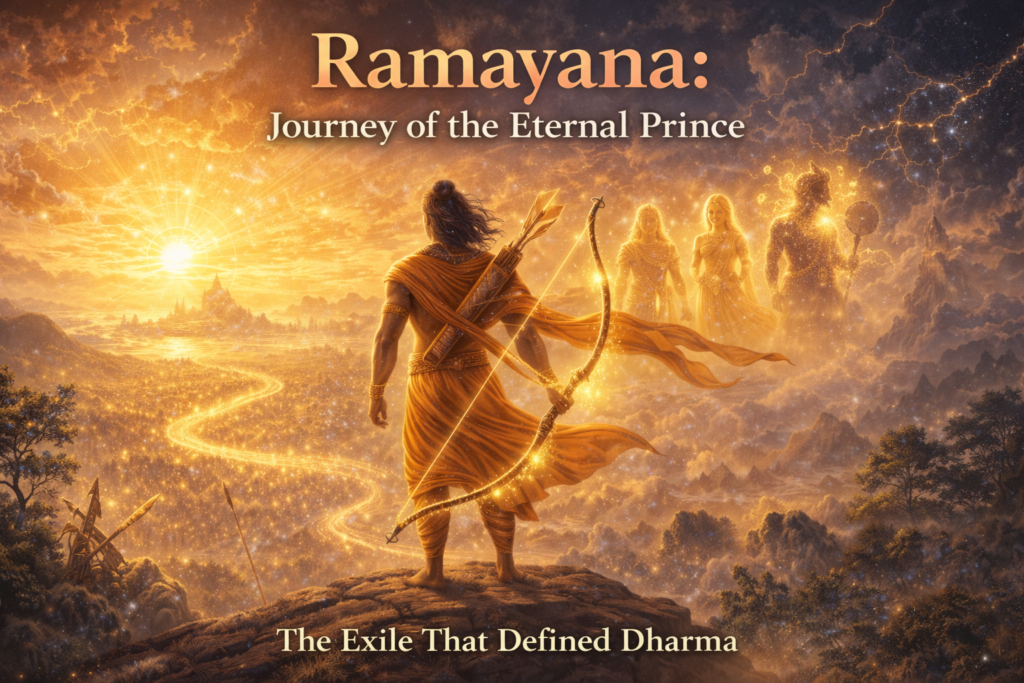
Ayodhya. A city like no other. In the ancient world it was spoken of as a jewel upon the earth, radiant like the heavens themselves. Its streets bustled with merchants, its gardens bloomed with life, its temples echoed with chants of devotion. The people lived with joy, secure in their prosperity, guided by a king whose name resounded with honor across the land. That king was Dasharatha.
Dasharatha was a warrior without equal, a ruler loved by his people, a man of strength and skill. Yet, for all his victories on the battlefield, for all the wealth of his palace, there was an emptiness in his heart. For he had no heir. His lineage, his throne, his kingdom’s future—everything hung in silence, waiting for a son who had not yet been born. His subjects prayed for him. His queens shared his sorrow. And the king himself, despite all his glory, bowed his head in anguish at the thought of an uncertain future.
It is in these moments of despair that destiny begins its work. For when man is humbled, he opens himself to the divine. Dasharatha sought counsel from his rishis, and it was the great sage Vashishta who guided him to a path of hope. The king would perform a sacred ritual, the Putrakameshti Yagna—a fire sacrifice to invoke the blessings of the gods, to ask that heaven itself grant him the children he longed for.
The ritual was prepared with the utmost devotion. Priests gathered. Altars were constructed. The fire was kindled. Into that sacred flame, offerings were poured—ghee, grains, chants, and prayers, rising upward like arrows aimed at the heavens. Dasharatha stood before the fire not as a mighty king, but as a humble servant, pleading for the blessing of fatherhood.
And then, the miracle. From the flames appeared a radiant figure, Agni, the god of fire. In his hands, he bore a golden vessel filled with divine nectar. His voice resounded through the sacrificial ground: “O King, the gods have heard your plea. Take this nectar and share it among your queens. Through this, you shall be blessed with sons who will bring glory not only to your house, but to the world.”
The king received the vessel with trembling hands, tears filling his eyes. He divided the nectar among his three queens—Kausalya, Kaikeyi, and Sumitra. Each drank, their hearts swelling with gratitude and wonder. And from that moment, destiny was sealed.
Time passed. The seasons turned. And then the palace of Ayodhya was filled with the cries of newborns. First came Rama, born of Kausalya, radiant like the rising sun. Then came Bharata, son of Kaikeyi, noble and steadfast. Then came the twins, Lakshmana and Shatrughna, born of Sumitra, inseparable in love and loyalty. The kingdom rejoiced as if heaven itself had descended upon earth. Songs echoed in the streets, lamps were lit in celebration, and Ayodhya glowed brighter than ever before.
The birth of Rama was not a mere event—it was a cosmic turning point. For at that very time, across the world, shadows were lengthening. Ravana, the mighty king of Lanka, intoxicated by his own power, was spreading terror. His strength was unmatched, his arrogance unrestrained. Even the gods feared him, for he had obtained boons that made him invincible against their might. The cries of sages, of the oppressed, of the innocent, rose up to the heavens. And in answer, Vishnu himself had chosen to descend, to be born as Rama, to restore balance and protect dharma.
Yet, in Ayodhya, Rama’s divine nature was hidden in the sweetness of childhood. He grew as any child would—playing in the courtyards, laughing with his brothers, filling the palace with joy. But even then, there was a majesty in him, a serenity beyond his years. His eyes shone with compassion, his words carried wisdom, and his heart radiated courage.
Kausalya, his mother, would often gaze at him in wonder. She saw in him not only her son, but a light that warmed the entire world. Dasharatha, holding the infant in his arms, felt his sorrow vanish. In Rama he saw not only the heir he longed for, but the future of Ayodhya, a future brighter than the sun.
The childhood of Rama and his brothers was filled with discipline as well as play. Under the guidance of sages, they began their education. They learned the scriptures, the art of archery, the principles of governance. But more than knowledge, they absorbed values—obedience, humility, self-control, respect. From the very beginning, Rama walked the path of dharma. He was gentle to the weak, firm against injustice, and always devoted to truth.
It is said that the land itself rejoiced in his presence. When Rama smiled, flowers seemed to bloom brighter. When he walked, the very earth felt blessed. He was loved not because he was the son of a king, but because he embodied the qualities that every heart longs for—kindness, courage, and compassion.
This is the lesson of his birth. Greatness does not begin in palaces or crowns. Greatness begins in character. Rama was destined to be king, but his true kingship lay in his values. From the moment he opened his eyes, he was being prepared—not for comfort, but for responsibility. Not for luxury, but for sacrifice.
And here lies the inspiration for us. We too are born into a world of trials. We too face shadows that seem overwhelming. But just as Rama was prepared by destiny, so too are we. Every hardship you face, every delay, every unanswered prayer—these are not punishments. They are preparation. They are shaping you into someone stronger, wiser, more capable of carrying your purpose.
Dasharatha’s sorrow seemed unbearable, yet it gave rise to Rama. Your struggles may feel endless, yet they may be the soil in which your greatness is taking root.
Remember this: Rama was not born to sit upon a throne and bask in praise. He was born to walk into exile, to battle demons, to endure loss, and to rise victorious through it all. Likewise, your life’s purpose will not be fulfilled in ease. It will be fulfilled in your trials, in your sacrifices, in your courage.
Rama’s birth is not merely a story of joy in a palace long ago. It is a reminder to you, today. That no matter how dark your circumstances, destiny is at work. That within you lies a potential far greater than you realize. That greatness does not wait for perfect conditions—it is born in the midst of imperfection, in the cries of struggle, in the silence of waiting.
So as you listen to this series, take this as your first lesson from the Ramayan: You are not defined by where you stand today. You are defined by what you are being prepared for. The struggles of today are the seeds of tomorrow’s victories. Rama’s birth was not only the answer to a king’s prayers. It was the promise that dharma will always rise, no matter how long it takes, no matter how dark the world becomes.
When you feel hopeless, remember Ayodhya awaiting an heir. When you feel forgotten, remember Dasharatha’s sorrow. And when you feel your prayers are unheard, remember the fire ritual that brought forth Rama. For in time, the light always comes.
This is the story of Rama’s birth. This is the story of destiny preparing greatness. And this is the story of your own life, waiting to unfold if only you walk with faith, patience, and unwavering courage.
If this story touched your heart, if it reminded you that your struggles are preparing you for something greater, support this journey of dharma with a symbolic donation of eleven dollars. And unlock Dharma Vault, claim it through the link in the description.