
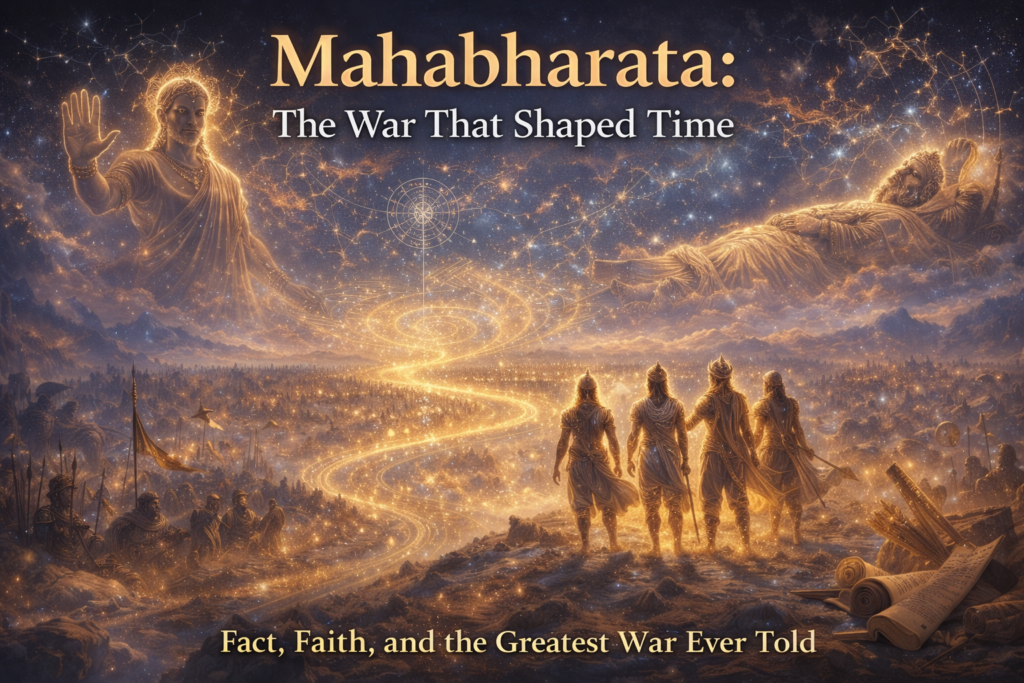
The Mahabharata begins not with Kurukshetra, not with the clash of armies, but with destiny unfolding across generations. For dharma and adharma do not rise overnight. They are sown as seeds in the past, watered by choice, ripened by time, and harvested in war.
Let us return to the banks of the Ganga, to the ancient city of Hastinapura. There ruled King Shantanu of the Kuru dynasty, a ruler noble and just. On the river’s edge he met a woman of beauty and mystery. She was Ganga, the river goddess herself. Shantanu loved her at first sight, and she agreed to marry him on one condition — he must never question her actions.
He agreed. They wed, and for a time all was bliss. But then the queen bore a child. At its birth, she carried the infant to the river and cast it into the waters. Shantanu, bound by his promise, could not speak. Again and again it happened — each son she bore, she drowned in the Ganga. Shantanu’s heart broke, yet he kept his vow. At the eighth child, he could bear it no more. “Stop!” he cried. “Why do you destroy my sons?”
Ganga turned to him and said, “You have broken your promise. But hear the truth. These were no ordinary children. They were the eight Vasus, cursed to be born on earth. My duty was to free them quickly, and so I returned them to heaven. This last child, however, will remain. Raise him well, for he will be great.”
That child was Bhishma — Devavrata, the mighty, the vow-bound. He would shape the destiny of the Kurus more than any other.
Years passed, and Shantanu, after Ganga’s departure, longed for companionship. He fell in love with Satyavati, a fisherwoman of charm and wisdom. Her father, however, demanded a heavy price. He said, “My daughter’s son must inherit the throne.”
But Shantanu already had Bhishma, his firstborn. The king was torn, and sorrow filled his heart. Bhishma, seeing his father’s pain, made the greatest vow in history. He renounced the throne. He vowed lifelong celibacy, swearing never to marry, never to father sons, never to claim kingship. His vow shook the heavens, and the gods cried out, “Bhishma! The terrible vow!” From that day, Devavrata was known as Bhishma, the pillar of sacrifice.
Shantanu married Satyavati, and from her were born two sons — Chitrangada and Vichitravirya. But fate was cruel. Chitrangada died young in battle, and Vichitravirya, though crowned king, was frail of health. To secure heirs, Bhishma brought two princesses from Kashi — Ambika and Ambalika. Yet Vichitravirya died before he could father children. The throne was empty, the dynasty threatened.
Satyavati, desperate to preserve the line, turned to her firstborn son from before her marriage — Vyasa himself, the sage who would one day write the Mahabharata. She called him to perform niyoga, the ancient custom where a chosen man fathered sons for the royal widows.
Vyasa agreed, though his form was austere, his body unkempt from tapasya. When he entered Ambika’s chamber, she closed her eyes in fear. Her son, Dhritarashtra, was born blind. When he entered Ambalika’s chamber, she turned pale with fright. Her son, Pandu, was born weak and bloodless. Satyavati urged Ambika to try again, but she sent her maid instead, and from her was born Vidura, wise and righteous, though not heir to the throne.
Thus were born the three pillars of destiny — Dhritarashtra, Pandu, and Vidura.
Dhritarashtra, though the eldest, could not be king because of his blindness. The throne fell to Pandu, though frail, who ruled with justice. Vidura, though denied kingship, became the voice of dharma in the court. Already destiny was weaving its web — a blind heir, a weak king, a righteous counselor, and Bhishma, the vow-bound guardian.
Pandu wed two wives — Kunti and Madri. Dhritarashtra wed Gandhari, princess of Gandhara. Each union brought its own destiny.
Kunti, even before her marriage, had received a boon from sage Durvasa. She could invoke any deity and bear a child by him. Curious, she once tested the mantra, calling the Sun god. Surya appeared, and from their union was born Karna — the child of radiance. Yet Kunti, unwed and afraid of scandal, placed the infant in a basket and set him afloat on the river. He was found and raised by a humble charioteer. Karna, the son of the Sun, grew up unknowing of his true lineage, carrying within him both greatness and tragedy.
Later, when Pandu ruled as king, he accidentally killed a sage while hunting, mistaking him for a deer. The dying sage cursed Pandu: should he ever unite with his wives, he would die instantly. Stricken with grief, Pandu renounced the throne, retreating to the forest with Kunti and Madri. Dhritarashtra, though blind, was crowned king in his place.
But the curse did not end the lineage. For Kunti remembered her boon. At Pandu’s request, she invoked the gods to father sons who would one day rule.
She called Dharma, the god of justice, and bore Yudhishthira, calm and wise.
She called Vayu, the god of wind, and bore Bhima, mighty and strong.
She called Indra, king of the heavens, and bore Arjuna, brilliant in arms.
At Madri’s request, Kunti shared the mantra with her. Madri invoked the Ashwini twins, divine physicians, and bore Nakula and Sahadeva, radiant and skilled.
Thus were born the Pandavas — five sons of gods, raised in exile, destined for greatness.
Meanwhile, Gandhari, wife of Dhritarashtra, had received a boon to bear a hundred sons. She conceived, but her pregnancy stretched for two years without result. At last she struck her womb in frustration, and a lump of flesh emerged. Sage Vyasa intervened, dividing the lump into one hundred jars, each placed with ghee, and from them were born the hundred Kauravas — led by Duryodhana, ambitious, jealous, and destined to clash with his cousins.
On the day of Duryodhana’s birth, signs of evil filled the land. Jackals howled, storms raged, and the wise Vidura urged Dhritarashtra to abandon the child. “This boy will bring ruin to the dynasty,” he warned. But blinded by love, Dhritarashtra refused. Thus was sown the seed of war.
The Pandavas and Kauravas grew together in Hastinapura, trained under Bhishma’s care, educated by Kripacharya and later Dronacharya. From childhood, rivalry flared. Duryodhana envied Bhima’s strength, Arjuna’s skill, Yudhishthira’s calm. The palace echoed with jealousy, plots, competitions, and fights.
Yet within this rivalry lay the destiny of an age. For the Pandavas and Kauravas were not merely cousins. They were the embodiment of dharma and adharma, of justice and greed, of humility and pride. Their conflict was the conflict of humanity itself.
This is the lesson of their birth: destiny is not always smooth. The blind may be born kings, the weak may be chosen rulers, the abandoned child may grow into a hero, the cursed womb may birth destruction. Dharma does not choose perfect vessels. It works through imperfection, shaping men and women through trial.
The Pandavas, though sons of gods, would know hunger, exile, and humiliation. The Kauravas, though princes of power, would know envy, arrogance, and ruin. And the world would watch as these two lines, born of the same house, grew into enemies who would decide the fate of Bharat itself.
What do we learn here? That greatness is not in birth but in choice. Karna was born of the Sun, yet he lived as a charioteer. Bhishma was born of a goddess, yet he gave up a throne. Dhritarashtra was born first, yet his blindness cost him kingship. Yudhishthira was born frail, yet his truth made him leader.
The Mahabharata tells us: do not be proud of birth, nor despair in lowliness. Destiny is written by action, not merely by parentage. Dharma tests each soul, no matter where it is born.
And so the stage is set. The Pandavas and Kauravas, born of the same family, nurtured under the same roof, trained by the same masters, destined to grow into rivals whose conflict would shake the earth.
Remember this: wars are not born in a day. They are born in choices — in envy left unchecked, in anger not restrained, in pride not humbled. The dice game and Kurukshetra would come much later. But the seeds were already planted in their very births.
Thus begins the Mahabharata — not with armies on the field, but with children in the cradle, destinies entwined, dharma and adharma born side by side.
This is not merely their story. It is ours. For within each of us lives a Pandava — calm, strong, noble. And within each of us lives a Kaurava — jealous, greedy, restless. The war begins at birth, within the heart, and it is fought every day of life.
If this story moved you, if it reminded you that greatness lies in choice, not birth, support this journey of dharma with a symbolic donation of eleven dollars. support this journey of dharma with a symbolic donation of eleven dollars. And unlock Dharma Vault, claim it through the link in the description.