
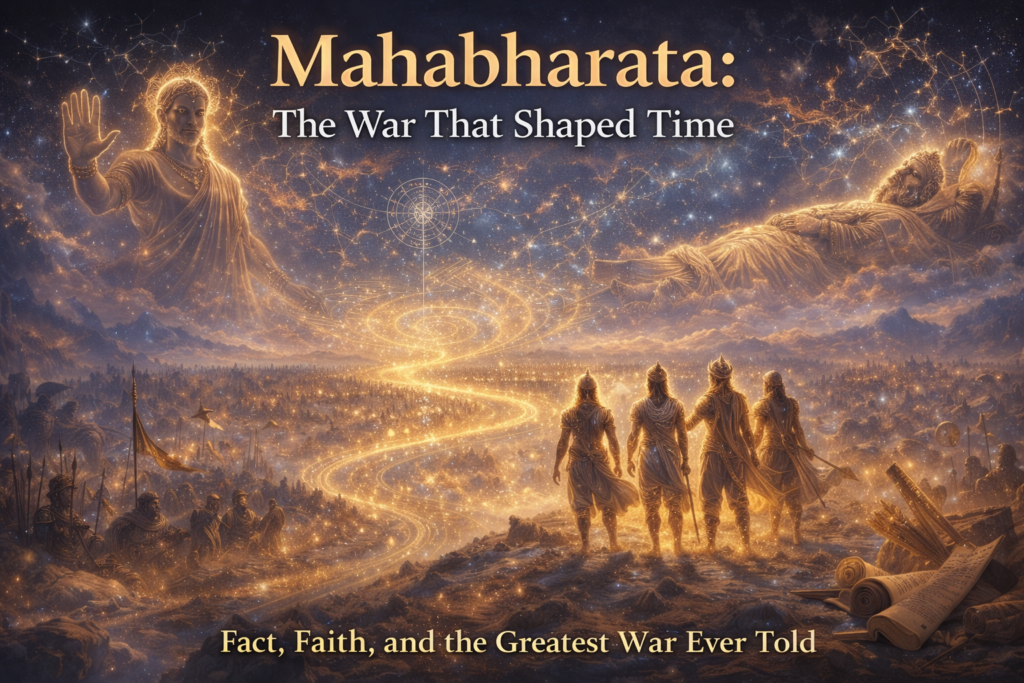
The war was over. Kurukshetra lay silent, its fields soaked not with rain but with blood. Millions had fallen, kings and warriors alike, and the cries of widows and orphans echoed across Bharat. The Pandavas, though victorious, carried no joy. Their hearts were heavy, their souls burdened with grief. Yudhishthira, crowned as king, bowed his head and asked again and again, “Was this dharma, Krishna? Have we not committed sin, drowning the world in blood for the sake of a throne?”
Krishna, with patience, said, “Your doubts are natural, Dharmaraja. But there lies one who can answer them more deeply than any other. Bhishma, son of Shantanu, grandsire of the Kurus, still breathes upon his bed of arrows. He waits for the sun to turn northward, for the moment of liberation. Go to him. Sit at his feet. Hear his wisdom, for in his words lies the peace you seek.”
And so the Pandavas, led by Krishna, walked to the place where Bhishma lay. The grandsire’s body was pierced with countless arrows, his head resting upon a bed of steel, yet his eyes shone with light, his voice steady as the Ganga he was born from. Kings, sages, and warriors gathered around him, for all knew that the wisdom of Bhishma was greater than the weapons of armies.
Yudhishthira knelt before him and wept. “Grandsire,” he said, “I am king, but I feel only sorrow. I see only ruin. Tell me — what is dharma? How should a king rule? How should a man live? How do we bear this burden of grief?”
Bhishma smiled gently, though pain seared his body. “Listen, Yudhishthira,” he said. “Listen, Pandavas. Listen, O kings who remain. For dharma is subtle, and life is fleeting. Hear now the truths I have carried through a century of battle, sacrifice, and rule.”
Then Bhishma spoke, and his words flowed for days, becoming the Shanti Parva, the Book of Peace, and the Anushasana Parva, the Book of Instruction. His voice became scripture.
He said, “The king is not master of his people, but their servant. He is like the rain that nourishes, like the sun that warms, like the earth that sustains. A king who rules for his own pleasure brings ruin, but a king who rules for his people becomes immortal. Power is not for pride, but for protection. Wealth is not for hoarding, but for giving. Strength is not for oppression, but for justice.”
He spoke of patience. “A ruler must be patient like the earth, for he will bear the weight of all. He must be forgiving like a mother, for anger only multiplies grief. Yet he must be firm like a mountain, for without firmness, justice crumbles. Balance is the heart of kingship.”
He spoke of truth. “Dharma rests upon truth as the world rests upon the sky. A lie may bring short gain, but truth alone sustains. Even in hardship, even in danger, let truth be your guide.”
He spoke of compassion. “A king must protect the weak, the poor, the orphan, the widow. He must see his subjects not as numbers, but as souls. The tears of one child weigh heavier than the gold of a thousand treasuries. Rule with heart as well as mind.”
He spoke of self-control. “The senses are wild horses. If the king is dragged by them, the chariot of the kingdom collapses. Control your desires, restrain your anger, master your pride. A king who masters himself can master the world. But a king who cannot master himself is slave, not ruler.”
He spoke of duty. “A man must not run from his duty, be he king or beggar. Dharma is not the same for all. For a warrior, it is to fight when justice calls. For a king, it is to rule with fairness. For a householder, it is to provide and protect. Do your duty without clinging to reward, for reward lies not in gold, but in the peace of the soul.”
Bhishma also spoke of charity, of sacrifice, of humility. He said, “Give without seeking return. Help without seeking praise. The hand that gives is greater than the sword that conquers. For kingdoms fade, but kindness endures beyond time.”
For days, his words flowed like the Ganga. Kings forgot their crowns. Warriors forgot their pride. All listened as children before a father. The Pandavas drank his wisdom like nectar. Even Krishna, eternal himself, smiled, for the words of Bhishma were dharma embodied in human form.
At last, when the sun turned northward, Bhishma knew his time had come. He turned to Yudhishthira and said, “My duty is ended. My vow is fulfilled. My arrows pierce my body, but my heart is free. Rule now as Dharmaraja, guided not by pride, but by what you have heard today. May dharma sustain you, may compassion guide you, may truth protect you.”
The Pandavas bowed, tears in their eyes. Yudhishthira touched his grandsire’s feet and said, “Your words are heavier than kingdoms, greater than victory. I will remember them till my last breath.”
Then Bhishma closed his eyes. The sun blazed in the northern sky, the moment of liberation. He left his body like a garment cast aside, and his soul rose to join the eternal. The field of Kurukshetra fell silent once more, for a pillar of dharma had departed.
The Shanti Parva is one of the deepest lessons of the Mahabharata. It teaches that war may end with swords, but peace begins with wisdom. It teaches that dharma is not found in pride or conquest, but in service, compassion, and truth. It teaches that even on a bed of arrows, a man may become a teacher greater than kings.
In our lives too, we must sit at Bhishma’s feet. We must remember that our power is not for us, but for others. That our strength is not to oppress, but to protect. That our wealth is not to hoard, but to share. That patience, truth, compassion, and self-control are higher than any crown.
Bhishma’s bed of arrows was not only his death. It was his pulpit. From pain, he gave peace. From suffering, he gave wisdom. From defeat, he gave dharma. This is his true immortality.
So when your life feels pierced with arrows, when grief and failure weigh upon you, remember Bhishma. Use your suffering not as chain, but as teacher. Turn your pain into wisdom, your fall into guidance, your end into a gift for others. That is the path of dharma. That is the path of immortality.
If this story moved you, if it reminded you that greatness lies in choice, not birth, support this journey of dharma with a symbolic donation of eleven dollars. support this journey of dharma with a symbolic donation of eleven dollars. And unlock Dharma Vault, claim it through the link in the description.