
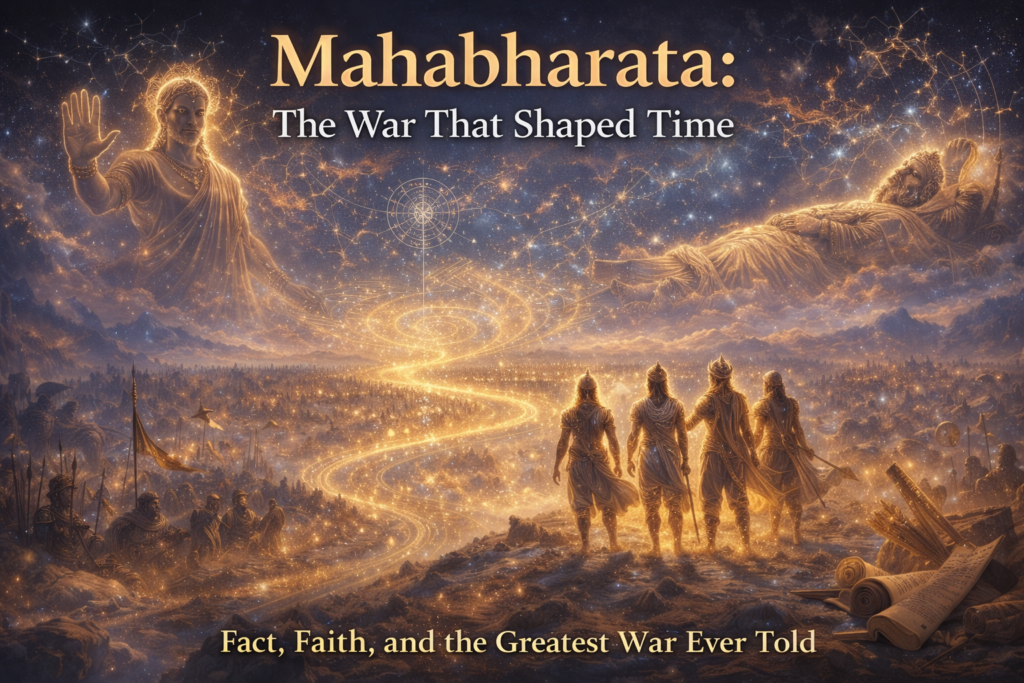
The war was over. Eighteen days of battle had turned Kurukshetra into a field of ashes. The conches had fallen silent, the chariots broken, the earth soaked with blood. The Kauravas were gone, their lineage ended. The Pandavas stood as victors, yet there was no joy in their victory. For victory without peace is hollow, and the price of dharma is often sorrow.
When Yudhishthira looked upon the field, he did not see triumph. He saw corpses of kin, rivers of grief, widows and orphans wandering amidst ruin. He turned to Krishna and said, “What is this victory, Madhava? For the sake of a throne, millions lie dead. Fathers, brothers, sons — all gone. What joy is there in kingship when it is built on this destruction?”
Krishna’s voice was steady. “This was not a war for power. It was a war for dharma. Without it, the world itself would have collapsed. You are weary now, Yudhishthira, but your duty is not ended. To rule justly, to protect, to heal — this too is dharma. Take the throne, not for yourself, but for your people.”
With heavy heart, Yudhishthira agreed. The Pandavas journeyed to Hastinapura, their home and throne now theirs at last. Yet even there sorrow greeted them. Dhritarashtra, blind king, father of the fallen, awaited them. His heart was torn between grief for his sons and resentment toward the Pandavas. When he embraced Bhima, his fingers tightened, for in his sorrow he wished to crush him. But Krishna, seeing this, pressed Bhima’s body aside and placed an iron statue in his arms. Dhritarashtra crushed it to dust, realizing his rage nearly consumed his nephews. In that moment, his anger broke, and he wept.
The coronation of Yudhishthira was performed with solemn grandeur. The people rejoiced outwardly, but inside the palace, hearts still bled. Gandhari cursed fate, her eyes forever blindfolded, her hundred sons gone. Kunti, at last, revealed the truth of Karna — that he was her firstborn, the eldest of the Pandavas, slain by his own brother. At this revelation, Yudhishthira collapsed in grief. “We killed our own blood,” he cried. “We called him enemy when he was kin. What dharma is this, Krishna?”
Krishna placed a hand upon his shoulder. “Do not drown in sorrow, Yudhishthira. Dharma is subtle. Karna chose his path with loyalty to Duryodhana, and his fate was written by his own vows. Grieve, but do not condemn yourself. Your duty now is to heal, not to despair.”
The Pandavas ruled from Hastinapura, and Yudhishthira, crowned as king, ruled with justice and humility. He held no arrogance of victory, no intoxication of power. His heart was heavy, but his mind remained clear. He sought to rebuild what war had destroyed, to give peace where battle had taken life. His reign was marked not by conquest, but by service.
Yet his mind was restless. He asked sages, “Have I done wrong? Was this war sin? Millions lie dead because of us. Even if dharma was defended, is the price too great?” The sages answered, “Dharma is not simple. Sometimes it demands sacrifice. Sometimes it demands sorrow. What matters is not your grief alone, but the balance of the world restored.”
Still, Yudhishthira longed for guidance. He turned to Bhishma, who still lay upon his bed of arrows, waiting for the auspicious moment of death. There, before the grandsire, Yudhishthira knelt and said, “Teach me, O Pitamaha. Teach me how to rule, for my heart is burdened.”
And Bhishma spoke, his voice weak yet filled with light. He spoke of kingship, of justice, of duty. He said, “A king is not master of his people, but servant. His wealth is not for himself, but for his subjects. His joy is not in pleasure, but in protection. A ruler must be patient like the earth, forgiving like a mother, firm like a mountain, sharp like a sword when justice demands. He must never abandon dharma, even when profit tempts, even when loss frightens. Remember this, Yudhishthira: the king is the heart of the people, and if the heart is pure, the body thrives.”
These words became Yudhishthira’s guide. He ruled with compassion, listening to the cries of the poor, protecting the weak, restraining the strong, rewarding the virtuous. His reign became known as a time of peace, of prosperity, of justice. The people of Bharat looked to him as Dharmaraja, the king of righteousness.
Yet even in prosperity, his soul carried scars. At times, he wished to renounce the throne, to retreat into the forest as ascetic. But Krishna reminded him, “Renunciation is not leaving the throne. True renunciation is ruling without attachment, serving without pride, giving without desire for return. Your throne is your forest, your scepter is your staff, your kingdom is your ashram. Rule, Yudhishthira, as a sage in the palace.”
Thus he did. Though Bhima roared with strength, though Arjuna shone with valor, though Nakula and Sahadeva guarded the people with loyalty, it was Yudhishthira’s calm that anchored their rule. Draupadi, queen of fire, stood beside him, her dignity unbroken, her wisdom a light to the women of the palace. Together they turned grief into guidance, ruin into renewal.
The reign of Yudhishthira teaches us that victory is not the end of war. After every battle comes a harder challenge — to heal, to forgive, to rebuild. To sit upon a throne is easy; to bear the burden of a kingdom is hard. Yudhishthira bore it not with joy, but with devotion. His crown was heavy, but he carried it as duty, not privilege.
The Mahabharata reminds us that true leadership is not about power, but about service. Yudhishthira’s greatness was not in conquering Kurukshetra, but in ruling Hastinapura with humility. He showed that a leader must be as firm as Bhima, as skilled as Arjuna, as wise as Vidura, as patient as Kunti, as enduring as Draupadi. A leader is not the sum of victories, but the sum of virtues.
And in our own lives, when we gain power — be it in family, in work, in community — we must remember Yudhishthira. Leadership is not about ruling over others. It is about bearing their burdens, guiding with fairness, protecting with strength, giving with compassion. It is about remembering that every decision shapes lives beyond our own.
So let Yudhishthira’s reign be your guide. Let his doubts remind you that even the righteous struggle with guilt. Let his service remind you that power must be used for others. Let his humility remind you that dharma is higher than kingship.
If this story moved you, if it reminded you that greatness lies in choice, not birth, support this journey of dharma with a symbolic donation of eleven dollars. support this journey of dharma with a symbolic donation of eleven dollars. And unlock Dharma Vault, claim it through the link in the description.