
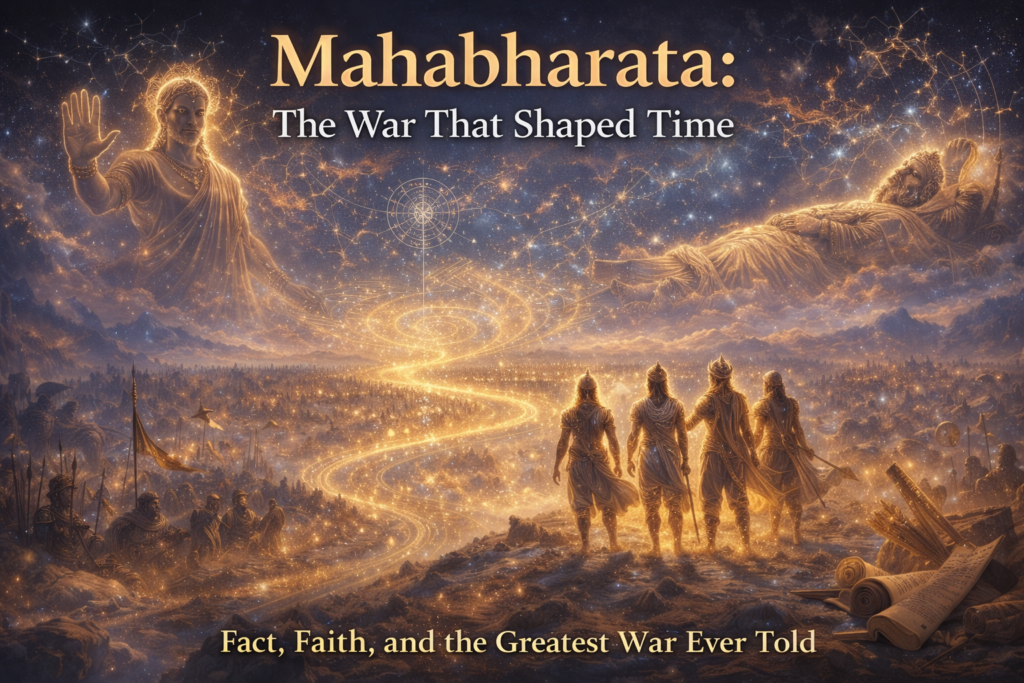
The war of Kurukshetra had consumed kings, heroes, and entire lineages. Bhishma lay upon his bed of arrows. Drona had fallen, struck down by his own grief when he heard of Ashwatthama’s supposed death. Karna, the son of the Sun, the friend whose loyalty never wavered, had been slain by Arjuna when fate seized his wheel. Day by day, the Kaurava army crumbled. The mighty elephants lay slain, the horses broken, the warriors scattered. Of the hundred sons of Dhritarashtra, only a handful remained, their pride dimmed, their strength fading.
But still, one stood unbroken — Duryodhana, the eldest, the source of the war, the fire of envy that had burned since childhood. Though his army was shattered, though his brothers lay dead, though his friends and guardians had fallen, his pride had not bent. He was wounded, weary, yet his heart remained as hard as iron.
On the eighteenth and final day of Kurukshetra, Duryodhana fled the battlefield and hid in a lake, submerging himself in its waters by the power of sorcery. The Pandavas searched but could not find him. At last, hunters revealed his hiding place, and Bhima cried out in fury: “Come forth, O coward! Face the sons of Pandu if you dare!”
Duryodhana rose from the waters, his body shining like molten gold, for his mother Gandhari, blindfolded for life, had once blessed him with her gaze, making his flesh impenetrable wherever her sight fell. Only his thighs were left uncovered, for out of modesty he had covered himself before her. Thus his whole body was like steel, save for that one weakness.
He stood upon the field, mace in hand, proud as ever. “I chose war,” he declared, “and I do not repent. My brothers are dead, but I fought for their honor. I stand alone, but I stand as king. Who among you will fight me in fair combat?”
The Pandavas conferred, and it was agreed that Bhima, master of the mace, would face him. The two stood opposite, their maces heavy as mountains, their eyes blazing. Krishna himself declared the rules: “Let this be a fair duel, by mace alone.”
The battle began. The ground shook as their maces struck, sparks flying with each clash. Bhima’s fury roared like thunder. Duryodhana’s skill was precise, honed under the same masters as the Pandavas. They circled, struck, dodged, and struck again. Dust rose, soldiers gasped, the world held its breath.
Hour after hour they fought, each blow capable of shattering stone. Duryodhana struck Bhima with crushing force, and Bhima staggered but did not fall. Bhima struck back with rage, but Duryodhana withstood it, his steel-like body unbroken. It seemed the duel would never end, for both were titans, and neither yielded.
Then Krishna leaned toward Bhima and whispered: “Remember your vow. Remember the thigh he slapped in mockery before Draupadi. Strike where he is weak. This is not merely combat, but justice.”
Bhima roared like a lion, leapt, and with all his strength, brought his mace down upon Duryodhana’s thighs. The bone cracked like thunder. Duryodhana screamed, collapsing to the ground, his body broken.
The Kaurava prince writhed in agony. His pride, his arrogance, his envy — all shattered with his thighs. The Pandavas stood over him, but Yudhishthira’s heart was heavy. He rebuked Bhima, saying, “It is against the code to strike below the waist.” But Krishna replied, “Adharma was never bound by code. Duryodhana broke dharma at every turn. Today dharma has broken him.”
Duryodhana, lying upon the earth, raised his voice. “You call this victory? You struck me with trickery, not in fair fight. You Pandavas will never be remembered as noble. I am the true king. My body lies broken, but my name will live in honor. The world will remember me as the one who stood against you all, alone.”
Even in defeat, his pride did not die. That was Duryodhana — unyielding to the end, bound by arrogance as tightly as by breath.
Yet destiny had one more turn. As Duryodhana lay dying, his ally Ashwatthama, son of Drona, vowed vengeance. In the darkness of night, with fury in his heart, he crept into the Pandava camp and slew their sons as they slept. The war had ended, but grief returned, showing that hatred never dies easily.
Duryodhana’s fall is one of the deepest lessons of the Mahabharata. He was not without courage, nor without skill. He was a warrior of brilliance, a leader of strength, a man who stood for his friends without hesitation. Yet envy poisoned his heart, pride blinded his eyes, greed chained his soul. He had every chance to choose peace, but he chose war. He had every chance to choose dharma, but he chose arrogance.
In him we see the warning that pride, even with courage, leads only to ruin. For pride blinds the wise, deafens the strong, and breaks the mighty.
And Bhima’s strike reminds us that sometimes justice comes not through rules, but through truth. When adharma bends the law, dharma too must strike outside it. Krishna’s whisper was the voice of dharma itself — reminding us that righteousness is not weakness, but wisdom that knows when mercy ends and justice begins.
As Duryodhana fell, so too fell the Kauravas. The war of eighteen days ended in silence. The battlefield lay covered in blood, in corpses, in the cries of widows and orphans. Victory was hollow, for no side rejoiced. Yet dharma had been defended, and adharma had been punished.
Duryodhana’s story is not only the story of a villain. It is the story of what envy can do to a man. It is the story of wasted greatness, of loyalty turned to arrogance, of courage twisted by greed. In him we see the warning: do not let envy guide you, for it will consume your life. Do not let pride blind you, for it will lead you to fall.
Remember Duryodhana when pride rises in your own heart. Remember his thighs broken, his voice still defiant, his name echoing in shame. Let his fall remind you that true strength is not in arrogance, but in humility. True victory is not in conquest, but in righteousness.
If this story moved you, if it reminded you that greatness lies in choice, not birth, support this journey of dharma with a symbolic donation of eleven dollars. support this journey of dharma with a symbolic donation of eleven dollars. And unlock Dharma Vault, claim it through the link in the description.