
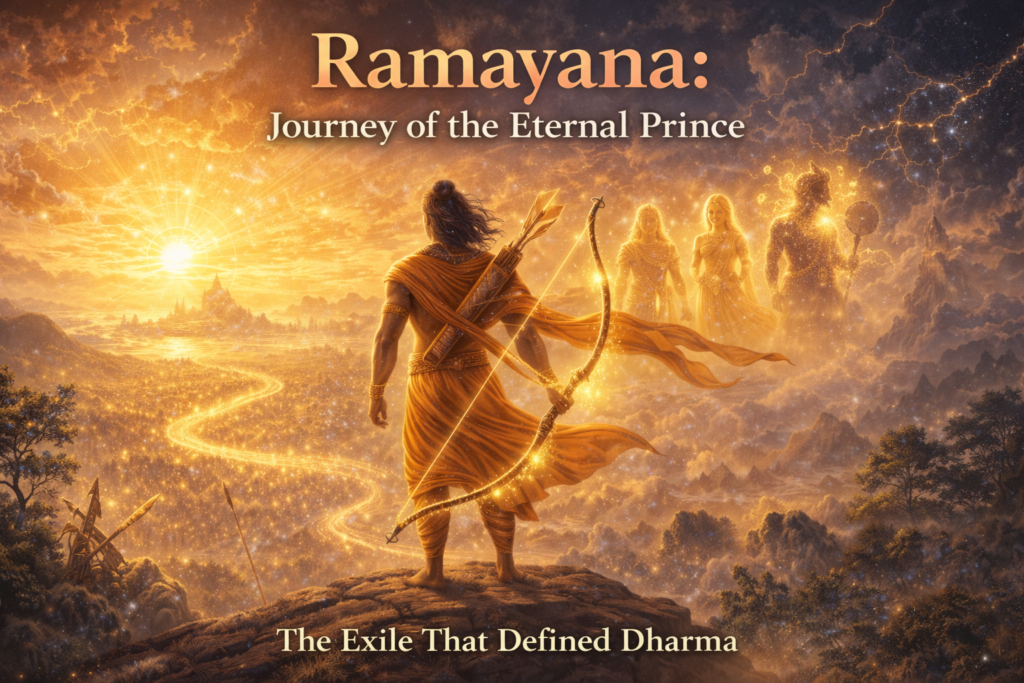
The bridge was complete. The roar of the vanara legions shook the very ocean they had conquered. Across the Setu they had marched, stone by stone, mile by mile, until they now stood upon the shores of Lanka. Before them rose Ravana’s city, glittering with towers of gold, its gates fortified, its streets filled with demons ready for war. Yet behind those walls lay Sita, waiting in faith.
Rama gazed upon the city, his eyes steady. “Here stands the fortress of arrogance. But it shall fall, for dharma does not yield.” His army cheered, their voices thunder rolling across the land.
Messengers were sent first, for Rama, even in war, upheld dharma. Angada, son of Vali, strode into Ravana’s court with dignity. Standing tall before the demon king, he declared: “Return Sita. Bow to Rama. End this without blood.”
Ravana laughed, his ten heads rearing in scorn. “Return Sita? To a forest-dwelling prince? I am Ravana, lord of Lanka. No god, no man, no vanara can command me.” Angada, unshaken, planted his foot upon Ravana’s floor and said: “If you can move my foot, know your strength is greater than Rama’s. But if you cannot, your pride is hollow.” Ravana’s warriors strained, but Angada’s foot was immovable. With calm defiance, he leapt back to Rama’s camp. War was now inevitable.
The drums of battle resounded. Conches blew. Lanka trembled as the armies clashed. From dawn to dusk, the fields shook with the roars of vanaras and the cries of rakshasas. Mountains were torn and hurled as weapons, trees became spears, arrows darkened the skies.
Sugriva struck down demon generals. Jambavan rallied the ranks with wisdom. Angada fought with the fury of youth. Hanuman, the mountain-sized warrior, tore through enemy lines, scattering demons like leaves in a storm. Yet the rakshasas were fierce, commanded by Ravana’s mighty sons.
Indrajit, the master of illusion, entered the battlefield cloaked in sorcery. His arrows rained like fire, striking even Rama and Lakshmana. Bound by the serpent-weapons of Indrajit, the brothers fell unconscious, and despair seized the vanaras. But Garuda, the divine eagle, descended, his presence shattering the serpents, reviving Rama and Lakshmana. The war raged on.
Kumbhakarna, Ravana’s giant brother, awoke from his slumber, a mountain of flesh and fury. His roars shook the skies, his arms crushed armies, his steps shattered the earth. But Rama, calm as ever, lifted his bow. His arrows pierced the giant, each shot a thunderbolt of justice. Kumbhakarna fell, his massive body crashing like a mountain into the sea.
Still, Ravana did not yield. His arrogance burned brighter than reason. “Let the world be drowned in blood,” he thundered, “but I will not bow.”
Indrajit returned with greater fury, wielding weapons of darkness. In battle he struck Lakshmana with the Shakti spear, piercing him deep. Lakshmana fell, his breath fading. Rama, grief-stricken, cried: “If my brother dies, what joy is left for me, even if Sita is saved?”
But Hanuman would not allow despair. At Jambavan’s urging, he leapt to the Himalayas to fetch the Sanjeevani herb. Unable to recognize the herb, he lifted the entire mountain and carried it through the skies. The fragrance revived Lakshmana, restoring him to life. Rama embraced Hanuman with tears. “What can I give you,” he said, “when you have given me back my brother?” Hanuman bowed and answered: “To serve you is my only reward.”
At last came the final duel. Rama and Ravana stood face to face, the battlefield cleared for their clash. Ravana’s ten heads glared, his twenty arms bristled with weapons. His laughter shook the skies. But Rama stood serene, his bow glowing with the fire of dharma.
Their arrows clashed like thunderbolts, tearing the heavens, shaking the earth. Demons and vanaras alike watched in awe. Ravana’s weapons were terrible—spears of fire, serpents of venom, storms of darkness. Rama countered each with calm precision, his arrows blazing with the light of righteousness.
Day after day they fought, the war stretching across dawn and dusk. Each time Rama struck, Ravana’s heads fell, only to rise again, his body infused with boons. The battle seemed endless, as though arrogance itself could not be slain.
At last, the sage Vibhishana, Ravana’s own brother who had joined Rama, revealed the truth: “Strike not at his heads, O Rama, but at his heart. Within lies the secret of his life.”
Rama lifted the Brahmastra, the divine weapon given by the gods. Folding his hands, he prayed: “O Lord of creation, let this arrow carry not my will, but the will of dharma. May it strike not from hatred, but from justice.”
He drew the bow, released the arrow. It blazed like the sun, streaking across the sky. It struck Ravana’s chest, piercing his heart. The demon king roared, his voices echoing like storms, then fell, his body shaking the earth. The arrogance of Lanka lay broken.
The war was over. The armies of Ravana scattered, the vanaras roared in triumph, the heavens showered flowers. Rama stood, his bow lowered, his heart calm. He did not rejoice in the fall of Ravana, but spoke softly: “He was great, though misled. Let his funeral be with honor. For even in the enemy, we must respect the spark of greatness.”
Here lies the deepest lesson of the war. Courage is not merely in striking down the foe—it is in facing despair without surrender. Leadership is not in commanding armies—it is in inspiring them with purpose greater than themselves. Justice is not in vengeance—it is in upholding dharma, even toward the fallen.
Rama’s war was not of conquest. He sought no throne in Lanka, no gold, no riches. He fought only to restore truth, to rescue his beloved, to uphold righteousness. That is true leadership—to wield power only for justice, never for pride.
And what of us? Each of us wages wars daily. Wars against fear, against temptation, against injustice. The demons may not bear ten heads, but they live in arrogance, greed, anger, and despair. Like Rama, we must fight them not with hatred, but with the weapons of courage, discipline, and truth.
Hanuman teaches us to serve without pride. Lakshmana teaches us to endure wounds for the sake of loyalty. Jambavan teaches us to guide with wisdom. Sugriva teaches us to stand firm in unity. And Rama teaches us to lead with compassion, to fight with justice, to conquer with humility.
The war with Ravana is not only an ancient battle—it is the eternal war of the soul. For in each of us, Ravana still whispers with arrogance, and Rama still calls with dharma. The question is: whom will we follow?
If this story touched your heart, if it reminded you that your struggles are preparing you for something greater, support this journey of dharma with a symbolic donation of eleven dollars. And unlock Dharma Vault, claim it through the link in the description.