
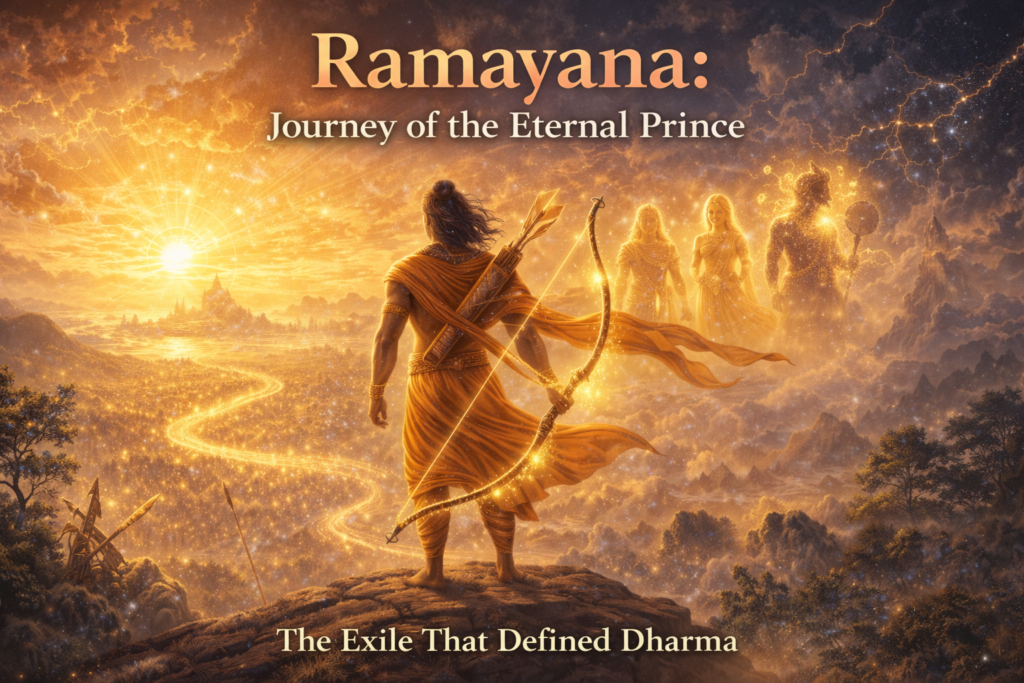
On the banks of the Tamasa river, in an age when sages roamed the forests in search of truth, a man sat in stillness. His name was Valmiki. Once a wanderer entangled in the illusions of the world, he was transformed by the power of devotion into a sage whose words would outlive kingdoms and empires. From his heart, like a sacred flame, arose the Ramayan.
The Ramayan is more than an epic. It is the heartbeat of dharma, the living essence of truth, courage, sacrifice, and love. It is not a tale written for entertainment; it is a map for life. It tells us not only who Rama was, but who we can become. It shows us not just Ayodhya’s triumphs and tragedies, but the battlefield within our own souls. It is a scripture that breathes, guiding us across centuries, whispering into the ears of each new generation: rise, walk the path of righteousness, and never fear.
Why is the Ramayan eternal? Because it speaks of the struggles that do not change. Kingdoms rise and fall, technology evolves, languages shift, but the questions of the human heart remain the same. How does one remain true in the face of temptation? How does one uphold loyalty when betrayed? How does one endure exile, loss, and despair, yet continue to walk with dignity? These are not the questions of one era; they are the questions of life itself.
The Ramayan is the answer.
When we think of Rama, we often imagine perfection — a prince born divine, the ideal son, the perfect king. But if we listen deeply, we see something even greater. Rama was tested, again and again, in ways most of us cannot imagine. He lost his kingdom at the height of his youth. He was exiled to the forest for fourteen years. His beloved wife was taken from him by deceit. His battles were not just against demons outside, but the storms of grief and duty within his own heart. What made Rama extraordinary was not that he avoided hardship, but that he endured hardship with unshakable dharma.
Greatness is not born in ease. Greatness is forged in fire.
In Rama’s calm acceptance of exile, we learn that dignity is greater than complaint. In his grief at Sita’s abduction, we learn that even the strongest may break, but breaking is not the end — it is the beginning of deeper strength. In his leadership over armies of vanaras, we learn that unity can build bridges across oceans. And in his battle against Ravana, we see that courage and justice, when united, can overcome the most terrifying darkness.
The Ramayan is not about gods seated high above humanity. It is about the human journey toward godliness. It is about men and women who chose dharma when desire called, who chose service when selfishness tempted, who chose sacrifice when comfort beckoned. Each character is a mirror, reflecting something of ourselves.
Sita shows us the unbreakable strength of dignity. She was born from the earth itself, and she returned to the earth with the same purity with which she lived. Captive in Ravana’s palace, surrounded by temptation, she remained untouched. Her strength did not come from weapons or armies, but from the fire of her soul. She teaches us that true freedom is not about circumstances, but about character.
Hanuman, the son of the wind, shows us what devotion truly means. His leap across the ocean was not a feat of muscle alone, but of faith. His power came not from pride, but from surrender. By forgetting himself and remembering only Rama, he accomplished the impossible. Hanuman teaches us that when we remove ego and align with a higher purpose, even the mightiest obstacles fall like dust.
Lakshman, Rama’s brother, shows us what loyalty and discipline mean. For fourteen years he walked beside Rama in exile, never once wavering, never once seeking comfort. His life teaches us that true service is not loud, it is silent and steadfast.
Bharata, who refused the throne in Rama’s absence, shows us humility. He could have ruled, but instead he placed Rama’s sandals upon the throne, ruling only as Rama’s representative. His sacrifice teaches us that true leadership is not about power, but about preserving dharma.
Even Ravana teaches us. For though he was a tyrant, he was also a scholar, a master of the Vedas, a devotee of Shiva. His fall was not because of ignorance, but because of arrogance. He reminds us that knowledge without humility is a path to destruction.
This is why the Ramayan is eternal. It is not about one man or one kingdom. It is about the eternal choice between dharma and adharma, truth and falsehood, humility and arrogance, sacrifice and selfishness. Every human being, in every age, must make these choices. And the Ramayan stands as a guide, showing us that though the path is difficult, it leads to victory.
Today, we live in a world of speed and distraction. Technology connects us, but it also scatters our minds. We chase after wealth, status, and comfort, yet still feel empty. The Ramayan calls us back to the essence. It reminds us that the measure of life is not in possessions, but in character. It tells us that leadership is not about ruling others, but about ruling oneself. It teaches that love is not mere passion, but a partnership in dharma. And it reminds us that no matter how powerful evil appears, it cannot stand forever against truth.
The story of Rama is not meant to remain on dusty pages. It is meant to live within us. When you rise each morning and face challenges at work or at home, remember Rama walking calmly into exile, leaving behind a throne without complaint. When you feel weak and unworthy, remember Hanuman discovering his boundless power the moment he remembered Rama. When you are tempted by illusions that glitter, remember Sita turning away from the golden deer. When you feel betrayed or broken, remember Bharata refusing the throne in loyalty to his brother.
The Ramayan tells us: you are not ordinary. You are born for dharma. You are meant to rise, to lead, to endure, and to triumph.
As we begin this journey through the Ramayan, understand this — it is not a tale that ended thousands of years ago. It is alive. It lives in your struggles, your decisions, your sacrifices, and your victories. Each episode we walk through together will not only recount the journey of Rama, but reveal the lessons you can apply today.
The first step is to open your heart. Listen not only with your ears, but with your soul. As Valmiki sang the verses of the Ramayan, sages, kings, and common people alike wept, because they saw themselves in its story. Let it touch you the same way. Let it remind you of the fire you carry within, the fire of courage, of dignity, of service, and of truth.
For in the end, the Ramayan is not only about Rama. It is about you.
If this story touched your heart, if it reminded you that your struggles are preparing you for something greater, support this journey of dharma with a symbolic donation of eleven dollars. And unlock Dharma Vault, claim it through the link in the description.