
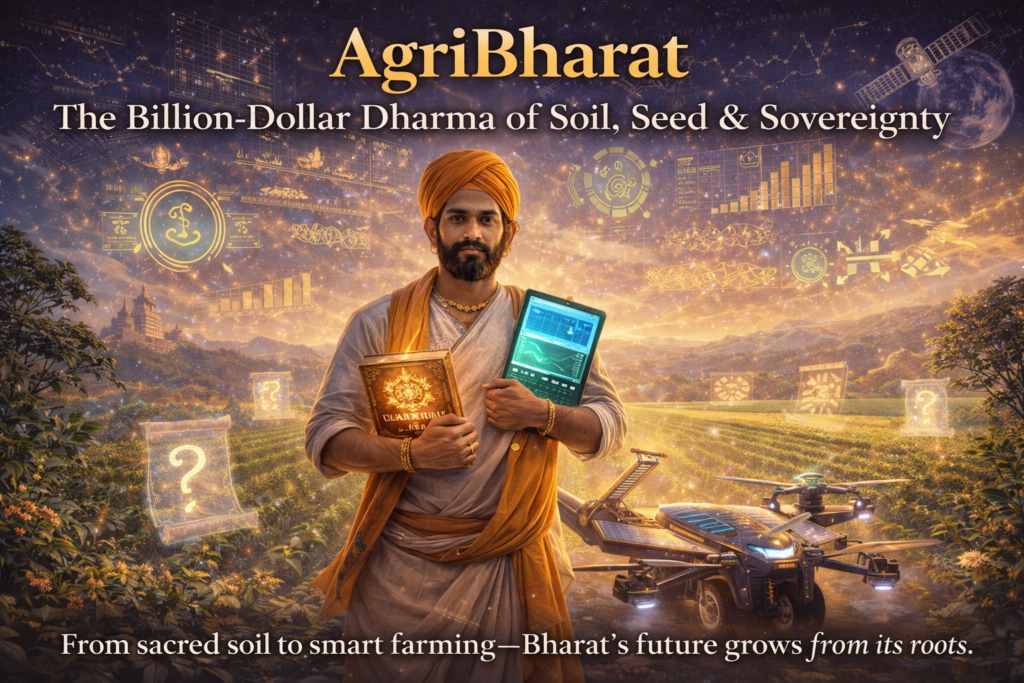
🪔 Opening Quote:“The first revolution is when the seed is sown in free soil.”
🧱 Beyond Independence — Toward Real Freedom
India became politically independent in 1947.
But true freedom goes deeper than flags and borders.
It lives in how we eat, own, and grow.
And at the core of it all is agriculture.
Without control over food, water, and land, no nation — no person — is truly sovereign.
“The one who controls food does not need to control anything else.”
🇮🇳 Gandhi’s Dream Was Rural, Not Retail
Mahatma Gandhi didn’t envision India as a land of malls, metros, and multinational takeovers.
He dreamed of:
- Self-sufficient villages
- Local food economies
- Dignified livelihoods from the soil
He once said:
“To forget how to dig the earth and to tend the soil is to forget ourselves.”
Freedom, for Gandhi, was not just political — it was nutritional, cultural, and agricultural.
We didn’t just fight the British.
We fought the idea of being dependent — on others for food, identity, and survival.
🏡 Soil Sovereignty = Self-Reliance
When you grow your own food:
- You are not at the mercy of corporations.
- You are not waiting for handouts.
- You are not consuming blindly — you are creating.
This is real Atmanirbharta.
It doesn’t mean growing everything alone.
It means building local systems that are:
- Resilient
- Regenerative
- Respectful of nature
A village that grows what it eats is unshakable.
“When your food comes from your field, your future is in your hands.”
💧 Water, Seeds, and Land — The Holy Trinity of Freedom
To reclaim sovereignty, three things must be in the hands of the people:
1. Water
- Local water harvesting (check dams, rain pits, tanks)
- Community management
- No privatization of rivers
2. Seeds
- Indigenous seed banks
- No dependency on genetically modified corporate seeds
- Seeds that can be saved, shared, and replanted
3. Land
- Protection from real estate takeovers
- Farming as a respected, profitable choice
- Land titles secured for small and marginal farmers
“You don’t need a passport to be free.
You need water that’s yours, seeds that are native, and soil that feeds you.”
💥 The Hidden Chains of Modern Dependency
Modern agriculture has introduced new forms of slavery:
- Fertilizer subsidies that trap farmers
- Seed monopolies
- High-interest loans from middlemen
- Unfair pricing by corporate buyers
It’s time to break these chains — not with anger, but with alternatives.
And those alternatives already exist:
- Farmer cooperatives
- Organic collectives
- Direct-to-consumer platforms
- Digital marketplaces for local produce
🌎 Global Examples, Desi Soul
Across the world, farmers are reclaiming sovereignty:
- Cuba’s food system collapsed post-Soviet Union — so cities started urban organic farming.
- Africa is pushing for agroecology to reduce corporate dependency.
- Bhutan is 100% organic, by national policy.
Bharat, with its rich agrarian heritage, can lead the way — not by copying, but by reviving.
We have the blueprint.
We have the land.
We have the youth.
All we need is the will to grow — not just crops, but freedom.
🔥 Farming Is Rebellion — The Right Kind
In a world obsessed with consumption, growing your own food is activism.
It says:
- “I choose health over hype.”
- “I choose dignity over dependency.”
- “I choose Bharat’s roots over someone else’s roadmap.”
🧠 Sow This Thought (Takeaway):
Freedom is not won once.
It must be grown season after season — with every seed, every harvest, every shared meal.
“When Bharat farms freely, Bharat lives freely.”
✍️ Chapter Summary (2 lines):
This chapter redefines agriculture as a form of sovereignty, not just livelihood — showing how food, water, and seed control are the keys to real self-reliance.
True independence is rooted in soil.
🪩 Suggested Highlight Quote:“Farming is not old-fashioned. Dependency is.”