
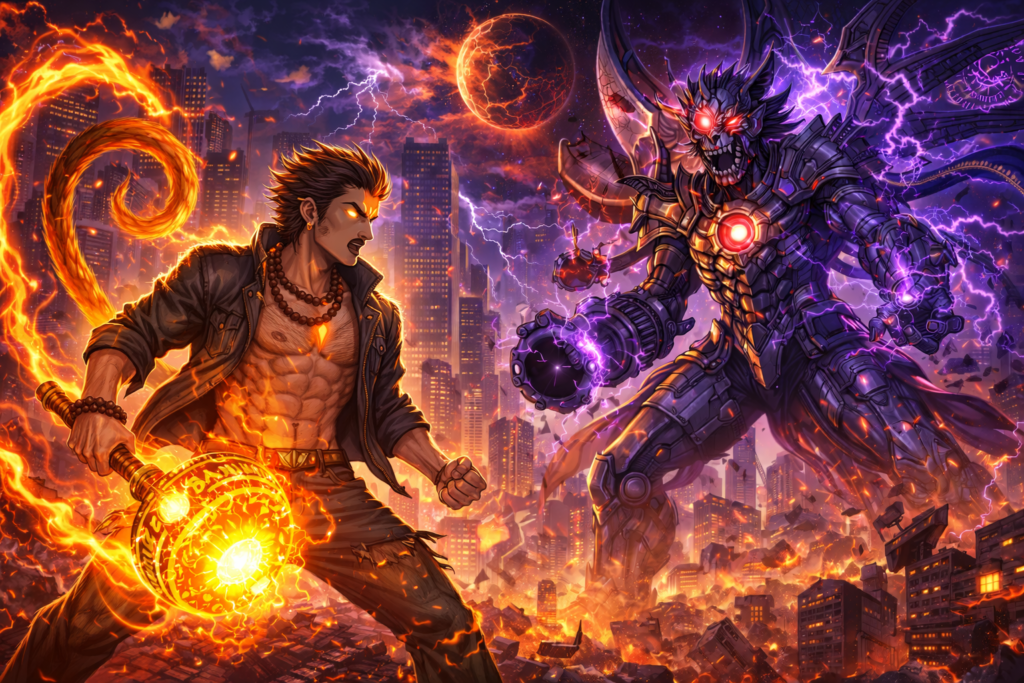
The gada rested in the center of a stone ring.
Not on a pedestal.
On the earth.
Because, as Rishabh had said, “Even divine power must kneel to something older.”
Makardvach stood at the ring’s edge, barefoot, arms crossed. The morning sun filtered through the trees in gold shafts. No birds sang. No insects buzzed. The world had quieted to listen.
Rishabh stood opposite him, tracing his staff lightly through the air, drawing glyphs that pulsed with low amber light before fading.
“This isn’t just a weapon,” he said.
Makardvach snorted. “Yeah, I noticed. It glows and it breaks everything I touch.”
Rishabh didn’t smile.
“This is Mahavīragada,” he said. “Forged in the final days of Treta Yuga. Hammered from a fallen star. Tempered in the River Mandakini. Blessed by Vayu and bound to Hanuman’s soul.”
Makardvach’s arms dropped slowly.
He looked down at the weapon. It didn’t shine now—its surface was matte, dull like cooled lava. But still… it felt awake. As though it were listening.
“Hanuman used this?” he asked.
“No,” Rishabh replied. “Hanuman wielded a gada. Not this one. This was made in secret, in case his essence ever had to return. It lay dormant beneath Anjanadri for over two millennia—until you touched it.”
Makardvach circled the weapon, slowly.
“It’s part of me now,” he said. Not a question. A realization.
Rishabh nodded. “The moment you grasped it, it tethered itself to your breath. Your emotion. Your will.”
Makardvach looked up sharply. “Then why does it feel heavier every time I pick it up?”
“Because it’s showing you the truth,” Rishabh said softly. “You are not yet worthy of its full weight.”
Makardvach stepped into the ring.
Bent down.
Placed one hand on the handle.
The metal was cool. Smooth.
And then—
It resisted.
Not with force. With memory.
Visions flickered through his skull:
Hanuman leaping over oceans.
Hanuman lifting mountains.
Hanuman striking down demons with a single word.
But also—Hanuman kneeling. Serving. Bowing.
To Ram.
To Sita.
To dharma.
Makardvach gritted his teeth and lifted.
The gada rose.
Not easily.
But it rose.
Sweat beaded his forehead.
His legs shook.
Rishabh watched, unmoving.
Makardvach finally held it high above his head.
And in that moment—
It shone.
Brilliant golden light erupted from its core, spiraling outward in Vanara script, wrapping around Makardvach’s arms like living tattoos.
The forest lit up.
The ground trembled.
And in some far corner of Paatal Lok—
Kalnemi’s lieutenants felt the shift.
Makardvach lowered the weapon slowly.
His hands were smoking.
His veins glowed faintly with golden heat.
He turned to Rishabh, panting.
“What now?”
The monk answered with quiet reverence.
“Now,” he said, “you learn to carry your soul without letting it crush you.”
The clearing had been prepared before dawn.
Rishabh had swept a wide circle with his staff, clearing leaves, twigs, and distraction from the earth. At its center, a single boulder sat—chipped, stubborn, ancient. Makardvach would come to know it well.
The gada stood upright in the dirt beside him.
Still.
Watching.
Makardvach flexed his fingers.
His arms were still marked from yesterday’s invocation—golden script burned faintly along his forearms, curling into his palms. The marks glowed when he breathed too fast, when he clenched his fists, when he felt too much.
Rishabh walked the perimeter.
“Begin with the stance.”
Makardvach squared his feet.
“Lower.”
He dropped into a crouch.
“Back straight.”
He adjusted.
“Now lift.”
Makardvach reached for the gada.
It shifted in the earth as he gripped the handle—and immediately grew heavier.
He grunted, pulling it upright. It felt twice as dense as the day before. He tightened his grip, raised it chest-high, and prepared to swing.
The moment he shifted weight into the arc—
The weapon pulled him forward.
His balance broke. He stumbled, dropped a knee, and the gada slammed into the ground, carving a deep furrow in the soil.
Makardvach cursed under his breath.
Rishabh didn’t flinch.
“It listens to your center,” he said. “There’s too much rage in your spine. Not enough intention.”
Makardvach stood, panting. “I can bench four hundred pounds. This thing’s messing with me.”
Rishabh raised a brow. “So punch it.”
Makardvach blinked. “What?”
“You said you’re strong. Prove it.”
Makardvach stepped forward, hauled back—and punched the gada.
CRACK.
Pain shot through his hand like lightning. His knuckles instantly bruised. The gada didn’t move a millimeter.
Rishabh sat on the boulder, calm as a breeze. “The gada isn’t a tool. It’s an extension. You don’t swing it. You channel through it.”
Makardvach clenched his aching hand.
“And if I can’t?”
“Then it won’t fight for you.”
Makardvach turned back to the weapon.
He planted his feet.
Lifted it again.
Heavier.
Always heavier.
And tried to swing with focus, not fury.
The arc was cleaner.
But the pull—it dragged him again.
He dropped to a knee, slamming the weapon into the earth just to keep from falling.
The wind rustled.
Rishabh remained silent.
The forest watched.
Makardvach stayed crouched, sweating, gasping.
And finally muttered—
“…Again.”
He stood.
Lifted.
Swing.
Fall.
Stand.
Lift.
Swing.
Fall.
Again.
By nightfall, he was on the ground.
Face in the dirt.
Muscles shaking.
The gada lay beside him—no longer glowing, but no longer resisting either.
It had begun to listen.
And as Makardvach closed his eyes in the dirt, he whispered, hoarse:
“Not tomorrow. Not some day. Now.”
And the gada pulsed once.
Soft.
But proud.
The car rattled up the dirt road like it didn’t believe it belonged in the jungle.
Megha Kapoor leaned forward in her seat, eyes narrowed behind black-rimmed glasses, clutching a leather-bound folio tight to her chest. The driver said something about the road getting worse. She didn’t answer. She’d read about this place—near Anjanadri Hill. She’d read everything. But reading was one thing.
Walking into living myth?
That was something else.
The clearing emerged just as the sun began to dip behind the trees.
Akshay jogged up to meet her, arms waving in excitement. “You made it!”
“I almost didn’t,” Megha muttered, stepping out. “The roads are an archaeological dig on their own.”
Akshay grinned. “Come on. He’s dying to meet you.”
She raised a brow. “He?”
“You’ll see.”
She followed Akshay past the tents, past the survey equipment, past the circle of burnt earth where something too heavy had fallen too many times.
And then she saw him.
Makardvach Rathore stood alone by a massive tree, shirt soaked in sweat, holding a glowing gada like it belonged to him and had for centuries.
Her breath caught.
This wasn’t a myth.
This was a return.
She approached slowly. “Makardvach Rathore, I presume?”
He turned, cautious. “And you are?”
“Megha Kapoor,” she said, handing him a card even though no one would care about titles after seeing what she’d just seen. “Professor of Comparative Mythology. Former researcher at Nalanda Revival Institute. And now, apparently, your unofficial historian.”
He didn’t take the card.
Just stared.
Rishabh arrived, silent as always.
“She knows,” he said. “She’s been studying the Shivnadi texts.”
Makardvach blinked. “You’ve read about… this?”
Megha opened her folio, flipping past sketches and diagrams until she reached a set of pages printed in ancient Devanagari script.
“The prophecy of the Vānara Āgaman,” she said. “The Return of the Vanara. Lost scrolls from the Ujjain library mention a ‘guardian born from stone and flame, who will lift the sleeping mace and halt the flood of death.’”
Makardvach stiffened. “The flood?”
Megha looked up, her tone changing.
“There’s something coming. An ancient current that flows beneath all three realms. A river. The Shivnadi. It’s not just metaphor. It’s real. Kalnemi wants to open it.”
Rishabh’s eyes darkened.
Makardvach looked between them.
“What happens if he does?”
Megha didn’t blink.
“Then the Earth drowns—not in water. In chaos.”
She handed him a page torn from the back of a scripture—an illustration: a massive demon parting a river of starlight while cities burned on either bank.
“And according to this,” she said quietly, “you’re the only one who can stop it.”
Makardvach looked down at the illustration.
Then at the gada in his hand.
Then at the horizon, where thunderclouds gathered like teeth.
“Then let’s get to work.”
Inside the central tent—now converted into an impromptu war room—maps, scrolls, satellite photos, and fraying palm-leaf manuscripts covered every available surface.
In the center: the Vanara Prophecy, freshly reassembled.
Megha ran her fingers across the text, murmuring under her breath as she read, not out of superstition—but respect.
Makardvach sat across from her, eyes sharp but quiet. He hadn’t touched the gada since returning from training. But it lay beside him, humming softly.
“The prophecy was written in two layers,” Megha said, laying down two translations. “One in Vedic Sanskrit. One in Vanara Bhasha—a language only a handful of scholars even knew existed.”
“And you translated both,” Makardvach said.
“Partially,” Megha replied. “Rishabh filled in the rest. Some of it came from meditation. Some from… dreams.”
Rishabh didn’t deny it.
Megha tapped the parchment. “The poem calls you ‘the echo of flame,’ and refers to ‘the vessel of the breath-born son.’ That’s Hanuman. It speaks of a protector who will rise when the Shivnadi stirs.”
Makardvach leaned forward. “What is the Shivnadi, really?”
Rishabh’s voice came like a wind behind thunder.
“It is the river of destruction and rebirth. The current that flows between all realms. Gods fear it. Demons covet it. Mortals forget it. It was sealed long ago—by Hanuman, Vishwakarma, and the Seven Saptarishis—after the fall of the third yuga.”
Megha took over.
“If Kalnemi opens it, the borders between realms collapse. Death won’t just rise. It will mix. Spirits from Paatal Lok. Powers from Swarg Lok. Every dark thing humans buried in story… will walk again.”
Makardvach stood slowly.
The air in the tent was heavy now.
“Where’s the seal?”
“Buried,” Rishabh said. “In a temple that no longer exists. Beneath what is now the western ridge of Varanasi.”
Makardvach frowned. “We were digging there two weeks ago.”
“Yes,” Rishabh said. “Because fate has hands. And they guided you.”
Makardvach turned to the gada.
It had begun to glow faintly on its own.
The same golden light that shimmered from the glyphs in the prophecy.
“You think Kalnemi knows I’ve read this?”
“He knew before you lifted the weapon,” Megha said.
Makardvach looked up at the canopy of the tent.
Past the canvas.
Toward the sky beyond.
And the thing waiting beneath it.
“I’m not the echo of a flame,” he said softly. “I’m the fire that answers it.”
Far below, in the shifting caverns of Paatal Lok, Kalnemi stood before the altar of the Shivnadi.
He placed his palm upon the seal.
And cracks began to form.
Lightning bloomed purple across the sky in Paatal Lok—silent, without rain.
Kalnemi stood at the center of the infernal dais, arms extended, cloak whipping behind him in the windless void. Around him, thousands of rakshasas knelt in concentric circles, chanting in a tongue that hadn’t been spoken in ten thousand years.
Blood glyphs pulsed on the obsidian floor, forming a mandala of war.
Shitala stepped into the circle, her veil shifting with unnatural grace.
She bowed low, face unseen.
“It begins,” she whispered.
Kalnemi didn’t look at her. His voice echoed from the walls of the realm itself.
“He has read the prophecy?”
“Yes.”
“Then he walks willingly into fire.”
Tarakasura strode forward, dragging his twin axes behind him. “Let me be the one to bring it. I want his spine.”
Kalnemi raised a hand.
The glyphs lit up. A shockwave rippled outward. The demons trembled in anticipation.
“You will lead the first wave,” he said. “But not alone.”
He turned to the swirling pit behind him—a massive vortex of smoke, bones, and molten chains.
From it emerged Krodha.
The Infernal General.
His molten armor hissed steam into the air. His runes pulsed with battle-hunger. Lava leaked from the corners of his eyes.
Kalnemi smiled.
“Send them to Earth. Not for conquest. For demonstration. Let the mortals know their gods are silent. Let the Vanara bleed.”
Aboveground, on the outskirts of Varanasi, the camp had transformed.
Akshay had erected satellite feeds and energy sensors along the perimeter. Drones buzzed overhead. The excavation crew had been cleared out—told it was due to a “gas leak.” No one questioned it. The city felt wrong. The air had weight.
Inside the war tent, Makardvach studied a holographic scan of the Shivnadi’s seal.
“It’s weakening,” Akshay said, pointing at the vibrational readings. “There’s a pulse now. Like… like a heartbeat.”
“Kalnemi’s doing,” Megha murmured. “He’s close.”
Rishabh stepped in, holding a small earthen bowl filled with black ash. “These came from the ground this morning. Not coal. Not volcanic. Rakshasa blood, dried centuries ago.”
Makardvach picked up a pinch. Rubbed it between his fingers.
It vanished into the air like smoke.
His eyes lifted.
“Then we meet them halfway.”
He turned to Akshay.
“Prepare the gear.”
To Megha: “Keep translating. I want to know what comes after the flood.”
To Rishabh: “Tomorrow we start combat drills. No more slow swings. No more theory. If they’re coming to kill us—”
Rishabh’s staff struck the ground once. “Then we teach them how gods are born.”
Makardvach nodded.
And far beyond the jungle, in a realm between seconds and flame—
Kalnemi opened the first of seven war-gates.
The invasion had begun.