
The first sign came as a low vibration in the ground—too subtle to register as an earthquake, but wrong enough that birds took flight without sound. In the ghats of southern Varanasi, where pilgrims bathed before dawn and oil lamps danced across the water, a fissure opened near the cremation grounds.
It didn’t erupt.
It bled.
Thick, black smoke rose—not from fire, but from shadow. It moved against the wind. It smelled like old flesh and forgotten gods.
And then—
The scream.
One voice, followed by twenty, then fifty more, as the ghats ignited in chaos. Structures collapsed not from pressure but from rot—as if time itself had turned its back. Stone crumbled. Water ran uphill. Statues cracked open like shells to reveal screaming beasts beneath.
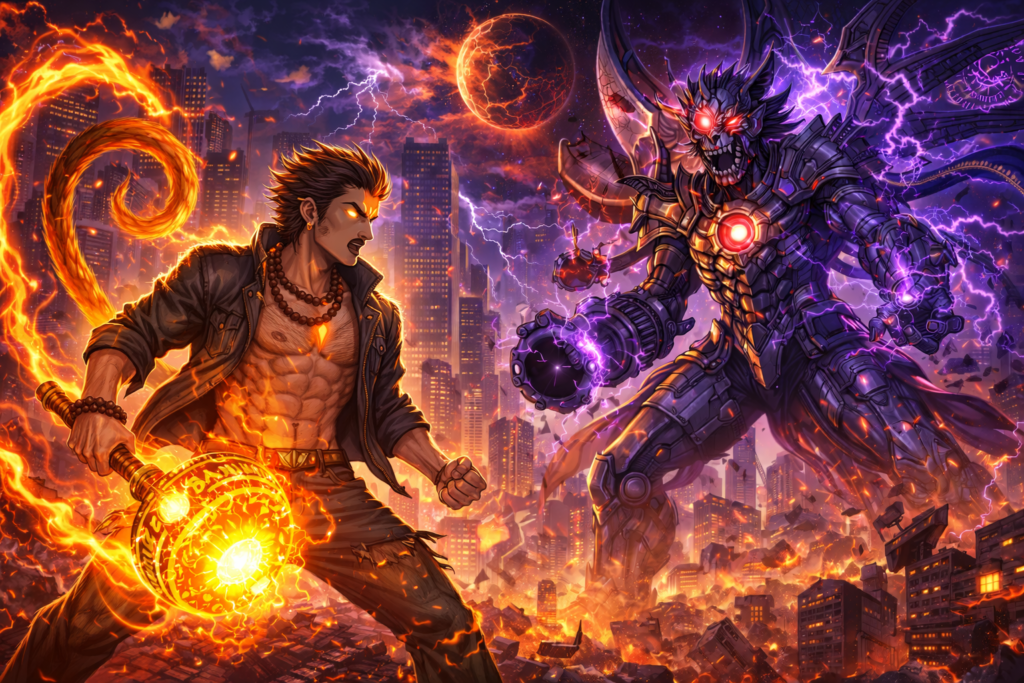
Tarakasura stepped onto the sacred stone barefoot, grinning. His axes trailed sparks.
Behind him came Shitala.
She did not walk.
She glided—a veil of translucent silk floating around her, hiding her true form. Her voice was a hum, soft and venomous, curling into the ears of the mortals she passed.
Some fell unconscious instantly. Others clawed at their own eyes, whispering names of people long dead.
A police van screeched to a halt.
Five officers leapt out—batons drawn.
They didn’t see demons.
They saw each other, grinning with bloodied teeth, eyes glowing red.
Within seconds, they were attacking each other in a blind, illusion-fueled frenzy.
Shitala twirled her fingers.
One of the policemen turned on himself.
“Too easy,” she whispered.
Tarakasura grunted. “You play too much.”
“I unmake,” she replied. “You just smash.”
Tarakasura turned toward the city skyline, where the first tendrils of dawn were touching the rooftops.
“He’ll come.”
Shitala’s veil pulsed.
“Yes,” she said. “But he won’t know what’s real when he does.”
Makardvach woke before the sun.
His body moved before his mind could catch up—grabbing the gada, throwing on boots, rushing outside into a wind that carried the scent of burned jasmine and blood.
Rishabh met him at the edge of camp.
“No training today,” the monk said.
Makardvach didn’t need to ask why.
He could already hear the screaming.
“I’m going,” Makardvach said, strapping the sling tight across his back.
Rishabh nodded. “Akshay will monitor the scene from base. Megha is en route to the temple archives. You will go alone.”
Makardvach paused. “What if I lose control again?”
“Then you’ll find it,” Rishabh said. “Or die trying.”
Makardvach leapt onto his motorbike—an old Royal Enfield—its engine roaring like a beast that had waited too long to run.
He didn’t wear armor.
Only a red scarf wound tight across his face, and the gada strapped to his back like a forgotten god.
The road to Varanasi blurred.
And somewhere, in the shadows of the crumbling ghats, Tarakasura smiled.
The bike skidded to a halt on the edge of the old Varanasi riverfront, tires slicing through ash and debris.
Makardvach leapt off before it stopped moving, his boots crunching down on fractured stone. The morning sun fought to pierce a veil of smoke that had no earthly source.
Bodies ran past him—civilians, police, priests in saffron, all fleeing the ghats in terror.
But some—a few—ran in circles, or flung themselves into the river with screams of madness.
Shitala’s illusions were already deep.
Makardvach pulled his scarf higher over his face and stepped forward into the choking air.
And there he was.
Tarakasura.
Standing atop a broken pyre, twin axes hanging casually in each hand, as if the apocalypse were a dance he’d been practicing his whole life.
“Well well,” the demon growled, voice rumbling like thunder through a cave. “The monkey shows up after all.”
Makardvach’s grip tightened around the gada. He said nothing.
He’d seen this creature in his visions—ripping through legions like a storm. Tarakasura had fought Hanuman’s kin once before. And survived.
“You look smaller than the last one,” Tarakasura sneered.
Makardvach charged.
He didn’t wait.
He didn’t posture.
He moved.
One step, two, then a sudden leap—legs coiling, then launching him into the air. He brought the gada over his head and came down with a roar.
Tarakasura moved just in time.
The gada smashed into the stone with the force of a comet, sending shards flying.
Makardvach spun, already swinging again—
But Tarakasura caught the shaft mid-swing.
“Strong,” the demon grunted, “but green.”
He twisted—flinging Makardvach through the air like a ragdoll.
Makardvach hit the side of a temple column, cracking it in half. Dust and plaster rained down.
He rose.
Blood in his mouth.
Adrenaline in his bones.
He charged again.
This time, he ducked the axe, drove his elbow into Tarakasura’s ribs, then planted a solid kick that sent the demon stumbling backward—
But as soon as he pressed the advantage—
Shitala whispered.
Makardvach heard it—just a breath, a syllable, a forgotten memory.
He blinked—
And suddenly the world shifted.
He was no longer at the ghats.
He was seven years old, again, standing at the edge of the balcony he fell from as a child.
His mother was calling out to him.
He stepped forward.
He almost stepped off the ledge.
The illusion cracked a second before he did.
Rishabh’s voice, remembered from meditation, cut through the haze:
“Hold your truth.”
Makardvach growled, forced his eyes open—and saw Shitala standing just behind him, veil shimmering, lips curled in delight.
He swung the gada without thinking.
She vanished in a wisp of smoke—laughing.
And that’s when Tarakasura hit him.
A full-body tackle.
Makardvach crashed through a stone wall, slammed into a shrine, and coughed blood.
He rolled, barely dodging a cleaving axe meant to sever his spine.
Tarakasura loomed above him, eyes blazing.
“Is this all the bloodline has left?” the demon snarled.
Makardvach stood.
Wobbled.
Wiped his mouth.
Then spun the gada once in his hand—like he’d done it a thousand times.
And replied—
“Not even close.”
Makardvach lunged forward, every fiber of his body burning.
The gada moved like a living thing now—responding before his mind could direct it. He struck low at Tarakasura’s knee, forcing the demon to twist away, then followed up with an uppercut swing that barely missed his jaw.
Tarakasura staggered.
But he didn’t fall.
He grinned.
“You’re learning,” the demon growled, swinging one axe in a wide arc.
Makardvach ducked it—just barely—and felt the blade graze a lock of his hair.
He retaliated with a spinning strike, smashing the gada into the demon’s ribs.
Crack.
Even Tarakasura winced.
The ghats shook with the force of the impact.
Smoke curled around them, thick and cloying.
And that’s when Shitala returned.
No warning. No sound.
Only a veil that danced at the edge of vision—impossible to look at directly.
Makardvach heard laughter. Behind him. Beside him. Within him.
He turned—and saw his mother.
Not the illusion from before.
This time, she was dying.
Bleeding.
Calling for help.
Then gone.
He swung the gada in rage—but hit only smoke.
Tarakasura tackled him from the side.
They crashed through a stone arch. Dust exploded outward.
Makardvach slammed into the earth hard enough to crater it.
The gada skidded out of his reach.
His ears rang. His chest screamed.
His vision blurred.
Tarakasura loomed above him.
One axe raised.
Shitala hovered beside him now, whispering into Makardvach’s ear—images of fire, failure, and forgotten gods filling his head.
He reached for the gada.
Too slow.
Tarakasura swung.
CLANG.
A staff met the blade.
Rishabh.
The monk stood, one hand on his wooden staff, the other gripping Tarakasura’s wrist with impossible calm.
“You’ve tested enough,” Rishabh said quietly.
Tarakasura snarled. “You always hide behind children, old man.”
Rishabh didn’t blink. “And you always mistake patience for weakness.”
The monk let go.
But the wind didn’t.
It rose—with a sound like chanting, like breath through a conch shell, like war drums pounding from beneath the earth.
Rishabh exhaled.
The wind slammed into Shitala and Tarakasura, sending them staggering.
In that second, he grabbed Makardvach and lifted him onto his shoulder like a sack of grain.
“I can still fight—” Makardvach protested, coughing blood.
“You will,” Rishabh said. “But not here. Not yet.”
He muttered something in Vanara tongue.
And the wind obeyed.
They vanished in a spiral of ash and air.
Far behind them, at the edge of the battlefield, Tarakasura roared in frustration.
But Shitala only smiled.
“Let him run,” she whispered. “He’s already dreaming the next illusion.”
They appeared in the forest clearing outside the dig site in a gust of ash and breath.
Makardvach collapsed to his knees the moment the wind faded. He vomited blood and dust. His arms shook. The gada clattered beside him, its golden glow dim, as if exhausted from sharing his pain.
Rishabh crouched beside him, silent.
The monk didn’t offer comfort.
He offered gauze.
Makardvach swatted it away.
“Don’t treat me like a child.”
“Then stop fighting like one.”
Makardvach looked up, his face caked in blood and fury. “I was winning.”
“No,” Rishabh said evenly. “You were surviving. Barely.”
He stood, walking in slow circles, the staff tapping against stone.
“Tarakasura is centuries old. He’s led demon legions across three yugas. And Shitala’s illusions can break kings. You’re not ready.”
Makardvach stood slowly. “Then make me ready.”
Rishabh looked at him long and hard.
The birds did not return to the trees.
Even nature seemed to wait.
Finally, the monk nodded once.
“Sit.”
Makardvach obeyed.
Rishabh sat opposite him, eyes half-lidded.
“You want the truth?” he asked.
Makardvach said nothing.
“You think Kalnemi is a demon. He is more than that. He was once divine.”
Makardvach blinked. “He was a god?”
“A lesser celestial,” Rishabh said. “A gatekeeper of cosmic balance. But when Hanuman grew too powerful during the Ramayana, Kalnemi was sent—not to destroy him, but to distract him.”
Makardvach frowned. “Why?”
“Because the gods feared Hanuman,” Rishabh said simply. “Even as they used him. He was too loyal. Too free. Too dangerous.”
He leaned closer.
“Kalnemi posed as a sage. Tried to lure Hanuman into meditation. A trap. But Hanuman saw through it. Killed him. And for his treachery, Kalnemi’s soul was cast out—stripped of celestial form. Banished to Paatal Lok.”
Makardvach’s fists tightened. “So this is vengeance.”
“No,” Rishabh said. “It’s hatred. Kalnemi doesn’t want revenge. He wants erasure. He wants to wipe out everything touched by Hanuman’s name—including you.”
Makardvach stood. The wind stirred again.
“And if I kill him first?”
Rishabh’s smile was grim.
“Then you’ll finish what Hanuman started.”
Makardvach looked to the sky.
It was darker now. Bruised and gray.
In the distance, the ghats still burned.
He picked up the gada.
Its glow returned.
Stronger.
As though it had heard the story and remembered, too.
The firelight flickered behind Makardvach.
But his gaze stayed forward—fixed on the gada now resting across his knees as he sat by the forest altar Rishabh had built from stone and prayer.
The symbols carved into the surrounding circle weren’t for worship. They were for focus. For discipline. Rishabh had explained earlier, during the silence between stories, that divine strength without intent would always turn into destruction.
Makardvach had said nothing then.
But now, he finally spoke.
“I’m not afraid to fight,” he said.
“I know,” Rishabh replied from the shadows. “That’s the problem.”
Makardvach looked up.
“You swing like a warrior,” the monk said, stepping into the firelight, “but you think like a mortal. You rely on your strength because you’re terrified of your purpose.”
Makardvach stood, slowly.
“What is my purpose, then? To avenge Hanuman? To fight Kalnemi? To become a symbol?”
“No,” Rishabh said. “Your purpose is to survive the storm and not become it. To stand between realms. To guard what cannot defend itself.”
He placed a hand gently on the gada.
“It begins here. With this weapon. With this vow.”
Makardvach stared down at the sacred staff.
The glow from the metal reflected in his eyes.
“I vow,” he said slowly, voice steady, “to fight for those who can’t.”
Rishabh nodded once. “Good.”
“I vow,” Makardvach continued, “to carry the burden of this power. Not for glory. Not for fear. But because I was chosen.”
The wind stirred around him.
“I vow,” he finished, “to train until this power no longer frightens me. Or until it kills me.”
Rishabh stepped back.
The trees rustled.
And for the first time since the visions began—Makardvach felt ready.
Not strong.
Not complete.
But willing.
Rishabh placed two fingers on Makardvach’s forehead.
“Then the training begins at dawn.”
Makardvach smiled faintly.
“Thought it already had.”
Far away, in the depths of Paatal Lok, Kalnemi stood before the Gate of Shivnadi—his hand resting on the seal of destruction.
He felt it, even across realms.
The boy had chosen.
Kalnemi’s lips curled back into a grin.
“Let the game begin.”