
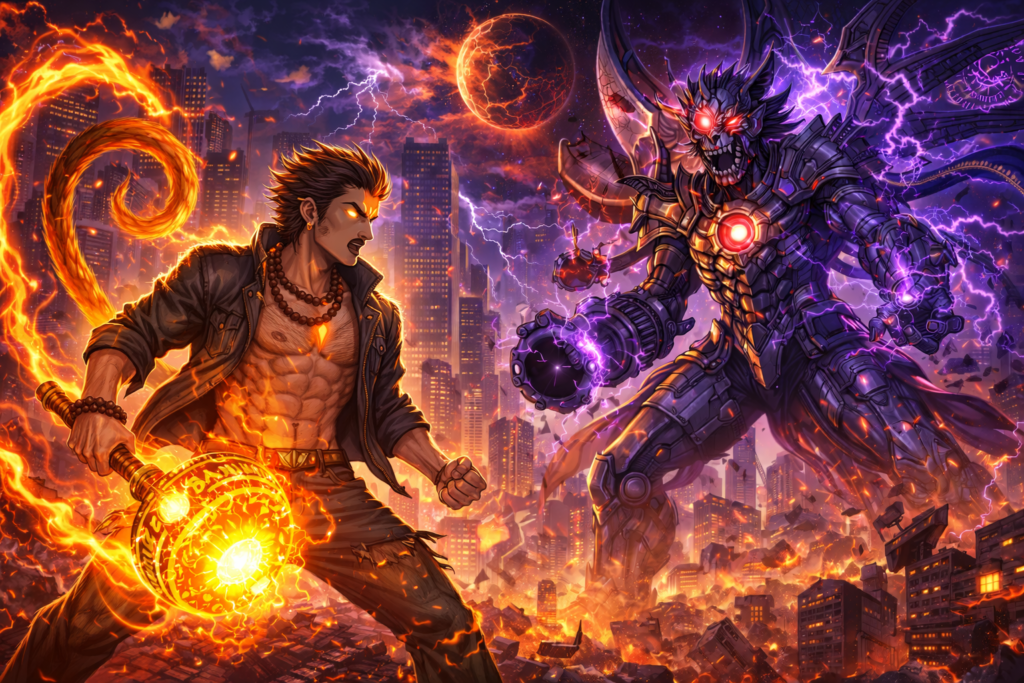
Two days passed. And nothing felt normal.
Makardvach woke each morning before the sun, without setting an alarm. He didn’t yawn. He didn’t stretch. His body snapped into motion as though sleep were a needless formality. He was sharper. Quicker. Stronger.
Too strong.
It began with small things.
A handshake with one of the porters—a friendly slap on the back—and the man winced, stumbling as though hit by a sack of bricks. Makardvach apologized, confused.
Lifting a box of artifact tools? It felt lighter than paper. Too light. He almost threw it over his shoulder by accident.
Then came the hammer.
They were at a fresh dig site a few kilometers southeast of the original cave. A few shallow burial mounds. Low promise. But Megha Kapoor, the historian Rishabh had mentioned, was due to arrive soon, and Makardvach had decided to stay busy.
He took a chisel and small sledge from the supply tent, heading to a stubborn slab of earth-stone lodged against a half-buried structure.
He raised the hammer—and tapped.
The entire slab cracked in two.
Not chipped.
Shattered.
Akshay, watching from the survey drone control station, looked up. “Bro…”
Makardvach blinked. “I barely touched it.”
“You’re gonna break the Earth at this rate.”
Makardvach dropped the hammer.
It bent when it hit the ground.
Akshay came closer, his tone lower now. “You’ve been acting… weird. I mean, ever since the ash demons from hell tried to eat us, sure—but also before that.”
“I’m fine,” Makardvach said.
“Dude, you crushed my water bottle in your sleep last night. While dreaming.”
Makardvach rubbed his temples.
His senses were too sharp now. He could hear every tool clink, every breath, every insect buzzing ten meters away. The wind itself sounded like a song just outside understanding.
He hadn’t touched the gada since the night of the attack.
But he felt it.
Even now. In the distance. In his bones.
He stood suddenly and walked toward the northern ridge, where the land dropped off into a shallow cliff overlooking the ruins below.
He crouched.
Eyes narrowed.
In the distance, a small bird—no larger than his thumb—flitted between two trees.
He tracked it.
Its wingbeat.
Its breath.
Then a child screamed.
A sharp, sudden wail from below.
Makardvach’s head snapped toward the sound—instantly.
A small group of villagers had been allowed to tour the lower excavation area. One of them, a young boy, maybe six, had slipped past the caution tape and run toward a half-excavated wall.
The wall, weakened from the morning’s tremor, buckled.
A sheet of stone—several hundred pounds—broke loose.
Falling.
Makardvach moved.
He didn’t think.
He flew.
Feet barely touched the earth as he sprinted down the slope, wind bending around him. People shouted. Someone reached for the child.
Too late.
Makardvach reached him first.
He slid beneath the falling slab, grabbed the boy, twisted his body, and caught the full weight of the stone on his back.
The slab shattered.
Dust clouded the air.
When it cleared—
Makardvach stood, unharmed, the boy clutched in his arms.
The villagers gawked. Mouths hung open.
One man murmured, “He picked it up… like it was nothing.”
Another whispered, “Monkey… monkey man…”
Makardvach blinked.
The child clung to him, crying softly but safe.
And the name took root.
Not one he chose.
But one they gave him.
“Vanara Man,” someone muttered, trying to remember the old legends.
“Monkey Man,” another said, easier on the tongue.
Makardvach set the boy down and walked away.
He could feel the stares on his back like heat.
He didn’t want them.
But he had them.
And somewhere, behind a veil of breath and flame, Kalnemi smiled.
By nightfall, the video had already gone viral.
One shaky phone clip—barely ten seconds long—had captured the moment Makardvach caught the falling slab. The grainy footage showed a man in a red bandana, a blur of motion, a dust cloud, and the crack of stone as it exploded against his back.
It didn’t matter that his face wasn’t clear.
Or that he fled the scene before reporters arrived.
The internet had done what it always did.
Named him.
“Monkey Man saves child in miraculous rescue!”
“Divine strength or freak accident?”
“Is Varanasi home to a new Indian superhero?”
The comments were worse.
This is fake. CGI. No man can catch stone like that.
He’s wearing red—must be a Hanuman bhakt!
Someone give him a cape already. This is awesome.
India finally gets her own mythic Avenger—meet MONKEY MAN!
Vanara reborn?
Makardvach scrolled through the headlines in silence.
Akshay leaned against the tent pole, arms folded, chewing sunflower seeds. “You’re officially famous.”
Makardvach didn’t respond.
“You should see Twitter. They’re already drawing fan art. One guy said you’re a CIA experiment. Another thinks you’re the second coming of Bajrang Bali.”
Still nothing.
Akshay sat beside him. “You know it’s only a matter of time before someone connects the dots. The dig. The symbols. The gada.”
Makardvach clenched his jaw. “I didn’t ask for this.”
“Hero names aren’t invitations,” Akshay said. “They’re reactions. You did something they can’t explain. You saved a kid with your spine. The name was bound to stick.”
Makardvach stood, pacing.
He could feel his skin buzzing again.
A faint warmth beneath his ribs. As if something was waking deeper every time someone called him that name.
“Monkey Man.”
He hated how easily it fit.
He walked to the edge of the tent and stared out across the hills. The moon was rising. Pale and slow. Shadows stretched across the dig site like old scars.
“I’m not a god,” he said.
“No,” came a voice behind him. “But you carry one inside you.”
Rishabh emerged from the darkness like a statue gliding from dream.
He looked at the tablet in Akshay’s hand. “The world sees the light, even if it doesn’t know what it is.”
Makardvach turned to him. “You said I was chosen. You never said I’d be… watched.”
“You inherited more than blood,” Rishabh said. “You inherited expectation. The gods watch. The demons wait. And the people… name what they fear and admire. That name—Monkey Man—it isn’t just for them. It’s for you.”
Makardvach folded his arms. “And what if I reject it?”
Rishabh looked at him steadily. “Then you’ll still be hunted. But alone.”
Makardvach’s fists tightened.
Akshay spoke up. “He’s not ready to be some kind of public deity, man. He’s just—he’s figuring this out. Maybe if we laid low for a bit…”
“You can’t hide from fate,” Rishabh said. “Especially when it walks in your skin.”
Makardvach looked back at the glowing screen. His own figure, a blur in mid-rescue, paused mid-frame.
Stone shattered.
Child saved.
Myth born.
“Monkey Man,” he murmured. “They won’t stop calling me that now.”
Rishabh smiled faintly. “Then make it mean something.”
They met at sunrise, where the jungle began to eat the land again—just past the broken statues and old roots that wound around forgotten pillars like serpents holding secrets.
Rishabh didn’t bring weapons.
Only a folded mat, a flask of water, and silence.
Makardvach followed, shirtless, bruised, restless.
He hadn’t slept well. Again. Not because of nightmares.
Because of sensation.
Everything was louder now. Sharper. The sound of beetles in the soil, the flutter of a hawk’s wing two hills away, the rustling of vines in windless air. His body itched to move, to leap, to strike.
He was changing.
And it terrified him.
“Sit,” Rishabh said without turning.
Makardvach hesitated, then sank onto the mat across from him.
Rishabh poured a splash of water into a clay bowl, dipped two fingers in, and flicked it gently toward Makardvach.
The drops hit his chest with the weight of a drumbeat.
He flinched.
“What was that?” he asked.
“Ganga water from Yamunotri,” Rishabh replied. “Purifies the tongue of denial.”
Makardvach scowled. “You could’ve just asked me to be honest.”
“I did,” Rishabh said. “And you’ve been lying since the moment the power touched you.”
Makardvach leaned forward. “I’m not lying. I’m confused. You tell me I’m descended from Hanuman—fine. Let’s say I accept that. But what am I? A soldier? A monk? A living weapon?”
Rishabh looked at him long and steady. “You are all those things. And none of them. You are a mirror. And the world will show you what you are only when you stop resisting your reflection.”
Makardvach clenched his fists. “That doesn’t help.”
“Then breathe.”
Makardvach sighed hard through his nose.
Rishabh smirked. “Not like that.”
He reached into his satchel, pulled out a folded scroll, and spread it across the earth between them. The script was in curling Vanara glyphs. Gold ink. Symbols that shimmered faintly under the morning sun.
“The breath,” Rishabh said, “is the key to every power Hanuman ever held. The wind obeyed him because he understood it. He did not command. He aligned.”
Makardvach tilted his head. “So you want me to… meditate?”
“I want you to stop running from yourself.”
He gestured.
Makardvach closed his eyes. Sat up straighter. Slowed his breath.
It was difficult.
The senses roared in his skull.
Every heartbeat felt like a thunderclap.
His own strength frightened him. Not because it was monstrous—but because it was deliberate.
As if it had always been there, waiting.
And now, as he breathed—
It rose.
Warmth in his lungs.
Pressure in his limbs.
The mark on his chest began to hum faintly.
Rishabh’s voice entered the stillness. Low. Calm. Repeating a mantra that wasn’t quite Sanskrit. Not quite human. It felt… older.
“Vayuputra. Rudraveerya. Mahabala…”
Makardvach repeated the sounds softly.
And for a moment—
The wind shifted around them.
Not hard. Not loud. But focused.
A single, clean gust that spiraled inward and upward, swirling the dust between them in a tight halo.
Makardvach opened his eyes.
The world felt… lighter.
Balanced.
But the moment shattered when Akshay burst through the trees, panting hard.
“Uh, sorry to break up the zen garden,” he said, “but we’ve got a problem.”
Makardvach rose immediately. “What kind?”
Akshay pointed behind him. “The kind with wings. And horns. And two cops already missing.”
Rishabh stood slowly, eyes narrowing.
“So,” he said, “he’s sent his lieutenant.”
“Who?” Makardvach asked.
Rishabh’s reply was a name that curled in the air like a curse:
“Tarakasura.”
Deep beneath the shifting bones of reality, where light was a stranger and time folded like paper, there stood a throne of horn and ash.
Around it—void.
Before it—devotion.
Tarakasura knelt.
Seven feet tall even on one knee, built like a mountain forged in hate, his skin was ashen red, wrapped in iron-twined muscle. His twin axes—each carved from the fangs of prehistoric beasts—rested across his back, still wet with mortal blood.
And yet he bowed.
Because before him sat the one even he feared.
Kalnemi.
His body was carved of darkness. Not black—black was a color. Kalnemi was the absence of light, robed in shadow, smoke rising from the slits in his flesh like incense from an open wound. His face was mostly obscured behind a molten mask shaped like a jackal’s snarl. Only his eyes were visible.
And they burned.
“Tarakasura,” he said at last, voice like glaciers grinding mountains into dust.
The general bowed lower. “He has awakened.”
Kalnemi said nothing.
But the ground beneath him cracked.
Tarakasura continued. “The bloodline lives. The seal broke two nights ago. The Vanara mark is active. The boy survived the shadowlings.”
A pause.
“A monk protects him. An old one. Vayu-trained.”
Kalnemi turned his head slightly. The temple fires dimmed around them.
“And the gada?”
Tarakasura hesitated. “…It chose him.”
For the first time in centuries, Kalnemi moved.
He leaned forward on the throne, the ash drifting from his body pooling at his feet. “Then the cycle begins again.”
He stood.
The throne screamed as he rose. Chains melted. Bones cracked in walls that had never lived.
Kalnemi walked toward the scrying pool at the edge of the room—a bowl of blood suspended in silence. He waved a single, taloned finger above it.
The image shifted.
Makardvach appeared.
Eyes closed. Breathing slow. Meditating with the monk.
Kalnemi stared.
And then… smiled.
It was a terrible thing.
“It will take time for his soul to ripen,” he said. “He still breathes like a man.”
Tarakasura growled. “Shall I end him before he remembers who he is?”
Kalnemi turned.
His voice was cold.
“No. Let him remember.”
Tarakasura snarled. “He grows stronger by the hour.”
“Good,” Kalnemi hissed. “The stronger he becomes, the more power I will consume when I break him.”
He turned back to the pool, watching Makardvach rise from meditation, eyes glowing faintly with power.
“Send Shitala,” he said. “Have her lace the wind with doubt. Twist his mind. Make him see failure. Pain. Regret.”
“And if that fails?” Tarakasura asked.
Kalnemi stepped into the shadows, his voice curling like black silk through the air.
“Then tear Varanasi apart, bone by sacred bone.”
Far away, beneath the mortal sky, Makardvach opened his eyes.
And the air was suddenly too still.
Too quiet.
Rishabh looked toward the trees.
He felt it too.
The first move had been played.
Makardvach didn’t sleep that night.
Not because of dreams.
Because of something missing.
The jungle was always alive at night—chittering insects, far-off jackals, the rhythmic call of nightjars—but now it had gone silent.
He stood alone atop the western ridge, the gada strapped across his back in an improvised sling Akshay had made from climbing harnesses. It pulsed against him, heavy and warm, like a heartbeat that didn’t match his own.
Rishabh joined him without a word.
They stood together, watching the moon drift above the canopy.
“Why do I feel it?” Makardvach asked at last. “Like… something’s about to break?”
“Because it is,” Rishabh replied. “You’re tuned now. Your blood remembers what it was. The closer war draws, the louder it sings.”
Makardvach looked down at his hands.
They weren’t glowing. Weren’t twitching. But they felt ready—charged, like a coiled spring or a held breath.
“They know I’m alive,” he said.
“They do,” Rishabh confirmed. “And they’re watching. Listening. Testing the wind for your scent.”
Makardvach sighed. “And I’m supposed to fight this army? Alone?”
Rishabh smiled faintly. “You’re not alone.”
“I’ve got a techie and a retired monk.”
“You have more than that,” Rishabh said. “You have a name now. A story. And that’s more dangerous to a demon than any sword.”
Makardvach glanced sideways. “You think a meme can stop Kalnemi?”
“No,” Rishabh said. “But a legend can.”
Makardvach said nothing.
He stared out at the night.
And then—
He felt it.
A ripple in the air.
Not wind.
Not weather.
Intention.
Somewhere far from the camp—maybe a village, maybe a market—something twisted the natural order. Like a hot nail pressed into the spine of the world.
Makardvach inhaled sharply.
His skin buzzed.
“What was that?” he asked.
Rishabh was already turning, heading back to camp. “A message. Kalnemi’s testing his reach. Tarakasura will attack soon. Maybe tonight. Maybe tomorrow. But not alone.”
“Shitala?” Makardvach guessed.
Rishabh nodded grimly. “Illusions. Poison of the mind. She’ll try to unmake your belief before the battle begins.”
Makardvach followed him, eyes glowing faintly in the dark. “And what do I do?”
Rishabh stopped.
Faced him.
“Hold your truth.”
Makardvach frowned. “That’s it?”
“That,” Rishabh said, “and be ready to bleed.”
In the realm between realms, Kalnemi stood atop a pillar of smoke, watching shadows swirl below him. His army stirred—thousands of Rakshasa souls, malformed beasts, and ancient curses wearing flesh.
He raised his hand.
One of the souls surged upward and formed into a shape—horned, crowned in obsidian flame, eyes like moons bleeding tar.
Krodha.
The general of destruction.
Kalnemi spoke.
“Soon. Let the bloodline feel the tremble of his first war.”
The demon smiled.
And the sky, for a moment, forgot how to breathe.