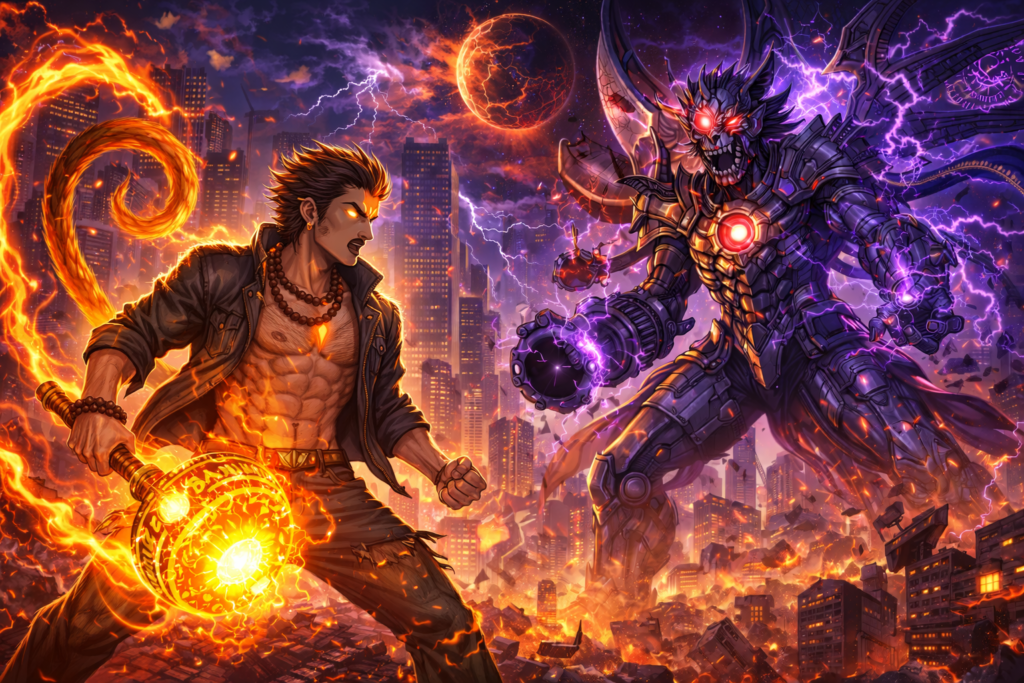
The sky over Delhi split without thunder.
No light.
No heat.
Just absence.
As if something had decided Delhi no longer needed up.
The clouds folded inward, lines of black etching across the air like handwriting in reverse.
From them fell the first Precepts.
They did not roar.
They did not burn.
They rewrote.
Where their limbs touched ground, street names changed.
Books in nearby libraries reversed their own titles.
One temple’s bell rang, then vanished—its sound never having been invented.
People ran.
Others stood frozen, staring, not remembering why they’d come outside.
The Mortal Gate—an ancient arch said to mark the convergence point between divine and mortal paths—was their target.
It stood silent.
Waiting.
Makardvach arrived by air—riding Vānaprakāśa like a storm-spear, wind underfoot, lightning guiding his descent.
Adira met him in midair, blades burning blue.
“Delhi’s mythic field is collapsing!” she shouted over the un-sound.
Rishabh followed with a warding chant, but his voice bent halfway through.
Megha, from below, tapped into half-stable leylines around the city.
“They’re trying to make Delhi forget itself.”
Makardvach’s boots struck the ground.
People around him looked up.
And remembered.
Because he wasn’t just a man.
He was their proof.
Of Hanuman.
Of power born not from prayers, but from inheritance.
He stood before the gate.
Raised Vānaprakāśa.
And bellowed:
“We are not stories you get to edit.”
The weapon roared.
Wind surged through the Mortal Gate—
And the gate answered.
It pulsed gold.
Then bright red.
Then every color of Earth’s oldest tongues.
The Precepts froze.
For the first time, they recognized resistance.
The city rallied.
Police, monks, poets, engineers—anyone who could remember something important, something ancient—stepped forward.
They chanted.
They drew.
They played instruments.
Not for offense.
But for reminder.
Every human act of memory held the Precepts back.
Makardvach smiled.
“We’re not fighting alone.”
The victory was short-lived.
The Mortal Gate pulsed with resistance—
but the Precepts simply changed course.
They stopped attacking the city.
They attacked the people.
One by one.
Quietly.
Like editors redlining a manuscript.
It started with Rishabh.
Mid-chant, he stopped.
Blinking.
Confused.
Then whispered, “Why… why am I dressed like this?”
He looked down at his prayer beads.
Then dropped them.
“No. I’m not a monk. I’m—what am I doing here?”
Megha was next.
She froze while transcribing a mantra into a protective field.
Her pen trembled.
Then she crossed out her own name.
“I don’t… I don’t think I ever studied Hanuman. I’m just a tour guide, aren’t I?”
Akshay collapsed against the side of a temple, staring at Makardvach blankly.
“Who… are you?”
Makardvach felt the weight hit his chest.
Not grief.
Something worse.
Erasure.
The Precepts weren’t killing.
They were revising.
He acted fast.
Laid Vānaprakāśa on the ground.
Chanted the mantra of breath.
Closed his eyes.
Reached not for the wind,
not for the river,
but for the thread of each soul bound to his.
He entered Rishabh’s memory first.
A half-formed temple.
No statues.
No chants.
Just a small boy sweeping stone steps.
Makardvach appeared as a ghost at his side.
“Do you remember why you picked up the broom?”
The boy frowned.
Shook his head.
Makardvach pointed to the sky.
The stars above began to align into Vanara script.
The boy looked up.
And whispered.
“Because someone had to clean the path…
before the gods arrived.”
Rishabh gasped awake.
His mantra roared back to life.
One soul reclaimed.
Megha’s mind was next.
A classroom.
Empty chalkboards.
Books with blank pages.
She sat in the back, chewing the end of a pencil.
Makardvach appeared beside her.
Slid a single page across the desk.
It read:
“You found the truth not in myth—
but in the fact that myths survive.”
Megha blinked.
Then smiled.
She returned.
Her field shimmered gold.
Two saved.
Akshay was hardest.
No classroom.
No temple.
Just a white void of noise.
Screens glitching.
Pages turning too fast.
Makardvach stood behind him.
Said nothing.
Instead, he handed him—
a broken prototype.
The first thing Akshay ever built.
A toy drone, still scorched.
Akshay stared.
And whispered.
“I made this to spy on my dad.
He never said he was proud.
But I still made it.”
He woke up.
“Bro,” he croaked. “That… was messed up.”
Makardvach helped him stand.
“I’m still here.”
Akshay grinned.
“And now I remember why.”
It started small.
A street vendor in Delhi murmured her grandmother’s name.
A bus driver whispered the first poem he ever memorized.
A child recited a bedtime story back to his frightened mother.
No weapons.
No magic.
Just words.
Remembered.
Then it spread.
Towns.
Villages.
Cities.
People gathered.
Not to chant Hanuman’s name.
But their own.
The names that built them.
The names that were nearly erased.
“My father’s name was Karunan. He was never late for temple.”
“My sister taught me how to ride a bicycle before she died.”
“I still remember the way my mother used to sing when it rained.”
And across the subcontinent—
those names became light.
The Precepts paused.
Their limbs, once so sure, began to bend.
Their mouths trembled.
Their forms started to blur—not into chaos,
but into mirror.
They were being shown a story they could not alter.
Because it had already been told.
At the Mortal Gate, Makardvach stood tall.
He didn’t chant.
He didn’t roar.
He whispered:
“My name is Makardvach Rathore.
My mother’s name was Meenakshi.
My father made maps no one ever used.
I was born in a city that forgot me.
But I remembered it.”
The ground pulsed.
Vānaprakāśa flared.
And something deeper than wind stirred.
Earth listened.
Not as an element.
As a witness.
And in that moment—
The planet itself chose not to be overwritten.
Rishabh raised his staff.
Megha held her tablet high, projecting thousands of chanted names.
Akshay hacked every media satellite in orbit.
And broadcast the same message, city by city:
“Your memory is your weapon.
Speak it.”
And India spoke.
A billion voices.
Not in sync.
But in truth.
The Precepts shrieked.
Their forms collapsed inward.
Not killed.
Unwritten.
The gate held.
The skies steadied.
And Earth—
Stood.
The sky stilled.
The Precepts vanished.
And for one fragile breath, it felt like the end had come.
Until the Earth cracked.
Not with collapse.
With rage.
A fissure tore through the pavement before the Mortal Gate.
Molten fire surged upward, not lava, but sanskrit in flame—ancient, corrupted, inverted.
The words of old mantras burned backward across the ground.
And from the pit rose a figure—
Twice Makardvach’s height.
Armor of ash and brass.
Eyes like furnaces.
Krodha.
He didn’t speak.
He roared.
The shockwave shattered the outer rim of the city.
Temples trembled.
Even the name-chant faltered.
Because Krodha did not forget.
He did not change.
He only burned.
Makardvach stepped forward.
Vānaprakāśa ready.
But his hand trembled.
“Rishabh,” he said softly. “He’s not myth. He’s… emotion.”
Rishabh nodded. “He was Kalnemi’s rage made form. Caged beneath Paatal Lok for centuries.”
Megha whispered: “We never freed him. We just stopped remembering why he was sealed.”
Akshay pulled up his scanner. “He’s running on mantra corruption. Divine rage with no conscience.”
Krodha raised a massive blade—
forged not of metal,
but of mantras that should never be spoken.
He struck.
Makardvach blocked with the wind end of Vānaprakāśa—
But the impact shattered the wind.
He flew backward, crashing through a pillar of the Mortal Gate.
The ground steamed where he landed.
His armor melted.
Krodha stomped forward.
Every step cracked the earth.
Makardvach staggered up.
“I can’t out-chant him.”
Rishabh’s voice was grim.
“No.
You have to outlast him.”
But Krodha did not give pause.
He swung again—
And Makardvach caught the blade with his bare hands.
The mantra burned into his palms.
His skin blistered.
But he held on.
Gritting his teeth.
And shouted:
“You don’t remember why you’re angry!”
Krodha froze.
Just for a second.
Then whispered:
“I never forgot.
You killed my name.”
And drove his fist into Makardvach’s chest.
The world dimmed.
Makardvach couldn’t breathe.
Couldn’t move.
He could hear his ribs crackle, feel blood bloom through his mouth.
Krodha stood above him.
Steam rising from every joint.
Mouth curling into something between victory and torment.
“I don’t need you dead,” he growled.
“I need you erased.”
And then—
Water.
Not rushing.
Not roaring.
Just a single drop.
From Makardvach’s chest.
Where the Shivnadi had once rested.
Krodha stepped back.
Confused.
Because fire shouldn’t bleed.
But this—
This was memory, taking liquid form.
And it reached up.
Tendrils of shimmering water circled his molten blade.
Not cooling it.
Naming it.
Words appeared across Krodha’s armor.
Not curses.
Names.
“Sharvata.”
“Son of Dhrika.”
“Chosen by the Gate of Yama to guard balance, not burn it.”
His armor cracked.
His eyes twitched.
“Who is that?” he whispered.
Makardvach whispered back, bleeding, grinning:
“That’s you.
Before Kalnemi turned you into Krodha.”
The water surged.
More names.
More fragments.
Krodha saw flashes:
Himself, in simple robes.
A guardian.
A teacher.
A poet who wrote verses to calm storms.
The man he used to be.
The man he had forgotten.
He screamed.
Fire burst from every joint.
But the Shivnadi did not retreat.
Because it did not fear flame.
It remembered before it.
Krodha dropped his sword.
Dropped to his knees.
“I remember…”
Makardvach sat up, choking.
Held out a hand.
“Then you’re not Krodha anymore.”
And the demon—
the general—
the wrath—
wept.
The Mortal Gate pulsed one last time.
And behind it, Delhi exhaled