
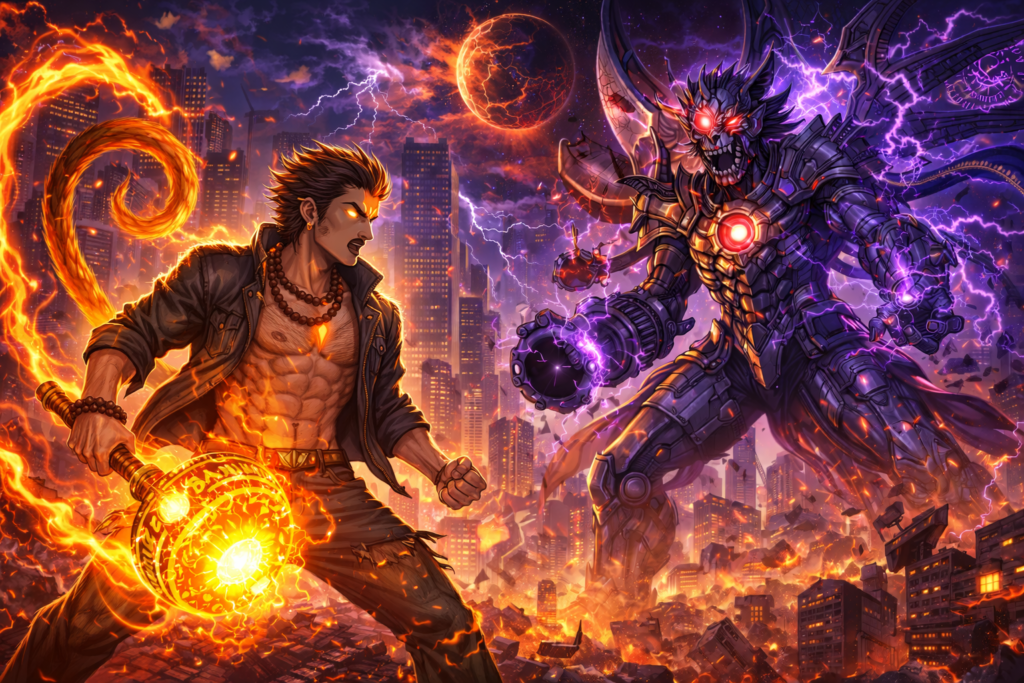
The morning arrived without light.
The sky was grey—not cloudy, but dull, colorless. The kind of sky that made even birds hesitant to sing. Makardvach sat in his tent, fully dressed, the gada lying silently beside him, as though neither of them had slept.
They hadn’t.
He hadn’t told the team about the weapon’s mysterious relocation. Nor about the visions. Or the pressure he felt in his bones, as though something ancient had wrapped itself around his soul.
He’d spent the whole night listening—to distant sounds, to whispers in the air, to the soft hum of power that never faded from the gada.
And now, as he poured cold instant coffee into a dented steel cup, a figure appeared at the edge of the dig site.
Makardvach noticed him immediately—not just because the man was barefoot, wearing saffron robes and carrying no visible supplies—but because he had walked through the restricted boundary without hesitation, as though it simply didn’t apply to him.
He was old, but not frail. Thin, but carved with wiry strength. A thick rudraksha mala hung around his neck, and in his right hand, he carried a wooden staff with Vanara symbols etched up its length. His forehead was marked with sacred ash, drawn into the shape of a crescent swirl.
The workers parted instinctively as he walked—some offering nervous bows, others retreating entirely.
Akshay, munching on a protein bar near the surveyor’s station, raised an eyebrow. “You expecting a wandering sadhu?”
Makardvach stood slowly.
The monk walked straight toward him without breaking stride.
He stopped three feet away and inclined his head in a slow, respectful nod.
“Makardvach Rathore,” the monk said. His voice was rough, like stone cracking under strain. “I have walked three lifetimes to find you.”
Makardvach blinked. “Come again?”
The monk’s eyes—deep-set and dark as temple oil—studied him for a long moment. Then he lowered himself to the ground cross-legged, resting his staff across his lap as though planting himself in the center of the universe.
“I am Rishabh,” he said. “Servant of the divine wind. Chronicler of the Vanara bloodline.”
Makardvach opened his mouth, closed it again.
This was a prank. Had to be.
Akshay muttered behind him, “Well this escalated.”
Makardvach cleared his throat. “Look, Rishabh… I don’t know who you are or how you got in here, but this is a private site. You’ll need to—”
“I have seen the gada,” Rishabh interrupted softly.
Makardvach’s spine straightened.
“I have seen it in dreams. In omens. In fire. I saw it rise in Kishkindha and vanish beneath stone. I saw it fall silent after the exile of the last Vanara prince. And now… I see it awake again.”
Makardvach said nothing.
Rishabh’s eyes didn’t blink. “You touched it. You heard him, didn’t you? You saw the war. The blood. The demon.”
Makardvach’s heart pounded like a wardrum.
“What do you know about Kalnemi?” he asked without meaning to.
Rishabh nodded, as though this confirmed everything.
“Good,” the monk said. “You’re remembering.”
Makardvach swallowed hard. “You need to leave.”
“No,” Rishabh said simply. “You need to listen.”
He leaned forward, staff glowing faintly as it rested on his knees.
“You are the last blood of the Vanaras,” he said. “Born of mortal skin, but bound to divine purpose. You are the echo of Mahabali Hanuman, the unshakable. The world will burn again if you do not rise. And if you do not believe me… the shadows will come tonight to make you.”
Akshay laughed awkwardly behind them. “Okay, no offense, but this is some serious comic-con level monologue—”
Rishabh turned and looked directly at him.
Akshay shut up instantly.
Makardvach met Rishabh’s gaze again.
And for just a moment—barely a second—he saw it.
Behind the old man’s eyes: fire. Storm. Memory.
Makardvach didn’t know what to say.
So Rishabh stood.
He tapped his staff once on the ground.
“Tonight,” he said. “The test will come. Choose who you are.”
He turned and walked away, vanishing beyond the tents like a dream receding from dawn.
Makardvach stood frozen, heart thundering.
The wind picked up.
And far away, too faint for anyone else to hear…
Something laughed in the dark.
Rishabh waited at the edge of the river that snaked past the dig site, seated on a boulder as if it had been carved specifically for him. He hadn’t moved in hours—not to eat, not to speak. He just sat, eyes half-lidded, staff across his knees, face turned slightly toward the breeze, as if listening to the sky breathe.
Makardvach found him there at twilight.
Still angry. Still uncertain.
He stopped a few feet away, arms folded, jaw clenched. “You’ve got ten minutes.”
Rishabh opened his eyes slowly. “You heard the laugh, didn’t you?”
Makardvach said nothing.
“You’ve felt the weight in your bones. The strength that doesn’t belong to men. You’ve smelled the ash of battles that haven’t burned in this age.”
“I’ve felt a lot of things,” Makardvach snapped. “None of them prove I’m part monkey god.”
“You’re not,” Rishabh said calmly. “You’re part Vanara—a race, not a godhood. Hanuman was both. You are what remains. What endures.”
Makardvach ran a hand through his hair. “This is mythology. This is legend. None of it’s real.”
“You touched the gada,” Rishabh replied. “You saw what no mortal has seen in two thousand years.”
Makardvach stepped closer. “That was a vision. A hallucination. Maybe a stress-induced trance.”
“It was memory.”
Makardvach barked a short, humorless laugh. “So what, I’m some kind of reincarnated warrior? The chosen one? That’s what this is? That’s what you want me to believe?”
“No,” Rishabh said. “You don’t need to believe it. You need to remember it.”
Makardvach turned his back on him, fists tight. “You sound like a lunatic.”
“Is it lunacy,” the monk asked gently, “to know that the past echoes in blood? That legacy chooses its bearer? Or is it fear?”
Makardvach wheeled around. “Fear? You think I’m afraid of some bedtime stories?”
Rishabh stood. The air shifted subtly—he didn’t grow taller, but the space around him seemed to bend slightly, as if the world were giving him room.
“I think,” Rishabh said, “you’re afraid of what you already know. That there’s something in you older than your name. Older than this land. A call you’ve tried to silence with logic and books and excavation dust.”
Makardvach took a step back.
“I’ve spent my life studying ancient symbols,” he said. “I dig up ruins. I translate broken stone. That’s real. What you’re offering is madness.”
Rishabh took a single step forward.
“You were born during a solar eclipse. You survived a fall from a third-story balcony at age seven that should’ve broken your spine. You once outran a leopard while hiking in Himachal—yet told no one. Why?”
Makardvach stared at him, throat dry.
“Because,” Rishabh said, “you’ve always known something was… different.”
Makardvach looked away. “Stop.”
But Rishabh wasn’t done.
“The marks on your chest—do you think they’re birthmarks? They’re seals. They hold back what you’re meant to become. But the gada awakened them.”
Makardvach’s breath caught.
He instinctively pressed his palm to the left side of his chest—where the odd, spiral-shaped discoloration had started glowing faintly in the mirror the night before.
He hadn’t told anyone.
Not even Akshay.
“How do you know that?” he whispered.
“Because I’ve seen it before,” Rishabh said softly. “On the ones who came before you. The ones who failed. You… are the last.”
Makardvach backed away.
“I don’t believe in destiny,” he muttered. “I believe in evidence.”
“Then wait for tonight,” Rishabh said. “Your evidence will come.”
He turned and began walking toward the darkening treeline, his staff tapping rhythmically with each step.
“But if you wait too long,” he added without turning, “you may not live to accept it.”
Makardvach stood there long after the monk had vanished into shadow.
And though he wouldn’t admit it—
He was already listening for the wind.
That night, the jungle pressed too close.
The dig site had quieted. Tents glowed with warm light, murmurs of the crew drifting like low incense through the warm air. A generator hummed near the survey station. Akshay blasted a late-night playlist from a Bluetooth speaker, upbeat music trying to push back the eerie hush that had settled over the land.
Makardvach sat alone in his quarters, shirt off, staring at the mirror.
The mark was still there—spiral-shaped, faintly raised, sitting just over his heart like a dormant storm. It hadn’t been there a week ago. Not like this.
And now?
Now it pulsed.
Every few seconds, it glowed—dimly, like a dying ember—then faded. The rhythm was almost… purposeful.
A whisper of breath curled at the base of his neck. He spun around.
Nothing. Just the tent flap rustling.
He took a deep breath, grabbed a T-shirt, and forced it down over his head. “It’s just psychosomatic,” he muttered. “Stress, heat, dehydration, hallucinations. That’s all.”
He picked up his tablet and scrolled through excavation notes. Anything to distract his mind. He could hear Akshay laughing in the next tent over, probably texting someone or watching cat videos.
Normalcy. Sanity.
Then the lights flickered.
Just once. A hiccup in the current. He ignored it.
Then again. Longer.
The third time, the bulb above him exploded, showering sparks. The fan stopped. The generator continued humming outside, undisturbed.
The air in the tent went dead.
And thick.
Makardvach stood slowly. His body tensed of its own accord. The hairs on his arms and neck rose like soldiers before a battle horn.
Then came the smell—burnt metal, incense, and something darker. Like wet ash and spoiled air.
He turned.
And saw the ash.
Across his desk, across the floor, even across the walls—ash had settled. But it wasn’t random. It had patterns.
Symbols.
Vanara script.
Freshly drawn in soot that hadn’t existed seconds ago.
His pulse roared in his ears.
He grabbed his phone and took a photo—but the screen showed nothing. Blank surface. Normal canvas.
He wiped at the ash—his hand passed right through it, dispersing nothing.
Then the tent flap fluttered inward, as though something had exhaled against it.
And a low voice—not cruel, not loud, but ancient and humming with power—whispered in the back of his mind:
“He sees you now.”
Makardvach stumbled back, knocking over his chair. He gritted his teeth, heart hammering, breath coming shallow.
“No,” he hissed. “This is not happening.”
He reached for the gada instinctively.
Only—it wasn’t there.
He spun.
The gada had moved.
Now it stood upright in the far corner of the tent—lit by no light, casting no shadow—facing him.
Watching him.
The mark on his chest burned.
Makardvach collapsed to one knee, clutching it.
And beneath his own skin, he felt something stir.
Not a voice.
Not a thought.
A memory.
A scream of war.
A black-winged demon laughing.
A roaring wind.
And a glowing figure hurtling through flame.
Makardvach gasped.
The vision faded.
He was back in the tent.
Sweating. Shaking. Breathless.
And then a voice—real, this time—outside the tent.
Rishabh.
Soft.
Certain.
“He has marked you. The hunt has begun.”
Makardvach looked up at the glowing spiral on his chest and finally spoke the truth aloud, under his breath.
“…I believe you.”
The scream cut through the night like a razor.
It wasn’t human.
Makardvach was already out of his tent before he knew he’d moved. Barefoot, shirtless, still slick with sweat, his body acted faster than thought—driven by instinct, not intellect.
He sprinted across the dirt yard toward the source.
Akshay burst from his own tent, dragging a flashlight and cursing. “What the hell was that?! A leopard?”
“No,” Makardvach said. His voice was quiet. Certain.
Not a leopard.
Something worse.
They reached the kitchen tent—and froze.
The fabric had been shredded like tissue paper. Pots and crates lay scattered, their contents smoking as if they’d been dipped in acid. But it wasn’t the damage that made them stop.
It was the darkness.
Thick. Wrong. It clung to the air like smoke but didn’t rise. It pulsed at the edges of visibility, writhing in the shadows cast by the overhead lanterns.
And then something moved.
Not toward them.
Around them.
Makardvach’s breath stilled.
From the tree line, just beyond the firelight, eyes opened. Not glowing—not dramatically orange or demonic—but dim and many. Blinking. Watching. Predatory.
Then came the first one.
It emerged like oil peeling off stone.
Seven feet tall. Humanoid, but barely. Its skin was slick, charcoal black, with veins of red light snaking beneath the surface. Its mouth was too wide. Its hands ended in claws that clicked softly, like chitin.
And its eyes—
Its eyes were empty.
Akshay swore and stumbled back. “Is this a prank?! Because if it is—”
Makardvach stepped in front of him.
He didn’t think. He didn’t hesitate. He just moved.
The creature hissed.
Makardvach surged forward.
His bare feet slapped the dirt—and in one impossible leap, he closed the gap between them, faster than a human had a right to move.
He didn’t punch it.
He grabbed it.
And with a roar—his first real roar—he slammed the creature into the earth.
The ground cracked.
The thing let out a screech that sounded more psychic than audible—like it was screaming straight into their nerves. It clawed upward, slicing a gash across Makardvach’s side.
He didn’t feel it.
He lifted the demon and hurled it through the air. It hit a tree trunk hard enough to shatter bark.
Two more creatures emerged from the dark.
One lunged at Akshay.
Makardvach moved before the scream could even rise.
His body blurred.
He tackled the creature mid-air, driving it backward and down. His fist connected with its face—once, twice, three times—until the thing dissolved into ash, scattered by an unseen wind.
The other leapt at his back.
Makardvach spun—too slow.
It clawed at him—cutting into his shoulder. Blood spattered the dirt.
Then—
A gust of wind erupted from Makardvach’s chest.
It wasn’t physical.
It was force.
The creature was blown back, yowling, its body twisting in midair before it collided with a boulder and cracked into glowing fragments.
Makardvach stood panting, blood running down his side.
His muscles throbbed.
His fists were raw.
And he was alive.
Too alive.
He turned slowly.
The clearing was silent.
The air was heavy with ash and something deeper—a silence that felt like someone holding their breath.
Then the shadows retreated.
Like smoke curling back into a pipe.
Gone.
Akshay stared at him.
Mouth open.
Hands trembling.
“You’re not… You’re not just a guy anymore,” he said.
Makardvach collapsed to his knees.
Breathing hard.
Eyes wide.
His chest mark was glowing white-hot.
Then came the voice again—just outside the light.
Rishabh.
“Now,” he said, stepping into view, “do you believe what you are?”
Makardvach looked up, bloodied, blinking through sweat and ash.
He didn’t nod.
He didn’t speak.
But in his silence, something ancient stirred.
And it recognized itself.
Dawn cracked over the jungle like gold bleeding through ink.
The fire was long dead. The ash remained. And so did the blood.
Makardvach sat alone by the boulder where the last shadow creature had shattered. His chest was bare, bandaged with torn strips of canvas. The glowing mark had faded back into his skin, but a faint outline remained—like a memory refusing to fully retreat.
Akshay was silent nearby, wide-eyed and pale, arms hugged to his knees. He hadn’t asked questions. Not yet.
Because there were no explanations left in science.
Only myth.
Only power.
And then came the sound—soft, rhythmic: wood striking earth.
Tap. Tap. Tap.
Rishabh emerged from the jungle’s edge as if he’d never left.
He looked unchanged. Calm. Dusty. The rising sun caught the beads of sweat along his temple, and his eyes, as ever, burned with an unspoken weight.
“You survived,” he said simply.
Makardvach stood, muscles sore, breath steady. “You knew they would come.”
“I told you,” Rishabh said. “You’re marked. Now the shadows smell you.”
Akshay stepped in, his voice a thin thread. “Those things—what were they?”
“Rakshasa fragments,” Rishabh answered without pause. “Shards of Kalnemi’s breath. Sent to test the seal.”
“The seal?” Makardvach asked.
“On your soul.”
Rishabh stepped closer and reached into the satchel slung across his shoulder. From it, he pulled a folded cloth—saffron red—and unwrapped it to reveal a small metal disk etched with concentric glyphs.
Vanara script. Divine seals.
“Your powers are sealed,” Rishabh said. “Split and hidden by Hanuman himself, to protect the world should they fall into unworthy hands. But now… they awaken.”
Makardvach stared at the disk. “So what do I do?”
“You train,” Rishabh said, folding the cloth again and placing it back into his satchel. “You fight. You listen.”
“To who?”
“To him.” The monk tapped Makardvach’s chest lightly with the butt of his staff, just over the spiral mark. “That which stirs within you is not a voice. It is a memory. A purpose. You must remember what you were born to protect.”
Makardvach’s eyes narrowed. “And Kalnemi?”
Rishabh’s gaze darkened.
“Kalnemi is not merely a demon. He is a curse made flesh. Long ago, he tricked Hanuman in battle—drew him into a realm of illusion. Hanuman overcame him. But Kalnemi’s essence fled. It’s been waiting… festering in the lower realms. And now he knows the bloodline lives.”
He stepped back, staff clicking softly against the earth. “He’ll send more. Stronger. Smarter. And eventually… he’ll come himself.”
Makardvach clenched his jaw.
“You think I can stop him?”
“No,” Rishabh said.
He paused.
Then smiled, just barely.
“I know you can.”
From the canopy above, the wind stirred.
It whispered not with menace, but with promise.
Makardvach looked toward the rising sun, the ashes at his feet, the blood on his skin, and the golden gada resting beside him.
His breath drew long.
The storm had found him.
And he would meet it head-on.