
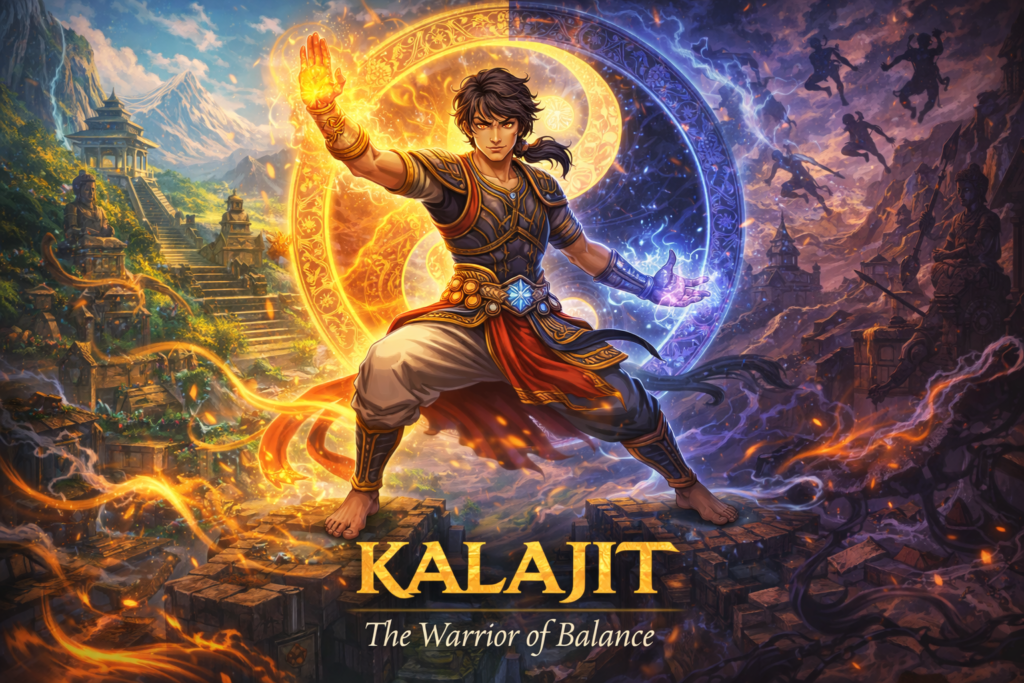
The first rays of dawn stretched across the valley of Shambala, casting golden hues over the quiet sanctuary. Aryan stood at the edge of the training grounds, his body still weary from his journey. The grand circular pavilion loomed ahead, its intricate carvings illuminated in the soft morning light.
The grounds were alive with activity. Disciples of all ages moved with precision and discipline, their forms flowing seamlessly between stances. Some practiced on wooden dummies, their strikes creating a steady rhythm, while others sparred in pairs, their movements like a deadly dance.
Aryan felt a knot tighten in his stomach. For all his skill and training, he was painfully aware that he didn’t belong here.
“Keep up, boy,” came a sharp voice from behind. Master Garuda strode past him, his steps brisk and purposeful. “The training begins now.”
Aryan hurried to follow, his legs heavy but his resolve unyielding.
Garuda led him to a secluded section of the grounds, where Master Nagini stood waiting. The tall, willowy woman gestured for Aryan to approach.
“This is where your journey truly begins,” Nagini said, her voice calm but firm. “You will start with the basics, as all disciples do. Forget what you think you know. Here, you are an empty vessel, to be filled with understanding.”
Aryan’s jaw tightened. He had trained under his father for years, mastering techniques most wouldn’t learn in a lifetime. The thought of starting over felt like an insult.
“I already know the basics,” he said, trying to keep the frustration from his voice.
Nagini arched an eyebrow. Without a word, she moved into a low, serpentine stance. Her body swayed gently, her hands raised in fluid, defensive positions.
“Show me,” she said.
Aryan hesitated, then dropped into his own stance, gripping the staff they had given him that morning. He lunged forward, aiming a precise strike at Nagini’s midsection.
She moved like water. Her body twisted effortlessly, and his strike hit nothing but air. Before he could recover, she struck his wrist with two fingers, forcing him to drop the staff.
“Too rigid,” she said, stepping back. “You telegraphed your attack.”
Aryan gritted his teeth, retrieving his staff. He adjusted his stance, focusing on his breathing. This time, he feinted left before striking from the right.
Nagini’s hand shot out, her palm connecting with his chest. The impact sent him staggering back, his breath knocked from his lungs.
“Too slow,” she said.
Anger flared in Aryan’s chest. He charged again, this time with a flurry of strikes. Nagini dodged each one with maddening ease, her movements barely perceptible. Finally, she swept his legs out from under him, leaving him sprawled on the ground.
“Do you understand now?” she asked, her tone gentle but unyielding. “Strength without precision is useless. Speed without control is chaos. Kalaripayattu is not about overpowering your opponent. It is about becoming one with the flow of the fight.”
Aryan sat up, his breath ragged. He wanted to argue, to defend himself, but deep down, he knew she was right.
Nagini extended a hand, helping him to his feet. “You have potential,” she said. “But potential is meaningless without discipline. If you wish to continue, you must learn to let go of your ego. Only then can you truly begin.”
Aryan nodded, swallowing his frustration. “I’ll do whatever it takes,” he said.
Nagini smiled faintly. “Good. Then we begin with the serpent form.”
She stepped into the stance again, her movements slow and deliberate. “The serpent is patient. It waits for the perfect moment to strike. Its strength lies in its precision and adaptability. Watch closely.”
She demonstrated a sequence of fluid strikes and evasive maneuvers, each motion seamlessly transitioning into the next. Aryan watched, mesmerized by her grace.
“Your turn,” she said.
Aryan tried to mimic her movements, but his attempts felt clumsy and disjointed. Nagini corrected him with gentle taps and quiet instructions, guiding him through the sequence until his motions began to flow more naturally.
Hours passed, the sun climbing higher in the sky. By the time Nagini called for a break, Aryan’s muscles ached in ways he hadn’t thought possible.
As he sat beneath a tree, gulping water from a clay jug, he caught sight of the other disciples practicing nearby. Their movements were flawless, each strike and block executed with effortless precision. He couldn’t help but feel a pang of inadequacy.
Master Vyaghra approached, his broad frame casting a shadow over Aryan. “You struggle,” he said bluntly.
Aryan nodded, his frustration evident. “I’ve never felt this… slow. This uncoordinated.”
Vyaghra crouched beside him, his expression thoughtful. “Every great warrior begins as a student. Even the Masters of Shambala once stumbled and fell. It is through those failures that we grow stronger.”
Aryan looked up, meeting the Master’s piercing gaze. “And if I fail again?”
“Then you stand up again,” Vyaghra said. “Until you no longer fall.”
As the sun set over Shambala, Aryan returned to the training grounds, his body weary but his resolve stronger than ever. The serpent form was not just a technique—it was a lesson in patience and adaptability, a challenge to let go of his anger and ego.
And though the path ahead seemed insurmountable, he knew one thing for certain: he would not give up.
The clang of wooden staffs striking filled the crisp morning air as Aryan braced himself for another attack. Master Vyaghra’s movements were relentless, his strikes deliberate and powerful. Each blow sent vibrations up Aryan’s arms, his grip faltering with every deflection.
“Hold your stance!” Vyaghra barked, his booming voice reverberating across the training grounds.
Aryan gritted his teeth, adjusting his footing as another strike came down. The force of it nearly knocked the staff from his hands, but he managed to absorb the blow and push back.
“Better,” Vyaghra said, stepping back and lowering his staff. He circled Aryan like a predator, his sharp eyes scanning him for weakness. “But not good enough. You’re too reactive. The tiger does not wait to be attacked—it dominates the battlefield.”
Aryan straightened, his breaths heavy. He had barely recovered from the grueling serpent training the day before, and his body screamed for rest. But there was no room for excuses here.
Vyaghra planted his staff into the ground, his posture unyielding. “The tiger form is about strength and control. Without control, strength is wasted. A reckless tiger is a dead tiger.”
Aryan nodded, his grip tightening on the staff. “Show me,” he said, his voice steady despite his exhaustion.
Vyaghra’s lips twitched into the faintest of smiles. “Good. Watch closely.”
He shifted into a wide, grounded stance, his movements deliberate and precise. Each step was firm, every strike of his staff fluid yet forceful. As he demonstrated, his strikes transitioned into blocks and counters, the rhythm of his movements commanding the space around him.
“The tiger moves with purpose,” Vyaghra said, his voice calm despite the power in his strikes. “It strikes not in anger, but with precision. Feel the ground beneath you. Draw strength from it.”
Aryan imitated the stance, his knees bent, his body low and centered. He mimicked Vyaghra’s movements, his strikes tentative at first but growing stronger with each attempt.
“Don’t just strike,” Vyaghra said, stepping beside him. “Feel the flow of energy from your feet to your hands. Let the power build naturally.”
Aryan adjusted his stance, grounding himself more firmly. This time, when he struck, he felt the force ripple through his body, the movement more fluid and connected.
“Yes,” Vyaghra said, nodding. “Now, again.”
For hours, they repeated the sequence, Vyaghra correcting Aryan’s posture and movements with gruff but precise instructions. Aryan’s muscles burned, his body drenched in sweat, but with each repetition, his strikes grew sharper, his stance more solid.
By midday, Aryan stood in the center of the pavilion, facing off against another disciple—a wiry young man named Suraj. The sparring session was meant to test Aryan’s application of the tiger form under pressure.
Suraj lunged first, his staff cutting through the air with speed and precision. Aryan met the attack head-on, his strikes heavier but slower. Suraj evaded easily, darting around Aryan and landing a sharp blow to his side.
“Faster!” Vyaghra barked from the sidelines. “A tiger does not chase its prey—it corners it!”
Aryan grunted, shifting his stance. He tried to anticipate Suraj’s movements, but the younger disciple was too quick, his attacks too unpredictable.
Suraj feinted left before striking right, and Aryan barely managed to deflect the blow. He felt his frustration rising, his focus slipping.
“Focus!” Vyaghra shouted. “Your strength means nothing if you cannot control it!”
Aryan took a deep breath, steadying himself. He shifted his grip on the staff, grounding his stance as Vyaghra had taught him. This time, when Suraj attacked, Aryan didn’t react immediately. He waited, watching the trajectory of the strike.
At the last moment, he stepped into the attack, deflecting it with a sharp upward motion. The force of the counter caught Suraj off guard, and Aryan followed with a powerful downward strike that sent his opponent’s staff clattering to the ground.
“Good,” Vyaghra said, stepping onto the platform. “But not good enough.”
Before Aryan could recover, Vyaghra launched an attack of his own, his staff a blur of motion. Aryan scrambled to block, his arms straining under the force of each strike.
“Control the flow of the fight!” Vyaghra shouted, his movements unrelenting. “If you allow me to dictate the rhythm, you will lose every time!”
Aryan adjusted his stance, pushing back against Vyaghra’s relentless assault. He began to anticipate the strikes, deflecting them with calculated movements. Slowly, he shifted from defense to offense, forcing Vyaghra to step back.
The moment Aryan thought he had gained the upper hand, Vyaghra swept his legs out from under him, sending him crashing to the ground.
“You’re improving,” Vyaghra said, extending a hand to help him up. “But you still have much to learn.”
Aryan took the offered hand, his body aching but his resolve stronger than ever. “I’ll get it,” he said, his voice steady.
Vyaghra nodded, a glimmer of approval in his eyes. “Good. Tomorrow, we begin again.”
As the sun dipped below the horizon, Aryan sat alone at the edge of the training grounds, his staff resting across his lap. The tiger form had tested not only his strength but his patience and focus. For the first time since arriving in Shambala, he felt a flicker of pride.
But as he gazed out at the valley, his thoughts drifted back to Kshatra. The memory of his family’s destruction lingered like a shadow, a reminder of why he was here.
“I will master this,” Aryan murmured, gripping the staff tighter. “I will stop him.”
Above him, the stars began to emerge, their light a quiet reassurance that his journey was far from over.
The afternoon sun cast long shadows over the training grounds as Aryan prepared for his next lesson. His muscles were sore from the grueling sessions with Master Vyaghra, but his mind remained sharp, driven by an unrelenting need to improve.
Today’s session was different. The air felt heavier, tense with an unspoken challenge that Aryan couldn’t quite place. He adjusted his stance, his fingers gripping the staff tightly as Master Garuda approached.
“Today, you spar with one of your peers,” Garuda announced, his voice brisk. “The lessons you’ve learned so far will be tested in real combat. This is not just about your skill with the staff—it is about your control over yourself.”
Aryan nodded, trying to suppress the flicker of doubt that rose in his chest.
A figure stepped forward from the line of watching disciples. It was Suraj, the wiry young man who had bested Aryan during a sparring match days ago. He wore a faint smirk, his confidence radiating in sharp contrast to Aryan’s nervous energy.
Garuda gestured for them to take their positions on the training platform. “Begin when ready,” he said, stepping back to observe.
Suraj moved first, his staff cutting through the air in a wide arc aimed at Aryan’s midsection. Aryan deflected it with ease, his movements grounded and deliberate. He countered with a swift strike, but Suraj sidestepped, spinning into a fluid counterattack that nearly caught Aryan off guard.
The two circled each other, their strikes and counters building a steady rhythm. Aryan felt his confidence growing as he began to anticipate Suraj’s movements. He pressed forward, forcing his opponent to retreat under the weight of his attacks.
But then Suraj feinted, baiting Aryan into overextending. With a sudden shift, Suraj swept Aryan’s legs out from under him, sending him sprawling onto the platform. The watching disciples murmured, a ripple of anticipation running through the crowd.
“Get up,” Suraj said, his tone taunting.
Aryan’s jaw tightened as he climbed to his feet. His grip on the staff felt too tight, his breathing quick and shallow.
“Focus, Aryan,” Garuda called from the sidelines. “Your anger makes you predictable.”
Aryan’s eyes narrowed. He adjusted his stance, grounding himself as Master Vyaghra had taught him. When Suraj attacked again, Aryan didn’t react immediately. Instead, he waited, watching the flow of his opponent’s movements.
At the last moment, Aryan stepped into the attack, redirecting the force with a sharp upward strike. Suraj staggered, momentarily off-balance. Aryan seized the opening, delivering a precise strike to his opponent’s side that sent him to the ground.
The crowd fell silent.
Suraj rose slowly, his expression unreadable. “Lucky,” he muttered, but there was no venom in his voice.
Garuda stepped forward, clapping once to signal the end of the match. “A victory,” he said, his sharp gaze fixed on Aryan. “But not a clean one. Your anger clouds your judgment. If you rely on it, it will destroy you.”
Aryan opened his mouth to respond, but the words caught in his throat. He looked down at his staff, his grip still tight, and realized Garuda was right. He hadn’t won because of skill or control—he had won because he was desperate not to lose.
That evening, Aryan sat alone beneath the ancient banyan tree at the edge of the training grounds. The bruises on his arms and legs throbbed, but the ache in his chest was harder to ignore.
His mind drifted to his father, to the nights they had trained together in the courtyard of their home. His father’s voice echoed in his memory: “The strongest warriors are not those who fight with rage, but those who fight with clarity.”
But how could he find clarity when his heart was consumed by the pain of loss? How could he let go of his anger when it was the only thing driving him forward?
“You’re thinking too loudly,” a voice interrupted.
Aryan looked up to see Master Nagini standing nearby, her serene expression illuminated by the moonlight. She approached and sat cross-legged beside him, her presence calming yet commanding.
“You let the past control you,” she said. “Your anger binds you to it, like a chain that grows heavier with every step you take.”
Aryan lowered his gaze. “I don’t know how to let it go,” he admitted.
Nagini was silent for a moment, her eyes scanning the horizon. “Your pain is real,” she said finally. “No one can ask you to forget it. But if you carry it with you into every battle, it will blind you. The more you fight with rage, the closer you come to becoming what you hate.”
Aryan’s fists clenched in his lap. “I can’t just forget what happened. Kshatra killed my family. He destroyed everything I had.”
Nagini turned to him, her gaze piercing. “And what will you have left when you destroy him? Will your family return? Will your home be whole again?”
The question struck Aryan like a physical blow. He opened his mouth to respond but found no words.
“The path of balance is not about forgetting,” Nagini continued. “It is about accepting. Accept what has been lost, and use it to guide you—not to consume you.”
Aryan stared at the ground, her words sinking in like water into parched soil. He didn’t know if he could do what she asked, but he realized that he needed to try.
“I want to learn,” he said quietly.
Nagini smiled, her expression softening. “Good,” she said. “Then tomorrow, we begin again.”
As she stood and walked away, Aryan leaned back against the tree, the weight on his chest feeling just a little lighter. The road ahead was long, but for the first time, he felt a glimmer of clarity breaking through the fog of his anger.
The early morning air was crisp as Aryan knelt in the meditation hall, its stone floor cool beneath him. The space was open to the elements, with carved wooden beams framing the rising sun. The scent of sandalwood lingered in the air, a faint trail of smoke curling from a single burning lamp in the center of the room.
Master Nagini circled Aryan slowly, her footsteps silent as she observed his posture. “Your breath is erratic,” she said, her tone even. “Calm your mind, or your body will never follow.”
Aryan exhaled sharply, frustration bubbling beneath his surface. Meditation was proving to be as difficult as combat, if not more so. His thoughts raced, leaping from memories of his father’s teachings to flashes of Kshatra’s cruel smile.
“How can I calm my mind when it’s filled with…” he hesitated, searching for the right word, “…everything?”
Nagini knelt beside him, her movements graceful. “You are trying to silence your thoughts. That is not the way. The mind is like a river—let it flow, but do not let it carry you. Observe, do not resist.”
Aryan closed his eyes, her words circling in his head. Let it flow, but do not let it carry you. He focused on the rhythm of his breathing, the rise and fall of his chest. For a moment, the storm in his mind eased, the chaos giving way to a faint sense of stillness.
Nagini’s voice broke the silence, low and measured. “Now, focus on your prana—the life force that flows within you. Feel it, like a current moving through your body. With every breath, draw it inward.”
Aryan did as she instructed, his focus narrowing to the faint warmth radiating from his chest. It was subtle at first, like a distant pulse, but as he concentrated, the sensation grew stronger.
“Good,” Nagini said. “Now, direct it.”
“Direct it where?” Aryan asked, his voice tense with effort.
“Where it is needed,” she replied.
He shifted his focus, imagining the energy coursing through his arms and legs. A tingling sensation spread through his limbs, as if the warmth in his chest were being carried outward by his breath. It wasn’t just his imagination—his body felt lighter, stronger.
The stillness shattered as Master Vyaghra’s booming voice echoed from the doorway. “Enough sitting. Time to put this to use!”
Aryan’s eyes snapped open. He turned to see Vyaghra striding into the hall, a broad grin on his face. “If you can control your prana in stillness, let’s see if you can control it in motion.”
They moved to the open training grounds, where a wooden dummy stood waiting. Its surface was scarred from countless strikes, its base weighted with stone. Aryan stood before it, his staff in hand.
“Channel your prana,” Vyaghra instructed. “Focus it into your strikes. Let the energy flow from your breath to your movements.”
Aryan nodded, adjusting his stance. He closed his eyes for a moment, drawing his breath inward and feeling the warmth build in his chest. When he opened them, his focus was razor-sharp.
His first strike was tentative, the staff connecting with the dummy with a dull thud.
“Again,” Vyaghra said, his tone unyielding.
Aryan struck again, this time with more force. The vibrations traveled up his arms, the impact resonating through his body.
“Do not force it,” Vyaghra said. “Let the prana guide your movement. Flow with it.”
Aryan adjusted his grip, his mind steadying. He inhaled deeply, feeling the energy gather within him. As he exhaled, he swung the staff in a fluid arc, the motion carrying the weight of his intent.
The strike connected with a crack that echoed across the training grounds. The dummy shook, its base shifting slightly.
Vyaghra grinned. “Better. Again!”
Aryan repeated the motion, each strike more precise than the last. With every blow, he felt the prana coursing through him, amplifying his strength and focus. Sweat dripped from his brow, but his body moved with a newfound lightness.
After a dozen strikes, Vyaghra raised a hand. “Enough. Now, let’s see how you fare against a moving target.”
Aryan turned to see Garuda approaching, his expression sharp and assessing. “I’ll be your opponent,” Garuda said, his staff spinning effortlessly in his hands.
Aryan squared his shoulders, his muscles tensing. Garuda’s speed and precision were legendary among the disciples, and sparring with him was no small challenge.
“Remember your breath,” Vyaghra said, stepping back. “And remember—control, not force.”
Garuda struck first, his staff a blur of motion. Aryan barely managed to deflect it, the force of the blow vibrating through his arms. Garuda moved again, his strikes fluid and relentless, forcing Aryan to retreat.
Aryan struggled to keep up, his defenses faltering. Garuda’s movements were faster than anything he’d faced before, each strike calculated to exploit his weaknesses.
“Focus, Aryan!” Vyaghra barked.
Aryan took a deep breath, centering himself. He let the prana flow, his movements becoming more deliberate. When Garuda struck again, Aryan didn’t react out of instinct. He waited, watching the trajectory of the attack.
At the last moment, he stepped into the strike, redirecting it with a sharp twist of his staff. Garuda staggered slightly, his balance disrupted.
Aryan pressed forward, his strikes gaining momentum. For the first time, he felt in control—not just of the fight, but of himself.
“Good,” Garuda said, stepping back and lowering his staff. His voice carried a note of approval. “You’re starting to understand.”
Aryan lowered his staff, his breaths coming in heavy but steady. For the first time since arriving in Shambala, he felt a sense of accomplishment—not from defeating his opponent, but from mastering himself.
Vyaghra clapped him on the shoulder, his grin wide. “Not bad, boy. But don’t get cocky. This is just the beginning.”
Aryan smiled faintly, his exhaustion momentarily forgotten. For the first time, he believed he could do this—not just survive, but thrive.
The evening air in Shambala was unusually still. The rhythmic hum of the nearby streams, once soothing, now seemed to carry a faint tension. Aryan stood at the edge of the training grounds, the soft glow of the pavilion lights behind him. Despite his physical exhaustion from the day’s rigorous training, he couldn’t shake the unease that had settled in his chest.
The Masters had called for an assembly. Word had spread among the disciples—something was happening beyond the sanctuary. Something dangerous.
The gathered students formed a semicircle around the Masters, their expressions a mix of curiosity and concern. Master Vyaghra stood at the center, his imposing frame illuminated by the torchlight. Beside him were Masters Nagini and Garuda, their faces grave.
“Tonight, we break tradition,” Vyaghra said, his voice a low rumble that silenced the crowd. “Shambala has always stood as a sanctuary—a place of learning and peace, removed from the chaos of the world. But that peace is under threat.”
Murmurs rippled through the crowd, disciples exchanging uneasy glances. Aryan stepped closer, his heart pounding.
Nagini raised a hand, her voice cutting through the noise. “We have received word from our scouts. Dhruksha has begun his march.”
The name sent a chill down Aryan’s spine. Though he hadn’t seen the man himself, the devastation Dhruksha’s forces had left behind was etched into his memory. His father’s voice echoed in his mind: “He twists everything he touches, turning discipline into destruction, order into chaos.”
“He is not coming alone,” Nagini continued. “His army grows with every village he passes. He offers power to those who join him and destruction to those who resist.”
Garuda stepped forward, his piercing gaze scanning the disciples. “Among his ranks are rogue martial artists, some of them trained in Kalaripayattu. He has corrupted them, teaching forbidden techniques that exploit prana for destruction rather than balance.”
Aryan felt a surge of anger rise within him. The idea of Kalaripayattu—an art rooted in discipline and harmony—being used for such purposes was a betrayal of everything his father had taught him.
“What do we do?” a voice called from the crowd.
Vyaghra’s expression hardened. “We prepare,” he said. “Shambala has remained hidden for centuries, but Dhruksha knows of its existence. His ultimate goal is to corrupt our teachings and use them to dominate the world. If he finds us, he will not hesitate to destroy everything we stand for.”
The disciples shifted uneasily. For many of them, the idea of combat beyond the controlled sparring of the training grounds was a foreign concept. Shambala had always been a sanctuary, not a battlefield.
Nagini’s gaze softened as she addressed the crowd. “This is not a call to arms,” she said. “It is a call to awareness. Dhruksha thrives on chaos, on exploiting fear. We will not let him find Shambala, but if he does, we must be ready to defend it—not with anger, but with clarity and purpose.”
Garuda nodded, his voice sharp. “Each of you has trained for this, whether you realize it or not. Kalaripayattu is not just a tool for combat—it is a way of life. Dhruksha cannot corrupt what is pure unless we allow it.”
Aryan felt a hand on his shoulder. He turned to see Suraj standing beside him, his usually confident expression replaced with one of uncertainty.
“They’re really coming, aren’t they?” Suraj asked, his voice low.
Aryan nodded, his grip tightening on the staff he held. “It doesn’t matter,” he said, more to himself than to Suraj. “We’ll stop them.”
Later that night, Aryan sat alone beneath the banyan tree, his thoughts heavy. The Masters’ words had stirred something within him—a combination of fear and determination. Dhruksha wasn’t just a distant threat anymore. He was coming, and Aryan knew that his arrival would bring devastation.
He closed his eyes, focusing on the breathing techniques Nagini had taught him. The familiar warmth of his prana spread through his body, calming his restless mind.
“You’re restless,” a voice said, startling him.
Aryan’s eyes snapped open to see Master Garuda standing nearby, his arms crossed. “It’s written all over your face.”
Aryan hesitated, then nodded. “I just… I don’t know if I’m ready,” he admitted.
Garuda approached, his expression unreadable. “None of us ever feel ready,” he said. “But readiness isn’t about certainty—it’s about resolve. The question isn’t whether you’re ready. The question is whether you’re willing.”
Aryan frowned. “Willing to do what?”
“To protect what matters,” Garuda said simply. “To defend the balance, even when it means facing the darkest parts of yourself.”
Aryan thought of his family, of the life that had been stolen from him. He thought of his father’s teachings, of the sanctuary of Shambala.
“I’m willing,” he said, his voice steady.
Garuda nodded. “Good. Then remember this: Dhruksha thrives on fear and anger. If you give in to either, you’ll lose—not just the fight, but yourself.”
Aryan met Garuda’s gaze, a flicker of determination igniting within him. “I won’t let that happen.”
Garuda’s lips curved into a faint smile. “See that you don’t,” he said, before turning and walking away, his silhouette disappearing into the night.
As the stars shimmered above, Aryan sat beneath the banyan tree, his resolve hardening like tempered steel. The shadow of Dhruksha loomed closer, but for the first time, Aryan didn’t feel fear.
He felt ready.