The floor of the trench exploded upward.
Not rock.
Not dirt.
Memory.
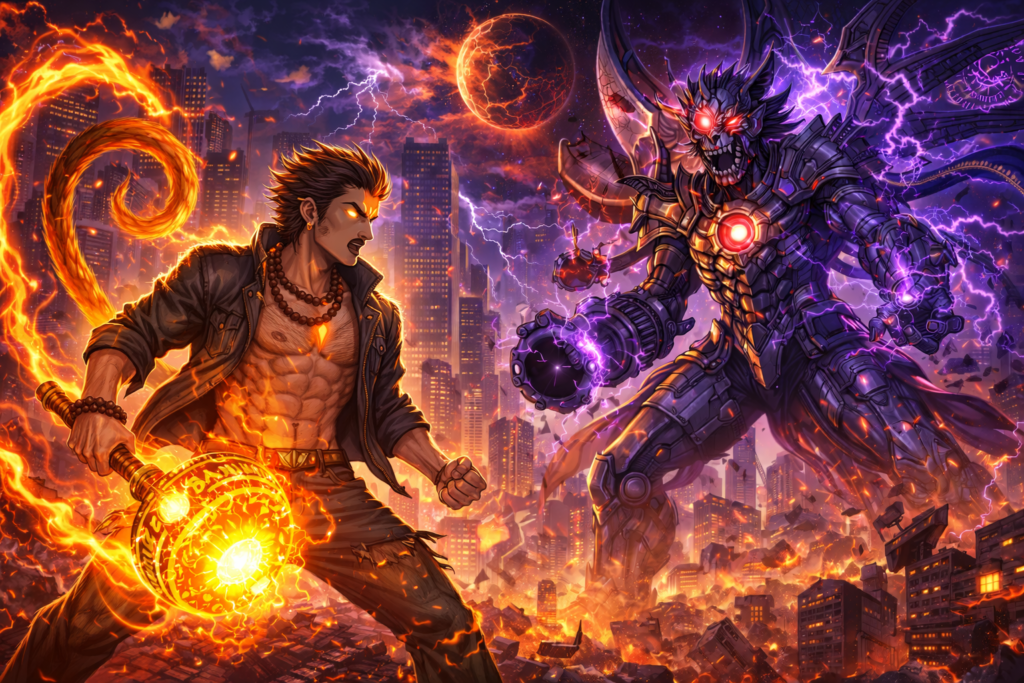
Slick red glyphs shot skyward, slicing through the air in perfect spirals. And from beneath them, a figure rose. Not walking. Not flying. Buoyed by the Shivnadi itself.
Kalnemi.
But not as they had seen him.
His arms were sleeved in flowing blood, dripping upward. His chest glowed with ancient script, shifting like tectonic plates. His eyes—vanished. Replaced by twin whirlpools of spinning, hungry mantras.
Makardvach stared up at him. Not flinching. But grieving.
“You let the river wear you.”
Kalnemi’s voice was deeper now. Multilayered.
“No. I let it remember what it once was. You wanted to seal it. I wanted to free it.”
He raised his arm. The river obeyed. It slithered into the trench, forming spectral limbs, half-bodied spirits, incomplete monsters, all tied to the Shivnadi’s rhythm.
Makardvach gripped Vānaprakāśa. The storm whirled at one end. The golden light burned on the other. He charged.
Kalnemi raised a hand. And the trench inverted.
Gravity broke.
Makardvach fell upward, spun in blood-laced air, hit a wall, and flipped mid-air to land—hard. The weapon stayed in his grip. He sprang back up.
Kalnemi descended, not flying but being carried by the Shivnadi’s pull.
Makardvach attacked again. The first blow connected—a direct hit to Kalnemi’s chest. But it sank in like striking a dream. The mantra-light evaporated inside Kalnemi’s torso. And came out twisted on the other side. A backblast of energy hurled Makardvach across the trench, into a jagged fossil pillar.
Blood dripped from his nose.
He got back up.
“You can’t win,” Kalnemi said. “You don’t understand. This river was never punishment. It was potential.”
Makardvach spat blood. “Potential without mercy is just another cage.”
Kalnemi raised both hands now. The trench began to collapse. The sky overhead cracked. And across Paatal Lok, every glyph began to glow.
The Shivnadi wasn’t awakening anymore.
It was preparing to spill.
Makardvach lay still. One knee down. Blood running across his face, mixing with the red-soaked earth. The golden glow of Vānaprakāśa flickered—one end dim, the other cold.
Kalnemi floated above, silent now. No longer gloating. No longer human. Just… becoming.
The trench itself bent around him like a mouth ready to open.
Makardvach tried to lift the weapon. His arms wouldn’t respond. His heartbeat slowed.
Then—a breeze.
Not wind.
Just a breeze.
Soft. Like breath on the back of the neck.
A presence.
No voice.
No shape.
Only warmth.
And a single thought:
“He was never meant to win by might.”
Makardvach’s eyes widened. Not because he heard Hanuman’s voice. But because he didn’t. He felt it. The way a child knows they’re being held, even when blindfolded.
A memory rose.
A temple garden.
Night.
Young Hanuman, crying. Not from fear. From confusion.
He’d leapt to the sun that morning. The gods had punished him. Made him forget.
And someone—a quiet, faceless sage—had held him.
“Someday, you will forget again. And someone else will remember for you.”
Makardvach stood.
His legs trembled.
But he stood.
He whispered: “You left the Shivnadi open… so it could still be turned. You made yourself forget… so I could remember.”
Kalnemi turned.
“What are you muttering?”
Makardvach raised Vānaprakāśa. But not to attack. He held it over his heart.
“Then take me in. Let me become your next mistake.”
The Shivnadi pulsed. Kalnemi’s form trembled.
“What are you doing!?”
Makardvach stepped forward. Not to fight. To merge.
The weapon glowed again—bright now. White-hot. Steady.
Megha’s voice crackled through the comms above.
“Makardvach, stop! If he takes you in—”
But it was too late.
The flood surged.
Kalnemi roared.
Makardvach leapt straight into the core.
He expected pain. He expected death.
He didn’t expect… music.
Not notes. Not rhythm. But the tone of a thousand voices whispering at once.
Some prayed. Some begged. Some simply wept.
Makardvach floated—formless now—his body reduced to pulse and thought.
The Shivnadi didn’t swallow him.
It read him.
Memories drifted past like slow-burning stars. Each one not his. But belonging to those the river had devoured.
A mother feeding her child as flames consumed her roof.
A soldier lowering his blade the moment he realized his enemy was praying too.
A demoness kissing a mirror because no one else ever had.
Each vision lasted only seconds.
Each one carved itself into him.
Makardvach cried.
Not from pain.
From witness.
Then the river stopped.
The visions cleared.
Ahead stood a figure. Not Kalnemi. Not Hanuman.
Himself.
But not as he was now.
As he would become.
Older. Scarred. Eyes gold. Heart quiet.
And that version spoke.
“You are not meant to hold the river. You are meant to remember what it forgot.”
He reached out his hand.
In it—a scroll.
No ink.
Just light.
Makardvach touched it.
And the final mantra burned into his soul:
Naashaye tamah, smritir jaye.
Yatra naam na ho, wahan rosh na ho.
Let darkness perish, and memory reign.
Where names are remembered, wrath cannot remain.
The scroll vanished.
The river began to tremble.
Not in violence.
In release.
Makardvach reached out with both hands.
And whispered the mantra.
The Shivnadi sang.
The blood lost its grip.
The rage turned to rain.
And Makardvach woke.
Not with breath.
With light.
He exploded out of Kalnemi’s chest in a beam of riverfire—
not red,
but white-gold,
etched with every glyph the Shivnadi had carried for millennia.
Kalnemi screamed.
“No… no, this is not memory! This is mercy!”
He began to fall.
But the Shivnadi, now freed, flowed upward. Outward. Around him.
Above, Megha and Rishabh watched as the trench bloomed with light.
Lanka raised his blades—then lowered them.
Makardvach floated in the air, glowing, eyes closed, arms outstretched.
The mantra continued to pour from him—not as chant, but as reality.
The river responded.
The spirits once twisted in blood began to reform.
Some smiled.
Some wept.
Some bowed.
Kalnemi’s body cracked.
His arms shattered.
His chest split open.
And from within—
A boy.
Young.
Alone.
Afraid.
“I didn’t want to destroy everything. I just wanted… to never be forgotten.”
Makardvach didn’t strike.
He placed one hand over Kalnemi’s heart.
“Then let memory be your end. Not erasure.”
Kalnemi dissolved—
Not into ash.
Into light.
The Shivnadi flowed once more.
Not blood.
Not weapon.
River.
For the first time in countless ages.
It remembered how to flow without burning.
Makardvach descended.
Vānaprakāśa in hand.
The last drop of the old river in his palm.
Still glowing.
Still pulsing.
But… calm.
The trench was quiet.
For the first time in known history, it was truly, utterly silent.
The Shivnadi now floated through the air like a ribbon of living thought—not rushing, not drowning—simply moving.
It circled Makardvach once. Twice. Then hovered before him—light woven with memories, faces, and forgotten names, flickering like stars trapped in water.
Rishabh approached, staff lowered.
“Is it… over?”
Makardvach didn’t answer.
The Shivnadi was speaking again.
Not in words.
In intention.
And this time, he understood.
“I am unbound.
But not aimless.
I remember all who held me.
Feared me.
Used me.
You did not.
You listened.”
Megha stepped forward, hand over heart.
“We could seal it again.”
Akshay shook his head. “Or use it. For healing. Justice. History.”
Lanka said nothing.
His gaze stayed locked on the river.
Makardvach raised Vānaprakāśa.
The river dimmed.
Waited.
He knelt.
“You are not a weapon.
You are a library of the unloved.
Go.
Flow not where you are told—
But where you are needed.”
The Shivnadi pulsed once.
Then unfolded like a scroll made of dawn.
It rose—
Through rock.
Through cloud.
Through realms.
And vanished.
But not completely.
The glyphs it passed through?
They remained.
Alive.
Evolving.
The Shivnadi had become a story.
And it would never again be forgotten.
Makardvach stood.
Scarred.
But whole.
Rishabh nodded.
“The real war begins now, doesn’t it?”
Makardvach looked to the stars above the trench.
And smiled.
“No.
Now… we write something better.”