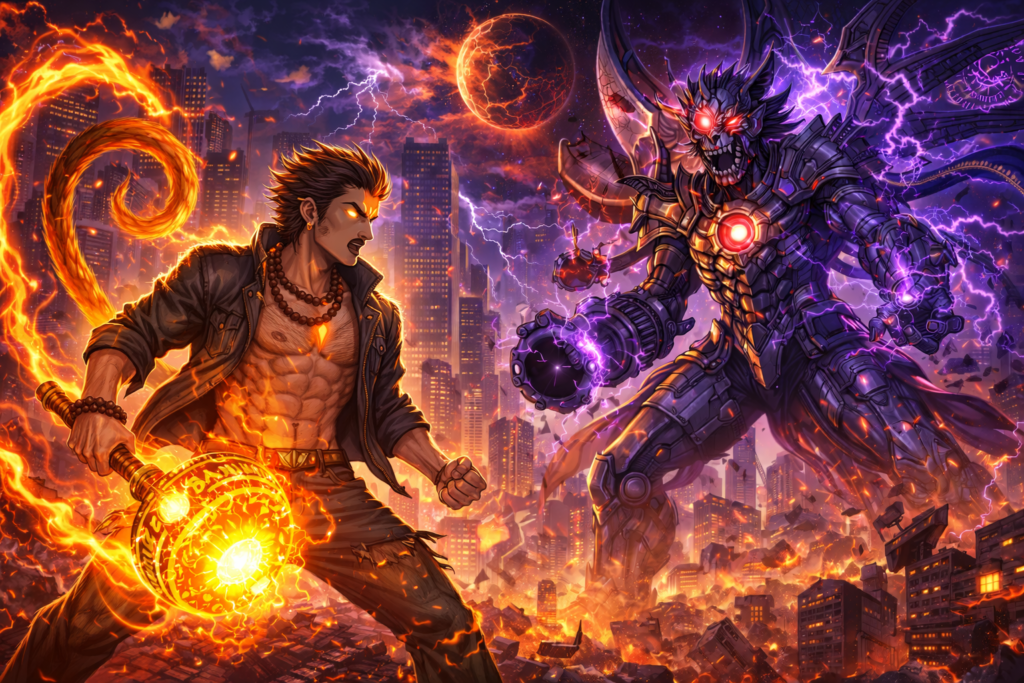
The walls appeared without warning.
Stone turned soft.
Air thickened into mirrors.
Megha took one step forward—and the world around her shifted.
Split.
Multiplied.
Suddenly, they were alone.
Rishabh.
Akshay.
Megha.
Lanka.
Makardvach.
Each dropped into their own private corridor.
A whisper slithered through the air:
“A fear unspoken… is a doorway unopened.
Let’s see what you’ve locked away.”
Makardvach stood in a hall lined with bronze panels.
Each one showed a reflection of him—slightly off.
One older.
One burned.
One smiling with too many teeth.
He ignored them.
Kept walking.
With each step, the walls tightened.
The floor curved upward.
Then the panels stopped showing him.
They showed Hanuman.
Bleeding.
Kneeling.
Crushed beneath a black boot.
And above him—Makardvach.
Not as he was now.
But twisted.
Eyes red.
Wielding the gada like a tyrant.
Crowned in smoke.
“No,” he whispered. “That’s not real.”
The walls didn’t listen.
The reflection spoke:
“You carry our power.
But do you carry our grace?
What happens when you start choosing who is worthy of saving?”
Makardvach turned.
Started to run.
But the floor stretched like rubber.
The air pulled him back.
Elsewhere, Rishabh stood in a garden of golden leaves, each one etched with a name he’d failed to save.
The wind made them fall—slowly, deliberately—until they buried him.
Megha wandered a ruined library where every book screamed her name—accusing her of believing too late.
Akshay relived a loop:
His sister’s voice calling for help.
The fire.
His machines, dead in his hands.
And Lanka?
Lanka stood before his old army.
Each demon wore his face.
Each one whispered, “We are who you really are.”
He closed his eyes.
Refused to believe it.
The illusion cracked.
Slightly.
Back in the corridor, Makardvach fell to one knee.
The false reflection stepped closer.
“You will fail them.
You will break them.
And when you do, I will be what’s left.”
Makardvach didn’t lift his weapon.
He didn’t scream.
He breathed.
Softly.
Once.
Twice.
Then he sang.
Not to attack.
To remember.
“Jeevan-lekha antarnaad mein sthira ho…”
The reflection twisted.
Shrieked.
Shattered.
The corridor collapsed.
And Makardvach stepped through the ruin.
Still afraid.
But not broken.
He emerged into a black-glass atrium grown from obsidian vines.
Each vine pulsed with faint illusion-light.
Rishabh stood in the center.
Eyes closed.
Hands in namaskara.
“Still with me?” Makardvach asked.
Rishabh opened his eyes.
There was grief in them.
But behind the grief—iron.
“One truth kept me grounded,” he said. “You’re not alone.”
One by one, the others followed.
Megha.
Akshay.
Lanka—quiet, shaking, but standing.
None unscathed.
But all had refused the maze.
Then the mirrors hummed.
A tone like a lullaby about to scream.
They parted.
And Shitala stepped through.
She was veiled in smoke.
Her eyes hidden beneath silver ornaments like insect wings.
She didn’t walk.
She glided.
And her voice wrapped around them like silk steeped in venom.
“So many brave minds,” she purred. “So many beautiful fractures.”
Makardvach readied the gada.
Shitala raised a hand.
“No need. I did not come to fight.”
Akshay muttered, “Good. I wasn’t ready to get psychologically dismantled twice in one day.”
She smiled faintly.
“You’ve passed my walls. That alone earns you a choice.”
Megha stepped forward. “What kind of choice?”
Shitala extended her hand.
In it, five mirrors, no larger than a coin.
They shimmered gold.
“Take one. And I will return to you one memory you’ve lost.
One truth the gods hid.
One answer you’re not supposed to know.
But in exchange… you give me one fear.
One that defines you. Forever.”
Rishabh frowned. “We’d forget that fear?”
She nodded.
“And with it, the pain… and the wisdom it earned.”
Makardvach stepped closer.
“Why offer this?”
“Because I serve balance,” she said. “Not Kalnemi.
And sometimes, clarity is best earned by breaking the glass.”
She looked at him.
“You carry too many memories not your own.
Take the mirror, Vanara man. Choose what burden you’ll keep.”
Makardvach looked to his team.
Then at the mirror.
Then—
He crushed it in his palm.
“I’ll carry my pain. And earn my truths.”
Shitala’s veils fluttered.
Almost like a nod.
The other mirrors shattered.
The maze collapsed.
No roar.
Just silence.
As they stepped forward, her voice followed:
“Well done, little fire.
But you may yet wish you had forgotten.”
They followed the path downward.
The silence deepened, as though the world held its breath.
The air was heavier.
The gada grew heavier.
And then—they saw it.
The gate.
Thirty feet high, carved into black stone streaked with crimson.
It wasn’t painted.
It had wept.
Dozens of Vanara faces sculpted into the surface.
Each frozen mid-scream.
Each mouth open wide enough for one sound:
A lullaby.
Soft.
Endless.
Megha stepped close.
“It’s a cradle song,” she whispered. “A lullaby for Vanara infants… in wartime.”
Akshay shivered. “Creepiest thing you’ve said all year.”
Rishabh removed his sandals and bowed.
“This gate doesn’t open for power.”
Makardvach knelt beside him.
“What do we offer?”
“Grief.”
Lanka approached.
Silent.
He placed his hand on a screaming face.
The gate pulsed.
The song slowed.
And for the first time since his betrayal—Lanka wept.
“I fought in the raid that carved this,” he whispered. “I didn’t know they were still inside.”
Makardvach stepped beside him.
Placed his hand beside Lanka’s.
“I do know.”
And he offered his own memory:
His mother’s final prayer.
“Remember the light even when the gods turn their backs.
Remember… even if you walk alone.”
He spoke the words aloud.
The gate glowed.
Not red.
Not gold.
Something between.
It opened inward.
Slow.
Reluctant.
The lullaby stopped.
And silence fell.
But not empty silence.
Listening silence.
The sanctum was vast—no torches, no ceiling.
Only height.
The walls were carved in countless languages.
And everywhere a name should be, it had been scratched out.
Makardvach ran his fingers over a gouge.
It pulsed.
Not with magic.
With memory.
Megha studied the glyphs. “They all refer to a ‘first bearer.’ The one who opened the pact.”
“But why erase his name?” Akshay asked.
Lanka answered:
“Because names give power. If Kalnemi erased him, no soul could call him back.”
Makardvach turned.
“What if I already do?”
He moved to the altar.
The gada twitched.
A glyph ignited:
Marut.
Everyone froze.
Rishabh whispered, “That name…”
“Marut,” Makardvach said. “My mother used to say it in her sleep.”
Suddenly, every wall whispered:
“Marut… Marut…”
Megha stepped back. “He wasn’t just the first Vanara soul. He was—”
Makardvach finished:
“My brother.”
The glyph flared white.
A door unlocked.
The door behind the altar opened like breath through bone.
The corridor was made of petrified wood veined in gold.
Alive with light.
At its end: a pedestal.
Hovering above it, a weapon.
Not a gada.
Not a sword.
A twisted, spiraling staff—glowing red.
Hovering above it: fragmented glyphs.
Older than Vanara.
Makardvach stepped onto the pedestal.
The glyphs snapped into place.
Marut.
The weapon pulsed.
Wind stirred.
From the glyphs came a voice:
“You left me behind, brother…”
“I didn’t know you existed.”
“They made sure you wouldn’t.”
The staff lifted.
Spun.
Flew into his hands—
Not with violence.
With recognition.
From the darkness, a form descended.
Half spirit.
Half flame.
Vanara armor.
Flickering face—child, warrior, stranger.
“I don’t know if I’m still Marut.
Or what they made from what was left.”
Rishabh bowed.
“We came to restore what was taken.”
“Then prove I was worth remembering.”
The spirit raised its hand.
The gada and the staff lifted.
Spun.
Merged.
Tested.
A thousand Vanara voices filled the chamber.
Not in grief.
In judgment.
Makardvach knelt.
“I don’t want to wield you,” he said. “I want to walk with you.”
The spirit paused.
Faces settled.
And for one moment—
Only one remained.
A boy.
Smiling.
“Then walk.”
The spirit flowed into the staff.
The new weapon fused.
Gada at one end.
Staff at the other.
A weapon of balance.
Of memory.
Of brothers.