
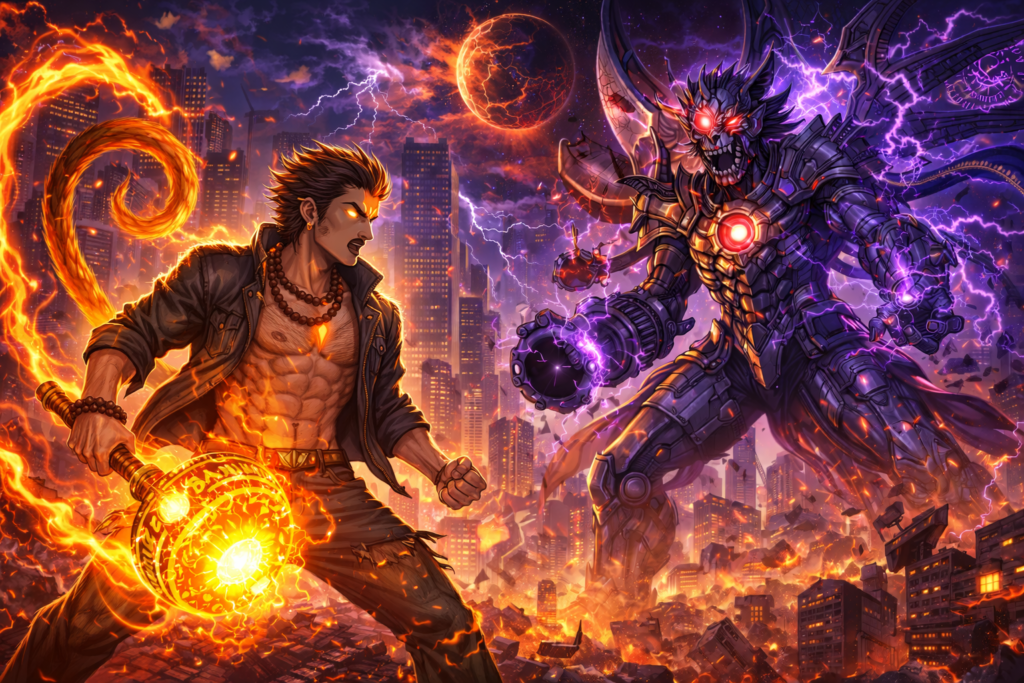
Kalnemi retaliates. His fire is not just destruction—it is corruption. As Varanasi burns under unnatural flame, Makardvach returns to the city as Vanara Man. But even fire fears the one born of wind.
The sky cracked open over Varanasi at 3:14 a.m.
There was no warning.
Just a wave of heat, unnatural and instant—like the world had been moved three feet closer to the sun.
Streetlights burst.
Phones fried.
Then the first pillar of fire rose from the eastern banks of the Ganges—towering, swirling, laced with black flame.
It didn’t burn like earthly fire.
It crawled.
Buildings touched by it didn’t just char—they withered, their steel frames turning inward, collapsing in on themselves like dying things.
Children screamed.
Dogs fled.
Priests at the Ghats tried to raise mantras—
But the fire laughed.
In the command tent near the edge of the city, red alerts flashed on every console.
Akshay stared in disbelief. “It’s… it’s not just combustion. These flames are spitting subharmonics—they’re disrupting air density, bending sound around the fire zones.”
Megha’s face was pale. “It’s cursed fire. Kalnemi’s hellblaze.”
Rishabh stood by the open flap of the tent, staring toward the glowing city skyline.
He didn’t blink.
“It’s begun.”
Makardvach was already moving.
Armor on.
Scarf snapped tight.
The gada burned at his back, already warm with anticipation.
As he passed the mirror, he paused.
Only briefly.
The eyes that looked back were no longer afraid of fire.
They welcomed it.
He stepped into the wind.
And jumped.
He landed near Dashashwamedh Ghat, where the flames licked up the steps of the temple like tongues of a hungering beast.
A mother screamed—trapped behind a wall of white-hot fire with a child curled against her.
Makardvach moved—
—and the flames parted.
Not because of force.
Because the wind answered him now.
He raised a hand.
And exhaled.
A gust whipped out from his body, circling him like a cyclone. It tore through the fire, carving a safe path for the woman and child.
“Run!” he shouted.
They did.
Another blast of hellfire surged toward him from the rooftops—guided by a robed demon holding a crimson staff.
Makardvach met it head-on.
The gada spun into his hand, glowing with script.
He struck the air—
And the flames bent backward.
The demon chanted again.
Makardvach didn’t wait.
He leapt to the rooftop in one breath, landing with a shattering thud. The demon turned just in time to catch the gada’s full arc—
—and was sent flying off the roof, crashing through three walls before erupting into ash.
Megha’s voice crackled through his comm. “You’re absorbing the fire?”
Makardvach looked down at his hands.
Glowing faintly now.
“No,” he said. “It just… knows me.”
Behind him, another column of flame exploded.
And he turned.
Makardvach enters the heart of Kalnemi’s infernal blaze to rescue civilians—but the fire recognizes the blood of Hanuman. In the furnace of corruption, he awakens another gift: divine fire immunity.
The inferno at Godowlia Junction burned like a living wound.
Every street was a river of flame.
Every breath a struggle.
The fire wasn’t spreading—it was choosing. Carving patterns across the city, swallowing landmarks with malice, not heat. No firefighter could touch it. Water turned to steam before it landed. Prayer only echoed.
And in the heart of it, surrounded by screaming, choking survivors—
Makardvach walked in.
No leap this time.
No flight.
Just a steady march into hell.
People screamed at him to stop. One old man lunged toward him—“Beta, no!”—but the flames reached for Makardvach first.
And they stopped.
Not all at once.
Not perfectly.
But clearly, visibly—hesitating.
Makardvach looked down at his hand.
No heat.
No pain.
The golden Vanara glyphs on his bracer flared, glowing brighter the deeper he moved.
He closed his eyes.
Reached inward—not for power, but for memory.
Hanuman.
Son of Vayu.
Who as a child had swallowed the sun.
Who survived the flames of Lanka.
Who laughed in fire because fire could never claim him.
Makardvach felt it then.
Not a shield.
Not resistance.
But acceptance.
He opened his eyes.
And walked faster.
He found them behind a collapsed tuk-tuk, crouched in a narrow alley: a family of four, faces streaked with ash and terror. The father tried to shield his children with his body.
Makardvach approached.
The flames parted like water.
The children stared at him like he was a god.
He held out a hand.
“Come.”
They did.
And as they passed through the walls of hellfire beside him, the little boy looked up and whispered:
“You’re not afraid of the fire?”
Makardvach smiled, calm. “The fire’s afraid of me.”
Minutes later, they emerged onto an untouched street where police and medics were waiting.
The family collapsed into rescuers’ arms, coughing, crying.
Makardvach didn’t pause.
He turned back toward the blaze.
Akshay’s voice came over comms: “What just happened? The thermal cameras are glitching. Are you in the center of the burn zone?”
Makardvach stepped through another plume of fire.
His cape now flowed with embers, not against them.
The flames licked at his suit like a curious animal.
They could not touch him.
Because he had remembered.
“I’m fine,” he said. “Tell the fire to try harder.”
Deep within the heart of Varanasi’s inferno, Makardvach faces the true source of the flames—not fire, but fury incarnate. A demon made of molten vengeance, Krodha’s lieutenant emerges from the blaze to crush the city’s last hope.
He didn’t see it first.
He heard it.
A groan of metal bending under unnatural weight. The high-pitched shriek of molten stone cracking. Then a deep, inhuman growl—more pressure than sound.
Makardvach turned the corner into one of the city’s old temple squares.
The fire was denser here—less wild, more… structured.
Flowing in spirals.
Curved sigils scorched into the pavement.
And at the center stood something wrong.
Twelve feet tall.
Hunched.
Armored in slag and molten iron that pulsed with red-hot breath. Its face was a visor of cracked volcanic glass, from which glared two eyes of seething lava. The creature’s gauntlets were etched with demon runes. From its chest, a slow ooze of magma dripped in time with its heartbeat.
Makardvach stepped forward.
The creature raised its head.
And spoke.
Not in words.
In a roar.
It was the sound of a child screaming in rage.
Of a forest burning alive.
Of a city watching itself be swallowed.
Makardvach flinched.
The gada at his back quivered.
“Akshay,” he muttered into comms. “Tell me what I’m looking at.”
Static.
Then—“That’s… not in any database. But energy signature matches something from Paatal Lok—hell-level entity, Fury-class. Your suit’s filters are maxing out.”
“I noticed.”
Makardvach stepped into the square.
The molten beast growled again and began to charge—each footstep cracking the stone, flames flaring with each movement.
Makardvach didn’t move.
Not yet.
He let the creature come.
When it swung—a massive overhead punch—Makardvach sidestepped, letting the fist crash through a market pillar.
The follow-up swipe came faster.
Makardvach ducked, rolled, brought up the gada—
And struck the creature across the ribs.
Boom.
The creature staggered.
But did not fall.
It turned its head slowly.
And hissed.
Makardvach narrowed his eyes.
“Okay,” he muttered. “Not just fire.”
He leapt high, spinning, and brought the gada down on the creature’s back—hard.
A ripple of golden energy spread through the impact.
This time, the creature stumbled.
A chunk of molten plating shattered off.
But it kept coming.
Megha’s voice crackled in his ear: “Makardvach! It’s not made of fire—it’s made of rage. Emotional energy. That’s Krodha’s whole essence!”
Makardvach leapt back, breathing hard. “Then what? I can’t beat it with heat.”
“No. But maybe… with calm.”
He stood still.
Closed his eyes.
Held the gada across his chest.
And breathed.
One long, still breath.
As the creature charged again—arms raised, flame roaring—
Makardvach exhaled.
And planted.
He whispered a mantra beneath his breath.
The bracer flared.
The gada shimmered—turning from flame to wind.
And Makardvach met the beast’s charge—
Not with a strike.
But with a redirect.
He moved with the force.
Twisted.
Guided it into the stone.
The creature smashed into the wall behind him—
And the wind, now dancing with mantra, shattered its body from the inside.
Silence.
Then collapse.
The flames around the square dimmed.
Not gone.
But subdued.
Makardvach stood alone in the smoke.
And whispered to the quiet,
“Fury can burn cities.
But peace can unmake monsters.”
As Makardvach vanishes into the smoke after saving Varanasi, survivors begin to share their stories. Some call him a myth. Others, a miracle. But across the city—and the world—a new name begins to spread: Vanara Man.
The fires were out.
Not all.
But enough.
The ones that remained now crackled like tired beasts, not howling ones.
And amid the wreckage, people talked.
At first, just in whispers.
“I saw him walk through the fire. Barefoot. Nothing touched him.”
“My kid was under a collapsed scooter. The fire came close—and then stopped. It just stopped. Like it saw him.”
“He didn’t even say anything. Just nodded. And the wind moved around us.”
News cameras caught nothing but shadows.
Too much heat interference.
Official drones failed mid-transmission.
But phones—blurry, scorched, barely-functioning phones—captured something.
A shape in red and gold, moving through the smoke, holding a glowing mace.
One still image, posted to social media by a college student, went viral within hours:
A man in a flowing scarf, backlit by fire, holding a family’s hands as he led them out of the flames.
Caption:
“Not all gods live in the sky. Some walk through our cities.”
The replies came fast.
“Who is this?”
“That’s him—the Vanara guy.”
“Bro that’s Hanuman Man.”
“No. The news called him Vanara Man.”
The tag caught.
By morning, it was trending across three continents.
In the underground corners of the internet—where myths are dissected and magic is debated—threads appeared:
“THE VANARA MAN IS REAL.”
Some called him a government experiment.
Others, an incarnation.
One user posted a shaky close-up from a drone clip—just the edge of the gada, glowing with golden script.
Caption:
“That’s not tech. That’s scripture.”
In a small hospital room near Assi Ghat, a girl with bandaged arms asked the nurse if she could see the man again.
“The man who walked through the fire.”
The nurse smiled.
“I don’t think he stays long, beta.”
The girl looked at the window.
Smiled too.
“He doesn’t need to. He left something behind.”
And somewhere in a forest clearing outside the city, under the pale hush of night, Makardvach sat cross-legged beneath an ancient tree.
The gada lay across his lap.
He was silent.
Breathing.
Listening.
Because now the world was speaking.
And it spoke his name not with noise—
But with hope.
In the cold heart of Paatal Lok, Kalnemi watches the fire’s failure. Vanara Man’s immunity wasn’t just an obstacle—it was a revelation. Kalnemi begins to reshape his plans. And someone else… awakens.
In the cold heart of Paatal Lok, Kalnemi watches the fire’s failure. Vanara Man’s immunity wasn’t just an obstacle—it was a revelation. Kalnemi begins to reshape his plans. And someone else… awakens.
The chamber at the center of Paatal Lok was never still.
It breathed.
Its walls weren’t made of stone—they were grown from the ribs of forgotten beasts. The floor pulsed underfoot like a heartbeat far beneath the earth. Shadows did not fall here. They rose—from cracks, from corners, from memory.
Kalnemi sat upon a throne of bone and brass, his eyes fixed on the hovering screen of molten glass in front of him. It replayed the footage again and again.
The man in the red scarf.
Walking through hellfire.
Not resisting it.
Commanding it.
Kalnemi did not blink.
Around him, a dozen lower demons knelt, trembling. One spoke.
“Lord… shall we strike again? While he recovers?”
Kalnemi raised one clawed hand.
The screen shifted—zoomed in on Makardvach’s face. Calm. Centered.
“Recover?” Kalnemi murmured.
His voice was slow, deep, carved from centuries of broken oaths.
“There was no wound.”
He stood.
Tall.
His shadow spilled across the chamber like spilled ink.
“He does not resist my flame. He rejects it. Not with strength—but with blood. The old blood. The cursed one’s line.”
He stepped down from his dais.
To the side of the chamber—an altar carved from the spine of a fallen rakshasa. Chains bound it.
And within, something pulsed.
Sleeping.
Kalnemi placed his hand against the chains.
“You were made for war,” he whispered. “You remember Hanuman. You remember the wind and the mountain and the mace that split your brothers in half.”
The pulsing mass within twitched.
A low growl.
Kalnemi smiled.
“I have tested him with fire. He did not burn.”
He turned.
“Then we shall test him with blood.”
Far below, deeper even than Paatal Lok’s known edges, something opened its eyes.
Red.
Ancient.
And hungry.