
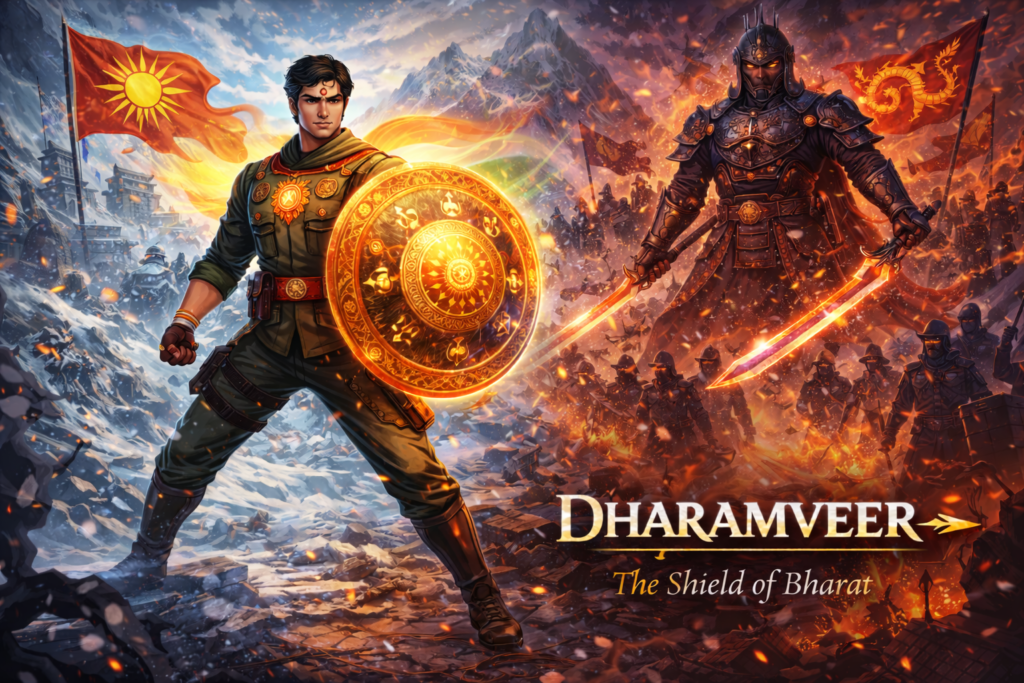
The northern winds howled through the rocky pass, carrying with them a bone-chilling cold that seeped into the bones of even the hardiest soldiers. The Bharatiya convoy, a line of supply wagons escorted by two platoons of infantry, moved cautiously along the narrow trail. The wagons carried vital provisions—food, medical supplies, and ammunition—destined for the forward outposts.
Captain Drishtadhyumna Rathore had personally overseen the planning of this mission. Knowing that Wei Long’s infiltrators had previously targeted supply lines, he had reinforced the convoy with experienced soldiers and equipped them with additional firepower, including a mounted Bren gun.
“We’re approaching the choke point,” called Subedar Arjun Pandey, riding alongside the lead wagon. His voice was steady, but his sharp eyes scanned the jagged cliffs above, searching for any signs of movement.
Drishtadhyumna, riding at the rear of the column, signaled for the group to halt. He dismounted from his horse, his boots crunching on the frost-covered ground as he approached Pandey. “The cliffs are too quiet,” he said, his voice low. “Tell the men to stay sharp. This is the perfect place for an ambush.”
Pandey nodded and raised his hand, motioning for the soldiers to spread out and keep their weapons ready.
High above the trail, hidden among the rocks and snow, Chinese soldiers lay in wait. Clad in white camouflage to blend with the terrain, they watched the convoy through binoculars. Their commander, a grim-faced officer named Lieutenant Shen, gestured silently to his men.
The plan was simple: wait for the convoy to enter the narrowest part of the pass, then strike hard and fast. With the trail blocked, the Bharatiya forces would have nowhere to retreat.
As the convoy moved into the choke point, the silence was shattered by the sharp crack of a rifle. The lead driver slumped over, blood spraying onto the snow.
“Ambush!” Pandey bellowed, diving for cover as a hail of gunfire erupted from the cliffs.
Drishtadhyumna reacted instantly. “Take cover! Return fire!” he shouted, his voice carrying over the chaos. Soldiers scrambled to the sides of the trail, their rifles snapping up to fire at the unseen enemy above.
The mounted Bren gunner, perched on the lead wagon, unleashed a burst of suppressive fire, the heavy rounds chewing through the rocks and sending debris tumbling down the cliffs.
The battle quickly devolved into chaos. The enemy’s position on the high ground gave them a significant advantage, their bullets raining down on the convoy with deadly precision. Bharatiya soldiers fired back, but their visibility was limited, and the narrow trail offered little room for maneuver.
Drishtadhyumna darted between wagons, shouting orders and directing fire. “Focus on the flanks! Pin them down!” he yelled, his Lee-Enfield rifle barking as he fired at a shadowy figure above.
Pandey, crouched behind a boulder, spotted a group of Chinese soldiers preparing to roll boulders onto the convoy. “Captain! They’re trying to block the trail!”
Drishtadhyumna’s eyes darted to the ridge. “Take them out!”
Pandey signaled to his sharpshooters, who took aim and fired. One by one, the enemy soldiers fell, their bodies tumbling down the slope.
Despite their efforts, the situation grew increasingly dire. An explosion rocked the trail as an enemy grenade struck one of the wagons, sending shards of wood and flames into the air.
“We’re pinned down!” Harjit shouted, firing blindly over the edge of his cover. “If we don’t move, they’ll pick us off one by one!”
Drishtadhyumna’s mind raced. They couldn’t retreat—the narrow trail and the burning wagon made it impossible. The only option was to break through.
He turned to Pandey. “We need to take that ridge! If we don’t neutralize their position, we’re finished.”
Pandey nodded grimly. “Leave it to me, Captain.”
Gathering a small team of soldiers, Pandey led a daring charge up the side of the cliff. Using grappling hooks and sheer determination, the group scaled the icy rock face under a storm of gunfire.
From below, Drishtadhyumna and the remaining soldiers provided covering fire, their rifles cracking relentlessly.
Pandey’s team reached the ridge, engaging the enemy in brutal close combat. The sound of bayonets clashing and fists striking echoed across the battlefield. Despite heavy resistance, Pandey’s group managed to drive the enemy back, clearing the ridge and silencing the gunfire.
As the smoke cleared, Drishtadhyumna stood amidst the wreckage of the convoy, his breath visible in the frigid air. The ambush had cost them dearly—several soldiers lay dead or wounded, and one of the wagons was completely destroyed.
Pandey returned, bloodied but victorious. “The ridge is secure, Captain. The rest of their forces retreated.”
Drishtadhyumna nodded, his expression grim. “Good work, Subedar. But this was more than just an ambush. They knew our exact route. Someone told them.”
Harjit joined them, his face pale. “The traitor.”
Drishtadhyumna’s jaw tightened. “Yes. And now we know the cost of their betrayal.”
Far to the north, in the Chinese encampment, General Wei Long reviewed the reports of the ambush. Though the Bharatiya forces had managed to repel the attack, the damage was done.
“Rathore is formidable,” Wei Long said, a faint smile on his lips. “But even the strongest warrior cannot win when his own house is divided. Let him bleed for every victory. His own people will finish what we’ve started.”
The aftermath of the ambush was somber. The Bharatiya convoy, battered but alive, limped back to the forward camp under the weight of its losses. The wagons that had survived were half-empty, their contents damaged by fire and shrapnel. The soldiers were weary, their eyes hollow, and their silence spoke louder than words.
Drishtadhyumna Rathore stood in the center of the camp as the convoy returned, his sharp gaze scanning the wounded and the exhausted men. The cost of betrayal was no longer abstract—it was written in the blood on the snow-covered ground.
Lieutenant Harjit Singh approached, his usual confidence replaced with grim determination. “The men are shaken, Captain,” he said quietly. “They know something’s wrong. This ambush wasn’t random.”
Drishtadhyumna nodded, his expression hard. “It wasn’t. They knew our route, our timing, even the size of our escort. Someone told them.”
In the command tent, the senior officers gathered to assess the situation. The atmosphere was heavy with tension as they reviewed the losses.
“Four dead, seven wounded,” reported Major Kuldeep Rawat, his voice steady but strained. “And half the supplies were either destroyed or rendered useless. We can’t afford losses like this, Captain.”
Drishtadhyumna stood at the head of the table, his hands resting on the edges of the map spread before him. “This wasn’t just a tactical setback—it was sabotage,” he said firmly. “The enemy knew our exact movements. That information could only have come from inside our ranks.”
Kuldeep frowned. “A traitor? That’s a dangerous accusation to make, Captain.”
“It’s not an accusation,” Drishtadhyumna replied, his tone cold. “It’s a fact. We’ve seen the pattern—every major ambush, every disruption to our supply lines. Someone is feeding them information.”
Harjit crossed his arms, his eyes narrowing. “The men have been talking about it. They don’t know the details, but they sense it. Morale is already fragile—this could break it entirely.”
As the officers debated, Subedar Arjun Pandey spoke up, his voice cutting through the noise. “If there’s a traitor among us, we need to root them out—quietly. Accusing the wrong person could do as much damage as the enemy’s bullets.”
Drishtadhyumna nodded. “Agreed. We need proof before we act. For now, no one outside this tent knows what we’re investigating. Tighten security, double the patrols, and monitor all communications. If the traitor makes another move, we’ll catch them.”
The officers exchanged uneasy glances but ultimately nodded in agreement.
Outside, the camp buzzed with subdued activity. Soldiers tended to their wounds, repaired equipment, and whispered in small groups. The mood was somber, but beneath the surface, a current of suspicion began to grow.
At one fire, a group of younger soldiers huddled together, their voices hushed.
“You heard about the ambush, right?” one of them said, glancing around nervously. “They knew everything—where we’d be, when we’d be there. How does that happen unless someone told them?”
“Don’t start with that,” muttered another, older soldier. “We’ve got enough problems without turning on each other.”
“But what if it’s true?” the younger soldier pressed. “What if someone here is working for them? How do we trust anyone?”
The older soldier sighed, his expression weary. “We trust our captain. Rathore’s never led us wrong.”
Later that night, Drishtadhyumna walked through the camp, observing the men as they prepared for another bitterly cold night. Harjit joined him, his expression thoughtful.
“You think they know?” Harjit asked quietly.
“They know something,” Drishtadhyumna replied. “They’re soldiers—they can sense when things don’t add up. We need to act quickly before suspicion turns into paranoia.”
Harjit nodded, though his concern was evident. “And when we find the traitor?”
Drishtadhyumna’s jaw tightened. “When we find them, they’ll answer for every life they’ve cost us.”
Far to the north, in the Chinese encampment, Rohan Mehra, now fully entrenched in his role as Shakuni, met with General Wei Long.
“The ambush served its purpose,” Rohan said, his tone confident. “Their supply lines are weaker than ever, and the seeds of doubt are already spreading through their ranks.”
Wei Long studied him for a moment before speaking. “Rathore is not a man to underestimate. He will suspect sabotage, and he will act on it.”
Rohan’s smirk faded slightly. “Let him suspect. Suspicion is a double-edged sword—it turns men against each other as much as it uncovers the truth. By the time Rathore realizes what’s happening, it will be too late.”
Wei Long nodded, though his expression remained inscrutable. “Do not overplay your hand, Shakuni. The greatest weakness of a spy is the belief that they are untouchable.”
Back in the Bharatiya camp, Drishtadhyumna called a meeting with his closest confidants—Harjit, Pandey, and a select few officers.
“This isn’t just about the ambush,” Drishtadhyumna said, his voice low but firm. “The traitor isn’t just passing information—they’re trying to destroy us from within. We need to act swiftly and decisively, or we’ll lose this war before it’s truly begun.”
Pandey leaned forward, his brow furrowed. “What’s the plan, Captain?”
Drishtadhyumna’s gaze was steely. “We set a trap. The next convoy will be bait. The traitor won’t be able to resist passing along the information. And when they do, we’ll catch them in the act.”
The officers exchanged determined nods, the weight of their task clear.
As the camp settled into uneasy quiet, Drishtadhyumna stood alone on the ridge, his hand resting on the hilt of his khukuri. The stars above glittered coldly, their distant light a stark contrast to the darkness closing in around him.
“We’ll find you,” he murmured, his voice carrying on the wind. “And when we do, there will be no escape.”
The following day, as the camp prepared for the next convoy, Drishtadhyumna Rathore finalized his trap. Inside the command tent, he and his trusted officers gathered around a detailed map of the region. The convoy’s planned route was marked in bold red, but this time, there were additional markings—alternate paths, fallback points, and ambush sites of their own.
“The convoy will follow the usual route,” Drishtadhyumna said, pointing to the line that snaked through the gorge. “But the supplies won’t be on those wagons. They’ll be decoys, carrying empty crates and scrap materials.”
Subedar Arjun Pandey raised an eyebrow. “And the real supplies?”
Drishtadhyumna tapped another point on the map. “They’ll travel along this secondary route, escorted by our best sharpshooters. The terrain is tougher, but it’s far less exposed. If the enemy attacks the decoys, it will confirm our suspicions.”
“And if they don’t take the bait?” asked Major Kuldeep Rawat.
“Then we lose nothing,” Drishtadhyumna replied. “But they will. The decoy convoy will be heavily guarded. If they move against it, they’ll walk into a trap.”
Meanwhile, in the Chinese encampment, Rohan Mehra stood before General Wei Long, a folded map in his hand. His uniform was immaculate, and his demeanor was calm, but a spark of ambition burned in his eyes.
“They’re sending another convoy,” Rohan said, placing the map on Wei Long’s table. “The route is the same as before. They haven’t changed their tactics.”
Wei Long studied the map, his sharp eyes flicking over the markings. “You’re certain of this information?”
Rohan nodded confidently. “My source is reliable. They don’t suspect a thing.”
The general’s lips curled into a faint smile. “Then we’ll strike again. Deploy a full platoon to intercept this convoy. We’ll hit them harder this time—no survivors.”
Rohan hesitated for a moment before speaking. “General, with respect, perhaps we should hold back. If they’ve reinforced their convoy, it could be a trap.”
Wei Long raised an eyebrow. “You doubt your own intelligence?”
“Not at all,” Rohan replied smoothly. “But Rathore is clever. He may have anticipated another ambush. We should be prepared for contingencies.”
Wei Long regarded him thoughtfully. “Very well. Deploy the platoon, but keep a reserve force nearby. If it is a trap, we’ll turn it to our advantage.”
Back in the Bharatiya camp, the convoy set out under the cover of dusk. Soldiers marched alongside the wagons, their rifles gleaming in the fading light. Despite the weight of the mission, they moved with confidence, trusting in their captain’s plan.
Hidden among the guards was Subedar Pandey, his sharp eyes scanning the cliffs above. His role was critical: to observe the enemy’s movements and signal the trap at the right moment.
From a ridge overlooking the secondary route, Drishtadhyumna and Harjit Singh watched the convoy wind its way through the gorge. The secondary convoy, carrying the real supplies, moved quietly along a higher path, blending into the rocky terrain.
“They’ll come,” Drishtadhyumna said, his voice low. “The traitor can’t resist passing this information along.”
Hours later, the enemy struck.
As the decoy convoy entered the narrowest part of the gorge, gunfire erupted from the cliffs. Chinese soldiers, dressed in white camouflage, poured down fire from above, their rifles cracking in the cold night air.
“Ambush!” Pandey shouted, diving behind a boulder. The Bharatiya soldiers returned fire, their volleys precise and disciplined. The Bren gun mounted on the lead wagon roared to life, spraying bullets at the attackers.
But this time, the Bharatiya forces were ready. Hidden sharpshooters on the surrounding ridges opened fire, targeting the enemy’s positions with deadly accuracy. Within minutes, the ambushers found themselves outflanked and outgunned.
Pandey signaled to his men. “Advance! Push them back!”
The Bharatiya soldiers surged forward, their bayonets gleaming as they charged up the cliffs. The enemy, caught off guard by the ferocity of the counterattack, began to retreat.
At the rear of the battle, a messenger from the Chinese forces sprinted toward the reserve unit stationed further back. Rohan, watching the battle from a safe distance, intercepted him.
“What’s happening?” Rohan demanded.
“The convoy… it’s a trap!” the messenger stammered. “Our men are pinned down!”
Rohan’s expression darkened. “Pull them back. We can’t afford to lose more men.”
The messenger saluted and ran off, leaving Rohan alone on the ridge. He stared at the chaos unfolding below, his mind racing.
“This is Rathore’s doing,” he muttered to himself. “But how did he know?”
Back at the Bharatiya camp, the real convoy arrived safely, its supplies intact. Drishtadhyumna and Harjit received the report with satisfaction.
“They took the bait,” Harjit said with a grin. “And we gave them a bloody nose for their trouble.”
Drishtadhyumna’s expression remained serious. “This wasn’t just about winning a skirmish. It was about confirmation.”
Harjit frowned. “You’re sure Rohan is behind this?”
Drishtadhyumna nodded. “The information about the decoy convoy came from inside our camp. Rohan’s betrayal is no longer a theory—it’s a fact. Now we bring him down.”
Far to the north, Rohan returned to the Chinese encampment. His uniform was immaculate, but his composure was beginning to crack.
Wei Long greeted him with a calm but pointed question. “What happened, Shakuni?”
Rohan stiffened at the use of his codename, a reminder of his precarious position. “Rathore anticipated our attack,” he admitted. “He used the convoy as bait to draw us out.”
Wei Long’s expression remained unreadable. “Then he is more resourceful than I thought. But do not forget, Shakuni—your position here depends on your usefulness. Fail me again, and you will find yourself without an ally.”
Rohan forced a smile. “I won’t fail, General. Rathore won’t outplay me again.”
Back in the Bharatiya camp, Drishtadhyumna stood at the edge of the ridge, the stars above glittering in the cold night sky. The enemy had been beaten today, but the war was far from over.
“Rohan Mehra,” he murmured to himself, his voice carrying on the wind. “Your time is running out.”
The Chinese camp buzzed with quiet activity as the aftermath of the failed ambush rippled through the ranks. While General Wei Long maintained his air of control, his officers knew better than to question his judgment. In a shadowy corner of the encampment, Rohan Mehra, now fully entrenched as Shakuni, met with a man who operated outside the formal military hierarchy—a smuggler named Chen Lu.
Chen was a wiry figure, his face weathered from years of operating in the treacherous borderlands between Bharat and China. His eyes gleamed with cunning as he laid a map on the table between them.
“These are the secondary routes your enemy uses to move supplies,” Chen said in a low voice, his heavily accented Hindi blending with Mandarin. “Hidden trails through the forest, some even through old caves. They’re not easy to find, but with the right price…”
Rohan leaned forward, his expression calculating. “You’ll have your gold, Chen, but only if this information is accurate. I don’t have time for half-truths.”
Chen grinned, showing a row of yellowed teeth. “My information is always accurate, Captain. That’s why you came to me.”
Rohan’s eyes narrowed. “You’ll get half now and half when I confirm your intelligence. If this leads to another failure, I’ll ensure you don’t live to make another deal.”
The smuggler held up his hands in mock surrender. “Of course, of course. You’ll see, Shakuni. This will be the breakthrough your general needs.”
Back at the Bharatiya camp, Drishtadhyumna Rathore reviewed the latest reports from his scouts. The victory over the enemy ambush had been significant, but the patterns emerging from their movements raised troubling questions.
“They’re regrouping faster than I expected,” Drishtadhyumna said, tapping a map with his finger. “And their focus has shifted. They’re probing the edges of our supply routes, testing for weak points.”
Lieutenant Harjit Singh, standing at his side, frowned. “That’s not random. Someone’s feeding them intelligence again.”
Drishtadhyumna nodded grimly. “Rohan. He’s too careful to act directly, but he’s working with someone on the ground—someone who knows the terrain.”
Subedar Arjun Pandey entered the tent, saluting sharply. “Captain, our scouts spotted movement along the eastern ridges—small groups, possibly advance parties. They seem to be mapping the area.”
Drishtadhyumna’s eyes narrowed. “They’re planning something. Double the patrols along the eastern trails, but keep them hidden. If they’re using scouts, I want them intercepted quietly. We’ll see what they’re looking for.”
Under the cover of darkness, a Bharatiya patrol intercepted a group of Chinese scouts moving through the dense forest. The skirmish was brief but decisive, with the enemy taken by surprise. Among the bodies of the fallen, the Bharatiya soldiers found a map marked with supply routes and hidden trails—routes that had only been discussed in the most secure of meetings.
When the map was delivered to Drishtadhyumna, his suspicions deepened.
“This map is too precise,” he said, studying it carefully. “It includes trails that even some of our officers don’t know about. This isn’t just local knowledge—it’s coming from someone with access to high-level plans.”
Harjit’s expression darkened. “Chen Lu. The smuggler we’ve heard rumors about. He’s been operating along the border for years, selling information to the highest bidder.”
Drishtadhyumna’s jaw tightened. “If Chen’s involved, Rohan’s using him to expand his reach. We need to cut off this connection before they do more damage.”
That night, Drishtadhyumna assembled a team of trusted soldiers for a covert mission. Their objective: intercept Chen Lu and sever the smuggler’s operations.
“He operates near the border, in a network of caves,” Drishtadhyumna explained to the team. “He’s well-guarded and knows the terrain better than anyone. This won’t be easy, but if we take him out, we disrupt Rohan’s supply of intelligence.”
Subedar Pandey nodded. “We’ll make sure he doesn’t slip through our fingers, Captain.”
In the borderlands, Chen Lu lounged in the flickering firelight of his hideout, counting the gold coins Rohan had paid him. Around him, his men sharpened weapons and prepared for their next move, oblivious to the Bharatiya team closing in.
The first sign of the attack came with the muffled sound of boots on snow. Before Chen could react, the Bharatiya soldiers stormed the hideout, their movements swift and precise.
“Down on the ground!” Pandey shouted, his rifle aimed squarely at Chen.
Chen’s men scrambled to defend their leader, but they were no match for the disciplined Bharatiya forces. Within minutes, the hideout was secured, and Chen was dragged into the center of the cave.
Drishtadhyumna stepped forward, his khukuri gleaming in the firelight. “Chen Lu,” he said, his voice cold. “You’ve been selling our secrets to the enemy. You’re going to tell me everything, or I’ll make sure you don’t have the chance to sell anything else.”
Chen’s eyes darted nervously, but he forced a smile. “You can kill me, Captain, but it won’t stop them. The information’s already out there.”
Drishtadhyumna’s expression didn’t waver. “That’s where you’re wrong. You’re going to help us unravel their plans. Start talking.”
The interrogation was brutal but effective. Under pressure, Chen revealed the full extent of his operations, including his recent dealings with Rohan.
“He calls himself Shakuni,” Chen admitted, his voice trembling. “He’s clever, always careful. But he’s not invincible. If you want to stop him, you need to cut off his support—like you’ve done to me.”
Drishtadhyumna nodded to Pandey. “Take him to the rear camp for further questioning. He’s more useful alive for now.”
As Chen was led away, Harjit approached Drishtadhyumna. “We’ve exposed his network, Captain. That’s a major blow to Rohan’s plans.”
Drishtadhyumna’s gaze was steely. “It’s a step in the right direction. But the real battle is still ahead. Rohan won’t stop until he’s brought down completely—and I intend to see that happen.”
Far to the north, Rohan received word of Chen’s capture. His expression darkened as he paced his tent.
“Rathore’s growing bolder,” Rohan muttered. “If he’s willing to strike this deep, he’s not just reacting anymore—he’s hunting.”
General Wei Long, seated across from him, regarded him with a calm but piercing gaze. “Perhaps you underestimated Rathore’s resourcefulness.”
Rohan clenched his fists. “No, General. I underestimated how desperate he’s become. But desperation can be exploited.”
Wei Long’s faint smile returned. “Then make sure it is. Rathore’s strength lies in his ability to inspire. Take that from him, and the rest will fall.”
The Bharatiya camp bustled with activity as soldiers fortified their defenses and prepared for another round of enemy maneuvers. Despite the recent success in capturing Chen Lu, the tension in the air was palpable. Drishtadhyumna Rathore stood near the edge of the ridge, staring into the snow-covered horizon.
His mind raced with questions. The war was escalating, and though the capture of the smuggler had disrupted Rohan’s network, Drishtadhyumna couldn’t shake the feeling that they were still several steps behind.
The crunch of boots on snow signaled Lieutenant Harjit Singh’s arrival. Harjit stopped beside him, holding two steaming cups of chai.
“You look like you’ve been staring at the mountains for hours,” Harjit said, offering one of the cups.
Drishtadhyumna accepted it with a faint nod. “I’ve been thinking,” he replied, his tone heavy. “Every move we’ve made so far has been reactive. We’re responding to their attacks, their traps. But Wei Long—he’s the one setting the terms. We need to change that.”
Harjit sipped his chai thoughtfully. “Easier said than done, Captain. Wei Long’s not just a general—he’s a tactician who thrives on making us second-guess ourselves. And then there’s Shakuni…”
At the mention of Rohan’s codename, Drishtadhyumna’s jaw tightened. “Rohan knows us too well. He understands our strengths and our weaknesses. That’s why he’s so dangerous.”
Harjit studied his captain for a moment. “You’ve been carrying the weight of this war alone, Drish. The men trust you, but you need to trust them too. You’ve built them up for this fight. Let them shoulder some of the burden.”
Drishtadhyumna turned to face him, his gaze sharp but thoughtful. “It’s not about trust, Harjit. It’s about responsibility. Every decision I make affects their lives, their families, their future. If I falter…”
“You won’t,” Harjit interrupted. “You never have. And that’s why they’ll follow you into hell if you ask them to.”
Later that evening, Drishtadhyumna called a meeting of his senior officers in the command tent. The lantern flickered as the men gathered around the table, their expressions ranging from determined to concerned.
“We’ve disrupted Rohan’s network,” Drishtadhyumna began, his voice steady. “But that’s only one piece of the puzzle. Wei Long and his forces are still out there, planning their next move. We need to anticipate him—to force him to react to us for a change.”
Subedar Arjun Pandey nodded. “Agreed, Captain. But how do we draw him out? He’s cautious. He won’t commit his forces unless he’s sure of victory.”
Drishtadhyumna tapped the map spread across the table. “We hit a target that matters to him—one he can’t afford to lose. This fort here, near the southern ridge—it’s a key logistical hub. If we take it, we cut off his ability to resupply his forward units.”
Major Kuldeep Rawat frowned. “It’s heavily fortified, Captain. A direct assault would be costly.”
“That’s why it won’t be a direct assault,” Drishtadhyumna replied. “We’ll use diversionary tactics. Make them think we’re attacking from the west, then strike from the north under cover of darkness.”
Despite the clarity of the plan, unease lingered in the camp. Among the soldiers, whispers of doubt began to spread. The relentless pressure of the war, combined with the knowledge of a traitor in their midst, weighed heavily on their spirits.
Drishtadhyumna walked through the camp, listening to the murmurs.
“What if the enemy knows our plan again?” a young soldier muttered to his companion.
“They won’t,” the other replied, though his voice lacked conviction. “Captain Rathore’s got it all figured out.”
“But what if he doesn’t?”
In the privacy of his tent, Drishtadhyumna sat alone, sharpening his khukuri. The blade glinted in the lantern light, its edge as sharp as his resolve. Yet, the doubts gnawed at him. Was he truly making the right decisions? Or was he leading his men into a trap set by a foe who always seemed one step ahead?
The flap of the tent rustled, and Harjit entered unannounced. “You’re brooding again,” he said, crossing his arms.
Drishtadhyumna didn’t look up. “I’m thinking.”
“No,” Harjit said firmly. “You’re doubting yourself. And I get it—this war’s enough to make anyone question everything. But let me remind you of something.”
Drishtadhyumna set the blade down and looked at him. “What’s that?”
“You’re not just fighting this war with your head, Drish. You’re fighting it with your heart. And that’s why the men trust you. It’s why they’ll follow you anywhere.”
Drishtadhyumna leaned back, his expression softening. “Sometimes I wonder if that trust is misplaced.”
Harjit grinned faintly. “It’s not. And if you ever need proof, just look at what they’re willing to endure for you. They’re not just following orders—they’re following you.”
The next day, as the camp prepared for the assault on the fort, Drishtadhyumna stood before his assembled troops. The cold wind bit at their faces, but they stood tall, their eyes fixed on their captain.
“Brothers,” Drishtadhyumna began, his voice carrying across the camp, “I know this war has tested us in ways we couldn’t have imagined. We’ve faced betrayal, ambushes, and loss. But through it all, we’ve stood together. And that is why we will win.”
He gestured toward the horizon, where the mountains loomed like silent sentinels. “The enemy thinks they can outlast us, that they can break us. But they don’t understand what it means to fight for Bharat. They fight for conquest. We fight for our homeland, our families, our dharma. And that is a strength they can never match.”
A cheer rose from the soldiers, their voices echoing through the valley. For the first time in days, the camp felt alive with purpose.
As Drishtadhyumna stepped back, Harjit clapped him on the shoulder. “See? You’ve still got it, Captain.”
Drishtadhyumna allowed himself a small smile. “Let’s make sure it’s enough.”
The assault on the Chinese-controlled fort began under the cover of darkness. The air was frigid, each soldier’s breath forming clouds that mingled with the rolling mist. Drishtadhyumna Rathore led the northern strike force, their movements silent as they approached the fort through a rugged, snow-covered ravine.
The diversionary force, under the command of Subedar Arjun Pandey, had already engaged the enemy on the western side. The sound of rifle fire and explosions echoed in the distance, drawing the defenders away from the northern flank.
Drishtadhyumna raised a gloved hand, signaling his men to halt. Ahead, the fort loomed—its stone walls reinforced with steel and barbed wire. The faint glow of lanterns flickered from the parapets, but the main defenses were focused on the west, just as planned.
“Harjit,” Drishtadhyumna whispered, turning to his lieutenant. “Take the sharpshooters and secure the outer wall. We’ll move in once the path is clear.”
Harjit nodded, gesturing for his team to follow. The sharpshooters crept forward, their rifles trained on the parapets.
In the western sector, Pandey’s diversionary force fought fiercely to maintain the enemy’s attention. Bullets ricocheted off rocks and walls, and the occasional grenade sent up bursts of snow and debris.
“They’re committing more troops to the west,” Pandey observed, his voice tense as he reloaded his rifle. “Good. Keep them focused here.”
One of his men, crouched beside him, shouted, “Subedar! They’re bringing in mortars!”
Pandey cursed under his breath. “Spread out! Keep moving! We just need to hold them a little longer.”
Back at the northern approach, Harjit’s sharpshooters eliminated the sentries on the outer wall with swift precision. Drishtadhyumna led the main force forward, scaling the wall with grappling hooks and ropes.
As they reached the top, the men moved quickly to neutralize the remaining guards. The fort’s interior was eerily quiet, the bulk of the defenders still engaged on the western side.
“We’re in,” Harjit whispered, his breath visible in the cold air.
Drishtadhyumna nodded. “Secure the courtyard. Once Pandey signals, we take the armory.”
The men spread out, their movements coordinated and efficient. But as they advanced, something felt off. The silence was too complete, too deliberate.
In the command center of the fort, Lieutenant Shen, the Chinese officer in charge, monitored the battle with a calm precision. Beside him stood Rohan Mehra, his expression cold and calculating.
“They’ve taken the bait,” Shen said, gesturing to a map of the fort. “Their main force is in the northern courtyard, just as you predicted.”
Rohan nodded, his lips curling into a faint smirk. “And the armory?”
“Reinforced and ready. The charges are set. As soon as they breach it, we’ll detonate the entire structure.”
“And the western sector?”
“A necessary sacrifice,” Shen replied. “It will buy us the time we need to spring the trap.”
In the courtyard, Drishtadhyumna’s instincts screamed at him. The layout of the fort, the positioning of the defenses—it didn’t feel right.
“Harjit,” he said quietly, “something’s wrong. This is too easy.”
Harjit frowned. “You think it’s a trap?”
Before Drishtadhyumna could respond, a distant explosion rocked the fort. The sound came from the western sector, where Pandey’s force was holding the line.
“Fall back to the armory!” a voice shouted from inside the fort, but it wasn’t one of his men.
Drishtadhyumna’s eyes widened. “It’s a setup. Harjit, pull the men back—now!”
In the western sector, Pandey’s forces were overwhelmed by the sudden deployment of mortars. The diversionary attack, meant to buy time, was now a desperate fight for survival.
“Subedar! They’re breaking through!” one of his soldiers shouted.
Pandey fired his rifle, taking down an advancing enemy soldier. “Hold the line!” he bellowed, though he knew their position was crumbling.
Inside the fort, Drishtadhyumna’s men tried to retreat, but it was too late. As the first group reached the armory, a deafening explosion tore through the structure. The ground shook violently, and a plume of fire and smoke rose into the night sky.
The blast threw Drishtadhyumna and Harjit to the ground, debris raining down around them. The air was filled with the screams of wounded soldiers and the acrid stench of burning wood and stone.
“Captain!” Harjit coughed, struggling to his feet. “It’s a trap—Rohan’s work, I’m sure of it!”
Drishtadhyumna pulled himself up, his face streaked with soot. “Rally the men. We need to regroup outside the fort. Leave no one behind!”
As the Bharatiya forces retreated, Rohan watched from a hidden vantage point, his expression triumphant.
“They’re scattering,” Shen observed, a hint of satisfaction in his tone.
“Good,” Rohan said. “But this is only the beginning. Rathore’s resilience is his strength. We’ll break it piece by piece.”
Back at the Bharatiya camp, the survivors of the failed assault regrouped in grim silence. The cost of the mission was painfully clear—several dead, dozens wounded, and nothing gained.
Drishtadhyumna sat in the command tent, his hands clenched into fists as he replayed the events in his mind. The trap had been meticulously planned, exploiting every detail of their strategy.
“This was Rohan’s doing,” Harjit said, his voice heavy with anger. “He knew exactly how we’d move, where we’d strike. He’s outplaying us, Drish.”
Drishtadhyumna didn’t respond immediately. When he finally spoke, his voice was cold and determined. “No more reacting. No more letting him dictate the terms. We’re going to find him, Harjit. And when we do, this ends.”
The command tent was dimly lit, the single lantern casting flickering shadows across the maps and reports spread over the table. Drishtadhyumna Rathore leaned over the map, his sharp eyes scanning every detail of the terrain. The sting of the failed assault on the fort still weighed heavily on him, but the fire in his resolve burned brighter than ever.
“We underestimated him,” Drishtadhyumna said, breaking the tense silence.
Lieutenant Harjit Singh, seated across from him, nodded grimly. “Rohan’s no ordinary traitor. He’s planning every move like a game of shatranj.”
Drishtadhyumna straightened, his gaze steady. “Then we outthink him. If this is a game, it’s time we start playing by our own rules.”
Across the mountains, in the heart of the Chinese encampment, Rohan Mehra, now fully entrenched in his role as Shakuni, sat in a similarly dim room. Opposite him was General Wei Long, the faint glow of the lantern illuminating his calculating expression.
“Rathore is stubborn,” Wei Long said, tracing his finger along the map. “He won’t retreat after this defeat. He’ll regroup, reorganize, and strike again.”
Rohan smirked faintly. “Exactly. He’s predictable in his persistence. But persistence can be turned into desperation. We let him push, let him believe he’s gaining ground, and then pull the ground out from under him.”
Wei Long raised an eyebrow. “You want to bait him again? He’ll be expecting it.”
“That’s the beauty of it,” Rohan replied. “Rathore will think he’s learned from the last trap, but this time, we’ll layer deception upon deception. He won’t see it coming until it’s too late.”
Back at the Bharatiya camp, Drishtadhyumna convened a meeting with his trusted officers, including Subedar Arjun Pandey and Major Kuldeep Rawat.
“We’re going to turn their tactics against them,” Drishtadhyumna announced, his voice firm. “Rohan thinks he has the upper hand because he knows how we operate. But he doesn’t know that we’ve adapted.”
Kuldeep frowned. “What’s the plan, Captain?”
Drishtadhyumna pointed to the map. “We’re going to create a false target. A supply convoy, heavily guarded, moving toward what appears to be a key position. Rohan’s network will pick up on it, and he’ll send his forces to intercept. But the convoy will be empty, and we’ll be waiting in ambush.”
Pandey grinned. “Give them a taste of their own medicine. I like it.”
“It’s risky,” Kuldeep said, his tone cautious. “If Rohan doesn’t take the bait, we’ll have wasted time and resources.”
Drishtadhyumna’s gaze was steely. “He’ll take it. Rohan can’t resist an opportunity to exploit our weaknesses. We just have to make it look convincing.”
The next day, preparations for the decoy convoy began. Soldiers loaded the wagons with crates filled with rocks and scrap metal, making them appear full. The guards were carefully chosen to look like an ordinary escort, and the convoy’s route was deliberately conspicuous.
Meanwhile, Drishtadhyumna and his ambush team positioned themselves in a forested area along the convoy’s path. The terrain was ideal for their purposes—dense trees provided cover, and narrow trails funneled the enemy into predictable positions.
“We only get one chance at this,” Drishtadhyumna told his men. “Stay hidden until I give the signal. We hit them hard and fast—no hesitation.”
In the Chinese camp, the report of the convoy reached Rohan through one of his informants. He studied the details with keen interest, his mind already working through the possibilities.
“It’s a trap,” Rohan said, setting the report aside.
Lieutenant Shen, seated nearby, looked surprised. “You’re certain?”
Rohan nodded. “Rathore’s learned from his mistakes. This convoy is too obvious. He wants us to attack it so he can ambush us.”
Shen frowned. “Then we should avoid it.”
“No,” Rohan said, a glint of cunning in his eyes. “We spring the trap—but on our terms. Let Rathore think his plan is working. While he’s focused on the ambush, we’ll strike elsewhere, at a target he won’t expect.”
As the convoy moved along its route, the tension among Drishtadhyumna’s men was palpable. Hidden among the trees, they waited silently, their weapons ready. Every sound—the crunch of snow under boots, the rustle of leaves in the wind—felt amplified.
Then, movement in the distance. A scout whispered, “Enemy approaching.”
Drishtadhyumna raised his hand, signaling his men to hold their fire. Through the gaps in the trees, they saw the Chinese soldiers advancing cautiously, their weapons raised.
“Wait for it,” Drishtadhyumna murmured.
The enemy moved closer, their focus entirely on the convoy. When they were within range, Drishtadhyumna gave the signal.
“Now!”
Gunfire erupted from the trees as the Bharatiya soldiers unleashed a devastating volley. The enemy, caught off guard, scrambled to respond, but the ambush was perfectly executed. Within minutes, the skirmish was over, the surviving Chinese soldiers retreating into the woods.
Drishtadhyumna stepped into the clearing, surveying the aftermath. The decoy convoy remained untouched, and his men had sustained minimal casualties.
“It worked,” Harjit said, a note of triumph in his voice.
Drishtadhyumna nodded, though his expression remained serious. “This was only part of the plan. If Rohan’s behind this, he won’t have committed all his forces. He’s planning something else.”
Far to the south, Rohan’s secondary strike force launched an attack on an unguarded Bharatiya outpost. The timing was precise, catching the defenders off balance.
When news of the attack reached Drishtadhyumna, his suspicion was confirmed.
“He played us,” Drishtadhyumna said, his voice cold. “He used our own strategy against us—split our focus, divide our forces.”
Harjit sighed, his frustration evident. “The outpost was lightly defended. They didn’t stand a chance.”
Drishtadhyumna clenched his fists. “Rohan’s playing a long game, but he’s revealing his hand. Every move he makes gives us more insight into his strategy. He won’t win this war—not as long as I’m standing.”
The fallout from the ambush and the attack on the outpost cast a heavy shadow over the Bharatiya camp. Soldiers whispered among themselves, their confidence shaken by the enemy’s relentless moves. Drishtadhyumna Rathore stood in the command tent, his gaze fixed on the reports of casualties and lost resources.
Lieutenant Harjit Singh entered, his expression grim. “The men are holding together, but barely. Morale’s fragile, Drish. Another setback like this, and I’m not sure they’ll recover.”
Drishtadhyumna didn’t look up. “Rohan’s reaching deeper into our ranks than I thought. Every move we’ve made, he’s known about in advance. Someone here is feeding him that information.”
Harjit nodded. “And it’s time we find out who.”
That evening, Drishtadhyumna summoned his inner circle for a closed meeting. Subedar Arjun Pandey, Major Kuldeep Rawat, and Harjit sat around the table, their faces tense as Drishtadhyumna laid out his plan.
“We’re going to flush out the traitor,” he said. “I’ve already planted false information about a key supply convoy moving to reinforce the southern outpost. The convoy doesn’t exist—but the information has been deliberately leaked through channels the traitor would have access to.”
Kuldeep leaned forward, his brow furrowed. “And when the enemy moves on it?”
“We’ll be waiting for them,” Drishtadhyumna replied. “And when we catch them, we’ll have all the proof we need to expose the traitor.”
Harjit smirked faintly. “You’ve been planning this for a while, haven’t you?”
Drishtadhyumna’s gaze was steely. “Rohan made this personal when he betrayed Bharat. I’m going to end this.”
Far to the north, Rohan Mehra received the false intelligence through his network. Sitting in his tent, he studied the report with a calculating expression.
“A convoy to the southern outpost?” he mused aloud. “It’s too convenient.”
Lieutenant Shen, standing nearby, frowned. “You think it’s a trap?”
Rohan nodded slowly. “It could be. Rathore is learning. But even traps can be useful if we approach them correctly. Send a small force to engage the convoy, just enough to draw them out. And keep our reserves ready to strike if the opportunity arises.”
At dawn, the Bharatiya forces moved into position near the southern pass, where the decoy convoy was supposedly headed. Drishtadhyumna led the main force, hidden among the rocky outcrops overlooking the narrow trail.
“Harjit, position the sharpshooters along the ridge,” Drishtadhyumna ordered. “Pandey, take your unit and cover the rear. No one moves without my signal.”
The men nodded and dispersed, their movements swift and disciplined.
Hours passed as the soldiers waited in tense silence. Then, the sound of boots crunching on snow and faint voices echoed through the pass. The enemy had arrived.
Drishtadhyumna raised his binoculars, scanning the approaching force. As expected, it was a small unit—likely a reconnaissance team sent to confirm the convoy’s existence.
“Hold your fire,” Drishtadhyumna whispered.
The enemy soldiers moved cautiously, their weapons raised as they approached the ambush site. When they reached the marked position, Drishtadhyumna gave the signal.
“Now!”
Gunfire erupted from the ridges as Bharatiya sharpshooters unleashed a deadly barrage. The enemy soldiers, caught in the open, scrambled for cover, but the terrain offered them little protection.
Within minutes, the skirmish was over.
Among the captured enemy soldiers was a young officer carrying detailed maps and communication logs. As Pandey secured the prisoners, Drishtadhyumna approached the officer, his expression cold.
“You’re going to tell me everything,” Drishtadhyumna said, his voice low but firm. “Who gave you this intelligence?”
The officer hesitated, fear flickering in his eyes.
“You think Rohan Mehra will protect you?” Drishtadhyumna pressed. “He’s not here. But I am.”
Under the weight of Drishtadhyumna’s glare, the officer broke. “It came from… someone in your camp. A high-ranking officer. The message was coded, but the source was clear—‘Shakuni.’”
Back at the Bharatiya camp, the implications of the revelation settled heavily over the command tent. The term “Shakuni” was known only to a few—those close enough to have heard Rohan’s codename from intercepted communications.
Drishtadhyumna’s voice was icy as he addressed his officers. “The traitor isn’t just any soldier. It’s someone who knows our plans, our codes, and our movements. Someone who’s been at this table.”
The room fell silent, tension crackling like a live wire.
Kuldeep Rawat shifted uncomfortably. “You’re suggesting one of us is the traitor?”
“I’m not suggesting anything,” Drishtadhyumna replied. “The facts speak for themselves.”
That night, Drishtadhyumna moved through the camp with quiet purpose. He watched the soldiers as they prepared for the next day, their camaraderie a sharp contrast to the betrayal festering in the shadows.
Stopping by Harjit’s tent, he said, “I need you to watch everyone closely—especially during tomorrow’s operation. If the traitor makes a move, I want them caught red-handed.”
Harjit nodded, his expression grim. “And if they don’t?”
“They will,” Drishtadhyumna said. “They can’t resist the opportunity to strike again.”
Far from the camp, Rohan stood on a ridge overlooking the Bharatiya positions. His confidence was unshaken, even as his plans began to unravel.
“Rathore’s getting closer,” Rohan admitted to himself. “But he’s still playing by the rules. And that’s where he’ll lose.”
The early morning air was brittle with cold, each breath misting as Drishtadhyumna Rathore and his officers stood at the edge of the ridge overlooking the camp. The night’s events still hung heavily in the air, the pieces of the betrayal beginning to fall into place. Harjit Singh approached, his footsteps crunching in the snow.
“We’ve cross-referenced the communication logs and the intelligence captured from the enemy,” Harjit said, handing a dossier to Drishtadhyumna. “It all points to the same conclusion.”
Drishtadhyumna opened the dossier, his eyes scanning the pages. His expression hardened as the name leapt out at him like a dagger: Kuldeep Rawat.
The officers convened in the command tent later that morning. Subedar Arjun Pandey and Harjit stood to one side, their expressions grim. Kuldeep entered the tent last, his face set in its usual stoic demeanor.
“What’s this about, Captain?” Kuldeep asked, his tone tinged with suspicion as he took his seat at the table.
Drishtadhyumna wasted no time. “It’s about betrayal.”
Kuldeep stiffened. “Betrayal?”
Drishtadhyumna fixed him with a steely gaze. “The enemy has been one step ahead of us at every turn. We’ve lost men, supplies, and critical ground because someone in our ranks has been feeding them information. Last night, we captured enemy scouts with detailed intelligence—intelligence that could only have come from you.”
The other officers turned to Kuldeep, their eyes narrowing.
Kuldeep’s jaw clenched. “You’re accusing me? That’s absurd. I’ve been fighting alongside you since the beginning of this war.”
“Exactly,” Harjit interjected. “You’ve been with us long enough to know our strategies, our movements, our weaknesses. And you’ve used that knowledge against us.”
Kuldeep’s eyes darted around the room, searching for an ally. “This is a mistake. You have no proof.”
Drishtadhyumna’s voice was cold. “We don’t need your confession, Major. The intercepted communications, the timing of the leaks, and the enemy’s precise knowledge of our plans—it all leads back to you. And then there’s this.”
He placed a coded document on the table, recovered from the enemy scouts. “Recognize it? It’s your handwriting.”
Kuldeep’s face paled, but he quickly regained his composure. “This is a forgery. The enemy’s trying to sow discord among us. Can’t you see that?”
Pandey stepped forward. “Enough lies, Kuldeep. We all trusted you. You fought alongside us, shared our burdens—and all the while, you were betraying us to Rohan Mehra.”
Kuldeep’s eyes blazed with defiance. “You’re blind! This war is unwinnable! Rohan offered me a chance to survive, a chance to build something after this conflict is over. Can you say the same?”
The tent fell silent, the weight of his words settling over the group like a heavy shroud.
Drishtadhyumna stepped closer, his voice low but firm. “You betrayed your brothers. Your homeland. The men who trusted you with their lives. And for what? A promise from a traitor like Rohan? He’ll discard you the moment you’re no longer useful.”
Kuldeep’s defiance faltered, replaced by a flicker of fear.
“Guards!” Drishtadhyumna called. Two soldiers entered the tent, their rifles at the ready.
“Take him into custody,” Drishtadhyumna ordered. “He’ll face a court-martial for his crimes.”
As the guards led Kuldeep away, he turned back, his voice filled with venom. “You think this changes anything, Rathore? Rohan will destroy you. You’re fighting a war you can’t win.”
Drishtadhyumna watched him go, his expression unreadable. When the tent flap closed, he turned to his officers.
“This betrayal ends here,” he said firmly. “We’ve rooted out the traitor. Now it’s time to take the fight back to the enemy.”
Far to the north, Rohan Mehra received the news of Kuldeep’s capture from a courier. His reaction was unreadable, his mind already calculating the implications.
“So, Rathore finally uncovered his mole,” Rohan said, pacing his tent. “Impressive. But it doesn’t change the fact that he’s still reacting to me.”
General Wei Long, seated across from him, raised an eyebrow. “The loss of your asset weakens your position. Are you certain you can still outmaneuver Rathore?”
Rohan smirked. “Rathore’s strength is his conviction. But conviction can be a weakness too. He’ll overreach, trying to prove he can win. That’s when we’ll crush him.”
Back in the Bharatiya camp, the atmosphere began to shift. The capture of Kuldeep Rawat and the end of the sabotage lifted a shadow that had hung over the soldiers for weeks.
Drishtadhyumna stood before his men, addressing them with quiet determination. “We’ve faced betrayal, loss, and hardship. But through it all, we’ve endured. The enemy thinks they’ve weakened us. They think they’ve broken our spirit. But they’re wrong.”
The soldiers stood straighter, their eyes reflecting the fire of their captain’s words.
“This war is far from over,” Drishtadhyumna continued. “But today, we take the first step toward victory. We fight not for revenge, but for Bharat—for our land, our people, and our dharma. Together, we will prevail.”
A cheer rose from the ranks, echoing through the camp and out into the frozen mountains.
The glow of the campfires cast long shadows across the snow-covered ground as the Bharatiya soldiers gathered for their evening routines. The earlier unease had begun to dissipate, replaced by a renewed sense of purpose. Drishtadhyumna Rathore, standing at the edge of the ridge, watched the camp with a mixture of relief and resolve.
The betrayal had been rooted out, but the war was far from over. If anything, the capture of Kuldeep Rawat marked the beginning of a new chapter—one that demanded not just strategy, but unrelenting determination.
Lieutenant Harjit Singh approached, his boots crunching softly in the snow. “The men are ready, Captain. They’ve shaken off the worst of the doubt.”
Drishtadhyumna nodded. “Good. They’ll need that clarity for what’s ahead.”
Harjit handed him a small leather-bound notebook. “Kuldeep’s interrogation yielded some valuable intelligence. He confirmed what we suspected—Rohan is orchestrating these attacks, and he’s operating directly under Wei Long’s command.”
Drishtadhyumna opened the notebook, scanning the neatly written notes. They detailed supply routes, troop movements, and coded messages exchanged between Rohan and Wei Long.
“This gives us an edge,” Drishtadhyumna said, closing the notebook. “For the first time, we’re not reacting. We can strike on our terms.”
Later that night, Drishtadhyumna convened his senior officers in the command tent. The flickering lantern light illuminated the map on the table, now marked with new intelligence gathered from Kuldeep’s files.
“Rohan’s playing a game of attrition,” Drishtadhyumna began, his tone firm. “He wants to bleed us dry, to force us into a position where surrender seems like the only option. But this intelligence shows us where his supply lines are weakest.”
Subedar Arjun Pandey leaned forward, his finger tracing one of the marked routes. “This pass here—if we sever it, we cut off their reinforcements to the western sector. They’ll have no choice but to pull back.”
Harjit nodded. “And if we take out this depot,” he added, pointing to another location, “we cripple their ability to resupply for weeks. It’ll force Wei Long to consolidate his forces, giving us the chance to hit him where it hurts.”
Drishtadhyumna’s eyes swept over his officers. “We’ve been on the defensive long enough. It’s time we go on the offensive. This won’t be easy, and the risks are high. But if we succeed, we shift the momentum of this war.”
The officers exchanged determined glances, their resolve clear.
As the camp settled into quiet, Drishtadhyumna walked among the soldiers, offering words of encouragement and sharing in their small moments of camaraderie. The men greeted him with respect, their spirits visibly lifted by his presence.
Stopping near a small fire where a group of younger soldiers sat cleaning their rifles, Drishtadhyumna crouched beside them.
“How are you holding up?” he asked one of them, a boy barely out of his teens.
The soldier straightened, his expression serious. “We’re ready, Captain. Just give the word.”
Drishtadhyumna nodded, his gaze steady. “Good. Remember, it’s not just skill that wins battles—it’s heart. And I’ve seen enough of that in all of you to know we’ll prevail.”
The soldiers exchanged glances, their confidence growing in the presence of their leader.
Far to the north, Rohan sat in his tent, the glow of a single lantern reflecting off the polished surface of his knife. He turned the blade slowly in his hand, his mind racing with thoughts of the coming battles.
The capture of Kuldeep had been a setback, but not a fatal one. If anything, it had only deepened Rohan’s resolve to see Drishtadhyumna fall.
“You’re resourceful, Rathore,” Rohan murmured to himself. “But you’re not invincible. This war isn’t about who’s right—it’s about who survives.”
As dawn broke over the mountains, the Bharatiya camp stirred to life. Soldiers moved with purpose, their preparations reflecting a newfound determination.
Drishtadhyumna stood at the center of it all, his presence a steady anchor for the men under his command.
“This war has tested us,” he said, addressing his officers as the first rays of sunlight bathed the camp in golden light. “We’ve faced betrayal, loss, and doubt. But through it all, we’ve endured. Now, it’s time to strike back—not just for survival, but for victory.”
The officers saluted, their confidence mirroring his.
As the camp mobilized, Drishtadhyumna allowed himself a brief moment to look out over the horizon. The path ahead was treacherous, but for the first time in weeks, the scales were beginning to tip in their favor.
With renewed resolve, he turned back to his men. The time for shadows was over—it was time to step into the light.
📖 Continue Reading
This chapter continues in the Vault.