
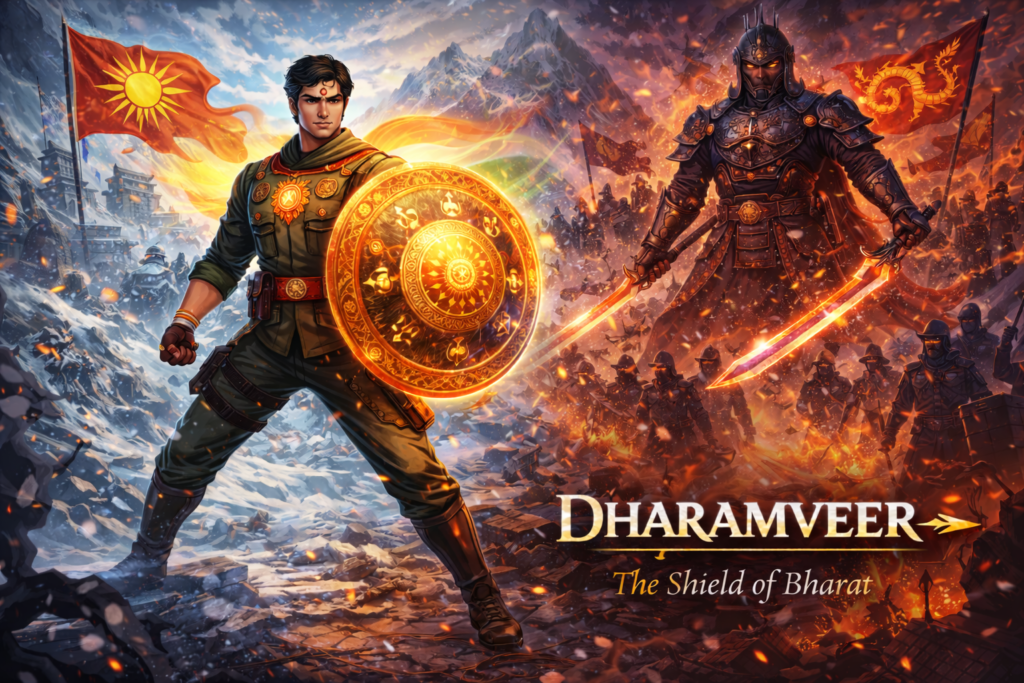
The cold winds of the north swept through the rugged terrain of the Himalayas, carrying with them a promise of conflict. The snow-draped peaks, ancient and immovable, bore silent witness to the rising tensions. In the capital city of Bharat Varsha, within the grand assembly hall of the Rajya Sabha, voices clashed in heated debate.
The hall was an architectural marvel—a testament to the Vedic principles of balance and harmony. Pillars adorned with intricate carvings of devas and ancient warriors framed the room, their serene faces in stark contrast to the turmoil brewing within. At the center stood a vast stone table, its surface etched with maps and scriptures. Around it, the Mantris—advisors, generals, and chieftains of Bharat—argued with raised voices.
“We cannot let this transgression stand!” bellowed Raja Indraketu, his fists slamming against the table. The lion emblem on his chest glinted in the lamplight as he leaned forward, his eyes fierce. “The Chinese forces have dared to infiltrate our borders, disrupting the sacred trade routes. If we do not act, we dishonor our ancestors and invite further incursions!”
Across the table, Acharya Lakshyaketu, a man of lean frame and sharp features, raised his hand for calm. “And yet, rash action could be the very trap our enemies have set for us. Wei Long is no ordinary commander. His actions are deliberate, guided by the strategies of Sun Tzu. To act impulsively would be to play into his hands.”
The assembly erupted into murmurs, the voices of the gathered chieftains and advisors blending into a cacophony. Some nodded in agreement with the Acharya, while others shook their heads in frustration.
At the far end of the room, Drishtadhyumna Rathore, a young officer dressed in a soldier’s tunic marked with the emblem of the rising sun, observed the proceedings in silence. He stood apart, his posture straight, his dark eyes scanning the maps spread across the table. Though untested in the larger arena of war, his instincts, honed through countless drills and small skirmishes, told him that Bharat was on the brink of something far greater than anyone here realized.
Raja Indraketu’s voice thundered again, pulling Drishtadhyumna’s attention back to the room. “What say you, Captain Rathore?” Indraketu’s piercing gaze landed on him. “You’ve just returned from the northern posts. Surely you have insight that can settle this debate.”
The room fell silent, all eyes turning to Drishtadhyumna. He hesitated briefly, aware of the weight of the moment. Then, stepping forward, he saluted with a crisp gesture. “With respect, Maharaja,” he began, his voice steady, “the incursions we’ve witnessed are not mere provocations. They are deliberate maneuvers, designed to weaken our presence in the region. The Chinese forces are not just testing our defenses—they are preparing to take the northern trade routes.”
Murmurs spread through the room, but Drishtadhyumna pressed on. “I have seen their scouts move like shadows through the mountains, their camps appearing and disappearing with precision. If we do not act swiftly, they will entrench themselves in positions that will be nearly impossible to dislodge.”
“Swift action?” interjected Acharya Lakshyaketu, his voice sharp. “Do you mean to send our soldiers to their deaths without proper preparation? You speak with the fire of youth, Captain, but the lessons of the Arthashastra teach us patience and cunning.”
Drishtadhyumna met the Acharya’s gaze, his jaw tightening. “And yet, Acharya, the Arthashastra also warns against allowing the enemy to dictate the terms of engagement. If we do not reinforce the northern posts now, we surrender the initiative to Wei Long.”
A ripple of approval spread through some of the assembly, though others exchanged doubtful glances.
“The cost of inaction will be greater than the cost of readiness,” Drishtadhyumna concluded. “Our soldiers are brave, but they need leadership and support. If Bharat is to stand, we must act as one.”
A brief silence followed, broken only by the faint rustle of robes and armor. Then Raja Indraketu spoke, his voice booming with approval. “The Captain speaks with the clarity of a warrior! We cannot let the enemy grow bolder while we squabble like merchants over the price of salt!”
The prime speaker of the council, Rajguru Vedanarayan, who had remained silent until now, finally raised his hand. The elder’s voice, though soft, carried the weight of authority. “Enough. The young Captain’s words hold merit, but haste and recklessness must not cloud our judgment. Reinforcements will be sent to the northern posts, but cautiously. This is not yet a war, and we must not ignite one prematurely.”
Drishtadhyumna saluted. “Thank you, Rajguru. I only ask that we act swiftly.”
The assembly began to disperse, the chieftains and generals retreating to their chambers or discussions in smaller groups. Drishtadhyumna remained by the table, his gaze lingering on the map. The northern posts were marked with small circles, precariously close to the border. He knew reinforcements would come, but not in time to prevent bloodshed.
“You spoke well, Captain,” came a voice behind him.
Drishtadhyumna turned to see Rohan Mehra, an officer of equal rank but with a reputation for charm and charisma that often overshadowed his deeds. Rohan leaned casually against a pillar, the faintest smirk on his face.
“Too well, perhaps,” Rohan added, stepping closer. “It’s dangerous to make the council look like fools, even if it’s unintentional.”
“I spoke the truth,” Drishtadhyumna replied evenly. “If that offends them, so be it.”
Rohan chuckled. “A noble sentiment, but remember—truth has its enemies, and they rarely fight fair.”
Drishtadhyumna studied him for a moment, unsure of whether Rohan’s words carried warning or mockery. He chose not to respond, turning his attention back to the map.
“Good luck up there,” Rohan said, his tone lighter. “The mountains are unforgiving. Let’s hope the council’s reinforcements don’t arrive too late.”
With that, Rohan walked away, leaving Drishtadhyumna alone in the flickering lamplight.
Beyond the walls of the Rajya Sabha, the northern winds howled, carrying with them the first whispers of war.
Far to the north, where the pristine snow gave way to jagged cliffs and icy ravines, a vast encampment sprawled across a plateau. Red and gold banners snapped in the frigid wind, their colors bold against the stark white landscape. At the heart of the camp stood a tent of black silk trimmed with intricate embroidery, its design stark and commanding. Inside, the air was heavy with the scent of ink, parchment, and the faint tang of polished steel.
General Wei Long, the architect of the incursion into Bharat, sat cross-legged before a large map spread across a low table. The flickering light of oil lamps cast dancing shadows across his face, sharp and angular like a blade. In one hand, he held a brush dipped in ink, its tip poised over the map like a weapon ready to strike.
The map was not merely a depiction of terrain; it was a battlefield in the making. Mountain passes, rivers, and trade routes were marked with precise strokes, while red and black markers indicated troop movements. Each mark represented a calculated step in a larger plan—a plan Wei Long intended to execute with ruthless efficiency.
“General,” said Colonel Zhang, his second-in-command, bowing as he entered the tent. The man’s armor, though plain, bore the wear of countless campaigns. “Our scouts have returned. The Bharatiya outposts are holding, but they are undermanned and poorly supplied. Their leadership appears divided.”
Wei Long didn’t look up. His brush moved with deliberate strokes as he traced a line from the northern valleys to the southern trade routes.
“Good,” he said finally, his voice calm but laced with menace. “Disunity is the seed of defeat. We will water it until it grows into their undoing.”
Colonel Zhang approached the map, studying the intricate patterns Wei Long had drawn. “Shall we move to engage, General? Their defenses are weak. A swift strike could cripple their morale.”
Wei Long’s lips curled into a faint smile. “And give them a martyr to rally behind? No, Colonel. Bharat’s strength lies not in its fortresses or soldiers, but in the ideals they cling to—dharma, unity, balance. We will not shatter their defenses. We will make them crumble.”
He placed the brush down and reached for a small red marker, setting it atop one of the northern outposts marked on the map. “The first step is isolation. Cut off their trade routes, disrupt their supply lines, and let hunger and cold weaken their resolve. Then we strike—not with brute force, but with precision.”
Zhang frowned. “And the captain they sent to the frontier? Drishtadhyumna Rathore. The scouts say he is young but driven.”
Wei Long leaned back, considering the name. “Drishtadhyumna,” he repeated, as if testing the weight of it. “An unpolished stone, no doubt. But even an unpolished stone can draw blood if wielded with enough strength. We will see how sharp he is when his men begin to starve.”
Zhang hesitated. “And if he proves more capable than expected?”
Wei Long’s smile widened, but his eyes remained cold. “Then we make him doubt himself. Fear, Colonel, is the most efficient weapon in war. Let him watch his men suffer, his leaders falter, and his ideals falter under the weight of reality. When the time comes, he will break.”
The colonel bowed deeply, his respect for Wei Long’s intellect evident in every movement. “I will see to it that our forces are ready.”
As Zhang left the tent, Wei Long turned back to the map. His hand moved to the Xuanyuan Sword resting by his side—a blade steeped in legend and said to carry the will of the heavens. Wei Long had no illusions of divine favor. The sword’s power, like his own, came from the belief it inspired in others.
He rose to his feet, the sword gleaming faintly in the lamplight as he fastened it to his side. Outside, the sounds of the camp filled the air—soldiers sparring, horses stamping their hooves, and the crackle of fires. Wei Long stepped out into the icy wind, his eyes scanning the horizon.
The peaks of the Himalayas loomed before him, their jagged edges shrouded in mist. Beyond them lay Bharat Varsha—a land of ancient wisdom and unyielding ideals. A land he intended to bring to its knees.
As the sun began to rise, casting a pale glow across the camp, Wei Long raised a hand. His voice, calm but commanding, carried across the encampment.
“Prepare the infiltrators,” he ordered. “Let them spread fear and discord in the Bharatiya ranks. Their leaders will falter, their soldiers will question, and their people will suffer. When they are at their weakest, we will strike. Not for conquest, but for dominance.”
The soldiers around him saluted, their movements precise and disciplined. Wei Long’s gaze returned to the mountains, his mind already several steps ahead.
“Bharat will not fall in a single battle,” he murmured to himself, the faintest trace of a smile on his lips. “But it will fall.”
The grand chamber of the Rajya Sabha buzzed with activity. The morning debate had spilled into mid-afternoon, voices rising and falling like waves against the stone walls. Ministers and generals crowded around the central table, their silken robes and armor forming a kaleidoscope of colors. Maps lay unfurled, marked with inked arrows and circles—each line a potential strategy, each mark a calculation of life and death.
At the head of the table stood Rajguru Vedanarayan, his white beard flowing like a river of wisdom. He gestured for silence, his voice calm yet commanding. “We face an adversary unlike any we have encountered before. Wei Long is no marauder; he is a master of strategy. If we act without unity, Bharat’s strength will turn into its greatest weakness.”
Murmurs rippled through the hall, some in agreement, others laced with dissent. Among the gathered advisors stood Rohan Mehra, his arms crossed and a faint smile playing on his lips. Clad in a crisp officer’s uniform adorned with golden embroidery, he exuded confidence, his every movement deliberate.
“Unity, Rajguru?” Rohan said, stepping forward. His voice cut through the murmurs like a blade. “Forgive me, but unity requires decisive leadership. What we have seen today are words and delays, not decisions.”
The room quieted, all eyes turning to Rohan. His charisma was undeniable, his words sharp and measured.
“And what would you suggest, Mehra?” asked Raja Indraketu, his tone challenging. The broad-shouldered king had little patience for posturing.
Rohan inclined his head respectfully. “We must think as Wei Long does, Maharaja. His tactics are rooted in deception, in striking where we are weakest. To counter him, we must identify our vulnerabilities and strengthen them—swiftly and without hesitation.”
A general nodded in agreement. “Mehra speaks true. Hesitation will cost us the northern valleys. Already the villagers there grow restless, unsure if Bharat can protect them.”
“And yet,” came the voice of Acharya Lakshyaketu, his expression skeptical, “decisive action without clarity can lead to ruin. Wei Long’s strength is not just in his armies but in his ability to manipulate our perception of the battlefield. We must tread carefully.”
Rohan’s smile widened, but his eyes glinted with something darker. “Tread carefully, Acharya, and we will find ourselves trapped in his web. Wei Long thrives on hesitation. If we cannot match his boldness, we may as well surrender the mountains to him now.”
The hall grew tense. Drishtadhyumna Rathore, standing quietly at the edge of the chamber, observed the exchange with a furrowed brow. Rohan’s words were compelling, but there was an edge to them—an impatience that gnawed at the heart of unity.
Drishtadhyumna stepped forward, his voice measured but firm. “Rohan makes a valid point, but boldness alone cannot win this war. Wei Long is a master of manipulation. If we act without a cohesive strategy, we risk playing into his hands.”
Rohan turned to him, his smile unwavering. “And yet, Captain Rathore, strategy without action is merely ink on paper. Tell me, what use is a plan if the enemy outpaces us at every turn?”
Drishtadhyumna met his gaze evenly. “A plan is the foundation of victory. Without it, even the boldest charge will end in ruin.”
The two men locked eyes, the tension between them palpable. Rohan’s smile remained, but his tone grew sharper. “Perhaps, Captain, you have yet to see how quickly foundations crumble under the weight of inaction.”
Before Drishtadhyumna could respond, the Rajguru raised his hand, silencing the room. “Enough,” he said, his voice resonating with authority. “This bickering serves no purpose. Rohan, your words carry merit, but do not mistake haste for wisdom. And Drishtadhyumna, your caution is well-placed, but do not let it dull your resolve.”
Both men inclined their heads, though the tension lingered like an unspoken challenge.
The debate continued, but Drishtadhyumna’s mind drifted to Rohan. There was something unsettling about his confidence, a subtle disdain for the traditions and unity that had long been Bharat’s strength.
As the meeting adjourned, Rohan approached him, his smile returning. “You spoke well, Captain,” he said, his tone light but edged with something unreadable.
“You too,” Drishtadhyumna replied, though his voice lacked warmth.
Rohan chuckled, clapping him lightly on the shoulder. “Don’t take it personally. We’re all fighting for the same goal—Bharat’s survival. Just remember, sometimes, the old ways must give way to the new.”
With that, he walked away, leaving Drishtadhyumna alone in the chamber.
Beyond the walls of the Sabha, the wind howled over the mountains, carrying with it the first whispers of betrayal.
The icy winds of the northern frontier swept across the rocky terrain, carrying a chill that seeped into every joint and sinew. Drishtadhyumna Rathore, crouched behind the makeshift defenses of the outpost, felt the cold bite at his exposed skin. His fingers gripped the polished wood of his bolt-action Lee-Enfield rifle, its iron sights trained on the faint movement in the distance.
To his right, Lieutenant Harjit Singh, his thick woolen coat barely enough to fend off the Himalayan cold, scanned the ridgeline through binoculars. A seasoned soldier with a weathered face, Harjit lowered the binoculars and gave a grim nod. “Movement near the tree line, Captain. Shadows… too deliberate to be wanderers.”
Drishtadhyumna squinted, the faint figures emerging like wraiths against the snow. “Scouts,” he muttered. “Chinese. They’re probing us.”
Harjit’s expression hardened. “Their discipline is uncanny. They’ll be back in force soon enough.”
Drishtadhyumna nodded. The outpost—a cluster of low stone walls reinforced with sandbags—was more symbolic than practical, a line drawn in the snow against an advancing enemy. Behind them, twenty soldiers huddled in trenches, their rifles clutched tightly. They were armed with the standard-issue Lee-Enfield rifles and equipped with bayonets, though few had ever used them outside of drills.
Farther back, a single Bofors mountain gun, hauled laboriously through the rugged terrain, sat under a camouflage net. Its long barrel pointed toward the narrow valley below—a silent sentinel of Bharat’s resolve.
“They’ll hit us hard,” Harjit said, his voice low.
Drishtadhyumna’s jaw tightened. “Let them. We hold this line. Reinforcements are days away, and if we lose this position, they’ll flood the valley.”
Harjit gave him a grim smile. “Understood.”
The first volley came without warning. The sharp cracks of 7.62mm SKS carbines rang out from the ridge, the bullets striking the sandbags with dull thuds. One soldier yelped as a round grazed his shoulder, blood staining the snow around him.
“Take cover!” Drishtadhyumna bellowed. He ducked as another round whizzed past, ricocheting off the stone behind him. “Harjit, report!”
“Ten, maybe twelve marksmen!” Harjit yelled back, peering over the edge of the trench. “They’re laying down suppressive fire!”
Drishtadhyumna swore under his breath. The Chinese tactics were precise—designed to keep his men pinned while their main force advanced.
“Riflemen, return fire!” he commanded.
The Bharatiya soldiers obeyed, rising from their positions to fire in disciplined volleys. The sharp cracks of their rifles echoed through the valley, their rounds arcing toward the shadows on the ridge. A few figures stumbled and fell, but the enemy held their ground, continuing their suppressive fire.
“Sir!” Harjit called out, pointing to the left flank. “They’re moving in formation—three lines, rifles and bayonets!”
Drishtadhyumna followed his gaze, his heart sinking. The Chinese soldiers, clad in dark winter coats, advanced steadily. Their PPSH-41 submachine guns and Type-56 carbines glinted in the pale light.
“Prepare for close combat!” he ordered. “Fix bayonets!”
The soldiers scrambled to attach their bayonets, the clicks of steel against steel echoing through the trench. Drishtadhyumna adjusted his grip on his rifle, his own bayonet gleaming in the faint light.
“Bofors team!” he shouted toward the gunners crouched behind the mountain gun. “Target their center line and fire!”
The gunners worked quickly, adjusting the angle of the cannon. The thunderous boom of the gun shattered the air as it fired, the shell hurtling toward the advancing line. The explosion sent snow and debris flying, breaking the enemy’s formation and scattering bodies across the field.
For a moment, there was silence. Then, with a guttural cry, the remaining Chinese soldiers surged forward, their sabers and bayonets gleaming as they charged the trenches.
“Hold the line!” Drishtadhyumna roared, his voice cutting through the chaos.
The clash was immediate and brutal. The trenches became a storm of steel and blood as the two sides collided. Drishtadhyumna moved with precision, his rifle swinging like an extension of his arm. He parried a bayonet thrust, driving his own blade into his attacker’s chest before pivoting to block another strike.
Harjit fought beside him, his movements honed by years of experience. He fired point-blank into an enemy soldier before slamming the butt of his rifle into another’s face. “We’re outnumbered, Captain!” he yelled, his voice hoarse.
Drishtadhyumna’s mind raced. The ridge to their right—a narrow path flanked by steep cliffs—offered a defensible position. If they could reach it, they could force the enemy into a bottleneck.
“Fall back to the ridge!” he commanded. “Cover each other as you move!”
The soldiers obeyed, retreating in tight formations. Drishtadhyumna held the rear, his rifle snapping up to fire at an approaching enemy before he swung it like a club to fend off another.
The ridge was narrow, its rocky sides forming a natural choke point. As the soldiers regrouped, Drishtadhyumna took position at the center, his bayonet ready.
“They’ll come hard,” he said, his voice calm despite the chaos. “But here, their numbers mean nothing. Hold this line, no matter what.”
The enemy advanced again, their discipline unbroken. The ridge became a crucible, the clash of steel and the crack of gunfire filling the air.
Drishtadhyumna fought tirelessly, his movements fluid and precise. He parried a saber strike, countering with a swift thrust of his bayonet. Around him, his men fought with a grim determination, their fear replaced by a fierce resolve.
Finally, after what felt like hours, the enemy began to falter. Exhaustion and casualties wore them down, and their lines broke.
As the last of the Chinese soldiers retreated into the shadows, Drishtadhyumna lowered his rifle. His chest heaved, and his limbs burned with fatigue, but the line had held.
Harjit approached him, blood streaking his face but his grin triumphant. “We did it, Captain.”
Drishtadhyumna nodded, though his expression remained somber. The snow was stained red, and the bodies of both friend and foe lay scattered across the ridge.
“For now,” he said quietly. “But this is only the beginning.”
The battered survivors of the skirmish huddled around the dying embers of a fire. The icy wind whistled through the rocks, chilling even those wrapped tightly in thick woolen coats. Blood still streaked the snow where the dead and wounded had fallen. The eerie silence that followed battle lingered, a heavy weight pressing on everyone’s shoulders.
Drishtadhyumna Rathore sat with his back against a rock, his Lee-Enfield rifle resting across his knees. His sharp eyes scanned the horizon, where the faint glow of the enemy’s fires burned on the far ridges. They had retreated for now, but the threat loomed, larger and more dangerous than ever.
Beside him, Lieutenant Harjit Singh poured steaming tea from a battered kettle into a pair of tin cups. The rich aroma cut through the sharp cold, a brief comfort in an otherwise grim moment. Harjit handed a cup to Drishtadhyumna, his own hands trembling slightly.
“They’ll be back, Captain,” Harjit said, his voice low.
Drishtadhyumna took a sip of the scalding tea, his mind already miles away. “Yes,” he replied, his tone calm but edged with steel. “But not until they’re ready to break us entirely. This was just the first probe.”
The quiet stretched between them as the men around the fire tended to their wounds or whispered prayers to the devas. Beyond their small circle, the Bofors mountain gun stood silent, its barrel trained on the valley below, a sentinel against the darkness.
Drishtadhyumna set his cup down and rose, brushing the snow from his coat. “Harjit,” he said, his voice firmer now, “send a runner back to headquarters. They need to know what we faced here and what’s coming.”
Harjit frowned, the lines on his face deepening. “Do you think they’ll listen?”
“They’ll have to,” Drishtadhyumna said, though even he felt the doubt creeping in. “They must understand that this isn’t a skirmish. It’s the opening act of a larger war.”
By the time the runner reached the capital, dawn was breaking over the bustling streets of Bharat’s heart. The Rajya Sabha convened in the grand hall, where the air was thick with incense and the murmurs of advisors debating the next steps.
The messenger, a young soldier with frost-bitten cheeks, burst into the chamber, his urgency disrupting the measured rhythm of the council’s deliberations.
“My lords!” he cried, clutching his side as he struggled for breath. “A message from the northern frontier!”
The room fell silent, every eye turning toward the exhausted soldier as he handed a sealed letter to Rajguru Vedanarayan. The elder opened it carefully, his eyes scanning the hastily scrawled words. His expression darkened as he read.
“What does it say, Rajguru?” demanded Raja Indraketu, his impatience breaking the silence.
Vedanarayan set the letter down slowly. “Captain Rathore reports a significant skirmish near the outpost. He confirms the presence of Chinese forces—disciplined, well-armed, and probing our defenses.”
“That is no surprise,” said Acharya Lakshyaketu, folding his hands before him. “Wei Long’s tactics are well known. Skirmishes are meant to test us, nothing more.”
“With respect, Acharya,” the soldier interrupted, his voice trembling, “this was no simple test. Their forces were organized, and their weapons far superior to our own. They’re not probing—they’re preparing.”
The tension in the room thickened, but Acharya Lakshyaketu waved dismissively. “The young captain’s fears are understandable. He is a soldier, and soldiers see the immediate. It is the duty of leaders to see the larger picture. Wei Long seeks to provoke us into overextending.”
Raja Indraketu slammed a hand on the table, making the maps flutter. “And what would you have us do, Acharya? Sit here and discuss philosophy while our men freeze and bleed in the mountains?”
“Enough,” Vedanarayan said, his tone firm, his voice cutting through the rising argument. “We cannot ignore the captain’s warning, but we must not rush into decisions blinded by anger.”
One of the generals leaned forward, his eyes sharp beneath a furrowed brow. “Then what do you suggest, Rajguru?”
Vedanarayan’s expression softened, though the weight of the moment was clear in his words. “We send reinforcements, but not recklessly. Let us strengthen our supply lines first and fortify the existing posts. This is not yet a war—though it threatens to become one.”
In the northern outpost, Drishtadhyumna stood on the ridge, his gaze fixed on the horizon. The sun hung low in the sky, its pale light casting long shadows over the valley. The message had been sent, but he knew how slowly the wheels of decision turned in the capital.
“They won’t act in time,” Harjit said, joining him.
Drishtadhyumna didn’t reply immediately. He gripped the hilt of his khukuri, the curved blade at his side—a weapon that had served him well in close combat. “Then we hold without them,” he said finally. “If they delay, it’s because they still believe this is a game of chess. We’ve seen the truth.”
Harjit’s mouth twisted into a grim smile. “And that truth is?”
Drishtadhyumna’s voice was low but resolute. “This is no game. It’s war.”
Below them, the valley stretched wide and silent, but in the distance, faint plumes of smoke rose against the horizon—the enemy’s camp, preparing for their next move.
In the great assembly hall of the Rajya Sabha, the air crackled with tension. The leaders of Bharat Varsha—rulers, chieftains, and generals—had gathered again to debate the troubling reports from the northern frontier. The ornate hall, its stone walls carved with depictions of devas and legendary battles, seemed to mock the current discord within its walls.
Seated at the head of the assembly, Rajguru Vedanarayan listened in silence as voices clashed around him. His fingers tapped the hilt of the ceremonial staff resting against his throne-like chair, his expression unreadable.
“We cannot keep draining resources from the southern kingdoms to bolster the north!” argued Raja Virendra of Dakshin, his richly embroidered robes flowing as he gestured emphatically. “The ports are already stretched thin protecting our trade routes. If we weaken them further, we risk economic collapse.”
Raja Indraketu, his rival from the central plains, shot to his feet. “And what will trade matter when the northern passes fall, Maharaja Virendra? The Chinese forces will not stop with the mountains. They’ll flood the heart of Bharat!”
“Enough of this fear-mongering,” Virendra snapped. “The north has always borne the brunt of invasions. It is their duty to defend the mountains, just as we defend the coasts.”
“That is not dharma,” Indraketu growled, his fists clenching. “Dharma demands that we stand united, not divide ourselves into factions.”
The argument spread like wildfire, drawing in voices from all sides of the chamber. Chieftains from the eastern forests demanded better representation, while generals from the western deserts lamented their lack of resources. Each faction defended its own priorities, their words heavy with distrust and regionalism.
Acharya Lakshyaketu, standing beside Vedanarayan, finally raised his voice, cutting through the noise. “This division is exactly what Wei Long desires! He seeks to fracture Bharat from within, knowing that a divided Bharat is a weakened Bharat.”
“And yet,” came the calm voice of Rohan Mehra, stepping forward from the shadows of the chamber, “division is already here, Acharya.”
All eyes turned to Rohan as he strode confidently into the center of the assembly. Clad in his officer’s uniform, his every movement exuded authority.
“You speak of unity,” Rohan continued, his tone measured, “but what unity have we seen? The north begs for reinforcements, and the council delays. The south hoards its resources, the west looks to its borders, and the east claims neglect. Where is the dharma in this chaos?”
The hall fell into an uneasy silence. Even Raja Indraketu, known for his fiery temper, seemed momentarily subdued.
Rohan’s voice grew sharper, his words deliberate. “Wei Long does not have to destroy us. We are doing it for him. While we debate, his forces grow stronger. While we argue, our soldiers bleed in the snow. If we do not act decisively, we will lose the north—and with it, our honor.”
A murmur spread through the room. Drishtadhyumna Rathore, who had remained quiet at the edge of the chamber, watched Rohan carefully. The man’s charisma was undeniable, but there was an undercurrent in his words—a subtle disdain for the traditions that had long bound Bharat together.
“And what would you have us do, Mehra?” Rajguru Vedanarayan asked, his voice calm but probing.
Rohan turned to face the elder. “Decisive action, Rajguru. Reinforce the north immediately, with everything we can spare. Stop worrying about pleasing every faction and focus on defending Bharat as a whole.”
“Spoken like a warrior,” Vedanarayan replied, his tone inscrutable. “But what of the consequences? Rash decisions can be as dangerous as no decisions at all.”
Rohan’s smile was faint, but his words cut deep. “The only consequence of delay, Rajguru, is defeat. If we wait for perfect unity, we will wait forever.”
The tension in the room grew thicker, the silence heavy with unspoken fears. Finally, Raja Indraketu spoke, his voice gravelly. “Rohan is right. The time for debate is over. We must act.”
Vedanarayan raised a hand, signaling for quiet. “The council has heard your words, Captain Mehra,” he said. “But unity cannot be forged in haste. We must tread carefully, lest we fall into Wei Long’s trap.”
Rohan bowed slightly, his expression unreadable. “As you wish, Rajguru. But remember—history will not judge us by our intentions, only by our results.”
In the northern outpost, Drishtadhyumna Rathore stood on the ridge, his eyes scanning the horizon. The faint glow of enemy fires burned in the distance, a constant reminder of the threat they faced.
Behind him, Harjit Singh approached, his boots crunching in the snow. “Message came back from the capital, Captain,” he said, his voice heavy.
“And?” Drishtadhyumna asked, though he already knew the answer.
“They’re debating,” Harjit replied bitterly. “Arguing about resources and priorities. No reinforcements, not yet.”
Drishtadhyumna’s jaw tightened, but his voice remained calm. “Then we hold without them.”
Harjit gave a grim nod. “Aye, Captain. But we won’t hold forever.”
Drishtadhyumna turned back to the horizon, his hand resting on the hilt of his khukuri. The mountains stretched out before him, vast and unforgiving. Somewhere out there, Wei Long was preparing his next move, confident in the division of Bharat’s leaders.
But Drishtadhyumna was not ready to surrender the north—not to the enemy, and not to the doubts of his own people.
The wind howled across the snow-drenched valley, carrying with it the faint echoes of a distant Chinese horn. In the enemy encampment, fires burned low, their glow casting flickering shadows on the icy terrain. General Wei Long stood atop a ridge, his silhouette sharp against the pale light of the moon. His eyes, cold and calculating, scanned the terrain below with the precision of a hawk hunting prey.
Beside him, Colonel Zhang, clad in a thick woolen coat, handed him a map. The parchment rustled in the wind as Wei Long spread it across a portable stand, weighted down with stones.
“The trade route is here,” Zhang said, pointing to a series of inked lines on the map. “A vital artery for their supplies. If we sever it, their reinforcements will have no way of reaching the northern posts.”
Wei Long nodded, his gaze unyielding. “Their dependence on these routes is both their strength and their weakness. Cut it off, and their outposts will collapse under the weight of hunger and isolation.”
Zhang hesitated. “It will take time to fortify our position. If Bharat’s leaders act decisively, they could counter us before we establish control.”
Wei Long’s lips curled into a faint smile. “Their leaders are as divided as their regions. They are caught between the demands of dharma and the realities of war. By the time they agree on a course of action, it will already be too late.”
He turned toward the encampment, where columns of soldiers were preparing for the maneuver. Under the glow of torches, teams of engineers hauled logs and stones to construct temporary blockades along the trade routes. Chinese riflemen cleaned their Type-56 carbines, their bayonets gleaming as they prepared for the advance.
“Send the infiltrators ahead,” Wei Long ordered. “They will disable bridges and disrupt supply caravans. Ensure their sabotage is thorough. I want no route left usable.”
Colonel Zhang saluted and left to relay the orders. Wei Long remained, his eyes fixed on the distant peaks where Bharat’s soldiers held their fragile posts.
“Dharma may guide them,” Wei Long murmured, gripping the hilt of his Xuanyuan Sword, “but even the most righteous path can be broken with the right pressure.”
At the northern outpost, Drishtadhyumna Rathore paced along the barricades, his eyes scanning the valley below. The snow-covered terrain stretched wide and silent, but he knew better than to trust the stillness.
“Harjit,” he called, spotting the lieutenant tending to the Bofors mountain gun. “Any sign of movement?”
Harjit shook his head, his breath misting in the cold air. “Nothing yet, Captain. But it’s too quiet out there.”
Drishtadhyumna nodded, his unease growing. The enemy had retreated after the last skirmish, but there had been no sign of reinforcements from the capital. Supplies were running low, and the men were beginning to feel the strain of constant vigilance.
“Captain!” A soldier rushed toward him, his boots crunching in the snow. “We’ve lost contact with the caravan bringing supplies from the south. The scouts report the bridge near the river has been destroyed.”
Drishtadhyumna’s stomach sank. The supply caravan was their lifeline. Without it, they would be unable to hold their position for more than a week.
“How far is the next bridge?” he asked.
“Ten leagues, sir,” the soldier replied, his voice tight with worry. “But reports say that one’s been sabotaged too.”
Drishtadhyumna cursed under his breath. This wasn’t an accident—it was strategy. Wei Long was cutting them off, one route at a time, forcing them into isolation.
“Harjit,” Drishtadhyumna said, his voice firm. “I need you to send two scouts southward. Have them locate any viable crossing points, even temporary ones. If we don’t restore our supply lines, this post won’t last.”
Harjit nodded, already calling for volunteers.
Drishtadhyumna turned back to the barricades, his jaw clenched. The situation was dire, but he couldn’t let the men see his doubt. They needed to believe in their ability to hold, even as the odds stacked against them.
Several miles away, Wei Long’s infiltrators worked under the cover of night. Their movements were silent, their actions precise. At a narrow gorge, they dismantled a suspension bridge with swift efficiency, the planks falling into the rushing river below.
One of the infiltrators, a wiry man with sharp eyes, glanced back toward the distant outposts of Bharat. “Do you think they’ll notice in time?” he asked in hushed Mandarin.
Another infiltrator, older and more seasoned, smirked. “Even if they notice, it won’t matter. By the time their supplies arrive, their outposts will be nothing but empty shells.”
The men finished their work and melted into the shadows, leaving only the sound of the rushing river behind them.
Back at the Rajya Sabha, the debate raged on. The messenger’s warning about the sabotage had arrived, but the council remained paralyzed by indecision.
“We cannot commit more resources until we understand the full scope of the threat!” Acharya Lakshyaketu insisted, his voice rising above the others. “Wei Long seeks to provoke us into overreacting. If we spread ourselves too thin, we will leave our other regions vulnerable.”
“And what of the men on the frontier?” Raja Indraketu countered, his fist slamming against the table. “Will you let them starve while we sit here debating philosophy?”
Rohan Mehra, leaning casually against a pillar, spoke up, his tone measured. “Gentlemen, let us not waste time bickering. If the reports are true, Wei Long is already several steps ahead of us. We must decide now—do we fight for the north or abandon it?”
Vedanarayan raised his hand, silencing the room. “We will not abandon the north. Reinforcements will be sent, but they must be calculated and efficient. Rushing blindly into Wei Long’s trap will doom us all.”
The council reluctantly agreed, though the delay left a bitter taste in many mouths.
At the outpost, Drishtadhyumna stood by the fire, his eyes fixed on the horizon. The glow of enemy fires in the distance had grown brighter—a sign that the enemy was preparing for their next move.
Harjit approached, his expression grim. “The scouts returned, Captain. Every bridge south of here has been sabotaged. They say the enemy is working in teams, moving faster than we can counter.”
Drishtadhyumna’s jaw tightened. “Then we’ll hold with what we have.”
Harjit frowned. “And when the supplies run out?”
Drishtadhyumna’s gaze didn’t waver. “Then we fight with whatever’s left. This post holds. No matter the cost.”
The wind carried the faint sound of drums from the enemy camp, a chilling reminder of the storm about to break.
The winds that had carried the faint echoes of drums from the enemy camp now roared across the valley, an icy herald of the battle to come. In the northern outpost, Drishtadhyumna Rathore and his men prepared for the inevitable. The defenses were manned, the Lee-Enfield rifles checked and loaded, and the lone Bofors mountain gun adjusted to cover the main approach.
The soldiers worked in grim silence, their breath fogging in the cold air. Supplies had dwindled to dangerously low levels, leaving the men hungry and fatigued. Yet none of them showed signs of faltering—not while their captain stood among them, his presence a quiet reassurance.
“They’ll hit us soon,” said Lieutenant Harjit Singh, joining Drishtadhyumna by the barricade. “The scouts report heavy movement beyond the ridges.”
Drishtadhyumna nodded, his eyes fixed on the distant peaks. “They’ve been testing us for days. This will be the real strike.”
Harjit glanced at the soldiers behind them. Young men with hollow cheeks and trembling hands, their inexperience masked by a veneer of determination. “Do you think we can hold?”
“We don’t have a choice,” Drishtadhyumna replied. “This outpost is the last line before the valley. If we break here, they’ll sweep through unopposed.”
The first attack came just before dawn. The Chinese forces advanced in disciplined waves, their dark coats blending into the rocky terrain. They moved with the precision of a well-trained machine, rifles raised and bayonets gleaming in the dim light.
“Positions!” Drishtadhyumna barked, his voice cutting through the pre-dawn gloom.
The Bharatiya soldiers scrambled into place behind the barricades, their rifles trained on the advancing enemy. The crack of the first shot shattered the stillness, followed by a volley of fire that lit up the ridge.
The enemy line faltered as several soldiers fell, but the advance continued. From their rear, the Chinese forces opened fire with Type-56 carbines, their bullets slamming into the barricades and forcing the Bharatiya soldiers to duck for cover.
“Focus your fire!” Drishtadhyumna shouted, firing his own rifle. The shot struck true, dropping an enemy soldier mid-step. Around him, the men fired in disciplined volleys, their training overcoming their fear.
The Bofors mountain gun roared to life, its shell exploding in the midst of the enemy’s ranks. The blast sent bodies flying and created a temporary gap in the advance.
“For Bharat!” Harjit bellowed, rallying the men as they redoubled their efforts.
But the respite was short-lived. From the flanks, a second wave of Chinese soldiers emerged, moving with ruthless efficiency. These were elite troops, armed with PPSH-41 submachine guns and grenades, their approach designed to exploit the outpost’s vulnerabilities.
“Flank attack!” Harjit yelled, spinning to fire at the encroaching enemy.
Drishtadhyumna’s mind raced. The barricades weren’t positioned to defend against an attack from multiple angles. They were outnumbered, and the enemy’s superior coordination was evident.
“Reposition to the right!” he ordered. “Hold the flanks, and cover each other!”
The men scrambled to adjust, shifting their fire to meet the new threat. But the strain was beginning to show. The Chinese forces pressed harder, their submachine guns unleashing devastating bursts that pinned the defenders down.
A grenade landed near the barricade, its explosion sending a spray of snow and debris into the air. Drishtadhyumna was thrown to the ground, his ears ringing as he struggled to regain his bearings.
“Captain!” Harjit’s voice cut through the chaos as he helped Drishtadhyumna to his feet.
“I’m fine,” Drishtadhyumna said, though his head throbbed. He looked around, assessing the situation. The barricades were crumbling, the soldiers falling back under the relentless assault.
“Pull back to the ridge!” he commanded, his voice hoarse. “We make our stand there!”
The retreat was chaotic, the men scrambling over rocks and snow as they sought higher ground. Drishtadhyumna stayed at the rear, covering the retreat with Harjit and a handful of others.
The ridge offered some protection, its narrow path forcing the enemy to advance in smaller numbers. But the advantage was temporary. The Chinese forces regrouped quickly, their sheer numbers overwhelming the defenders.
Drishtadhyumna fought with everything he had, his khukuri flashing as he engaged in close combat. Beside him, Harjit fired his rifle until it ran dry, then used it as a club to fend off attackers.
But it wasn’t enough. One by one, the defenders fell, their cries lost in the roar of gunfire and the clash of steel.
By midday, the battle was over. The outpost lay in ruins, its defenses shattered. The remaining Bharatiya soldiers, bloodied and exhausted, had retreated deeper into the mountains, carrying their wounded with them.
Drishtadhyumna stood on the ridge, his uniform torn and bloodstained. He watched as the enemy consolidated their position below, their banners raised in silent triumph.
Harjit limped toward him, his face pale. “We lost the outpost,” he said, his voice heavy with grief.
Drishtadhyumna’s jaw tightened, his fists clenching at his sides. “This isn’t over,” he said, his voice low but resolute. “We may have lost this battle, but the war is far from decided.”
As the sun dipped below the horizon, casting the valley in shadow, Drishtadhyumna turned to the battered remnants of his men. “We regroup,” he said firmly. “And we fight back.”
The retreating column of Bharatiya soldiers moved silently through the rugged mountain pass. The snow, once pristine and white, was now churned into muddy slush by the boots of the weary survivors. The men marched with their heads low, their breath fogging in the icy air. The weight of defeat hung over them, as heavy as the packs on their shoulders.
At the head of the column, Drishtadhyumna Rathore led the way, his expression grim. The fresh scars on his face told the story of their failed defense. Despite the crushing loss, his steps were steady, his posture unyielding. Beside him, Lieutenant Harjit Singh limped along, leaning slightly on a makeshift crutch.
“They fought well, Captain,” Harjit said, breaking the silence. His voice was hoarse, as though each word carried the burden of the fallen. “But they couldn’t have known about the flanking attack. It was too precise.”
Drishtadhyumna didn’t reply immediately. His mind churned with doubts. The enemy had known their weaknesses too well—the barricades, the flanks, even the location of their supplies. It was as if someone had handed the Chinese their battle plans.
When he finally spoke, his voice was low. “This wasn’t just superior strategy, Harjit. They had information. Specific, accurate, and timely.”
Harjit frowned, his eyes narrowing. “You think there’s a traitor?”
Drishtadhyumna stopped in his tracks and turned to face Harjit. “I don’t think, Harjit. I know. Someone in our ranks is feeding the enemy.”
In the capital, far from the frozen front lines, Rohan Mehra stood on the balcony of a sprawling mansion. The opulent structure, draped with silk banners and surrounded by sprawling gardens, belonged to one of Bharat’s wealthiest merchant families. The city below bustled with activity, its markets alive with the sounds of trade and chatter, blissfully ignorant of the unfolding war in the north.
Rohan swirled the wine in his goblet, his expression unreadable. Behind him, a shadow moved through the room—a figure cloaked in dark robes, their face hidden beneath a hood.
“The captain suspects something,” the figure said in a low voice, speaking Mandarin with a heavy accent.
Rohan turned, his smile faint. “Let him suspect. By the time Rathore pieces it together, it will already be too late.”
The figure stepped closer, their voice laced with urgency. “General Wei Long expects results. If you cannot deliver, there are others who can.”
Rohan’s smile vanished, his eyes hardening. “Tell your master I am not a petty saboteur. I’ve already delivered his first victory, haven’t I? The outpost is gone, their lines are shattered, and their leaders are paralyzed. I’ll deliver more—on my terms.”
The cloaked figure hesitated, then gave a small nod. “Very well. But Wei Long is not a patient man.”
As the figure slipped back into the shadows, Rohan drained his goblet and set it down on the table. His gaze returned to the city below, but his thoughts were far away—on the frozen mountains and the man he had once called a comrade.
Back in the mountains, Drishtadhyumna’s column reached a small encampment tucked into a sheltered valley. The survivors of the skirmish were greeted by the grim faces of reinforcements who had arrived too late. Fires crackled as medics tended to the wounded, and soldiers shared meager rations in silence.
Drishtadhyumna wasted no time. After ensuring the men were settled, he entered the command tent where the officers had gathered. Maps and reports cluttered the table at the center, the dim lantern light casting long shadows on the walls.
“Captain Rathore,” said Colonel Arvind Naik, a tall man with a salt-and-pepper beard and a voice that commanded attention. “I’ve read your report. The loss of the outpost is a significant blow.”
Drishtadhyumna met the colonel’s gaze, his own expression steady. “It wasn’t just a loss, sir. The enemy knew too much about our position. I believe we have a traitor in our ranks.”
The room fell silent, the officers exchanging uneasy glances.
“That’s a serious accusation,” Colonel Naik said, folding his arms. “Do you have proof?”
“Not yet,” Drishtadhyumna admitted. “But their precision wasn’t coincidence. They knew about our barricades, our supply lines, even the weak points in our formation. Someone is feeding them information.”
Another officer, Major Kuldeep Rawat, frowned. “And what do you suggest, Captain? A witch hunt in the middle of a war?”
“No,” Drishtadhyumna replied. “But we need to tighten security. Double-check supply routes, interrogate anyone who moves between posts, and monitor communications.”
Colonel Naik nodded slowly. “Very well. I’ll implement your recommendations. But tread carefully, Captain. A false accusation could sow chaos in an already fragile army.”
As the officers dispersed, Harjit caught up with Drishtadhyumna outside the tent. “You think it’s one of us, don’t you?”
Drishtadhyumna’s gaze shifted to the horizon, where the peaks stood dark against the starlit sky. “I don’t know, Harjit. But someone is working against us. And until I find out who, every step we take feels like walking into an ambush.”
Far to the north, in the heart of the Chinese encampment, Wei Long studied the latest reports with quiet satisfaction. He traced a line on the map with his finger, his expression unreadable.
“Rohan has delivered what he promised,” he said to Colonel Zhang, standing beside him. “The cracks are forming, just as I expected.”
Zhang nodded. “And the next step?”
Wei Long smiled faintly. “Let Bharat destroy itself. Their suspicion, their distrust—it will grow like a poison. When the time comes, we will strike the final blow, and they will crumble from within.”
The biting cold of the mountain winds seeped through the cracks of the command tent, but Drishtadhyumna Rathore barely felt it. His gaze remained fixed on the map spread across the wooden table, the flickering light of the lantern casting sharp shadows on his face. Each mark on the map represented a potential threat, a step closer to the enemy’s inevitable next move.
Behind him, the sounds of the camp continued—soldiers murmuring in low voices, the crackle of fires, and the muffled groans of the wounded. The aftermath of their defeat weighed heavily on everyone. Supplies were running low, morale was frayed, and the specter of betrayal lingered like a shadow over the camp.
But Drishtadhyumna’s resolve was unshaken. If anything, the loss of the outpost had only hardened his determination. Bharat would not fall—not on his watch.
The flap of the tent rustled as Lieutenant Harjit Singh entered, his boots crunching on the snow-dusted ground. “The men are settling in,” Harjit said, setting a steaming cup of tea on the table. “No signs of enemy movement so far.”
Drishtadhyumna nodded, though his attention remained on the map. “They’ll come,” he said quietly. “Wei Long isn’t one to let us regroup in peace.”
Harjit studied his captain for a moment before stepping closer. “You’ve been at this for hours, Captain. The men need to see you out there. It’ll remind them why they’re fighting.”
Drishtadhyumna straightened, his fingers curling into fists. He turned to Harjit, his dark eyes fierce. “Do they need a reminder, Harjit? Or have they already begun to doubt why we’re here?”
Harjit met his gaze evenly. “They’ve lost friends. They’ve seen what the enemy is capable of. Doubt is natural after a loss like this.”
Drishtadhyumna sighed, the tension in his shoulders easing slightly. “You’re right. They deserve better from me.”
He stepped out of the tent, the frigid air hitting him like a wall. Around the camp, the fires flickered weakly, casting long shadows over the weary soldiers. Drishtadhyumna walked among them, nodding to those who met his gaze and offering quiet words of encouragement.
“Captain Rathore,” called a young soldier, his arm bandaged and his face pale but determined. “Do you think we’ll be able to push them back?”
Drishtadhyumna stopped, crouching to meet the soldier’s gaze. “I don’t think,” he said, his voice steady. “I know. They’ve tested us, yes, but they haven’t seen what we’re truly capable of. This isn’t over—not by a long shot.”
The soldier nodded, his expression lifting slightly.
As Drishtadhyumna moved on, he heard Harjit mutter behind him, “You’ve got a way with words, Captain.”
“It’s not words that will win this war,” Drishtadhyumna replied. “It’s action.”
The next morning, the camp was a hive of activity. Under Drishtadhyumna’s orders, the soldiers began fortifying their defenses. Logs were hauled into place to create barricades, trenches were dug deeper, and the lone Bofors mountain gun was repositioned to cover the most vulnerable approaches.
Drishtadhyumna worked alongside his men, his presence a constant source of motivation. He hefted logs, reinforced barricades, and demonstrated techniques for bayonet combat with an intensity that left no room for doubt.
“Captain!” Harjit called from the edge of the camp, waving a scrap of paper. “Message from HQ!”
Drishtadhyumna approached, his boots crunching on the frozen ground. He took the note and read it quickly, his jaw tightening.
“Reinforcements are delayed,” he said, his voice calm but edged with frustration. “They’ll send supplies, but not for another week.”
Harjit frowned. “A week? We don’t have enough rations to last that long.”
“Then we ration what we have,” Drishtadhyumna said firmly. “And we prepare for the worst.”
As night fell, the camp fell silent except for the occasional crack of ice and the murmur of sentries patrolling the perimeter. Drishtadhyumna stood on the ridge overlooking the valley, his khukuri strapped to his belt and his rifle slung over his shoulder. The enemy fires burned faintly in the distance, a reminder of the threat that loomed over them.
Harjit joined him, his breath visible in the cold air. “You’re still thinking about the traitor,” he said quietly.
Drishtadhyumna didn’t answer immediately. When he spoke, his voice was low. “Whoever it is, they’re not just giving the enemy an advantage. They’re endangering every man here. I won’t let that stand.”
Harjit placed a hand on his shoulder. “We’ll root them out, Captain. But right now, the men need to see strength, not suspicion.”
Drishtadhyumna nodded, though the doubt gnawed at him. “Strength,” he repeated. “That’s all we have left.”
The following day, as the first light of dawn crept over the peaks, Drishtadhyumna stood before his assembled men. Their faces were pale from the cold, their bodies weary from days of battle and preparation. But their eyes were on him, waiting for his words.
“Brothers,” he began, his voice carrying across the camp, “we’ve faced losses. We’ve faced betrayal. And now we face an enemy who thinks they can break us. But they’re wrong.”
He stepped forward, his boots crunching on the frost. “We are Bharatiya. We fight not for ourselves, but for something far greater—for our homeland, for our people, and for the dharma that binds us together. The enemy underestimates us because they see only our struggles. But what they don’t see is our resolve.”
The men straightened, their exhaustion giving way to determination.
“They’ve taken a position from us,” Drishtadhyumna continued. “But they haven’t taken our will to fight. And as long as we stand, as long as we hold the line, Bharat will never fall.”
A cheer rose from the soldiers, echoing through the valley. For the first time since their defeat, the camp felt alive with hope.
As the men returned to their preparations, Harjit approached Drishtadhyumna with a small smile. “Strength,” he said, nodding. “You showed them that today.”
Drishtadhyumna looked toward the horizon, where the enemy fires still burned. His grip tightened on the hilt of his khukuri.
“This is just the beginning,” he said.
📖 Continue Reading
This chapter continues in the Vault.