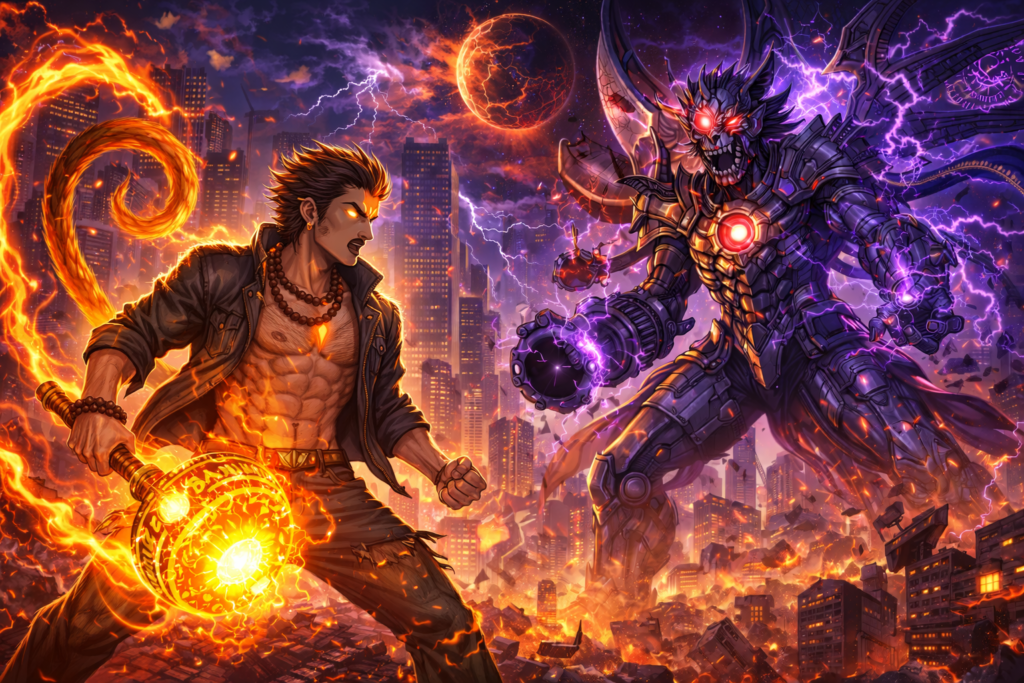
The Ash That Whispers
Hanuman Jayanti in Varanasi.
Bells. Wind. Children with red ribbons tied to sticks, waving them like flags of faith. Pilgrims chant. The air is thick with offering smoke and mantras. But deep beneath the celebration, something stirs. It watches not the noise—but the certainty. And certainty is what it was made to unmake.
The sun rose over Varanasi like a flame offered to the gods.
Golden. Slow. Humble.
By the banks of the Vānaranadī, saffron-robed priests knelt on damp stone steps, setting afloat bowls of flame.
Diyas drifted like fireflies born of memory.
Children danced barefoot in temple courtyards, red scarves tied to their wrists like superhero gear.
One boy leapt from a low wall, arms wide—
“Bajrangbali ki—JAI!”
A dozen voices echoed like thunder through prayer halls.
In the north ghat, women painted Om on banana leaves.
In southern alleyways, a mural of Makardvach glowed with fresh crimson powder—his golden Vanara eyes watching over the market.
From rooftops, the Hanuman Chalisa played on loop, some recordings scratched and warped like vinyl time-travel.
At the base of the banyan tree, the gada—Vānaprakāśa—rested against its roots.
Still. Wrapped in a red cloth that flickered under the tree’s shadow.
Some came to bow.
Some simply whispered, “Thank you.”
Rishabh arrived just past dawn.
Older now—curved spine, wild white beard—but the moment he stepped onto the ghat, a hundred eyes softened.
Not for a saint.
For a witness.
He placed his palm on the stone, whispered:
“He is here.
In the remembering.”
Across the city, Megha Kapoor closed her book and left her notes behind.
She wore red—not by ritual, but because it felt earned.
Akshay climbed the tower above Hanuman Chowk, adjusting solar speakers.
“Can’t let Vanara Man hear static today, eh?” he joked.
Then paused.
Because the wind had paused.
Not died.
Paused.
As if something else had just begun breathing.
In the crowd, no one noticed the man in ash.
Barefoot. Cloaked in grey-white robes like peeling parchment.
No jewelry. No symbol.
Only soot. And silence.
He passed between two chanting monks.
Both went quiet—mid-syllable.
Not confused.
Just blank.
As if the names in their throats had been… unwritten.
A woman dropped her mala beads.
A child forgot the lines he’d practiced all week.
The Chalisa skipped a verse in the loudspeaker.
No glitch. Just—missing.
And still, the man walked.
Toward the banyan.
Toward the gada.
Toward the memory.
By sunset, all of Varanasi had chanted.
Sung.
Celebrated.
They did not yet know—
The day of remembering
was about to become
the night of forgetting.
The bells cracked.
Not shattered—just split, like time itself had sighed too deeply.
The man in ash stopped at the ghat’s center.
No one looked.
Not because he was invisible.
Because he was irrelevant.
Attention slid off him like rain on oil.
A priest began to chant.
Forgot the words.
His disciples blinked.
“Which Ram?”
“What’s tapasvee mean?”
Even the priest’s own mouth forgot its line.
Ash drifted from the man’s feet—rising, not falling—turning stone into silence.
Rishabh’s fingers grew cold.
The warmth of remembrance gone.
He looked up.
“You…” he rasped.
The figure opened his mouth.
No sound.
But a word was understood:
“Finally.”
The first name disappeared.
A child stared at Makardvach’s mural.
“Who’s that man?”
“I… don’t know,” his mother replied.
The mural faded.
The river stopped carrying names.
And Vānaprakāśa fell dim.
Adira gripped her chest on the sky bridge.
“I can’t say his name…”
He had not fought.
Had not cursed.
And still, he won.
He knelt at the banyan.
“Let this god sleep.
Let his name rot in the mouths that never knew him.”
The wind stilled.
And for the first time in a thousand years—
the people forgot how to pray.
The Vānaranadī had always moved.
Even in drought. Even in war.
Said to carry Hanuman’s breath.
But when Aghorvaan—the god of being forgotten—touched the banyan root, the river held still.
Diyas floated in place.
Scrolls turned blank.
The Hanuman Chalisa vanished from every file, every page.
No sound.
No trace.
Megha opened her laptop—her final draft gone.
No error.
Just silence.
She couldn’t remember his name.
Makardv—
Nothing.
The river turned grey.
Not dirty.
Ashen.
Aghorvaan’s prayer took meaning instead of giving it.
“You carved memory into water.
You forgot that silence came first.
And I…
am older than sound.”
But from beneath the ghat—a hum.
Off-key. Faint.
Like belief remembering how to sing.
Rishabh stood.
Stepped into the water.
The river sighed.
Aghorvaan frowned.
He stepped toward the gada.
The bark beneath shivered.
And something deep spoke:
Not all things were carved to be seen.
Some were planted to be felt.
The red cloth unraveled.
Beneath it—gold.
A heartbeat.
A child sang a broken version of the Chalisa.
Off-key. Alone.
But remembered.
The ash peeled from Aghorvaan’s hands.
“You erased my god,” whispered the boy,
“but not our courage.”
The name may fade.
But the will remained.
Schools couldn’t teach Hanuman anymore.
Teachers forgot.
Scrolls blanked.
Temples cracked.
But red scarves still hung.
And in a slum, a mute woman hummed.
No words. Just rhythm.
A child clapped in time.
In silence, rhythm remembered what names forgot.
Keshav, the deaf boy, stood.
Hands trembling.
He signed:
J A I
H A N U M A N
The river moved.
The scarf caught the wind.
Aghorvaan trembled.
His ash robes faltered.
Aasha, the mute elder, hummed beside Keshav.
Others joined.
Not lyrics.
But harmony.
The gada pulsed scarlet.
People began to try.
To remember.
Not with names.
But with acts.
A child drew in the dust—
a figure with a tail, a mace.
Joy.
Not doctrine.
But joy.
Ash tried to erase it—
but the chalk became stone.
And above the banyan—
a figure returned.
Makardvach.
Not roaring.
Not crowned.
Remembered.
He looked at Keshav.
“I remember you too.”
The gada leapt into his hand.
Aghorvaan stepped back.
“You erased my name,” Makardvach said.
“Not my reason.”
Aghorvaan unleashed his storm.
Ash rose.
Chants faded.
Temples cracked.
But the people remembered.
A scarf tied.
A child lifted.
A chalk figure redrawn.
Vanara.
Makardvach charged.
The gada struck.
Ash shattered.
“I was before belief!” Aghorvaan cried.
Makardvach stood firm.
“You erased a name.
But we remember the choice.”
And choice was enough.
Ash crumbled.
Silence broke.
But before fading, Aghorvaan whispered:
“You remembered one.
But names are doors.
And the ones who built the halls…
are stirring.”
Makardvach turned.
The scarf on his wrist burned faintly.
He smiled.
“Then let them come.
We’re not afraid of forgetting anymore.”
He stepped into the crowd.
A child reached up—
and held his hand.
And somewhere beneath the city,
in the place where stories wait their turn—
a page turned.
And another story
began
to wake.