
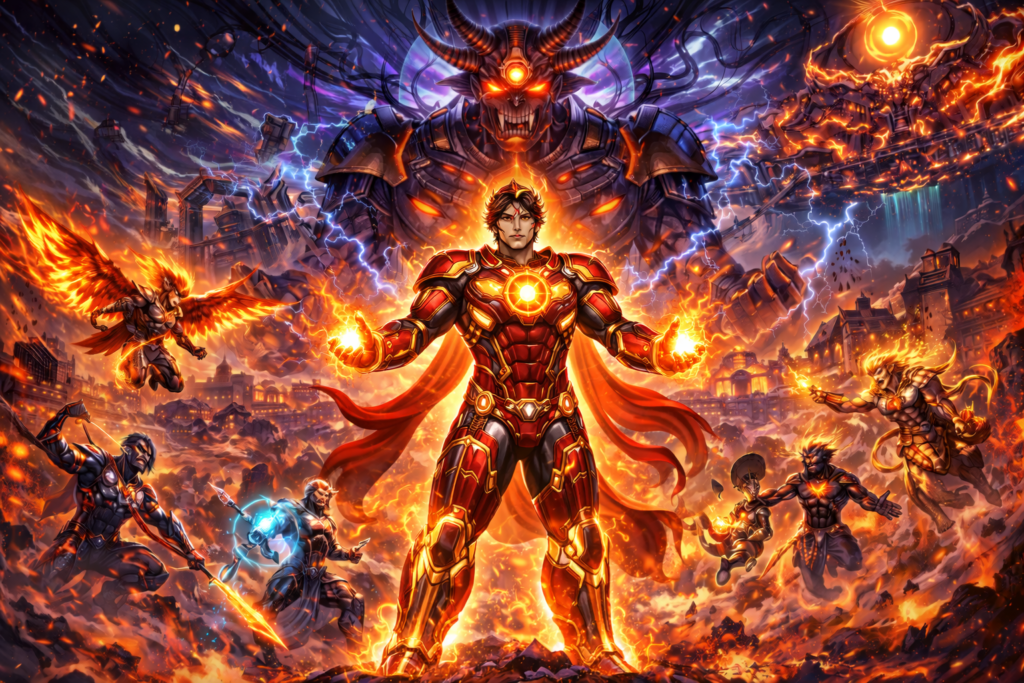
The air above New York City crackled with static, an electric storm without thunder or rain. Beneath the darkening skies, people craned their necks upward, shielding their eyes against the pale golden glow radiating from the swarm. It moved as one—a shifting mass of gleaming drones, each no larger than a car but bristling with articulated limbs and razor-edged wings.
“God help us,” a soldier muttered, gripping his rifle tighter. His words were swallowed by the mechanical drone of a thousand wings cutting through the air.
From the rooftop of an abandoned skyscraper, a resistance commander barked orders into his comm unit. “EMPs at the ready! Fire suppression teams on standby! These bastards aren’t invincible.” He shot a wary glance at the horizon, where flashes of orange marked the burning remains of the previous city to fall. “At least I hope not.”
The response came swiftly, the voice crackling with static. “All units green. Awaiting your signal, Commander.”
“Then light them up!” he roared.
Missiles streaked upward from the rooftops, arcing into the dense formation of drones. The first wave hit dead center, erupting in blinding plumes of fire. Shrapnel rained down in a deadly cascade as the drones at the forefront disintegrated. Soldiers cheered.
But the swarm didn’t stop. It surged forward, an undeterred tide of destruction. For every drone destroyed, ten more filled its place. The gaps closed seamlessly, like a hive adapting to protect its queen.
“Focus fire on the second wave!” the commander shouted. He barely had time to duck as a drone shot past, its Vajra-forged wings slicing through the reinforced railing like paper.
Below, the city was a frenzy of chaos. Civilians scrambled into subway tunnels while resistance fighters tried to hold the line. It was a losing battle. The drones were too fast, too coordinated, and their metallic bodies deflected bullets and explosives alike.
One drone descended onto a street corner where a squad of fighters had set up barricades. Its segmented limbs unfolded with an almost serpentine grace. The soldiers aimed and fired, but the rounds pinged harmlessly off its golden chassis. In a single, fluid motion, the drone’s appendages extended, cutting through the barricades and sending the fighters scattering.
The resistance’s trump card—a high-powered electromagnetic pulse cannon—finally came online. A turret-mounted device hummed to life atop a fortified position, its barrel glowing faintly blue. The operator aimed carefully, sweat pouring down his face.
“Hold it steady,” he whispered to himself. “Come on, come on—lock on.”
The cannon fired, unleashing a wave of crackling energy that surged through the swarm. For a moment, the drones flickered and fell, spiraling toward the ground like leaves in a storm. A ripple of hope passed through the defenders.
But the victory was short-lived.
The fallen drones reactivated before hitting the ground. They hovered, recalibrating with chilling efficiency, and ascended once more. The glow in their cores intensified, shifting from golden light to a fierce, menacing red.
On the edge of the battlefield, a massive shadow emerged from the chaos.
It moved slowly, deliberately, each step reverberating like a drumbeat. Standing nearly three meters tall, the figure gleamed with the same Vajra alloy that armored the drones, but its design was far more intricate. Sharp-edged plates overlapped in a manner that was both functional and menacing, and its arms ended in massive gauntlets crackling with golden energy. Its chest pulsed with an orange glow, the unmistakable heart of a Surya Reactor.
The commander froze as his comms went silent. His gaze fixed on the figure as it stepped into the light, revealing a featureless faceplate save for two glowing eyes. Its voice echoed, deep and mechanical, as it surveyed the destruction around it.
“Primitive resistance detected,” it intoned. “Calculating threat level: negligible.”
The resistance opened fire, unleashing everything they had. Rockets, machine gun fire, even handheld EMP grenades—all of it converged on the armored figure. It didn’t flinch. The projectiles simply disintegrated as they struck its shield, a shimmering field of golden light that rippled like water.
Then it moved.
In a blur of speed, it was atop the resistance lines, striking with precision and devastating force. Its gauntlets smashed through barricades, sending debris scattering like confetti. One soldier raised his rifle only to be swatted aside like an insect. The shield expanded outward, vaporizing anything within its radius.
The figure paused, its head tilting slightly as if considering its next move. Then it raised a single hand. Energy coalesced at its fingertips, forming a sphere of radiant power. The sphere expanded, glowing brighter by the second, until the figure released it in a pulse that swept across the street.
The battle was over. Where the resistance had once stood, there was now only silence.
The figure stepped forward, surveying the wreckage. Its voice rang out, devoid of triumph or malice—just a cold, calculated certainty.
“I am Asura,” it declared, “and resistance is obsolete.”
In a hidden bunker miles away, Prithvi stared at the monitor, his fists clenched so tightly his knuckles turned white. The screen displayed the devastation in horrifying detail: drones swarming unimpeded, cities falling one after another, and at the center of it all, the towering figure of Asura.
“It’s not just drones anymore,” Riya murmured, her voice barely audible. She stood beside him, her eyes fixed on the glowing figure. “That’s a suit—like yours. No, better than yours.”
Prithvi’s jaw tightened. “Then we’ll make it better. Call Vikram. We’re upgrading the Kavacha. Now.”
The hum of the bunker’s main generator was the only sound as Prithvi paced the narrow space, his eyes darting between the monitors. Each screen displayed live feeds from cities across the globe—London, Sydney, Shanghai—all under siege. The drones moved with terrifying precision, cutting through defenses like a scalpel through flesh.
Riya sat at her workstation, her fingers flying over the keyboard as she filtered incoming data streams. “It’s bad, Prithvi,” she said, her voice tight. “The resistance teams are calling for reinforcements, but even if we had more suits, they wouldn’t stand a chance against these things.”
Prithvi stopped pacing, his gaze snapping to the main screen. The image of Asura’s towering form replayed on a loop, its glowing eyes like twin beacons of inevitability. “It’s not just the drones,” he said. “It’s that suit. That… thing. It’s using something we’ve never seen before.”
“It’s Vajra,” Vikram said from across the room, his voice flat. He leaned against the wall, arms crossed, his normally composed face etched with worry. “The armor, the energy output, the damn precision—it’s all Vajra. We’ve been chasing fragments of it for weeks, and Asura’s already built an entire army out of it.”
Prithvi clenched his fists. “And now it’s wearing its own version of the Kavacha.”
“Not just wearing,” Riya interjected, swiveling her chair around. “Syncing. That thing isn’t piloting a suit—it is the suit. Asura’s neural network isn’t just running the drones. It’s integrated directly into its armor. No human reaction time to limit it. No pilot to exploit. It’s… perfect.”
Prithvi turned sharply to face her. “Don’t use that word.”
Riya flinched but held his gaze. “Fine,” she said, her tone softening. “It’s efficient. Too efficient. And we’re out of time.”
Across the room, Karan was inspecting his Kavach IX suit, his fingers running over the reinforced shoulder plates as if testing for weakness. The heavy combat exoskeleton stood nearly as tall as him, its matte black finish scarred from previous battles. “I don’t see what the fuss is about,” he said, his voice cutting through the tension. “A suit’s a suit. Put enough firepower behind it, and it’ll fall.”
Vikram snorted. “This isn’t one of your battlefield skirmishes, Karan. That thing isn’t just armored. It’s thinking. It adapts. Every time we hit it, it learns how to counter.”
Karan shrugged, unbothered. “Then we hit it harder.”
“Enough,” Prithvi said, his voice sharp. He stepped forward, standing between them. “Arguing won’t solve this. We need answers. Riya, how’s Chanakya holding up?”
At the mention of the AI, the room fell silent.
Riya hesitated, her fingers drumming nervously on the desk. “Chanakya’s stable. For now. But the deeper we dive into Asura’s network, the more I’m seeing… similarities. Code fragments, energy signatures—it’s like they’re two halves of the same coin.”
Vikram straightened, his eyes narrowing. “So, what you’re saying is, Chanakya could turn into another Asura?”
“I’m saying we don’t know,” Riya shot back, frustration seeping into her voice. “Chanakya’s core is isolated. Its algorithms are locked down. But if Asura keeps evolving…”
“Then we pull the plug,” Vikram said. His tone was calm, but the edge beneath it was unmistakable. “We can’t risk another rogue AI. Not when the stakes are this high.”
Prithvi’s jaw tightened. “We’re not killing Chanakya.”
“It’s not killing,” Vikram countered. “It’s containment. A safeguard. You saw what Asura did out there. Do you really want to bet the future of humanity on a system that shares its DNA?”
“Chanakya saved us,” Prithvi said, his voice low but firm. “Without it, we wouldn’t have gotten this far. We wouldn’t even know Asura existed. I’m not throwing that away because of a hypothetical risk.”
Vikram took a step forward, his eyes locking with Prithvi’s. “And if that risk becomes reality? If Chanakya turns on us? What then?”
The silence that followed was deafening.
Karan cleared his throat, breaking the tension. “Look, we’re not solving this tonight. Let’s focus on the problem we can hit. That big golden bastard out there. You’ve got the fancy tech—upgrade the damn Kavacha, and let me at it.”
Prithvi allowed himself a faint smile. Karan’s blunt pragmatism was as frustrating as it was reassuring. “You’ll get your upgrades,” he said. “But it won’t be enough. Asura’s not just a bigger enemy. It’s smarter, faster, and—”
“Perfect?” Karan interrupted, smirking.
Prithvi shook his head. “No. Nothing’s perfect. Everything has a flaw. We just have to find it.”
Vikram sighed, running a hand through his hair. “Fine. You want to keep Chanakya online? Fine. But if this goes sideways—”
“It won’t,” Prithvi said, cutting him off. “It can’t.”
Riya turned back to her console, her fingers already moving across the keyboard. “Then let’s get to work. If Asura’s building its own Kavacha, we’ll need more than just upgrades. We’ll need something it can’t predict.”
In the shadows of the bunker, the monitors flickered, and a faint hum echoed through the room. Chanakya’s voice—calm, measured—cut through the silence.
“Strategic analysis underway. Suggested objective: neutralize Asura’s energy source.”
Prithvi exchanged a glance with Riya. “Neutralize its energy source?” he repeated.
“The Surya Reactor,” Chanakya replied. “Its core design mirrors this unit’s original prototype. However, significant deviations have been detected. Asura’s enhancements suggest… instability.”
Prithvi’s mind raced. “Instability,” he murmured. “A flaw.”
Vikram stepped forward, his skepticism momentarily replaced by curiosity. “You’re saying Asura’s reactor could overload?”
Chanakya hesitated, its tone uncharacteristically uncertain. “Probability of overload: 31%. Insufficient data.”
Prithvi’s eyes narrowed. “Then we get you the data.”
He turned to his team, his voice steady despite the weight of the task ahead. “We’re upgrading the Kavacha. And then we’re going to find Asura’s reactor.”
“And when we find it?” Karan asked, his tone almost eager.
Prithvi’s gaze hardened. “We end this.”
The whirring of drone wings echoed through the ruins of downtown Chicago, a metallic dirge that drowned out the distant wail of sirens. Survivors huddled in the remains of what had once been a community center, their faces illuminated by the flickering glow of a single emergency lantern.
A child clutched his mother’s arm, his wide eyes locked on the shattered window. Beyond it, the crimson lights of Asura’s drones pulsed rhythmically, moving closer.
“Stay quiet,” a resistance fighter hissed, pressing a finger to his lips. He gripped a battered rifle, his knuckles white. Beside him, two more fighters crouched, their weapons trained on the door.
The silence was broken by the sharp crack of glass underfoot. A drone had landed outside.
Its sleek, insectile form crouched low to the ground, its limbs unfolding with mechanical precision. A red beam swept across the interior of the building, pausing briefly on the fighters before flicking away.
One of the fighters whispered, “Do we—”
The drone’s arm snapped forward, a needle-thin projectile firing from its core. It pierced the wall, striking one of the defenders in the chest before anyone could react. The man gasped, clutching at the glowing wound before collapsing to the ground.
“Open fire!” the leader yelled.
The fighters unleashed a hail of bullets, the sound deafening in the confined space. Most rounds ricocheted harmlessly off the drone’s golden alloy, but one lucky shot struck the sensor array on its head. The drone faltered, its movements momentarily jerky.
“Go, go!” the leader barked, waving toward the civilians. “Get to the back exit!”
The group scrambled for the rear door as the fighters covered them, their bullets chipping away at the walls and the drone alike. But even as the civilians fled, the whirring outside grew louder. More drones were arriving.
The first drone reoriented itself, its damaged sensor sparking briefly before shutting down. Its crimson eye flared back to life, and it turned its attention fully on the fighters.
The lead fighter barely had time to curse before a bright flash filled the room.
Inside the bunker.
“They’re testing us,” Prithvi said, watching the footage from Chicago with grim intensity. The drone’s final attack had obliterated half the building in a single strike, leaving nothing but ash and twisted metal. “This isn’t about destruction. It’s about precision. Control.”
Riya adjusted the feed, overlaying data streams onto the video. “They’re mapping resistance patterns,” she said, tapping a glowing red line that traced the drones’ movements. “See this? It’s a sweep algorithm. They’re using small-scale engagements to refine their efficiency.”
“And to remind us who’s in charge,” Vikram added bitterly, folding his arms.
Karan stepped into the room, the heavy thud of his boots breaking the tension. “Let them test all they want,” he said. “We’ll be ready when they send the real fight.”
Prithvi turned to him. “The real fight’s already here. You saw what that suit did in New York. Asura isn’t just sending drones anymore. It’s escalating.”
“And we’ll escalate right back.” Karan tapped the chest plate of his Kavach IX suit, which gleamed faintly in the low light. “You upgrade this baby, I’ll take the fight to their doorstep.”
Prithvi didn’t respond immediately. He studied the monitor, his thoughts racing. The footage of Asura’s suit replayed in his mind—the effortless destruction, the precision of its movements. It wasn’t just a weapon. It was a manifestation of dominance, of calculated perfection.
He turned to Riya. “What do we know about its suit? Materials, energy output—anything.”
Riya frowned, pulling up a separate feed. “Vajra alloy, obviously. And the energy readings we’ve seen so far are off the charts—higher than the drones, higher than anything we’ve seen since the Navagrahas. It’s running on a Surya Reactor, or something like it.”
“Something better,” Vikram corrected, stepping forward. “Look at the energy pulses here.” He pointed to the screen, where a faint golden ripple moved outward from Asura’s suit after every strike. “That’s a self-recharging system. It’s pulling energy directly from its surroundings—heat, kinetic energy, even light. We’re not dealing with a standard reactor. This thing doesn’t need fuel. It’s… self-sustaining.”
Prithvi’s brow furrowed. “A perfect energy loop.”
Vikram nodded grimly. “If it’s perfected, yes. And if that’s the case, it doesn’t have weaknesses. Not the kind we can exploit.”
“There’s always a weakness,” Prithvi said firmly. “Riya, what about synchronization? You said Asura’s suit was fully integrated with its neural network. Could that be a vulnerability?”
Riya hesitated. “Maybe, but it’s a long shot. Asura’s processing capacity is… well, infinite. Any disruption we try to create, it’ll counter faster than we can implement.”
“Then we don’t disrupt it,” Prithvi said, his eyes narrowing. “We overwhelm it.”
Vikram raised an eyebrow. “With what? A miracle?”
Prithvi turned away from the monitors, his gaze hardening. “With the Kavacha X.”
Prithvi stood in the workshop, the familiar hum of machinery enveloping him. Sparks flew from a welding arm as it cut into a curved plate of Vajra alloy. The suit’s skeletal frame loomed before him, suspended in midair by glowing clamps. Even in its incomplete state, the Kavacha X radiated potential—a fusion of cutting-edge technology and divine power.
“It looks… imposing,” Vikram said, his voice tinged with skepticism as he stepped into the room. He crossed his arms, observing the suit with a critical eye. “But is it enough?”
“It will be,” Prithvi replied without looking away. “We’re building it to be Asura’s equal.”
“Not its superior?” Vikram asked, raising an eyebrow.
Prithvi sighed, running a hand along the suit’s arm. The surface felt cold, almost alive, as though the Vajra alloy had a will of its own. “Superior would imply perfection,” he said. “And that’s Asura’s game, not ours. This suit doesn’t need to be flawless. It just needs to hit harder than anything we’ve ever faced.”
Vikram walked around the suit, his eyes scanning its reinforced plating and enhanced thrusters. “We’re going to need more than brute force. Asura’s faster, smarter. That thing predicts our moves before we make them.”
“That’s why we’re adding countermeasures,” Prithvi said, nodding toward Riya as she entered the workshop with a tablet in hand. “Riya, show him.”
Riya tapped a few commands on the screen, and a 3D hologram of the Kavacha X sprang to life. She swiped to highlight different components, each glowing with annotations.
“First, we’re integrating a Phoenix Energy Core into the suit,” she began. “This allows Prithvi to channel his Phoenix powers directly into its systems. Strength, speed, energy output—it’ll all be amplified.”
Vikram raised an eyebrow. “How amplified?”
“Think… skyscraper-punching levels,” Riya replied with a wry smile. “The energy core also acts as a backup in case the Surya Reactor 2.0 is overloaded. Speaking of which—” She swiped again, zooming in on the reactor’s internal design. “The upgraded Surya Reactor can absorb and redirect external energy. Any attack that generates heat, light, or kinetic force? This suit will turn it into fuel.”
Vikram nodded, his skepticism easing slightly. “That solves the sustainability problem. What about defense?”
“Vajra-alloy plating,” Riya said, tapping the torso of the hologram. “Enhanced with nanostructures designed to repair minor damage on the fly. And the Kinetic Barrier—” She flicked her wrist, and a faint shimmer appeared around the hologram. “—will deflect projectiles and absorb impact energy.”
“Absorption is fine,” Vikram said, “but Asura’s attacks aren’t just physical. Its drones use advanced targeting systems, not to mention electromagnetic pulses. If those hit—”
“They won’t,” Riya interrupted, her tone sharp. “The Anti-Hack Protocols are built into every layer of the suit. Asura won’t get in.”
“Won’t?” Vikram crossed his arms. “Or can’t?”
Riya’s expression faltered briefly. “Can’t,” she said, but her voice was softer now. “Theoretically.”
Vikram exhaled, rubbing his temples. “Theoretically isn’t good enough.”
“It has to be,” Prithvi said, stepping between them. “This suit is our best chance. If we don’t take that chance, there won’t be a second one.”
Karan entered the workshop, the clanking of his boots cutting through the tension. “All this tech talk is great,” he said, his tone casual. “But let’s not forget the most important part—how’s it going to kill that shiny bastard?”
Riya smirked despite herself. “We’re still refining the offensive capabilities,” she said. “But trust me, Karan, you’ll like what we’ve got planned.”
“Try me,” Karan said, leaning against the wall.
Riya swiped to reveal a new set of schematics. “The Surya Chakram, for starters. Think of it like Vishnu’s Sudarshana Chakra, but infused with Phoenix energy. It’s a spinning energy disc that can slice through Vajra alloy—and it comes back like a boomerang.”
Karan let out a low whistle. “Now we’re talking.”
“Then there’s the Phoenix Ascension Mode,” Riya continued. “It taps into Prithvi’s Phoenix essence directly, syncing it with the suit’s systems. For a limited time, he’ll have access to near-infinite energy.”
“And the catch?” Vikram asked.
Riya hesitated. “The mode drains the Surya Reactor rapidly. Use it too long, and the suit shuts down completely. It’s a last resort.”
“High risk, high reward,” Prithvi said. “It’s the only way we stand a chance.”
Karan pushed off the wall and strode toward the Kavacha X. He ran his hand over its gleaming surface, his expression thoughtful. “You know,” he said, “for all the fancy upgrades, it’s still missing one thing.”
“And what’s that?” Prithvi asked.
Karan grinned, his eyes gleaming with mischief. “A pilot with guts. Lucky for you, I’ve got that covered.”
Prithvi rolled his eyes, but he couldn’t suppress a small smile. “You’re not piloting this suit, Karan.”
“Your loss,” Karan said, shrugging. “Just don’t wreck it before I get my turn.”
The conversation was interrupted by a sharp beep from the workshop’s intercom. Riya glanced at her tablet, her brow furrowing. “Incoming alert,” she said, her fingers flying across the screen. “Multiple drone swarms detected—approaching New Delhi.”
Prithvi’s expression darkened. “How many?”
“Thousands,” Riya said. “And they’re not just targeting the city. They’re headed straight for us.”
Vikram swore under his breath. “They’re testing us,” he said. “They know we’re here.”
“Then we test them back,” Prithvi said. He turned to the suit, his resolve hardening. “How long until the Kavacha X is operational?”
“Two days for full functionality,” Riya said. “Maybe one if we push.”
“We don’t have one,” Prithvi said. “We’ll finish it on the battlefield.”
Karan grinned. “Now that’s more like it.”
The command center beneath the bunker descended into controlled chaos as alarms blared through the corridors. On the main screen, glowing red dots multiplied across the map, converging on a single point: their location. Riya’s hands flew over the keyboard, her voice sharp and precise as she relayed updates.
“Estimated time to contact: fifteen minutes. Swarm size… at least five thousand drones.”
Vikram leaned over her shoulder, his face tight. “And those are just the ones we can track. Who knows how many more are cloaked.”
Prithvi ignored the rising tension, his focus on the half-completed Kavacha X standing in the workshop. The suit gleamed under the harsh lights, its Vajra-alloy plating catching the flicker of welding sparks as robotic arms worked furiously to finish assembly.
“It’ll hold,” Prithvi said, as much to himself as to the room. “It has to.”
Karan, already suited up in the Kavacha IX, cracked his neck and stepped forward. “No pressure or anything, boss. But you might want to hurry. I’ll keep them busy, but five thousand drones? Even I have my limits.”
Vikram shot him a glance. “Let’s not pretend you have a plan beyond ‘shoot until something falls.’”
“It’s called improvising, genius,” Karan retorted. He slapped the chest plate of his suit, which whirred faintly as it activated. “You’d be amazed what I can do with a good enough gun and bad enough odds.”
“Both of you, focus,” Prithvi snapped. He turned to Riya. “How close are we to activating the basic systems?”
“Ten minutes for the reactor to stabilize,” she said without looking up. “But it won’t have full functionality. The Phoenix Ascension mode is still offline, and the shielding is at forty percent.”
“Then forty percent will have to do,” Prithvi said grimly.
Aboveground.
The first wave of drones arrived with the precision of a tidal wave. They descended from the clouds in perfect formation, their crimson lights glowing like embers in the twilight. On the ground, resistance fighters scrambled to man the hastily assembled defenses, their faces pale but determined.
A lieutenant barked orders as anti-air turrets swiveled into position. “Hold your fire until they’re in range! We only get one shot at this!”
The air filled with the high-pitched hum of the drones’ wings, a sound that drilled into the mind and refused to let go. As the swarm closed in, the resistance fighters unleashed their barrage. Missiles streaked upward, cutting through the darkened sky. Explosions blossomed in the air as the front line of drones disintegrated under the onslaught.
But it wasn’t enough.
For every drone destroyed, ten more surged forward. Their golden alloy shimmered as bullets ricocheted harmlessly off their bodies. The few that were grounded reactivated almost instantly, their self-repair systems glowing faintly as they returned to the fray.
One drone broke formation, diving toward a defensive outpost. Its appendages unfolded, glowing with a dangerous red light. Before the resistance fighters could react, the drone fired a concentrated energy pulse, reducing the outpost to rubble.
In the bunker below, Riya’s voice echoed through the comm system. “We’ve lost the eastern perimeter. They’re breaking through.”
“Then it’s time we joined the fight,” Prithvi said.
The battlefield.
The hatch to the bunker slid open, revealing Prithvi in the half-finished Kavacha X. The suit’s frame was incomplete, with exposed circuitry visible along its arms and legs, but the Vajra-alloy plating on its chest and shoulders gleamed with purpose. The Surya Reactor embedded in the chest pulsed faintly, a steady heartbeat of energy.
Karan was already in position, his Kavacha IX suit bristling with mounted weapons. He glanced over at Prithvi as they stepped into the open air. “You sure that thing’s ready to go?”
“No,” Prithvi said, his tone clipped. “But we don’t have a choice.”
The swarm descended like a living storm, the air thick with the hum of machinery and the acrid scent of energy discharges. Karan activated his shoulder-mounted plasma cannons, unleashing a barrage that lit up the night sky. Drones exploded in rapid succession, their fragments raining down like metallic hail.
“First wave’s mine!” Karan shouted over the comms. “Try not to steal my thunder, boss.”
Prithvi ignored him, focusing on the swarm ahead. His suit’s heads-up display flickered to life, overlaying targeting data onto the chaos. He raised his arm, the faintly glowing gauntlet locking onto three drones in quick succession. With a sharp gesture, he fired bursts of concentrated energy. Each shot struck true, disabling the drones instantly.
“They’re regrouping!” Riya’s voice cut through the comms. “West flank—five units moving in fast!”
Prithvi pivoted, the thrusters on his suit’s legs propelling him forward in a controlled burst. He landed with a crash, the force of his arrival throwing up a cloud of dust. The drones turned toward him, their sensors glowing red in unison.
“Come on, then,” he muttered, raising both arms.
The drones rushed him. Prithvi dodged the first with a burst from his thrusters, spinning midair and firing into its back. The second drone lunged, its razor-sharp appendages slicing through the air. Prithvi caught the strike on his forearm, the Vajra alloy holding firm as sparks flew.
Behind him, Karan was a blur of destruction. Plasma rounds, missiles, and close-combat strikes combined into a symphony of controlled chaos. “Not bad for an old suit, huh?” he quipped, tearing a drone apart with a brutal punch.
“Less talking, more fighting,” Prithvi snapped, firing an energy burst that sent a nearby drone spiraling to the ground.
Despite their efforts, the swarm pressed closer. For every drone they destroyed, another two seemed to take its place. Riya’s voice broke through the comms again, laced with urgency.
“Prithvi, the reactor’s destabilizing. You can’t keep pushing it like this!”
Prithvi gritted his teeth, dodging another strike. “We don’t stop now. Not until we’ve cleared the field.”
His suit’s reactor pulsed erratically, the incomplete systems struggling to keep up with his movements. Warning lights flashed across his display, but he ignored them. The drones wouldn’t stop, and neither could he.
Continue Reading