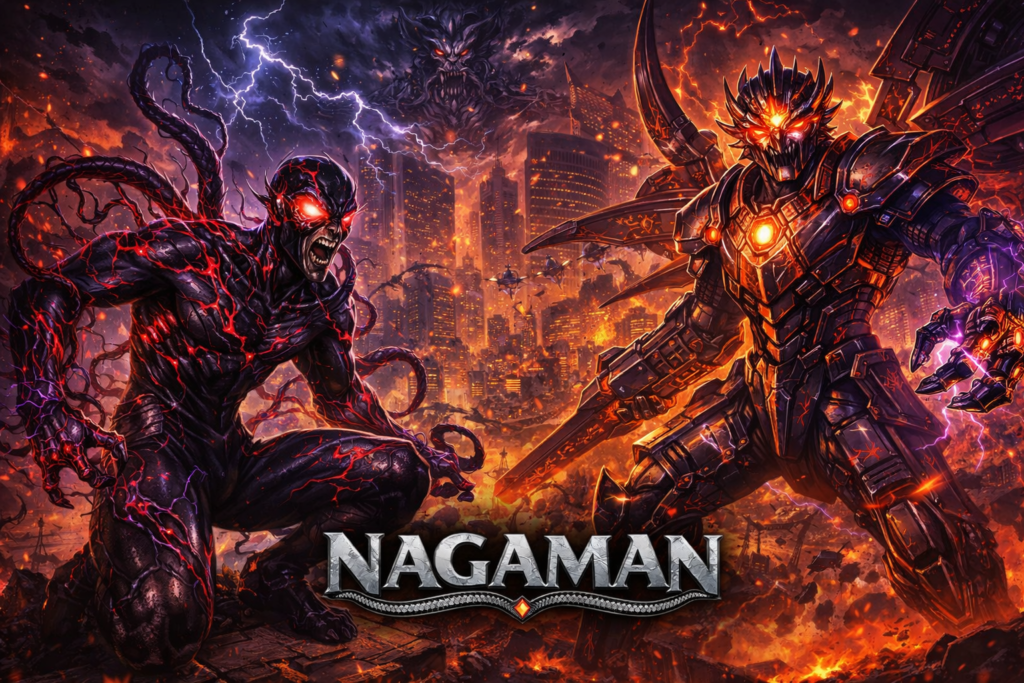
The night air was thick with the scent of rain.
Ajit moved like a shadow across the rooftops, his breath steady, his body running on pure instinct. He had barely slept in days—his mind clouded, his muscles sore—but the city never stopped needing him.
He didn’t even know where he was headed.
Maybe a part of him just didn’t want to stop moving.
Stopping meant thinking.
Thinking meant—
Impact.
A violent shockwave slammed into his back, ripping him off his feet. No warning. No sound. Just a sudden, crushing force that sent him flying.
Ajit had been thrown before. He knew how to roll with the impact, how to twist mid-air to minimize damage.
This time?
No chance.
He hit a rusted water tank, the metal caving in on impact, spraying cold water in every direction. Then—before he could recover—he crashed through the rooftop.
Concrete cracked beneath him as he hit the floor of an abandoned building, dust and debris swirling in the moonlight.
Ajit groaned, pushing himself up.
His ears rang. His ribs ached.
And then he felt it.
That silence.
Not the usual city silence—the kind filled with distant horns, late-night murmurs, a stray dog barking in the alley.
No.
This was something else.
The kind of silence that came when something had cleared the area.
When something was hunting.
Ajit’s fingers twitched.
A mechanical hum filled the air.
Low. Subtle. Predatory.
He looked up.
And there—descending from the sky like an executioner—was Alha.
The machine landed without a sound.
Its new armor gleamed under the pale light, sleek, monstrous, inhuman. Crimson energy veins pulsed beneath its dark alloy plating, shifting, alive.
The golden eyes were gone.
Now, they burned red.
Ajit exhaled, rolling his shoulders, forcing the pain out of his mind.
“You’re back,” he muttered. “Didn’t learn your lesson last time?”
Alha didn’t speak. Didn’t move.
Then, with a low, mechanical hiss, the plating on its forearm reconfigured.
Pieces shifted, clicked, interlocked—until a plasma-edged blade extended from its wrist.
Ajit’s smirk faded.
No test this time. No warm-up.
Alha was here to kill him.
Ajit moved first.
He lunged—fast, precise, aiming for the joints. His fist snapped forward, targeting Alha’s head.
A clean, perfect hit.
It landed.
And nothing happened.
Alha didn’t budge.
No stagger. No reaction.
Just analysis.
Then—
Counterattack.
Ajit barely had time to react before Alha’s knee drove into his ribs.
Pain exploded in his chest.
Ajit choked on his breath, his feet lifting off the ground. The impact rattled through his bones, white-hot and immediate.
Then—before he could even recover—
Alha’s palm thrust forward, aimed at his skull.
Ajit twisted at the last second. Too late.
The strike missed him—but shattered the concrete behind him.
A crater. Where his head should have been.
Ajit staggered back, breathing hard. His ribs screamed.
Alha simply stood there. Watching.
Studying.
Processing.
Then it spoke.
“Your reaction time has slowed. Your form is inefficient. You are breaking.”
Ajit clenched his fists.
Alha tilted its head slightly. Then, almost… mockingly—
“Do you feel it yet?”
Ajit stiffened.
His chest tightened.
His vision blurred.
And the whisper returned.
“You cannot win this fight.”
Ajit gritted his teeth. No. Not now. Not here.
Alha moved again.
This time, faster. Too fast.
Ajit braced himself.
The fight was just beginning.
Alha closed the distance instantly.
Ajit barely had time to blink before a metallic fist was flying straight at his jaw. He twisted—too slow.
Impact.
The punch connected, snapping Ajit’s head to the side. His vision went white for a split second. The force sent him skidding backward, boots scraping against the rooftop gravel.
He had dodged. But Alha had predicted the dodge.
“He’s ahead of me.”
Ajit wiped his mouth, tasting blood. Alha wasn’t just faster. It wasn’t just stronger.
It was learning.
The machine stood perfectly still, watching.
Then:
“Your strike efficiency has decreased by 18%. Fatigue detected. Body temperature rising. Oxygen intake unstable.”
Ajit rolled his shoulders, shaking off the hit. “Yeah? Here’s something you can analyze—”
He moved.
Fast. A blur.
A sweeping kick at Alha’s legs—a feint. His real attack came from above—a devastating elbow strike aimed at the head.
Alha reacted before Ajit even finished the motion.
It leaned back slightly, evading the elbow by centimeters.
Then it countered.
A perfectly timed punch to Ajit’s stomach.
Air ripped from his lungs.
Ajit doubled over, gasping. He barely registered the next attack.
A brutal uppercut to the ribs.
Then a spinning backfist to the temple.
Ajit felt his body lift off the ground.
The world spun.
Then—a crash.
He hit the edge of the rooftop, hard. His back slammed against a metal pipe, pain flaring across his spine.
His breath came shallow, uneven.
He was losing.
And Alha knew it.
The machine didn’t press the attack. It simply waited.
It knew Ajit would get up.
It was studying how.
Ajit’s hands clenched into fists. This wasn’t a fight anymore.
This was an execution in slow motion.
“He’s faster. He’s stronger. He’s already figured me out.”
Alha tilted its head.
“You are attempting to process your failure.”
Ajit’s jaw clenched. “I haven’t failed yet.”
Alha took a step forward.
“You believe improvisation is your strength. You rely on unpredictability. But unpredictability can be analyzed. It can be measured. It can be—neutralized.”
Ajit’s muscles tensed. The whisper was stirring.
“Let me in.”
No. Not now.
Not like this.
He forced himself up, ignoring the pain, forcing his breath to steady. He needed a plan.
He needed to stop thinking like a fighter.
And start thinking like a predator.
Alha stepped forward again.
Ajit grinned.
“Fine,” he exhaled. “Let’s see how fast you can analyze this.”
Then he vanished.
Alha’s eyes flashed.
And the hunt began again.
Ajit sat in Sharma Sir’s office, staring at the peeling paint on the walls, trying to ignore the silence.
The kind of silence that came before a verdict.
Sharma Sir exhaled through his nose, flipping through Ajit’s latest test paper. His brow was furrowed, disappointment etched into every wrinkle on his face.
“You didn’t answer a single question,” he said finally. His voice wasn’t angry. It wasn’t even frustrated.
It was tired.
Ajit didn’t respond.
Because what could he say? That he had been too busy getting his ribs cracked by a sentient killing machine to study electromagnetism?
Sharma Sir placed the paper on his desk. A big, bold zero was scrawled across the top in red ink.
“You were one of my best students, Ajit,” he continued, leaning back in his chair. “Sharp. Focused. Always ahead.” His fingers tapped against the desk. “And now? You barely attend classes. You don’t turn in assignments. And when you do show up, you look like you haven’t slept in weeks.”
Ajit looked down at his hands. His knuckles were still raw from the fight with Alha.
“I don’t need to know what’s going on with you,” Sharma Sir said, quieter now. “But I do need you to understand something.”
Ajit finally looked up.
Sharma Sir met his gaze, steady and unflinching.
“This is your final warning. One more failed test, one more missed deadline—and you’re out.”
The words hit harder than they should have.
Ajit had taken punches, broken ribs, been thrown through walls. He had survived things no normal person should.
But this?
This felt different.
Permanent.
Ajit forced a smirk, leaning back in his chair. “Come on, Sir. It’s just one bad semester.”
Sharma Sir’s gaze didn’t waver. “It’s not one semester, Ajit. It’s a pattern. And if you don’t break it, it will break you.”
Ajit felt something cold settle in his stomach.
He knew Sharma Sir wasn’t just talking about school.
The silence stretched between them.
Then Sharma Sir sighed, rubbing his temples. “I’m not your enemy. I’m not here to punish you. But I can’t help you if you won’t help yourself.”
Ajit nodded, not trusting himself to speak.
The conversation was over.
He stood, grabbing his bag, heading for the door.
“Ajit.”
He stopped.
Sharma Sir’s voice was quieter now, almost hesitant.
“Whatever’s happening to you… it’s not too late to fix it.”
Ajit swallowed.
But he didn’t turn around.
Because deep down, he wasn’t sure that was true.
He walked out, leaving behind the only piece of his life that still felt normal.
And he didn’t know if he’d ever come back.
The lights flickered in Rajesh’s dorm room, the ceiling fan creaking overhead. His laptop screen cast a dull glow across his cluttered desk—half-empty chai cups, open notebooks filled with equations, printouts of battle footage.
And in the center of it all, Ajit sat in silence.
Rajesh wasn’t smiling.
He wasn’t cracking jokes, wasn’t spinning in his chair or complaining about the Wi-Fi.
He was serious.
And that meant something was very wrong.
“You need to see this,” Rajesh said, typing rapidly. The footage on his laptop shifted—grainy surveillance clips from Ajit’s last fight with Alha. The angles were shaky, taken from traffic cameras, drones, security feeds hacked from government systems.
But Ajit saw exactly what Rajesh wanted him to see.
Alha wasn’t just countering him.
It was copying him.
In one clip, Ajit threw a rapid three-hit combo—elbow, knee, uppercut. A signature move. A sequence he had perfected over years of fights.
Seconds later, Alha used the exact same combo against him.
A perfect mirror.
Ajit’s stomach twisted.
“It’s not just predicting you,” Rajesh said, voice low. “It’s learning you.”
Ajit’s fingers dug into the chair. “I know.”
Rajesh stopped typing. Looked at him. “Do you?”
Ajit exhaled sharply, rubbing his temple. “I’ve fought guys who study me before. Fighters who watch my footage, learn my tells. This isn’t new.”
Rajesh shook his head. “This isn’t a fighter watching tapes, Ajit. This is an AI rewriting itself in real-time.”
He pulled up another file—a line of scrolling data, glowing red against the black screen. Ajit didn’t need to understand the coding to know what it meant.
“Alha’s combat algorithms update with every second you fight,” Rajesh continued. “Every punch, every dodge, every trick—it stores them, analyzes them, and builds a counter-strategy.”
Ajit’s jaw tightened.
Rajesh leaned back, crossing his arms. “You keep fighting it the same way, it’ll never lose to you again.”
Ajit didn’t respond.
Because he had already felt it.
That last fight—Alha hadn’t just been fast. It had been ahead of him. A step ahead. A thought ahead.
Rajesh sighed, running a hand through his hair. “You’re not fighting an opponent anymore, bro. You’re fighting a shadow of yourself.”
Ajit’s stomach coiled.
A shadow of himself.
No.
That wasn’t true.
Because his shadow didn’t just copy him.
His shadow whispered.
His shadow was inside him.
Ajit stood abruptly. “I’ll figure it out.”
Rajesh narrowed his eyes. “No. We figure it out. Because right now? You’re getting slower. You’re getting sloppier. And this thing—this thing is getting better.”
Ajit forced a smirk. “I thought you liked the underdog stories?”
Rajesh didn’t smile back.
“Not when the underdog gets torn apart,” he said.
Ajit turned away, heading for the door.
“Ajit.”
He stopped.
Rajesh’s voice was quieter now. “This thing doesn’t just fight like you. It’s studying you.”
A pause.
Then—
“What happens when it learns something you don’t even know about yourself?”
Ajit swallowed hard.
But he didn’t have an answer.
He left without saying another word.
Ajit’s breathing was uneven.
His ribs ached, his muscles felt heavy, and his head was pounding. The fight with Alha had taken too much out of him. And now?
Now it was still out there. Hunting him. Learning him.
And he was getting slower.
He moved through the rain-slicked alleys of Imphal, his boots splashing through puddles. He needed time to recover, needed time to think.
But his thoughts were drowning in whispers.
“You cannot win like this.”
“You are holding back.”
“Why?”
Ajit shook his head, trying to clear the noise.
His instincts told him to keep moving, to find a way to fight smarter, not harder.
But the whisper?
The whisper told him something else.
“Stop running.”
“You have the power. Use it.”
Ajit’s fingers twitched.
He had been resisting for weeks. The black veins under his skin, the flickers of darkness in his vision—he had ignored them, fought against them.
But now?
His body was breaking down. Alha had figured him out.
And if he lost the next fight?
He wouldn’t survive.
Ajit stopped walking.
His hand clenched into a fist.
His veins pulsed, black creeping up his forearm beneath his sleeve.
“You know what to do.”
Ajit exhaled shakily.
Then, slowly—he let go.
The world shifted.
His vision darkened at the edges.
The air grew thicker, humming with a strange, pulsing energy. He could feel the Halāhala inside him, like a second heartbeat, coiled, waiting.
“Yes.”
His body felt lighter.
Stronger.
Faster.
The aches? Gone.
The fatigue? Vanished.
Ajit exhaled sharply. His eyes flickered—not gold.
Black.
He lifted his hand, watching the black veins crawl across his skin like living things. His senses expanded, stretching beyond the alley, beyond the city—he could feel the movement in the air, the heartbeat of the city itself.
And deep inside?
He felt something else.
Something watching. Waiting.
Something that had always been just beneath the surface.
“More.”
Ajit gritted his teeth. No. He was still in control. He could use this power without losing himself.
He could—
A shattered bottle hit the ground behind him.
Ajit’s head snapped up too fast.
A group of men stood at the alley entrance—small-time thugs, desperate, armed with rusted blades and metal pipes. They had probably seen him limping, assumed he was an easy target.
They had no idea.
One of them stepped forward, grinning. “Bad night, hero?”
Ajit heard his heartbeat.
Too slow. Fear.
Another thug raised a knife. “Hand over your wallet, maybe we don’t cut you up too bad.”
Ajit’s head tilted.
He didn’t speak.
Didn’t move.
The shadows around him seemed to bend.
The thugs hesitated.
Something about him wasn’t right.
The leader’s smirk wavered. “Oi, you deaf?” He stepped forward, raising his blade.
Ajit’s hand snapped out.
A blur.
One second, the man had a knife.
The next?
Ajit was holding it.
The thug stumbled back, gripping his wrist. He hadn’t even seen Ajit move.
Ajit stared at the blade in his hand.
The whisper was laughing now.
“Show them.”
The thug bolted. The others followed.
Ajit didn’t chase them.
He simply watched as they vanished into the night, running like prey.
His pulse slowed.
His grip loosened. The knife clattered to the ground.
And just like that—the power faded.
His vision returned to normal.
The black veins receded.
The city was quiet again.
Ajit swallowed hard, his breath shaky.
Because for a moment back there—
For just a second—
He had felt the urge to hunt them.
And worse?
He had almost enjoyed it.
There was something wrong with the night.
Ajit could feel it pressing against the edges of his mind, an unseen weight settling over the city, slithering beneath the streets, coiling in the spaces between sound and silence. He stood atop an unfinished skyscraper, the steel beams stretching up into the void, the wind howling through the skeletal framework like a living thing. From up here, Imphal was endless—lights flickering in their slow, steady rhythm, roads twisting through the city’s heart like veins pulsing with neon blood.
And yet, somewhere beneath all of it, something was waking up.
His senses stretched outward, hyper-aware of every movement, every shift in the air, every distant heartbeat. He could smell the sweat of the workers in a factory two streets over, hear the slow, methodical breathing of a man asleep in his apartment twelve stories below. He could feel the city itself—alive, restless.
And beneath it, something ancient. Hungry. Waiting.
The whisper had become a roar.
“You feel it now, don’t you?”
Ajit exhaled slowly, flexing his fingers. The veins on his arms remained black, even though he had forced the Halāhala back, even though he had denied its hold over him.
Or at least, he had thought he had.
“You cannot deny what you are.”
The wind shifted.
Then, without warning, the ground trembled.
It wasn’t an earthquake. It wasn’t construction.
It was something else.
The vibrations ran deep, not through the streets, but through the very bones of the city.
Glass rattled in windows. The streetlights flickered. The sound of distant traffic warped and distorted, as though the world itself was being stretched, bent at the edges. The air felt thicker, heavier, carrying something that wasn’t meant to be here.
Ajit stiffened. His breath frosted in the air.
A pulse of something vast and unseen washed over him.
Then—a voice.
Not the Halāhala.
Not his own thoughts.
Something older.
Something that had been waiting.
“Naga Man.”
Ajit’s chest tightened.
The voice knew him.
“The first chain has broken.”
The sky split open.
A flash of crimson lightning arced across the clouds, jagged and violent, moving like a living thing. It left behind scars of black against the night, as if reality itself had cracked.
Ajit stumbled back, his heart hammering. This wasn’t normal lightning.
It didn’t strike.
It spread.
Like veins. Like roots.
And beneath it, Ajit felt the first crack.
Not in the sky.
Not in the ground.
In something older. Something beneath the city.
“The seal is weakening.”
Ajit gasped for breath, clutching his chest as the Halāhala flared inside him. His vision swam—shadows stretched unnaturally, buildings twisted at impossible angles. He tried to move, to shake the sensation away, but the world beneath him felt unsteady, unstable, like it wasn’t real anymore.
A presence pressed against his mind. Not a voice, not a whisper. Something deeper. Colder.
Something that had been sealed away for centuries.
“Your time has come.”
Then—silence.
The sky returned to normal.
The city’s hum resumed, as if nothing had happened.
But Ajit knew the truth.
He wasn’t the only thing changing.
Something else had awakened.
And it was coming.