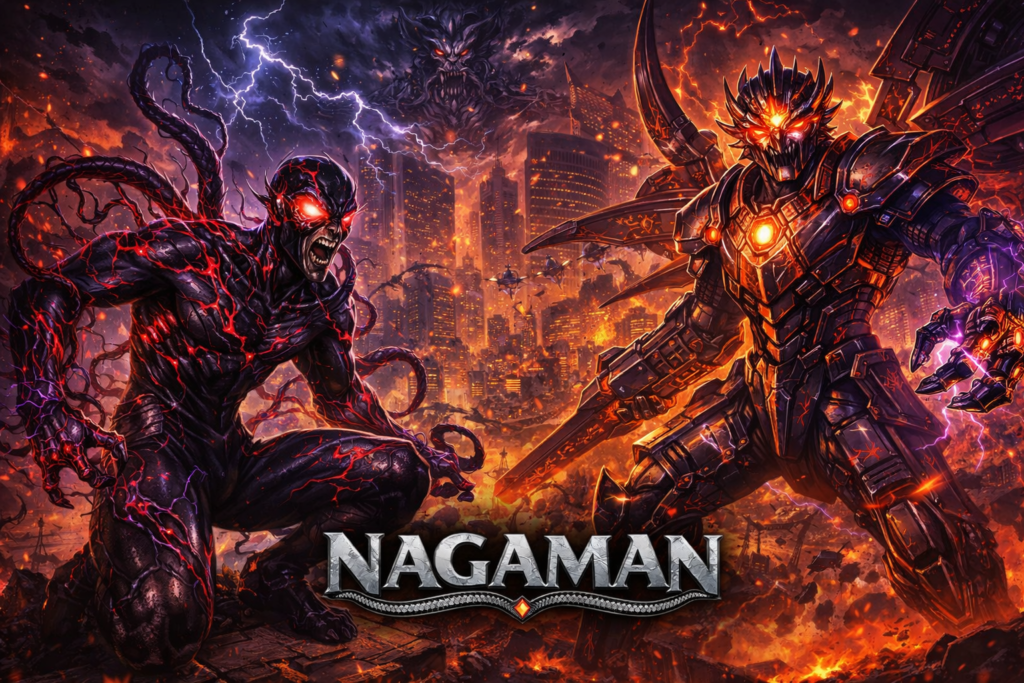
Nagaman

Nagaman Volume 3; Curse of Halahala

CHAPTER 14: A NEW DAWN
The skies over Imphal were clear.
For the first time in days, the black-red storm had lifted, and the golden light of morning stretched over the horizon, casting long shadows across the ruined city.
Ajit stood at the very edge of what had once been Manipur’s tallest skyscraper, now a jagged shell of its former self. Half of it had collapsed, its steel bones twisted, glass shattered, its remains crumbling toward the earth like the ribcage of some ancient titan. The wind carried the scent of dust and ash, the air still thick with the memory of fire.
Below him, Imphal stirred.
The city should have been dead.
But it wasn’t.
From his vantage point, he could see people moving among the wreckage.
They weren’t running. They weren’t screaming.
They were rebuilding.
Volunteers dug through rubble, pulling out anything that could be salvaged. Paramedics carried the wounded. Shopkeepers—their stores reduced to broken walls and shattered counters—were already sweeping away the dust.
Ajit’s fingers curled into a fist.
Just two nights ago, the city had been caught in a war between gods and monsters.
And yet, here it was.
Because Imphal always survived.
The golden glow of the Nagamani pulsed faintly beneath his skin, but he let the power fade, suppressing it until it was nothing more than a lingering warmth in his chest.
Naga Man wasn’t needed right now.
Ajit Singh was.
He pulled his hood over his face and leapt down.


THE CITY ON THE MEND.
The streets of Imphal were lined with scarred buildings and shattered roads, the skeletons of once-thriving markets now reduced to dust and ruin. Cracks spiderwebbed through the pavement, and the few neon signs that had survived the battle flickered weakly, barely clinging to life.
But the people—the people were unshaken.
Ajit moved through the streets, unnoticed. A shadow among the ruins. His tattered hoodie covered most of his face, and with his head down, he was just another survivor.
A relief camp had been set up near the collapsed hospital. Rows of white tents stood in the wreckage, medical teams moving between them with quiet urgency. Nurses wrapped bandages around burnt arms, volunteers handed out food and water, and rescue teams searched the ruins for any last survivors.
A radio crackled from a nearby table, voices murmuring through the static.
“…rescue teams have confirmed survivors near the temple ruins…”
“…the Chief Minister has declared a week of mourning for those lost in the attack…”
“…but despite everything, the people of Imphal remain hopeful. They say the storm has passed. They say their protector will return.”
Ajit stopped.
His fingers twitched.
Their protector.
Naga Man.
His jaw tightened, his shoulders stiffened.
Was that still who he was?


A SHADOW IN THE CROWD.
He moved toward one of the medical tents, watching from a distance.
A young girl sat on a cot, her right arm wrapped in fresh bandages, her legs kicking idly as she studied the people moving around her. She wasn’t crying.
She wasn’t afraid.
She was watching.
Watching the volunteers, the medics, the survivors who had lost everything yet still found the strength to rebuild.
Ajit felt something tighten in his chest.
She couldn’t have been older than ten.
Her skin was still streaked with dust, her clothes torn, but her eyes—
Her eyes held something stronger than fear.
They held belief.
Ajit took a step closer.
The girl turned her head.
For a moment, she studied him.
Then—
Recognition flickered in her expression.
She tilted her head, her small fingers clutching at the edges of her cot.
“Naga Man?” she whispered.
Ajit froze.
The words hit harder than any punch he had taken in battle.
He hadn’t expected anyone to recognize him like this.
Broken. Exhausted. Just a man in the ruins.
The girl reached out her hand.
Not in fear.
Not in awe.
In certainty.
Like she had always believed he would be here.
Like she had always known he would return.
Ajit stared at her small, dust-covered fingers.
For a second, he hesitated.
Then—he reached out, gripping her hand.
“You’re safe now,” he said.
She nodded.
Then—
She smiled.
And for the first time since the battle had ended—
So did he.


The river still carried the scent of smoke and blood.
The morning light stretched across its surface, turning the ripples to molten gold. Beneath the water, broken fragments of stone and steel drifted like corpses, remnants of the battle that had nearly erased this city.
Ajit stood at the river’s edge, his boots half-buried in the damp earth.
The wind tugged at his hoodie, cool against his sweat-streaked skin. He barely felt it. His fingers curled around the object in his palm—small, cold, metallic.
Laxman’s pendant.
He turned it over, running his thumb across the worn engraving on the back. The chain had snapped, the edges dented, as if it had been crushed in a dying grip.
His throat tightened.
A month ago, that pendant had hung around Laxman’s neck.
A week ago, it had been clenched in his fist.
Two nights ago, it had fallen lifelessly into Ajit’s hands.
The city had moved forward. People were rebuilding.
Ajit was still here. Still standing.
Laxman wasn’t.
His grip closed around the pendant. Hard.


The wind shifted.
A distant sound—laughter.
Ajit turned his head slightly.
On the far side of the river, a group of boys ran along the broken docks, leaping from one platform to another, their voices rising over the water. Their clothes were torn, their faces streaked with dirt, but they laughed.
One boy—no older than ten—stumbled, his foot slipping against the wet wood.
Ajit’s muscles tensed—a reflex, a twitch, a phantom instinct to move.
But before he could react, another boy grabbed his wrist, yanking him upright before he could fall.
They stood there for a moment, breathless.
Then, without hesitation, they both laughed.
Ajit exhaled slowly, his shoulders unclenching.
The boy hadn’t needed saving.
They would be fine.
People would be fine.
With or without him.


The pendant in his palm felt heavier than before.
Ajit crouched down, his fingers brushing against the surface of the river.
The water curled around his knuckles—cold, smooth, endless.
For a second, he imagined letting go.
Letting the pendant sink.
Letting the weight of it drift away, swallowed by the current.
But he didn’t.
His fist closed around it again, slipping the broken chain into his pocket.
The past couldn’t be erased.
And some burdens weren’t meant to be dropped.
The square was filled with people.
They stood shoulder to shoulder, packed between the broken remains of buildings and the makeshift scaffolding that framed the square. The air was thick with dust and voices, but no one was moving. No one was speaking.
All eyes were fixed on the veiled monument in the center.
Ajit stood at the edge of the crowd, hood pulled low over his face.
He didn’t need to be close to see it.
He wasn’t sure he wanted to.
A podium had been set up in front of the covered statue. The Chief Minister stepped forward, adjusting the microphone, waiting for the murmuring to quiet.
It didn’t.
It wasn’t disrespect.
It was exhaustion.
The people of Imphal had seen too much, lost too much. They were here because they had to be. Because in the wake of a war between gods, monsters, and men, something had to come next.
Something had to make sense.
The Minister’s voice carried across the square.
“We stand today in the ruins of our own city. A city that, just days ago, nearly ceased to exist.”
No one looked away.
“We lost much. More than we can ever count. But Imphal stands. And we, as its people, stand with it.”
A murmur of agreement. Small. Hollow.
Ajit’s hands tightened into fists.
“We dedicate this statue to our resilience. To the strength of those who fought. To the memory of those who fell.”
The Minister turned. Raised a hand.
“To Imphal’s protector.”
Ajit’s stomach coiled.
The white cloth was pulled away.
And the crowd erupted.


A SYMBOL OF SURVIVAL.
The bronze figure of Babruvāhan stood tall, its polished surface gleaming against the wreckage of the city.
The ancient warrior-king was frozen mid-stride, his sword raised, his shield cracked but unbroken, his face turned forward. Unyielding. Defiant. Unstoppable.
Even in ruin, even in the aftermath of something too big for history to understand, he stood.
Ajit exhaled slowly.
They hadn’t built a statue for Naga Man.
They had built it for themselves.
For the people.
For every survivor who had fought and suffered and stood again.
For Imphal.
The crowd wasn’t cheering. Not really.
This wasn’t a celebration.
It was a promise.


The wind shifted.
Someone moved beside him.
Ajit didn’t need to look.
Padmini.
She didn’t say anything at first.
Just stood with him, watching the monument, watching the people watch it.
“They’re moving forward,” she said eventually.
Ajit’s eyes didn’t leave the statue.
“Yeah.”
A pause.
Then—
“And you?” she asked.
Ajit didn’t answer.
The statue stood in the center of the square.
Unyielding. Defiant. Unstoppable.
A hero carved in bronze.
Ajit wasn’t sure if he was any of those things anymore.
The narrow alleys of Chingmeirong Market were quiet.
Too quiet.
The battle had reshaped the city, but some things never changed.
Here, in the ruins of old storefronts and abandoned stalls, shadows still moved.
A man stood under the flickering glow of a half-broken streetlight, a knife spinning between his fingers. He was young—early twenties at most—but his eyes were older. Hardened.
Across from him, four others stood in a loose circle, their voices low.
A conversation. A negotiation. A division of power.
“Ravana’s gone,” the first man murmured.
“His men aren’t,” someone else countered. “There are still plenty of them out there.”
“But they don’t got a leader anymore.”
A pause.
“That means someone else steps up.”
The knife stilled between the man’s fingers.
A slow grin spread across his face.
“Yeah.”
He let the blade drop. Caught it by the handle without looking.
“And if Naga Man’s smart, he’ll stay gone too.”
The group muttered their agreement.
There was a vacuum in the streets.
And the city never stayed empty for long.


Footsteps.
They all froze.
The first man turned his head, sharp and instinctive.
Something moved at the edge of the alley.
A figure. Small. Quick.
Too late.
The kid bolted.
“Shit—!”
The man lunged forward, grabbing the nearest pipe from the rubble and hurling it.
It struck the wall just ahead of the runner, sending a shower of broken brick and dust exploding outward.
The kid tripped, sprawling onto the ground.
He tried to scramble up—but the knife was already at his throat.
“Well, well,” the man sneered, pressing the tip against the kid’s skin.
“Spies get their tongues cut out.”
The kid—a skinny, dust-covered teenager, no older than fifteen—froze.
Eyes wide. Terrified.
The others circled around them, voices low and amused.
“You gonna run and tell the cops?”
“The cops ain’t comin’ here.”
“Maybe he’s one of Naga Man’s little rats.”
The first man scoffed, leaning in.
“Naga Man’s gone, kid.”
The blade pressed just a little deeper.
“You think he’s gonna show up for a nobody like you?”
The kid swallowed.
Tried to keep his breathing even.
He looked past them.
Past the circle of men.
Up.
And then—
He smiled.
The first man frowned.
“What the hell are you—?”
A shadow dropped from above.
The impact was instant.
Two men went down before they even realized what had hit them.
The third stumbled back, hands going for his belt—but a golden whip lashed out, coiling around his wrist, yanking him forward.
He slammed into the wall, head cracking against the bricks. Out cold.
The first man barely had time to blink.
The knife was gone.
Ripped from his grip in the same breath that a hand wrapped around his throat and lifted him off the ground.
The alley was dark, but he could see the golden glow.
The eyes.
Burning. Watching.
Judging.
“Naga—” he gasped.
A fist drove into his stomach, knocking the air from his lungs.
Ajit leaned in.
“You were saying?”


The kid scrambled to his feet.
His hands trembled, but he didn’t run.
Ajit lowered the man to the ground, shoving him back toward his fallen crew.
They groaned. One of them was still unconscious.
“You picked a bad time to test your luck,” Ajit muttered, shaking his hand, flexing his fingers.
The first man coughed, wiping blood from his mouth.
His voice was hoarse.
“You—you weren’t supposed to—”
Ajit tilted his head.
“Be here?”
His golden tendrils snapped back into his skin, fading beneath his hoodie.
“Guess you were wrong.”
The kid was still staring.
Ajit met his eyes.
“You alright?”
The boy hesitated, then nodded.
Ajit glanced back at the men.
“Call the cops,” he muttered.
The kid’s breath caught.
“They—they won’t come here.”
Ajit exhaled.
“Yeah.”
His fist slammed into the nearest pipe, denting the metal.
The gang flinched.
“But they’ll find you eventually,” Ajit continued, voice low.
“And if they don’t…”
He let the words linger.
He didn’t need to finish them.
The men shrank back, pressing into the shadows.
Ajit turned, crouching slightly so he was at eye level with the kid.
“Go home,” he murmured.
The boy hesitated.
Then—he ran.
Ajit stood.
Looked at the trembling gang one last time.
And then—
He vanished into the night.
The city was still awake.
Even this late, even after everything, Imphal refused to sleep.
Ajit moved through the quieter streets, his hood pulled low. The golden glow of streetlights flickered over shattered roads, casting long, broken shadows. Somewhere in the distance, sirens wailed—a faint echo of the world moving on.
His body ached. His bones felt heavy.
He didn’t stop moving.
The alley behind him, the gang, the kid—it was over.
For now.
But it wouldn’t stop.
It never stopped.
His fingers curled slightly, feeling the tension in his tendons, the bruises beneath his skin.
He wasn’t tired.
He was just… empty.
Something moved ahead.
A figure, leaning against a streetlamp.
Waiting.
Ajit slowed.
Padmini.
Her arms were crossed, her bag slung over one shoulder, her face half-lit by the neon hum of a nearby sign.
She didn’t look surprised.
Of course, she didn’t.
Padmini always knew where to find him.
Ajit pulled back his hood.
She took one look at him and exhaled.
“You really don’t sleep, do you?”


She started walking.
Ajit fell into step beside her.
Neither of them spoke at first.
The city stretched around them, the roads still scarred, the buildings still broken. Pockets of people moved in the distance—volunteers, police officers, survivors.
Life moving forward.
Ajit shoved his hands into his pockets.
“Did you go to the monument?”
Padmini nodded.
“You didn’t.”
It wasn’t a question.
Ajit exhaled through his nose.
“They don’t need me there.”
“They built it because of you.”
Ajit didn’t answer.
A pause.
Then—
“Do you really believe that?” she asked.
Ajit glanced at her.
Her eyes were sharp, but not unkind.
“Do you?” she pressed.
He looked away.
They kept walking.


A street vendor was still open near the corner.
The old woman running the stall had her hair tied back, her sleeves rolled up. A single gas lamp burned beside her, casting flickering gold over the steam rising from her pots.
Padmini stopped, digging into her bag.
“Two chai, please.”
Ajit raised an eyebrow.
“You don’t drink chai at night.”
She handed him a cup.
“You do.”
Ajit sighed, taking it.
It was too hot, too strong, just the way he liked it.
They sat on the edge of a crumbling sidewalk, the steam curling between them.
For a while, neither spoke.
Then—
“You’re different,” she murmured.
Ajit stared into his cup.
“You mean quieter?”
“I mean colder.”
Ajit’s grip tightened slightly around the ceramic.
Padmini kept watching him, her hands wrapped around her own cup.
“You’ve been out there every night since the fight,” she said. “I know you. You aren’t letting yourself stop.”
Ajit said nothing.
She didn’t let it go.
“You don’t have to do this alone.”
Ajit huffed a small, humorless laugh.
“I’ve heard that before.”
Padmini frowned.
He knew what she wanted to say.
That she had been there. That Rajesh had been there. That Laxman had been—
Ajit tensed.
Padmini caught it.
She sighed, setting her cup down.
“You didn’t let him die, Ajit.”
His throat tightened.
She nudged his shoulder.
“Hey.”
He looked at her.
“You know that, right?”
Ajit swallowed.
The city hummed around them, alive and moving.
A reminder that there was still something here.
Something left.
He exhaled slowly.
Then, finally—
He nodded.
Padmini smiled.
And for the first time that night—
Ajit didn’t feel like running.
The city felt different at night.
It had always belonged to shadows, to the hum of neon signs flickering between broken alleys, to the scent of distant smoke curling over rooftops, to the quiet footsteps of those who moved unseen, surviving in the spaces others ignored. But now, after everything, it felt emptier. The ruins still held echoes of the war, whispers of something that should have never touched this place.
Ajit moved through it the way he always had—silent, unseen, watching. His steps were lighter than they had ever been, his body moving without thought, without effort, the power inside him humming just beneath his skin, waiting. He had walked this path before, past these same markets and streets, leaping between these same buildings, but there was a weight in the air now, something unspoken pressing down on him as he moved.
Or maybe it was just him.
Maybe it was the silence he carried.
A figure moved below, ducking through the wreckage of a collapsed storefront, the dim light catching the flash of a blade in his hand. Ajit didn’t hesitate.
His fingers flexed, and the power responded.
Golden tendrils snapped from his back, fluid as silk, fast as a striking cobra, catching the edge of the rooftop and launching him forward in a single bound. The world blurred around him, the wind tearing at his hoodie, the city stretching out in flashes of light and movement, the old instincts taking over. The streets had changed, but his role had not.
The man below didn’t hear him coming.
Ajit dropped silently, his landing as light as a whisper, his presence only known when his shadow passed over the man’s shoulder. The would-be thief spun, eyes wide, knife raised—
But Ajit had already moved.
His arm shot forward, faster than sight, his fingers locking around the man’s wrist in an unbreakable grip. There was a moment of resistance, the tension of muscle against muscle, but it was pointless. The thief’s arm trembled, his strength failing him in seconds as Ajit squeezed, his grip just shy of breaking bone.
The knife fell to the ground.
The man swallowed, hard.
“Naga Man,” he breathed, voice shaking.
Ajit didn’t speak.
Didn’t move.
Just held him there, watching, waiting.
The thief’s breathing hitched, his pulse pounding against Ajit’s fingers. “I— I wasn’t gonna—”
Ajit didn’t let go.
A flicker of fear crossed the man’s face.
He struggled, but the grip didn’t loosen.
Didn’t shift.
Didn’t shake.
Ajit wasn’t even trying.
The thief’s fear deepened into something else. Something more primal. Something people only felt when they realized they were prey.
“Please,” the man whispered.
Ajit blinked.
And then, suddenly—he saw it.
The man’s terror. The way his body tensed, the way his breath stuttered in his throat, the way his legs were half-locked, unsure whether to run or collapse.
Ajit let go.
The man stumbled backward, gasping, rubbing his wrist like he wasn’t sure it still worked. He was still staring, his eyes darting over Ajit’s face, his posture hunched—not like someone who had lost a fight, but like someone who had seen something they weren’t supposed to.
Ajit turned without a word.
He leapt back into the shadows, vanishing from sight before the man could say anything else.


The rooftop was cold beneath his boots.
Ajit stood at the edge, staring out over the city, his breath slow, controlled. His heart wasn’t pounding. His limbs weren’t shaking. There had been no real fight, no real threat, nothing more than a moment, a choice.
But something was wrong.
His grip had been too tight.
His movements too fast.
His silence too long.
That man had feared him—not as a vigilante, not as a myth, but as something else.
Something he didn’t recognize.
Something that had stayed behind after the war.
Ajit’s fingers curled again, testing the tension in them, feeling the way the power answered him now, differently than before.
It had always been a part of him.
But now, it listened too quickly.
Now, it felt too easy.
He exhaled, looking down at the streets below. The city was still awake, still moving, still waiting for its protector.
But tonight, for the first time, he wondered—
Did they even recognize him anymore?

0

Subtotal