
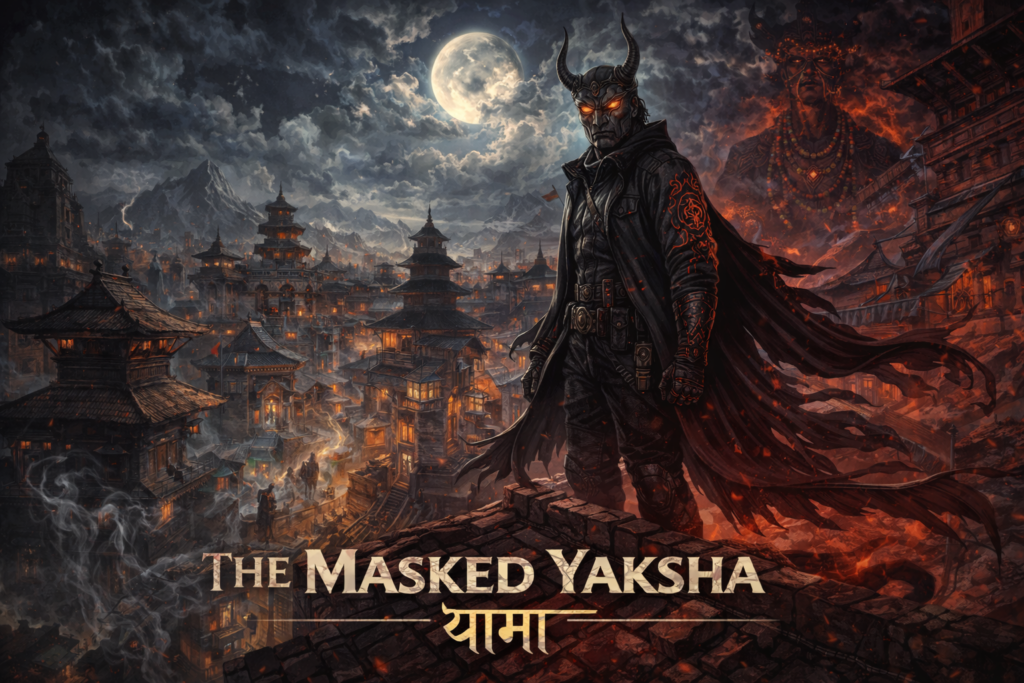
The temple was alive with whispers.
They slithered through the ancient stone corridors, winding around crumbling pillars, slipping between the cracks in the walls. Voices—dozens, hundreds, maybe thousands—murmuring in a language that no living tongue had spoken in centuries.
At the center of the temple, beneath a dome of flickering oil lamps, Guru Kaalo knelt in the dark.
His robes were tattered, black as the void between stars. His skin—if it was still skin—stretched thin over sharp bones, his fingers long and clawed, his nails caked with something dark.
The air around him vibrated. Not with sound, but with something deeper, something wrong.
Before him, a body lay on the cold temple floor. A woman, motionless. The most recent offering.
She was still breathing. But not for long.
Guru Kaalo placed a single hand on her chest, and the whispers grew louder.
His lips barely moved as he spoke. The words weren’t meant for human ears.
“Smaran-hin bhava.”
Become forgotten.
The woman convulsed. Her body arched, her mouth gaping as something black and shapeless began to unravel from her skin. Not blood, not breath—something deeper.
Her name.
It curled into the air like smoke, twisting, struggling, before Guru Kaalo’s fingers closed around it.
He inhaled.
The black tendrils sank into his mouth, into his throat, disappearing into the hollow void of his body. His skin pulsed—his veins turning darker, thicker.
And the woman beneath him…
She was gone.
Not just dead.
Gone.
Her eyes stared blankly at the ceiling, her chest perfectly still. The flesh remained, but there was nothing inside it anymore.
No memories. No identity.
She had been erased.
The temple trembled as the whispers faded.
Guru Kaalo exhaled slowly. When he lifted his head, his eyes burned with black fire.
And then he spoke to the darkness.
“He has awakened.”
For a moment, there was silence.
Then, from the shadows, a voice responded.
“Yes. The mask has found him.”
Guru Kaalo’s lips curled into something that might have been a smile.
“Good.”
His fingers curled, his body shifting, the ancient fabric of his robes stirring like living things.
“Let us welcome our new brother properly.”
And in the temple of forgotten names, the shadows began to move.
The rain had stopped, but the streets of Kathmandu still dripped with silence.
Pravash walked through the city, his hands deep in his coat pockets, his mind tangled in too many questions. He should have gone home. He should have stopped, tried to sleep, let his body recover from whatever the hell had happened back at the warehouse.
But he couldn’t.
Guru Kaalo.
The name felt like a splinter lodged in his skull. He had heard of it before—not in police reports, not in crime circles, but in whispers. In half-finished sentences, in muttered prayers from the old, in warnings scratched into temple walls.
A ghost. A story.
A thing that should not exist.
But Pravash knew better now. Some ghosts were real.
The streets were too empty. It was past midnight, but this was Ason Bazaar. Even at this hour, there should have been someone—vendors unloading fruit, drunks stumbling home, night guards patrolling temple grounds.
But there was nothing.
No sounds. No voices.
Just the weight of the watching dark.
Pravash slowed his steps, his fingers grazing the inside of his coat where his gun sat. Something was wrong.
Then, just as he reached the temple steps, a voice cut through the silence.
“Detective.”
Pravash froze.
The voice came from everywhere and nowhere. Low, smooth, like a whisper spoken just behind his ear.
He turned.
Three figures stood at the edge of the temple courtyard.
Not moving. Not breathing.
Their faces were hidden behind the same hollow wooden masks he had seen at the stupa. Their robes were tattered black silk, their bare feet pale against the wet stone.
The cult.
Pravash’s fingers tightened around his gun.
“Brave of you to show your faces,” he said.
One of them took a slow step forward. Their voice was wrong. It barely sounded human.
“There is no need for violence. We only bring a message.”
Pravash scoffed. “Yeah? And what’s that?”
The masked figure tilted its head. It didn’t blink.
“You have been chosen, Pravash Bajracharya.”
A chill slithered down his spine.
“Guru Kaalo knows you now. He sees you. He welcomes you.”
Another step forward. The temple lights flickered. The air thickened.
“You are no longer like them.” The figure gestured toward the empty city. “You have felt it, haven’t you? The power. The mask does not just reveal—it transforms. You are already changing. The question is—”*
A pause.
“Do you wish to resist it?”
Pravash’s jaw tightened.
He had been expecting threats. Warnings. Maybe even an attack.
But not this.
Not an invitation.
“You have seen how broken this world is.” The cultist’s voice was smooth, almost kind. “The wicked go unpunished. The forgotten are swallowed by time. But you—*”
Another step. The figure was too close now.
“You can be something greater. The mask chose you. Why fight it?”
Pravash should have shot him.
But something in his chest twisted.
Because a part of him—a small, dark part—knew that the masked figure wasn’t wrong.
He had felt it. The justice. The power.
In the warehouse, when he had marked that man, when he had forced him to relive every crime he had ever committed—it had felt right.
Like balance had been restored.
Like justice had finally meant something.
“Join us.”
The whisper slid into his ears like silk.
“Embrace what you are becoming.”
Pravash inhaled slowly. His hand was still on his gun. The mask was still in his bag.
He had a choice.
The shadows shifted, waiting.
Pravash didn’t move.
His grip on the gun tightened, his body tensed, but he didn’t raise it. He didn’t need to. The masked figures weren’t advancing anymore. They simply stood there, waiting, watching.
The city was still too quiet. The wind had died. The rain had stopped. The lights hadn’t flickered since they spoke.
It was like time had paused, like reality was holding its breath.
“Join us.”
The words curled around him, soft, insidious.
For the briefest moment, Pravash considered it.
Not because he wanted to. But because he understood the temptation.
He had seen the justice that came from the mask. He had felt it. The way it had stripped away the lies, the way it had forced men to face the weight of their sins. It was pure. Absolute.
It made sense in a way the real world never had.
He could become something more. Something beyond a tired detective chasing the dead.
He could be justice itself.
His breath came slow, measured. The mask in his bag seemed heavier now, warmer. Like it was waiting for him to speak, to answer.
Then he exhaled.
And he knew his answer.
“Go to hell.”
The cultists didn’t react. They didn’t flinch, didn’t move.
Then, without a sound, they began to step back.
Pravash expected a threat. A warning. But they simply melted into the darkness.
“You have already chosen, Pravash Bajracharya.”
The voice was neither angry nor disappointed. Just certain.
“He will come for you soon.”
And then—they were gone.
The city breathed again.
The streetlights buzzed softly. The neon glow of distant shop signs returned. Somewhere in the distance, a stray dog barked.
The moment had passed.
But the weight of it lingered.
The Old Monk
Pravash didn’t go home.
Instead, he followed a different instinct, one that pulled him toward Kathmandu’s oldest temple district.
Through winding alleys, past silent stupas, he walked until he found the shrine.
It was ancient—older than the city itself, some said. It sat between crumbling walls, its doors adorned with faded murals of forgotten deities. Few came here anymore.
But Pravash knew who did.
Inside, bathed in the flickering glow of oil lamps, sat Bhante Rigdzin.
The blind monk from before.
The old man didn’t turn his head when Pravash entered. He didn’t react at all. He simply sat there, cross-legged on his mat, his fingers resting lightly on a string of wooden prayer beads.
Pravash stood in the doorway, the weight of the night pressing into his skull. He hesitated, then spoke.
“They came to me.”
The monk didn’t move. But after a moment, he sighed.
“Of course they did.”
Pravash took a step closer, his hands still buried in his pockets. “They said the mask chose me. That I should embrace it.”
The monk’s hands stilled.
“And what do you think?”
Pravash let out a breath. “I think they’re right about one thing.”
The monk tilted his head slightly, listening.
Pravash’s voice was low.
“The mask is… changing me.”
The words tasted bitter in his mouth. Saying them aloud made them real.
The monk was silent for a long time. Then he murmured, almost too softly—
“Do you know why it exists?”
Pravash frowned. He hadn’t thought about it. He had assumed it was just an artifact, an old relic of power.
The monk finally turned his head, his milky, sightless eyes locking onto Pravash’s face.
“It was once worn by a protector.”
A chill crawled down Pravash’s spine.
The monk’s voice was barely above a whisper.
“Until it consumed him.”
The first sign was the wind.
It howled through the ancient streets, too sudden, too sharp. A bitter, ice-cold gust that made the old prayer flags snap violently, sending dust spiraling into the air.
The second sign was the silence.
Pravash had barely registered the monk’s warning before the night itself seemed to shift.
The usual city sounds—the distant hum of motorbikes, the muffled voices of late-night temple-goers—had disappeared. It was as if Kathmandu had been swallowed whole.
Bhante Rigdzin’s fingers tightened around his prayer beads. His clouded eyes widened.
“They are already here.”
Pravash turned.
A single oil lamp flickered at the shrine’s entrance. Its flame stretched unnaturally, bending sideways as if reaching for something unseen.
Then, beyond the threshold—
They came.
Figures melted out of the darkness, their shapes warping and shifting, human but not. Their wooden masks gleamed under the lamplight, their empty eyes locked onto him.
The cultists.
But this time, they weren’t alone.
Something crawled beside them.
Pravash’s breath hitched. His instincts screamed.
Not human. Not even close.
The thing moved on all fours, its limbs too long, its joints bending the wrong way. Its body was covered in twisting, shifting darkness, like it wasn’t fully solid.
And its face—
No.
It had no face.
Just an empty hole where its mouth should have been.
And yet—it was breathing.
A slow, rattling inhale. A wet, clicking exhale.
Pravash’s gun was already in his hand.
“You brought friends,” he muttered.
The cultists didn’t answer. They didn’t need to.
The creature lurched forward.
Pravash fired.
The gunshot tore through the night, deafening in the silence.
The bullet hit. He saw it strike the creature’s chest, saw it rip through black, shifting flesh.
But it didn’t fall.
It didn’t even bleed.
Instead, it twisted.
Its body cracked, reforming, as if reality itself was correcting the wound.
Then, with a sudden, inhuman shriek, it lunged.
Pravash dodged—barely. He felt the air shift as a clawed hand swiped past his face, too fast. He hit the ground and rolled, firing twice more.
The bullets passed through smoke.
His heart slammed against his ribs. This wasn’t just a cult.
This was something else.
Something wrong.
The shadows deepened. More figures slipped from the alleys, their masks gleaming. More creatures, shifting, breathing, watching.
Trapped. They had trapped him.
Pravash’s fingers twitched toward his bag.
Toward the mask.
The power was there, humming beneath his skin, waiting.
If he put it on—
“No.”
The monk’s voice cut through the panic.
Pravash turned. Bhante Rigdzin had risen to his feet. His hands trembled, but his face was calm.
“Not here.”
Pravash’s teeth clenched. “You want me to fight these things without it?”
The monk didn’t answer. Instead, he took a single step forward.
The air shifted.
And then—the prayers began.
His voice was low but strong. Words older than the temple itself, older than the city. Sanskrit syllables woven with something deeper, something ancient.
And the creatures paused.
The cultists hesitated.
Their empty eyes flicked toward the monk, their heads tilting slightly.
The faceless thing let out a low, rattling hiss.
But it didn’t attack.
Not yet.
Pravash didn’t waste the opening.
He moved.
One step back—then he ran.
Through the temple threshold, past the dim-lit stupas, down the alley where the city was still alive.
Behind him, the whispers rose again.
But he didn’t look back.
Pravash drove through the rain-slicked streets, his grip white-knuckled on the steering wheel. The wipers dragged across the windshield in slow, rhythmic strokes, but his mind wasn’t on the road.
It was still back there.
At the temple.
At the thing that had crawled toward him.
At the monk’s words.
“The mask was once worn by a protector… until it consumed him.”
The truth settled like iron in his gut. This was bigger than a cult. Bigger than kidnappings. He had seen the things lurking behind the masks now. He had felt them.
And the worst part?
His bullets had done nothing.
His gun sat heavy in its holster, cold, useless. It was the first time in years he had felt that particular kind of helplessness.
But he wasn’t helpless.
Not anymore.
His eyes flicked to the passenger seat. The bag.
The mask was inside. Silent. Waiting.
It had saved him before. It had given him power. A way to fight back.
But at a price.
His mother’s face was still gone.
Pravash exhaled sharply and pushed the thought away. First, answers. Then, revenge.
He took a hard turn onto a side street, tires skidding slightly. His destination was an abandoned police archive—a building scheduled for demolition, its records untouched for years. But Pravash knew it still had files that weren’t in the official system.
Old files. Forgotten cases.
He needed to know who Guru Kaalo really was.
The Archives
The old records room smelled like dust, mold, and time.
Filing cabinets stretched in uneven rows, some rusting, others with their drawers hanging open. Pravash clicked on his flashlight, scanning the stacks.
No digital records. No automated systems. Only paper.
He started digging.
Through decades of missing persons reports. Through unsolved disappearances dating back before Nepal even had a police force.
It wasn’t just recent.
It had been happening for centuries.
His fingers stopped on a file from 1896.
A monk. Gone without a trace.
Another from 1912.
A nobleman, erased from history.
Pravash swallowed hard and flipped further back. Older. Deeper.
Then, finally—he found it.
A single yellowed manuscript. Fragile, handwritten. Older than any police file in the room.
It wasn’t in Nepali. Not even in Sanskrit.
It was in a language that no longer existed.
But the name…
It was there.
Guru Kaalo.
And below it—a woodblock print illustration.
Pravash’s pulse stopped.
The image showed a man kneeling inside a temple, his arms stretched out, his face upturned toward a swirling black void.
Beneath the image, a single translation:
“He who devours the forgotten.”
Pravash’s breath came slow. Cold. Calculated.
He flipped the page.
Another woodblock print.
This time, a city.
It looked like Kathmandu—but wrong.
The streets were empty. Not destroyed. Not abandoned. Just… hollow.
No people. No movement.
A city erased.
He exhaled shakily. His hands felt like they didn’t belong to him anymore.
Then—one last page.
One final name.
His own.
Written in red ink.
Fresh.
His vision blurred. His heartbeat slammed against his ribs.
Then the lights went out.
Continue Reading