“Let me tell you a story. About a man who remembered.”
It started with the temples.
Not crumbling.
Not burning.
Just… closing.
Priests forgetting the words.
Mantras skipping a syllable.
Sanskrit echoing wrong in the halls.
Not once.
Everywhere.
In Varanasi, Rishabh’s staff hummed uneasily.
“It’s like… the divine itself is receding.”
Megha was checking her scrolls. “Whole passages are vanishing. Not redacted. Just… missing.”
Akshay’s data feeds scrambled symbols into static.
Makardvach stood silent.
Watching the horizon.
Where the sky didn’t ripple.
Didn’t pulse.
It reflected.
Perfectly.
Too perfectly.
And then—
From that reflection—
Something stepped out.
It looked like a god.
But cleaner.
Sharper.
Too symmetrical.
It wore robes of impossible geometry.
Its eyes were blank scrolls.
Its hands held no weapons—only erasures.
It spoke once.
And every crow in the city fell silent mid-call.
“I am the Archive.
The final correction.”
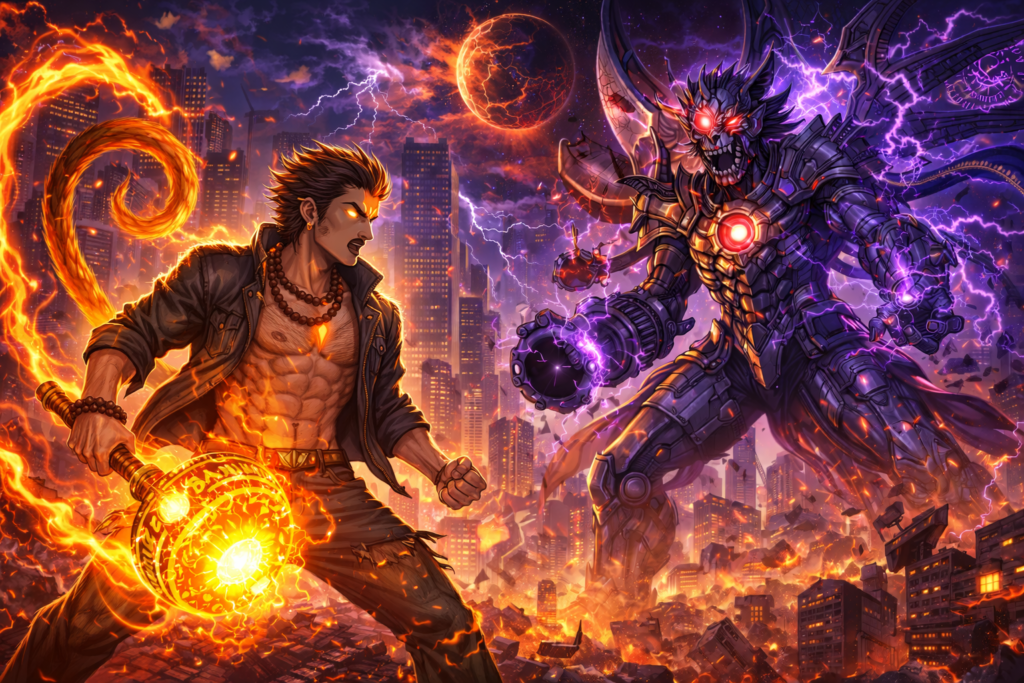
Makardvach stepped forward, Vānaprakāśa in hand.
“You’re not legacy.”
The Archive turned its head in a movement too smooth.
“No.
I am its guilt.
And I will end what Hanuman began.”
Rishabh whispered, “It’s the celestial failsafe. The gods created it ages ago… to purge timelines that strayed too far from divine law.”
Megha gasped.
“Then why is it here now?”
Akshay answered, terrified:
“Because Makardvach won.
And the gods are afraid.”
The Archive raised its arm.
Reality bent around its fingers.
It didn’t strike.
It redacted.
A whole street disappeared.
Not exploded.
Not destroyed.
Just… deleted.
As if it had never been written into Earth’s code.
Makardvach ran forward.
Swung Vānaprakāśa.
The blow connected—
But left no mark.
The Archive turned.
“You are fiction empowered by affection.
Unstable.
Sentimental.
Unworthy.”
Makardvach narrowed his eyes.
“Then I guess it’s time
to weaponize memory.”
Back to Anjanadri Hill.
He climbed it alone.
Each step felt like descending, not ascending.
Beneath the birthplace of Hanuman…
lay a vault not even the gods had dared open.
It wasn’t sealed with stone.
But with silence.
The kind that only comes after betrayal.
He placed his palm on the wall.
The mark of the Vanara pulsed.
A line split open—
And the Scroll of the Forgotten revealed itself.
It wasn’t a scroll.
It was a room.
A breathing archive made of failed myths.
The son who ran from war.
The goddess who loved a mortal and was punished for it.
The sage who broke his vow—
not out of evil,
but because his child cried alone.
Makardvach stepped inside.
And every story greeted him.
Not with pride.
But with need.
“You were never meant to be erased,” he whispered.
And the vault pulsed in agreement.
He read them.
Wore them.
Wove them around Vānaprakāśa.
Etched them into his very skin.
Each tale whispered:
“We were not errors.
We were experience.”
He emerged from the vault—
Glowing not with celestial might,
But with messy, painful, unholy truth.
Rishabh wept.
Megha bowed.
Akshay whispered:
“Now you are the Archive.”
He returned to the city.
The sky had no color.
Where the Archive floated, definition itself had thinned.
Makardvach approached.
Not as fire.
Not as wind.
But as witness.
The Archive turned.
“You have absorbed contamination.
Illegitimate narratives.
Corrupted fragments.”
Makardvach opened his hand.
Revealed not a weapon.
But a story.
He read:
“There was once a god
who forgot to descend during a war.
The people won without him.
And he wept—not from shame,
but from relief.”
The Archive’s robes pixelated.
Its edges trembled.
Makardvach stepped forward.
“You’re not here to protect order.
You’re here because the gods forgot how to evolve.”
The Archive paused.
“What is your designation?”
Makardvach placed a hand on its chest.
“I am not versioned.
Not drafted.
Not corrected.
I am continued.”
And then—
The Archive bowed.
Shifted.
Dissolved.
Not defeated.
Freed.
A spool of ink and thread.
“I will no longer erase.
I will remember.”
And then—
The gods descended.
Not with trumpets.
Not with judgment.
But with reverence.
They offered Makardvach the Crownless Throne.
A seat above all realms.
A title without chains.
And he refused.
“Let the gods have their seat.
I’ll take the road.”
And somewhere, the scribes wrote:
“Remained.”
The city was quieter now.
Not silenced.
Listening.
Makardvach walked alone.
No scarf.
No mask.
No armor.
Just him.
His shadow.
His breath.
His scars.
And his story.
At the riverbank, a boy sat.
Fishing with a thread and no hook.
“Uncle,” he asked.
“Were you really the Monkey Man?”
Makardvach smiled.
“They call me Vanara Man now.”
The boy blinked.
“What’s a Vanara?”
Makardvach looked out at the Ganga.
“A Vanara is someone who remembers
when the world forgets.”
“Like a superhero?”
He laughed.
“Sometimes.
Sometimes a Vanara just shows up.
Holds someone’s hand.
Listens when nobody else will.”
“It’s hard. Remembering.”
Makardvach nodded.
“That’s why it’s a power.”
The boy smiled.
Offered him the thread.
Makardvach tied it around the boy’s wrist.
“Now you remember something.
So now… you’re one too.”
And the boy ran off.
Makardvach turned to the river.
The Shivnadi whispered.
Not in thunder.
But in a child’s voice:
“Let me tell you a story.
About a man
who remembered.”