vanaraman

Chapter 19: Raktanjali’s Ritual

Varanasi was loud again.
Markets reopened. Temples buzzed with cautious joy. The air smelled of spiced oil and monsoon rain.
But beneath the sound—beneath the noise of the world resuming—Makardvach heard something else.
A stillness.
Not of peace.
Of waiting.
He stood on the rooftop of Akshay’s observatory, the city stretching around him like an ancient breath made of sandstone and bells. Below, children played in the alleys. A vendor called out fresh jalebi.
But he couldn’t relax.
Even with the Shivnadi’s final mantra still echoing faintly in his bones—he felt it.
The gap.
Like a question no one dared to ask yet.
Rishabh joined him with a cup of chai.
“You’ve earned more than a moment, you know.”
Makardvach didn’t take the tea. Just nodded.
“Do rivers ever stop flowing?”
Rishabh’s eyes narrowed. “No. But they choose where they go.”
Akshay climbed up next, holding a new device—part drone, part glyph-recorder.
“Energy signatures in the east are still… weird. Like the land’s recovering too fast. Or being rewritten.”
Makardvach turned to him sharply. “What do you mean rewritten?”
Akshay tapped his screen. “See this spike? It’s in Khumbalgarh. A ruined fortress with no recorded myth links. But suddenly, there’s Vanara script appearing on walls that should’ve been sandstone.”
Megha’s voice came through the comm.
“I was going to tell you all at once. But there’s something else. Something worse.”
Her tone was clinical. But trembling.
“One of the seals beneath the Ganga has broken. The one tied to the Karnamal Pit.”
Rishabh paled. “The Pit of Breaths.”
Makardvach looked out at the horizon.
“What was sealed there?”
No one answered.
And that was answer enough.
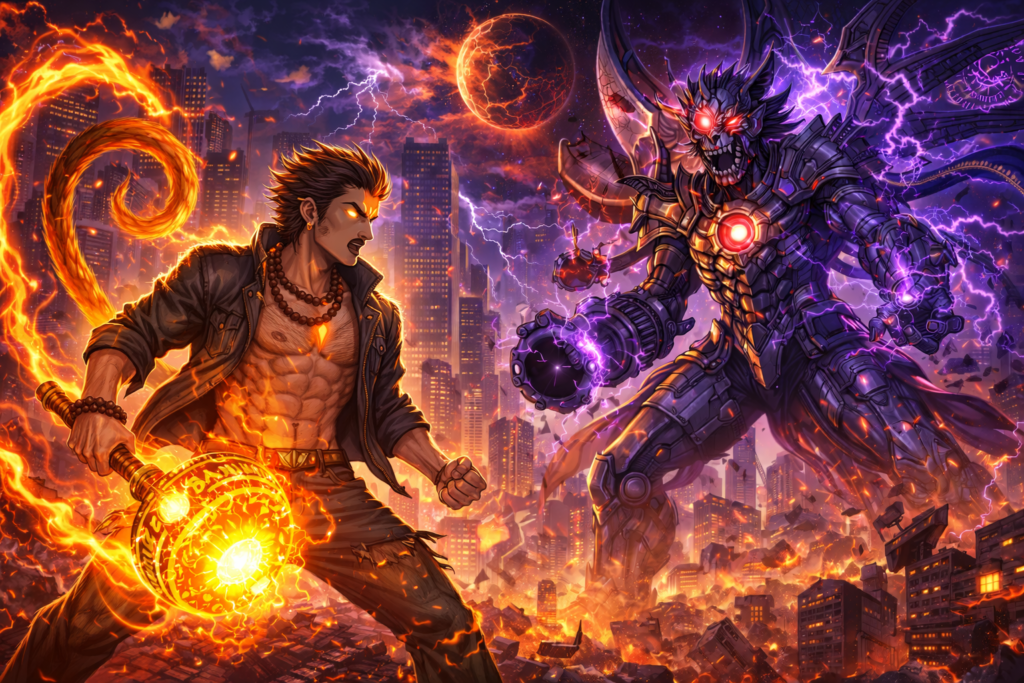
Makardvach picked up Vānaprakāśa, now sealed in a case of carved obsidian. He opened it. The staff hummed.
Not from within.
From the world around it.
He tightened the straps of his gauntlets.
“Then the breath between battles is over.”
Karnamal was not a place on maps.
Even satellite scans blurred over it.
It was said to be a pit that exhaled once every hundred years—not smoke. Not gas. But voices that didn’t belong to anything still alive.
Now, it exhaled every minute.
The team stood at the edge of a canyon veined with cracks. The rock was dry as bone, the wind unnaturally cold for mid-summer India.
Makardvach stepped forward. Dust clung to his boots like memory. He held Vānaprakāśa loosely in one hand, wrapped in red cloth. Not glowing. Just listening.
Megha examined the ridges of the canyon wall. “These aren’t erosion marks,” she whispered. “They’re glyphs. Eaten away. Not carved.”
Akshay ran sensors across the lip of the pit. “Vocal frequency is subsonic. Too deep for animals. But it keeps repeating one phrase.”
He turned the scanner. Amplified it.
A whisper rose.
Not a hiss. A language.
Old Vedic—older than Rigveda.
Megha translated in pieces, barely breathing.
“This is not breath. This is… what breath was before it became air.”
Rishabh fell to one knee. “This is not demon work.”
Makardvach narrowed his eyes.
“No. This is something… colder.”
He stepped into the pit.
One foot.
Two.
The ground didn’t resist.
It welcomed.
The center of the crater was filled with ash.
A single tree stood there—charred black, but untouched by time.
At its base:
A skeleton.
Not human.
Not demon.
Just wrong.
Its bones were smooth, not porous.
Its ribs wrapped twice around its body.
Its skull was faceless—no sockets, no mouth.
And yet—the wind whispered from inside it.
Makardvach crouched beside the bones. A glyph shimmered faintly on the ground. He pressed two fingers to it.
A flash.
And the message unlocked.
Not spoken.
Not visual.
A knowing dropped into their minds.
It said:
“The gods were not the first keepers.
The breath came before sound.
The watchers came before name.
And one still stirs beneath the fourth realm.”
Rishabh reeled backward.
Megha gasped. “The fourth realm…?”
Makardvach stood slowly.
“Tamoraksha,” he whispered.
“The Realm of Void and Chaos.”
The wind around them screamed once—not in rage. But in warning.
Then the ash lifted. Formed a ring. Formed eyes.
And in a voice that didn’t echo—
“He was only Kalnemi’s hand. The arm still reaches.”
Varanasi again.
Makardvach walked its streets like a man floating.
Everything seemed normal—too normal.
The light didn’t flicker. The dust didn’t rise. And people’s blinks didn’t seem to line up.
He’d walk past a fruit vendor, turn a corner—
And see that vendor again, handing over the same apple, the same smile, in the same second.
The clock on his wrist froze.
Then jumped.
Then froze again.
Akshay noticed first.
“You’re losing time.”
Makardvach nodded.
“It’s not just me. The world is.”
Rishabh ran a diagnostic on the air’s frequency spectrum. No irregularities.
And yet…
The pigeons in the square beat their wings out of rhythm.
As if the laws they flew by had been edited.
Megha opened an ancient scroll. Tamoraksha was referenced once. Not by name. By metaphor.
“The Fourth Seat.
Where no god sits.
Where no demon walks.
Where only the question waits.”
She underlined one line in red.
“The realm that watches when all others blink.”
Makardvach began to test it.
He stood on a temple step.
Closed his eyes.
Held his breath.
Let his pulse slow.
And he felt it.
The moment between the next two seconds.
Where time should move forward—but paused.
And in that breathless pause—
He saw it.
A shape.
Tall.
Faceless.
Cloaked in night.
Watching him from the corner of everything.
He gasped. Opened his eyes. The world returned.
But the air was colder.
And his skin—
Felt written on.
He lifted his shirt.
New glyphs.
Not Vanara.
Not divine.
Just… wrong.
Like time had tried to tattoo itself onto his body to keep up with him.
Akshay scanned him. “These aren’t natural. You’re being tracked.”
“By what?”
Akshay swallowed. “I don’t think it’s a ‘what.’”
Megha touched Makardvach’s arm.
“Whatever’s watching you… it’s not trying to enter.”
Makardvach turned to her.
“Then what?”
She looked down.
“It’s trying to map you.”
The alley was not there yesterday.
Megha swore on every cartographer’s record, on every digitized city scan.
It was not there.
And yet—
Here it was.
A side street off Dashashwamedh Ghat. No name. No exit. Just a bend that shouldn’t exist.
A turn that curved tighter than it should, too sharply for Euclidean space.
And when you stepped in—
The city forgot you.
Akshay held his tablet out before him.
The live feed stuttered. Then looped. Then showed them standing where they hadn’t walked yet.
Makardvach gripped Vānaprakāśa tighter. The weapon pulsed softly. Not warning. Not resisting. Just… observing.
Rishabh chanted a protective mantra as they entered.
The alley narrowed behind them, closing like a throat.
The walls began to curve upward, turning into a tunnel—but without a roof.
Just more wall.
Above them, the sky stuttered.
Megha looked up.
“This isn’t a portal.”
Akshay agreed. “It’s a test sketch. A draft.”
Makardvach frowned. “Of what?”
Rishabh answered without hesitation. “Of our world.”
Symbols lined the alley—tall, thin, scribbled into brick like teeth.
The glyphs from Makardvach’s skin appeared here again, etched larger, blinking softly like embedded eyes.
Then—
A ripple.
A hum.
A shadow turned the wrong way.
Something walked toward them from the far end of the alley.
But its legs didn’t move.
Its body stayed still.
Only its outline shifted.
As though the idea of it approached.
Not the body.
Makardvach stepped forward.
“Back.”
Rishabh raised his staff. “What is that?”
Makardvach answered with a whisper.
“Tamoraksha’s first scout.”
The thing tilted sideways.
Not its head—its entire shape.
It broke geometry.
It broke language.
And when it opened its mouth—
It spoke a word in reverse.
“AHTARAV.”
Makardvach staggered.
It was his name.
Spoken backward.
Spoken wrong.
Spoken as the realm saw him.
A flaw in the map.
The alley shook.
The bricks twisted.
One broke apart—and inside was sky.
Akshay screamed, pulling Megha back.
“Makardvach! It’s unraveling the city!”
The thing took another not-step.
Makardvach raised Vānaprakāśa.
“I’ve seen rivers lie. I’ve seen gods fall.”
He pointed the storm end at the distortion.
“Let’s see what happens when nothing meets memory.”
He struck.
Vānaprakāśa’s storm end howled.
Wind curved like a blade, lightning etched into its wake.
The scout’s shape bent with it—folded around the blast.
Not resisting.
Learning.
The strike passed through.
No damage.
No reaction.
Only… adjustment.
The being twisted again, more angular now.
More specific.
Its outline began to resemble Makardvach.
Not in face.
In structure.
In narrative.
It was mapping him.
Not physically.
Mythically.
Rishabh gasped.
“It’s tracing his story.”
Megha’s scrolls unfurled themselves—glyphs jittering as if glitching from proximity.
Akshay’s tablet overheated and shut down.
And the alley?
It remembered too much.
Brick patterns shifted to resemble chapters.
The ground cracked in a grid of timeline paths.
Makardvach stepped backward—
And his own shadow lagged behind.
Not a second late.
A sentence late.
The scout opened its mouth.
Not wide.
Perfectly.
To the precise width of Makardvach’s chest.
And inside that mouth—
Not teeth.
Glyphs.
Spinning. Blinking. Sorting.
Like an eye that eats only meaning.
Then it whispered.
“Incomplete myth.
Version 3.5.
Possible deviation.”
Makardvach gritted his teeth.
“You’re not a god. You’re not even alive.”
The thing tilted.
“No.
I am the pen before the first draft.”
Then it lunged.
And as it reached him, Makardvach felt his origin pulled—the moment in the cave, the word “Descendant,” the breath of Hanuman’s memory—
All unspooling, like a scroll unwriting itself.
He screamed.
Vānaprakāśa fell from his grip—
And glowed brighter on its own.
Not with wind.
Not with light.
But with memory.
Every battle. Every wound. Every vow.
The staff pulsed with the entire story—not of a warrior, but of a witness.
And the scout hesitated.
Just long enough.
Makardvach seized it again—
And spoke not a mantra.
But a truth.
“You can’t map me.
Because I’m still becoming.”
He slammed the storm end into the ground.
A shockwave ripped the alley apart.
Not with power—
With disbelief.
The distortion folded inward.
Not destroyed.
Returned to sender.
Silence.
The alley gone.
No rubble.
Just a blank space.
As if that part of the city had never existed.
Makardvach stood, breathing hard.
Rishabh approached slowly.
“What did it want?”
Makardvach didn’t answer.
But on his forearm, new glyphs had appeared.
Not Tamorakshan.
Vanara script.
One word:
“Observed.”

0

Subtotal