vanaraman

Chapter 9: The Gada Awakens

They chose the ravine because it was empty.
A vast, jagged depression outside Varanasi’s southern limits, scarred by monsoons and abandoned quarrying. No people. No traffic. Just stone, wind, and echoes.
Rishabh called it perfect.
Megha called it a risk.
Makardvach had said nothing.
He stood in the center of the ravine now, sunlight slicing across the broken terrain. His suit gleamed. The gada hung in his grip—not clenched, just held, as if it belonged there the way a sword belongs to a flame.
Rishabh stood on a ridge above.
“This time,” he called, “don’t just strike.”
Makardvach looked up. “Then what?”
“Listen.”
He closed his eyes.
Took a breath.
And moved.
One swing—slow, wide.
The gada hummed.
Then—
A pulse.
The stone under his boots cracked.
Makardvach froze.
The air thickened.
Rishabh’s eyes narrowed. “Again.”
Makardvach swung again—faster, this time.
And the gada sang.
A high, rising vibration, as though the weapon itself had found its voice.
Then—
Boom.
A golden shockwave burst from the tip of the swing, flaring outward like a ripple in molten air.
It flattened everything in a fifteen-meter radius.
Stones split.
Dust erupted.
Nearby boulders shattered into powder.
And far above, a cloud blinked out—erased by the sheer pressure wave.
Makardvach staggered back.
He looked at his hands.
Then at the gada, now glowing white-gold, humming like a tuning fork struck by heaven.
“What was that?” he whispered.
Rishabh’s voice echoed from the ridge.
“That,” he said, “was remembrance. The gada doesn’t hold your strength. It holds Hanuman’s. It remembers what it was made for. And it just decided you were ready.”
Makardvach’s knees buckled.
He dropped to one knee, breathing hard.
The gada slowly dimmed, returning to a passive state—but its shape looked… sharper. As if something inside had opened.
Akshay and Megha scrambled down the slope, eyes wide.
“That wave registered on every satellite,” Akshay said, breathless. “You just set off atmospheric sensors in Nepal.”
Megha was scanning the energy trails. “It’s not just kinetic. It’s celestial. That blast carried mantra signatures—actual script woven in the air. It wrote sound.”
Makardvach looked up at them.
“I didn’t mean to.”
“You didn’t,” Rishabh said, now standing behind him. “But now that you can, you must learn when to.”
Makardvach stood.
He looked at the gada.
The weapon had been quiet.
Now it watched.
It remembered.
And so must he.
They made camp that night in the ruins of an old dharmashala, tucked between two forested hills. The silence of the ravine still clung to their skin. The shockwave from Makardvach’s swing had left them shaken, not because it was dangerous—because it was grieving.
That was how Rishabh had described it.
“You think the gada is proud of its power?” he said, stirring a small fire.
“You haven’t yet heard it cry.”
They sat in a quiet ring—Megha patching a damaged drone, Akshay sketching new shock absorbers for Makardvach’s armor. Rishabh had gone still again, eyes half-shut in a trance of sorts.
Makardvach, sitting apart, ran his fingers over the gada, which now rested against his thigh like a docile wolf. Every now and then it pulsed—not brightly. Softly. Like a sleeping heartbeat.
And then—
A figure approached the fire.
Old. Thin.
Eyes cloudy, but posture unbowed.
None of them had heard his steps.
Not even Rishabh.
“Traveler?” Megha asked, startled.
The old man ignored her. His gaze had locked onto the gada.
He pointed.
“Do you know what that is, boy?”
Makardvach stood instinctively. “It’s mine.”
The elder chuckled—not mockingly. Almost… sadly.
“It’s no one’s,” he said. “Not really. That thing belongs only to remembrance.”
Rishabh watched silently.
The man limped closer. His shawl was simple, feet bare, skin weathered like driftwood that had outlived a dozen tides.
“I saw that weapon once before,” he said.
Everyone froze.
“I was six. My father took me up a hill in Andhra, near Lepakshi. He told me there was a shrine built on a stone where Hanuman once landed. But what I remember most was the sound.”
He pointed at the night sky.
“The air cracked. The trees bent. And when we reached the top…”
His voice faltered.
“I saw a man. Dressed in red. Alone. Crying.”
Makardvach’s voice came quietly. “Hanuman?”
The old man nodded.
“He had used the gada to seal something beneath the mountain. I don’t know what. But he didn’t look proud. He looked like someone who had destroyed something he loved… to save something he didn’t trust.”
He turned to Makardvach now, eyes sharp despite the age.
“That weapon doesn’t just remember its power. It remembers its regrets. Every time you call it… it will show you both.”
Makardvach clenched his fists. “Then maybe I have to make better memories with it.”
The elder smiled.
“That would be a first.”
He turned.
And vanished into the trees.
No footsteps. No rustle.
Gone.
Megha exhaled.
Akshay looked spooked. “That guy was real, right? Like… that wasn’t one of your ghost monks?”
Rishabh didn’t answer.
Because somewhere behind them—
The gada pulsed once.
Not loud.
But sorrowful.
The call came just after midnight.
Rishabh was meditating.
Megha was asleep against a wall of scrolls.
Akshay, headphones on, was watching grainy satellite feeds from a new relay drone. He didn’t expect the ping to matter. Probably another bird crash. Or fog interference.
Then he saw the footage.
Stone soldiers—glowing red, twelve feet tall, carved from basalt and alive—marching toward the edge of a temple carved into the cliffside above Lohargal, a sacred Vanara site.
They weren’t attacking pilgrims.
They were destroying the walls.
The inscriptions.
The story.
Makardvach was already pulling on the suit before Akshay finished saying: “There’s movement at the hill shrine.”
Rishabh stood without a word. He didn’t need to ask if this was a trap.
Because it didn’t matter.
When the past is attacked—you answer.


The ride to Lohargal took forty minutes by air.
Akshay had reconfigured an old emergency evac drone into a low-sky drop carrier—stealthy, untraceable, fast.
Makardvach stood in the open hatch, scarf trailing like comet silk, the gada now clipped to his back like thunder waiting to fall.
Below, the land curved into prayer.
The shrine wasn’t grand—but it was pure.
Carved straight into cliff and vine, its pillars held verses etched by Vanara sages long before Rama was even born.
Those verses were now cracking.
A golem—fifteen feet high, molten veins glowing through obsidian skin—raised a claw and swiped across the eastern wall.
Stone exploded.
Another golem lifted a broken arch and hurled it at the main sanctum.
Makardvach dropped.
Not like a soldier.
Like judgment.


He landed between the golems and the sanctum—fist to the ground, scarf igniting in a burst of wind. The earth cracked beneath his boots.
The constructs paused.
They didn’t think.
They sensed.
Something older than them had arrived.
Makardvach stood.
Unsheathed the gada.
And let it glow.
Not in wrath.
In reminder.
“This shrine remembers,” he said.
“So will you.”


The first construct charged.
Makardvach pivoted low—swinging the gada in a clean arc that caught the golem mid-stride.
BOOM.
The impact didn’t just break the construct—it unwrote it.
The Vanara script etched on the gada flashed, and the construct shattered into dust, like it had never been summoned at all.
The second golem tried to flank him.
Too slow.
Makardvach leapt—twenty feet straight up—and came down with a downward arc that smashed the creature into the ground, embedding it three feet deep.
Then the final construct, the largest, charged—shoulders covered in glowing runes.
Makardvach didn’t dodge this time.
He planted.
Closed his eyes.
Let the gada hum.
And swung.
The energy wave didn’t just strike the golem.
It dispersed it.
The red core at its chest flickered—
—and was gone.
Silence.
Then—
Cracks ran along the desecrated shrine walls.
Not from damage.
From reconstruction.
The glyphs slowly began to repair—stone folding inward, like the shrine itself had accepted its protector’s offering.
Megha’s voice crackled through the earpiece. “How bad?”
Makardvach looked around at the quiet dust.
Then at the gada, now faintly glowing with Vanara script again.
“They weren’t sent to kill,” he said.
“Then what?”
Makardvach turned to the central sanctum.
To the verse newly revealed in the moonlight:
“He who forgets his blood shall lose it.”
He spoke into the mic.
“They came to erase.”
Beneath the ruined shrine at Lohargal, Makardvach discovers a sealed chamber hidden for millennia. Inside: an echo of Hanuman’s past, a truth never told, and a burden passed down in silence.
After the battle, the air felt hollow.
Not silent.
Drained.
Makardvach stood in the stillness of the shrine, the gada resting on his shoulder, its hum quiet now—as if it, too, were listening.
The outer walls were healing, but the center of the sanctum remained damaged.
One particular panel had cracked clean down the middle, revealing not destruction—
—but design.
An unnatural seam beneath the carvings.
Makardvach knelt beside it, tracing the hairline fracture.
And the bracer on his arm pulsed once.
Vanara script flickered across its surface like a whisper:
“Below, the memory sealed.”
He pressed his hand into the seam.
And the stone responded.
With a hiss, a slab of floor sank inward—revealing a narrow stairwell, descending into earth untouched by air in ages.


The chamber was round.
No torches. No flame.
But as Makardvach entered, the walls lit with golden script, cascading around him like constellations.
At the center sat a statue.
Not of a god.
Of Hanuman—
—but older. Not heroic. Not triumphant.
Wounded.
Bent over in meditation.
A crack ran across the chest of the sculpture.
A wound.
The kind no stone should show unless it came from memory.
Makardvach stepped forward.
Below the statue, an inscription glowed:
“Here rests the burden even the wind could not carry.”
The air in the room grew heavy.
The gada vibrated.
Makardvach touched the base of the statue.
The room darkened.
And a vision bloomed.


Not a vision like before.
No battlefield.
No glory.
Just Hanuman.
Alone.
Sitting in this very chamber.
Weeping.
He held the gada across his knees, blood dripping from his hands.
A second figure stood nearby—cloaked in light.
Rama.
But older. Pale.
Weary in a way even gods weren’t meant to be.
Hanuman spoke:
“You made me promise to protect the worlds.
But I broke my word.
I let them take it.”
Rama: “You fought. You gave all.”
Hanuman: “It wasn’t enough.”
Rama knelt beside him.
“Then leave behind what was not enough.
So the next may become more.”
Hanuman placed the gada on the pedestal.
Then—
He pressed his hand to the statue.
And sealed it.


Makardvach gasped.
The vision ended.
The chamber returned to light.
And now—
On the base of the statue—
New words had appeared:
“Let him be more than I was.”
Makardvach stepped back.
His chest was tight.
His hands shook.
The gada felt… lighter now. Not in mass. In meaning.
Because now he knew—
Hanuman hadn’t left it behind out of pride.
He had left it behind out of grief.


Having seen Hanuman’s grief and the true purpose behind the gada’s slumber, Makardvach emerges from the shrine forever changed. Now, no longer afraid to feel, he bonds fully with the weapon—unlocking its second form: the Gada of Living Flame.
Dawn crept over Lohargal in pale gold.
The cliffs still bore scars from the night before, but now, light kissed every surface like a benediction. Birds had returned. Pilgrims, too—timid at first, then emboldened by the sight of a man in red and gold armor standing at the gate, unmoving, like a sentinel carved from the storm.
Makardvach hadn’t spoken since returning from the chamber below.
He simply stood, facing the rising sun.
The gada floated at his side.
Not gripped.
Not holstered.
Just… present.
It orbited slowly, like a satellite held by gravity deeper than physics.
Megha approached, carefully.
“You’ve been up here for hours.”
He nodded once.
She looked at the weapon, then back at him. “You saw something down there, didn’t you?”
He exhaled. Not a sigh. A release.
“Hanuman didn’t just give me his strength,” he said. “He gave me his unfinished story.”
The gada pulsed, faintly—warm now, not white-hot like before.
Megha stepped closer. “And now?”
Makardvach turned toward the training field at the base of the shrine.
Without a word, he extended his hand.
The gada snapped into it.
But this time—it didn’t vibrate violently.
It sang.
A low, harmonic frequency that made the grass bow and the birds go silent.
Then—
It changed.
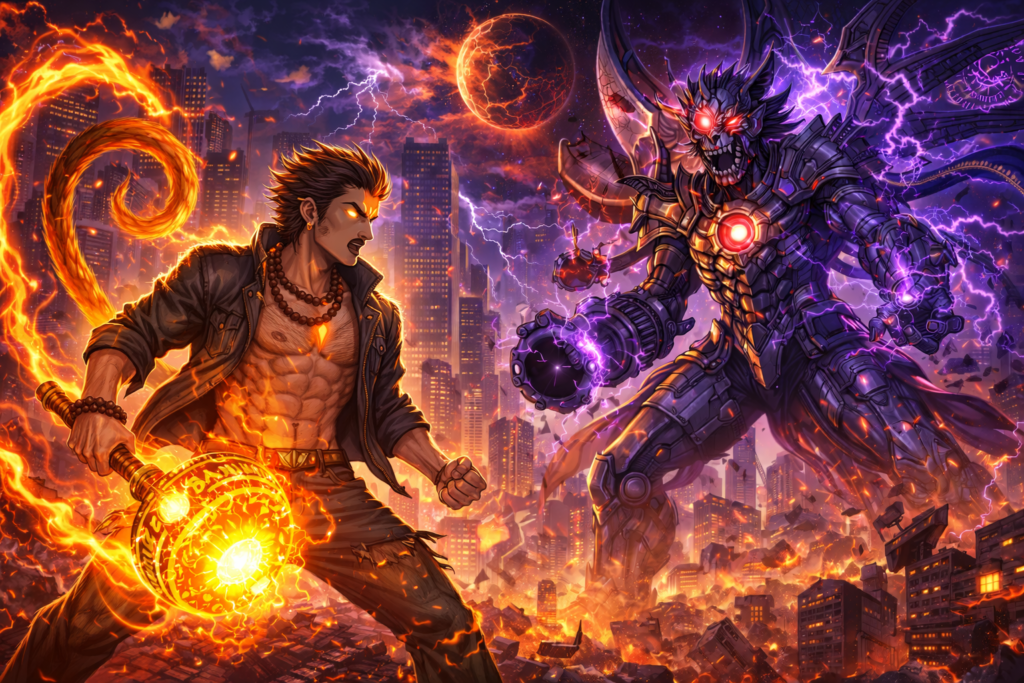
The haft extended. The glyphs across its length rearranged. The head bloomed open like a lotus—each petal edged in glowing fire-script, not flames, but words burning with light.
Akshay ran up, eyes wide. “Is that—did it just evolve?”
Makardvach stepped into the training ring.
Swung once.
A clean arc.
The air behind the swing caught fire—
—but didn’t burn the ground.
The flames followed the shape of the arc, lingering like brushstrokes in divine ink, suspended mid-air.
Not destruction.
Expression.
He turned to them, eyes faintly glowing.
“It responds not to rage,” he said. “But to grief made whole.”
Megha stared, jaw slightly open.
“So… what now?”
Makardvach smiled faintly.
“Now we stop pretending I’m new to this.”
He hurled the gada upward.
It spun once, igniting in full celestial flame—
—and returned to his hand.
Makardvach turned to the horizon.
A storm was coming.
And this time, he was ready to meet it—not with borrowed strength.
But with inherited resolve.

0

Subtotal