vanaraman

Chapter 7: Return to Kishkindha

The jeep rattled up the winding path like a pilgrim struggling to climb the back of a sleeping titan.
Makardvach sat in the front seat, quiet.
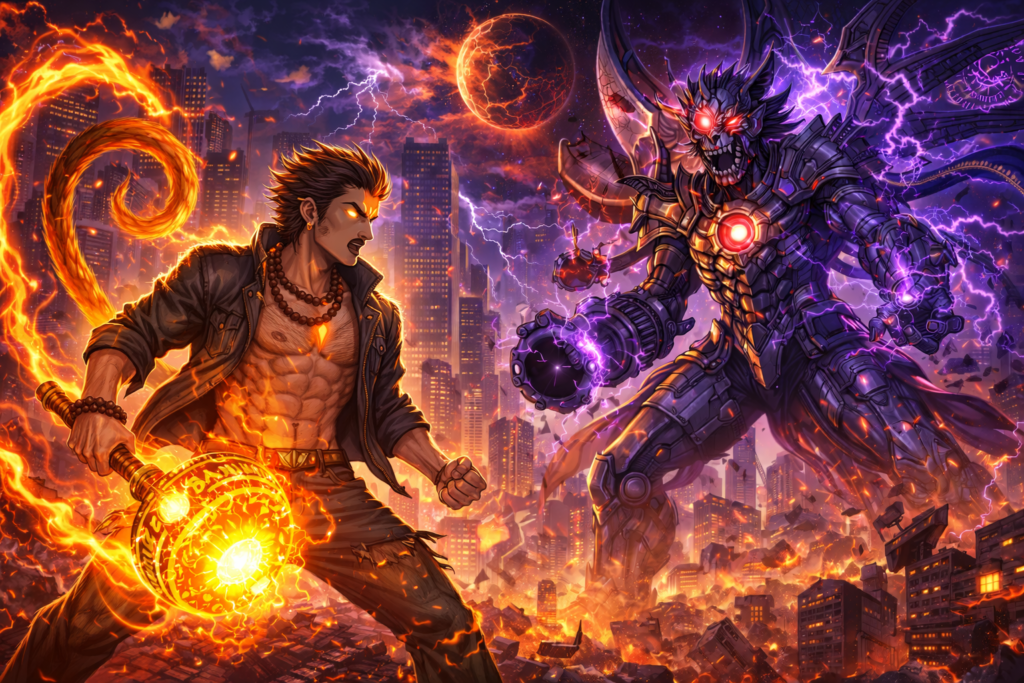
He wore a simple black kurta and a crimson scarf wrapped around his neck—not for disguise this time, but reverence. The gada lay across his lap. Not strapped, not sheathed. Just held. Like an heirloom returned to the family altar.
Behind him, Megha flipped through a leather-bound text of inscriptions Akshay had digitized and annotated the night before. Her voice occasionally murmured dates, places, mantras—like she was rehearsing for a confrontation with ghosts.
Akshay sat in the back, legs bouncing, scanning aerial maps on his tablet and muttering to himself. “The density in this rock strata shouldn’t exist. But it does. And it curves into a shape that matches—”
ā€œBreathe, Akshay,ā€ Megha said.
ā€œI am breathing. Just fast.ā€
The jeep groaned as it rounded the final bend—and the view opened before them.
Anjanadri.
The hill rose like a wave of stone frozen mid-crash, crowned by an ancient temple. The path to it was lined with rusted prayer bells and carved monkey faces half-worn by rain. Pilgrims walked the steps in silence. Langurs watched from trees above.
And the wind—
The wind changed.
Makardvach felt it the moment he stepped out of the vehicle.
Warm.
Constant.
And alive.
Rishabh appeared beside him.
He hadn’t ridden in the jeep.
He had walked.
He carried no gear, no staff.
Only silence.
Makardvach looked up at the slope. ā€œThis is where it began?ā€
Rishabh nodded. ā€œThis is where he first touched the sky.ā€
Megha joined them, breathing hard as she looked around. ā€œThe temple carvings here—some of them predate the Ramayana’s oldest oral versions. We’re standing on something deeper than text.ā€
Akshay muttered, ā€œThis whole hill is humming.ā€
Makardvach didn’t answer.
He began to climb.
Every step up the stone path felt heavier—but not from exhaustion.
From recognition.
The ground knew him.
The wind curled around his ears like an old friend.
By the time they reached the main temple gate, the air felt charged—thick with stories, waiting to be spoken.
An old priest greeted them with a nod.
ā€œYou came back,ā€ he said, eyes resting on Makardvach.
Makardvach paused. ā€œDo I know you?ā€
The priest smiled faintly. ā€œNo. But your blood does.ā€
And then he stepped aside.
Rishabh placed a hand on Makardvach’s shoulder.
ā€œEnter,ā€ he said. ā€œAnd remember what never forgot you.ā€
Makardvach stepped through the gate.
And inside—
the walls moved.
Not physically.
But through memory.
Murals pulsed faintly with color. Glyphs flared gold, then faded. The gada in his hand felt lighter. His chest warmer. His breath steadier.
And when he looked to the far wall—
He saw a carving of Hanuman.
Eyes fierce.
Muscles coiled.
Tail curled in divine arc.
But carved behind Hanuman…
A shadow.
Another figure.
Smaller.
Armed with a gada.
Makardvach stepped forward slowly.
It wasn’t just prophecy.
It was recognition.
He placed his palm on the carving.
The stone burned under his skin—not in pain.
In welcome.
And above him, the wind howled.
Not loud.
Not wild.
Just… clear.
Like a whisper carried across ages.
ā€œHe returns.ā€
They sat at the summit in silence.
The sun had begun its descent, casting long golden rays across the temple stones. Clouds drifted like slow-moving thoughts. The world below had softened to a distant hum—only the breath of wind remained, curling gently around Makardvach’s shoulders like a shawl stitched by gods.
Rishabh gestured to the carved slab beside them—weather-worn and cracked, but intact enough to show the mudras etched into its face.
ā€œClose your eyes,ā€ he said.
Makardvach obeyed.
ā€œMatch your breath to the wind. Not your heartbeat. Not your thoughts. Just the wind.ā€
Makardvach inhaled.
The gada lay across his lap.
And then—
It changed.
He felt his ribs expand… too far. His spine crackled as if it remembered a form older than him. His shoulders grew heavy. His ears tingled.
The breath wasn’t just inside him anymore.
It was around him.
And then—
The world shifted.


He stood on a battlefield.
Dust everywhere. Trees burning. The sky red with smoke.
And there—Hanuman.
Not a statue. Not a painting.
The being.
Ten feet tall. Golden skin slick with blood and ash. Muscles roped like iron bands. Gada spinning like the orbit of a moon around his hand.
He moved through an army of rakshasas with precision, not rage.
Not a berserker.
A surgeon of righteousness.
Makardvach tried to call out—but his voice had no place here.
This wasn’t a memory.
This was an inheritance.


The vision shifted.
Hanuman knelt before Rama.
Not in submission.
In devotion.
Makardvach felt it ripple through his chest—humility without weakness. Power without pride.
The wind whispered again.
ā€œServe without needing to be seen.ā€


The vision fractured again.
Now Hanuman stood at the peak of a mountain—alone. Older. Quiet.
He gazed out at a world that no longer called for him.
Makardvach saw it in his face: the sorrow of usefulness ending. The ache of eternity.
And then Hanuman turned.
Looked directly at him.
Not through time.
Into it.
ā€œNot all battles are for glory. Some are for breath. Some are for balance.ā€
Makardvach trembled.
Hanuman reached forward.
Touched his forehead.


He awoke gasping.
Rishabh didn’t speak.
He had seen the change.
Makardvach’s eyes were glowing faintly now—not fully gold, but touched by it.
Megha stood nearby, hands tight around her notebook. ā€œWhat did you see?ā€
Makardvach stood slowly.
His voice was calm.
Not shaken.
Not awed.
Certain.
ā€œI saw what I need to become.ā€
The chamber was small.
Carved into the north face of Anjanadri Hill—sealed for centuries, maybe longer. The entrance had been covered in moss and forgotten prayer flags, half-swallowed by vines.
It was Akshay who noticed it first, tracing strange mineral densities on his scanning tablet. ā€œThere’s a void in the rock. Perfect rectangle. It’s not natural.ā€
Makardvach stayed behind at the summit, still catching the last threads of breath left by his vision. Rishabh remained in stillness beside him.
So Megha descended with Akshay.
Torch in one hand, notebook in the other.
The entrance was narrow. The air thick with memory. And silence.
Then—
The passage opened into a hollowed dome of black stone, etched on every surface with swirling script. Not Sanskrit. Not Vanara Bhasha. Something more ancient. Seed syllables layered like waves across the walls.
And at the center—
A single phrase, repeated in curling golden ink:
Naada Brahma Raksha-Vinaashaka
Divine Sound—the Destroyer of Darkness.
Megha stepped closer.
Her breath caught.
ā€œThese aren’t just inscriptions,ā€ she said aloud. ā€œThey’re mantras. Not written to be read. Written to be heard.ā€
Akshay’s eyes widened. ā€œThese walls… they’re resonant. Like the whole place is built to vibrate when the right frequency hits.ā€
She nodded, awe blooming in her voice. ā€œIt’s a sound temple. Not for worship. For containment.ā€
She turned back to the central slab and traced the final line with one shaking finger.
ā€œShould the sacred sound be corrupted, the seal shall crack. Should the hymn turn hollow, the river shall awaken.ā€
Akshay frowned. ā€œWhat river?ā€
Megha stepped back, face pale. ā€œThe Shivnadi.ā€
Akshay’s voice dropped. ā€œYou think Kalnemi’s not just trying to break the seal physically—but spiritually? Using dark frequencies to invert the divine chant?ā€
Megha nodded slowly. ā€œNot think. Know.ā€
She looked up at the ceiling.
The carvings there showed two figures:
One—Hanuman, seated in meditation, singing to the world.
The other—Kalnemi, mouth open in mockery, twisting that same sound into ruin.
And above them, a crack in the sky.
Divine harmony disrupted.
The gates of death unbound.


Back at the summit, the wind shifted.
Makardvach stood.
His eyes turned toward the direction of the chamber.
He didn’t know why.
But he heard it.
A frequency in the wind.
One that didn’t belong.


The first tremor was subtle.
Just a low hum underfoot. Like the hill exhaled unease.
Makardvach turned away from the summit and narrowed his eyes toward the treeline. The jungle was too still. The birds had gone silent.
Even the wind, so faithful a companion since his arrival, had hesitated.
Rishabh rose beside him.
ā€œIt’s coming,ā€ the monk said.
Makardvach nodded. ā€œNot an army. One presence.ā€
He didn’t ask how Rishabh knew.
The gada in his hand confirmed it, vibrating gently—as if growling.
And then, from the shadow of the banyan roots below, it stepped forward.
Tarakasura.
But no longer flesh alone.
His body was blackened, scorched with infernal tattoos that pulsed red like veins of magma. His horns curled sharper, twisted. His eyes glowed not with hatred—but hunger.
Not a soldier anymore.
A weapon.
Makardvach stepped forward, planting his feet.
ā€œI broke you once.ā€
Tarakasura’s voice was different now. Deeper. Rotted. Echoing with more than one soul.
ā€œI was remade,ā€ the demon rasped. ā€œKalnemi offered me death. And I drank it. Now I am the curse that remembers.ā€
Makardvach didn’t wait.
He moved.
The gada came like a comet, and Tarakasura met it with bare arms this time—catching the strike.
Makardvach’s eyes widened.
So did the impact radius—trees bending, dust exploding in a ring.
Tarakasura spun, used Makardvach’s momentum, and threw him through a pillar of stone. It collapsed behind him in a rain of shards.
Makardvach rolled, coughed, stood again. Blood from the lip.
Good.
He was awake now.
They clashed again.
This time, it was different.
Tarakasura’s strikes were faster, more disciplined. There was no berserker rage—only cold purpose.
He used the terrain.
He feinted.
He struck at joints.
Makardvach felt it—this was not the same opponent.
And then—
A roar.
Not his.
Tarakasura’s.
Woven with a dark frequency. It hit the air like acid.
The wind itself faltered.
Makardvach dropped to one knee, clutching his ears. Behind him, rocks cracked.
Even Rishabh staggered, placing a hand to the earth for stability.
The hill was rejecting the sound. But it couldn’t block it fully.
Makardvach looked up.
Eyes bleeding. Ears ringing.
Tarakasura raised a hand—not to strike.
But to chant.
Corrupted Vanara script spiraled from his fingertips.
ā€œNaada-Vināsha-Bhavaā€”ā€
(Let the sacred sound be undone.)
Makardvach forced himself upright.
No.
He hurled the gada not at Tarakasura—
—but at the stone behind him.
The resonance chamber.
The impact shattered the corrupted mantra mid-air, disrupting its pitch.
Tarakasura screamed—not from pain, but fury.
Makardvach staggered forward, bleeding from his temples.
ā€œYou want my death?ā€ he said hoarsely. ā€œYou’ll have to earn it.ā€
The gada flew back to his hand—its glow pulsing in sync with his heart.
Tarakasura vanished into smoke again, retreating.
Not defeated.
Not this time.
But warned.
And above them, the wind howled—not in fear.
In anger.
Makardvach collapsed to his knees.
Not from injury alone—but from something deeper.
His muscles trembled. His ears rang. The gada had gone still in his hand, as if even it needed breath.
The trees swayed in mourning.
Rishabh rushed forward and caught him before he could fall to the stones completely. Megha was close behind, eyes wide with fear and awe.
ā€œHe’s burning up,ā€ she said, pressing a cloth to his temple. ā€œHe was chanting something dark—maybe it infected his aura.ā€
ā€œHe’s not poisoned,ā€ Rishabh murmured, his eyes distant. ā€œHe’s… aligned. Too strongly. Too fast.ā€
Akshay ran up from the base of the hill, panting. ā€œI saw the spike. The sound went ultrasonic—I’ve never seen readings like this. The ground itself bent.ā€
ā€œIt wasn’t just sound,ā€ Rishabh said. ā€œIt was invocation—corrupted.ā€
Then—
The mountain moved.
No quake.
No collapse.
Just a breath.
A slow inhale.
The wind stilled.
And then the ground beneath Makardvach cracked open.
Not violently. Gently. As if making room.
A fissure widened beneath the platform, revealing stairs made of pale gold-veined stone, leading downward into silence.
Everyone froze.
Megha whispered, ā€œThis isn’t on any map.ā€
Rishabh closed his eyes. ā€œBecause it was never meant for the map. It was meant for him.ā€
Makardvach stirred. His eyelids fluttered. The glow along his arms pulsed softly—alive again.
Then his lips moved.
A single word, exhaled like it was carved in his bones:
ā€œHanumatāya.ā€
The ancient invocation.
A salutation to Hanuman.
And the stone stairs shimmered.
Megha gripped his hand. ā€œYou’re not going alone.ā€
Makardvach opened his eyes. Bleary, cracked—but burning with clarity.
ā€œI think I already have.ā€


The descent was silent.
The stairwell lit itself—not with flame, but with memory. The walls were carved with scenes too old for record: Hanuman meditating beneath the stars, lifting mountains, bowing before sages.
But it was the final carving that stopped them.
A Vanara, smaller, human-sized, standing before a storm, holding a glowing gada aloft. Around him: humans, demons, gods—watching.
Not fighting.
Watching.
Below it, a single phrase:
ā€œFor the one who stands between the realms.ā€
At the end of the stair, they found it:
A pedestal of silvered stone.
And upon it—
A golden bracer, etched with shifting script, glowing faintly.
Makardvach stepped forward.
The bracer lifted on its own.
And latched onto his arm.
The wind roared in answer.
Not across the hill.
But within it.
The mountain had given its first gift.
And the boy who bore Hanuman’s echo had become harder to ignore.

0

Subtotal