
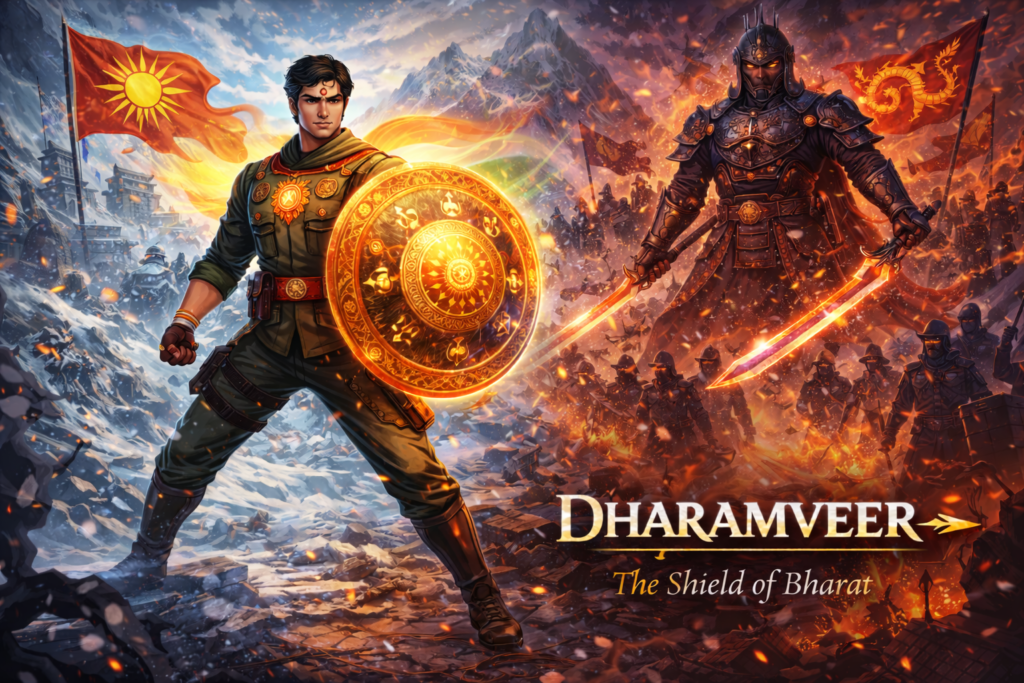
The capital of Bharat Varsha was a city of contrasts. Its ancient temples and palaces, carved from stone and gilded with gold, stood proudly against the backdrop of a bustling modern city. Markets buzzed with traders hawking their wares, the scent of spices mingling with the smoke from countless hearths. But beyond the noise of daily life, the Rajya Sabha, the heart of the nation’s governance, hummed with tension.
The great hall of the Sabha, a vast chamber built to inspire awe and reverence, was now filled with the discordant sounds of raised voices and heated arguments. The ornate murals of the devas on the walls seemed to watch in silence as the leaders of Bharat clashed.
At the head of the room sat Rajguru Vedanarayan, his white beard flowing over the folds of his saffron robes. His staff rested against his chair, the carved serpent coiling around its base seeming to mirror the spiraling chaos in the chamber. He tapped his fingers lightly against the armrest, his expression serene yet unyielding.
“To send more soldiers north is to strip our coasts bare,” argued Raja Virendra, his voice rising above the din. “Our ports are vital to Bharat’s prosperity. If they fall, we lose more than just trade—we lose our lifeline.”
Raja Indraketu slammed his fist onto the table, the sound reverberating through the chamber. “And what of the northern frontier? If the mountains fall, the invaders will not stop until they reach your precious ports. They’ll crush everything in their path!”
“The north has always been our shield,” interjected Raja Kumara of the eastern forests, his voice calmer but no less pointed. “But a shield must be strong to withstand repeated blows. If we focus only on the north, the rest of Bharat will suffer.”
The chamber erupted again, each faction defending its priorities with fervor.
Vedanarayan raised his hand, and slowly, the room fell silent. His voice, though quiet, carried an undeniable authority. “Enough,” he said. “We have all heard the arguments, but this division serves no one except our enemies. Wei Long seeks to exploit our differences, to fracture us into pieces that he can pick off one by one. If we allow this to continue, we will not need an enemy to destroy us—we will do it ourselves.”
Rohan Mehra, standing near the edge of the chamber, stepped forward. His polished boots clicked softly on the stone floor as he approached the center of the room. Dressed in his officer’s uniform, he looked every bit the confident soldier, his presence commanding attention.
“Rajguru,” Rohan began, his tone measured, “you speak of unity, but what unity have we seen? The north bleeds, and the council debates. Our soldiers face a disciplined enemy armed with superior weapons, yet we hesitate to act.”
A murmur spread through the room, some in agreement, others bristling at Rohan’s audacity.
“And what would you suggest, Captain Mehra?” Vedanarayan asked, his gaze sharp.
Rohan turned to face the assembly, his expression resolute. “Decisive action. Reinforce the north with everything we can spare. Strengthen the supply lines, secure the mountain passes, and fortify the remaining outposts. Delay will only lead to further losses.”
“And leave the rest of Bharat vulnerable?” countered Raja Virendra, his tone cutting.
“If the north falls, none of Bharat will be safe,” Rohan shot back. “The mountains are our first line of defense. If we lose them, the enemy will flood the plains and beyond.”
The tension in the room thickened, the air heavy with unspoken doubts and fears.
Vedanarayan leaned forward, his piercing eyes locked on Rohan. “And what of dharma, Captain? Unity is not achieved through force or fear. If we act rashly, we risk fracturing the very foundation of this nation.”
Rohan hesitated, the weight of the Rajguru’s words pressing against him. “Dharma demands action, Rajguru,” he said finally. “Inaction in the face of danger is no different from surrender.”
The chamber fell into an uneasy silence. The leaders exchanged glances, each weighing the costs of action against the risks of delay.
Outside the Sabha, in the sprawling courtyards lined with banyan trees, Drishtadhyumna Rathore stood waiting. The warmth of the capital felt almost foreign after weeks in the frozen mountains. His woolen coat, frayed from battle, felt out of place amid the silken robes and polished armor of the palace guards.
As the meeting dragged on, Harjit joined him, a steaming cup of chai in hand. “Still nothing?” Harjit asked, handing Drishtadhyumna the cup.
“They’re debating,” Drishtadhyumna said curtly, his eyes narrowing at the closed doors of the Sabha. “While they argue, the enemy grows stronger.”
Harjit leaned against a pillar, his tone laced with bitterness. “Do they even understand what we’re up against? Half of them haven’t seen a battlefield in years. They speak of dharma and unity, but what do those words mean to a soldier bleeding in the snow?”
Drishtadhyumna didn’t reply. Instead, he sipped the chai, its heat doing little to warm the frustration building within him.
The doors of the Sabha opened suddenly, and the leaders began filing out, their expressions ranging from grim determination to barely concealed frustration.
Vedanarayan approached Drishtadhyumna, his gaze steady. “Captain Rathore, the council has agreed to send reinforcements to the north, but sparingly. Supplies will be prioritized, and your orders are to hold the line until we can muster more resources.”
Drishtadhyumna saluted sharply, though his voice carried a hint of discontent. “Understood, Rajguru.”
Rohan approached next, a faint smirk on his lips. “A small victory, Captain. But don’t expect miracles. The council moves like a glacier—slow, and only under great pressure.”
Drishtadhyumna met Rohan’s gaze, his tone cold. “Pressure is something the front lines know well, Captain Mehra. Perhaps you should see it for yourself.”
Rohan chuckled lightly, though his eyes held a dangerous glint. “Careful, Rathore. Not everyone returns from the front lines.”
As the sun set over the capital, Drishtadhyumna and Harjit prepared to return north. The promise of reinforcements brought little comfort, but Drishtadhyumna’s resolve remained unshaken.
The mountains awaited, and so did the enemy.
The faint hum of activity within the Rajya Sabha was punctuated by the murmurs of advisors, the rustle of silk robes, and the sharp clinks of ceremonial weapons as leaders gathered once more. The long stone table in the center of the chamber bore the weight of maps, dispatches, and scrolls. Drishtadhyumna Rathore, still clad in his battle-worn uniform, stood at the far end of the room.
Though the council had allowed him entry to make his case, the unspoken tension in the room made it clear that his presence was unconventional—a soldier among statesmen, a reminder of the war that loomed just beyond the mountains.
“Captain Rathore,” said Raja Indraketu, his voice booming as he gestured to the gathered leaders, “you have fought at the northern frontier. Speak freely, so this council may hear firsthand what our soldiers face.”
Drishtadhyumna stepped forward, his boots echoing against the polished floor. His sharp eyes swept the room, meeting the gazes of the assembled leaders. He began speaking, his voice steady and clear.
“The situation in the north is dire,” he said. “Wei Long’s forces are disciplined, well-armed, and relentless. They’ve cut off our supply lines, isolated our outposts, and forced us into a defensive position. Every day we delay, they gain ground. Every decision we hesitate on, they exploit.”
A murmur spread through the room, some voices filled with concern, others tinged with skepticism.
Drishtadhyumna continued, his tone growing firmer. “Our soldiers fight with courage, but courage alone cannot withstand starvation, cold, and overwhelming odds. Without reinforcements, without a cohesive strategy, we will lose the northern passes—and with them, the gateway to Bharat.”
Acharya Lakshyaketu, seated near the Rajguru, raised a hand. “Your words are stirring, Captain, but the Arthashastra teaches us that haste is the enemy of wisdom. Rushing to fortify one position may leave another vulnerable. What would you have us do—strip our coasts and central plains of their defenses to protect the mountains?”
Drishtadhyumna met the Acharya’s gaze evenly. “The Arthashastra also teaches us to neutralize threats at their source. The northern frontier is not just a position—it is the shield of Bharat. If we lose the mountains, the enemy will flood the plains, and no amount of coastal defenses will stop them.”
The room fell silent for a moment, the weight of his words pressing against the gathered leaders.
Rohan Mehra, leaning casually against a pillar, chose this moment to interject. “And yet, Captain, you speak as if the northern frontier is our only concern. Bharat is vast, and its enemies are many. Even if we hold the mountains, what then? What if another threat emerges while our forces are concentrated in the north?”
Drishtadhyumna turned to Rohan, his voice calm but sharp. “A distant threat is a possibility. The enemy at our doorstep is a certainty. Prioritizing distant risks over immediate dangers is not strategy—it’s folly.”
Rohan smirked, but he said nothing further.
As the debate continued, Rajguru Vedanarayan raised his hand, his calm voice silencing the room. “Captain Rathore,” he said, “you have made your case. But strategy requires not only boldness but balance. If you were in this council’s place, what course of action would you recommend?”
Drishtadhyumna stepped closer to the table, his hand moving to one of the maps spread across it. “Rajguru, Bharat’s strength has always been its unity—the ability to bring together our regions, our armies, and our resources. Right now, the north is isolated. We must reestablish supply lines, secure the mountain passes, and ensure that reinforcements can move freely between posts.”
He pointed to a series of marked positions on the map. “These bridges and trade routes are critical. The enemy has sabotaged them, but they can be repaired. Our engineers and soldiers, working together, can restore these lifelines and fortify them against further attacks.”
“And what of the enemy?” asked Raja Virendra. “Wei Long’s forces are already entrenched. Rebuilding these routes will take time—time the enemy will use to strengthen their hold.”
Drishtadhyumna nodded. “That’s why we must counter their tactics with our own. Chanakya’s Arthashastra speaks of using deception, alliances, and unconventional strategies. While we rebuild, we harass the enemy—small, calculated strikes to disrupt their plans and weaken their morale.”
The room buzzed with renewed discussion. Some leaders nodded in agreement, their expressions softening as they considered Drishtadhyumna’s words. Others remained skeptical, their arms crossed as they whispered among themselves.
Finally, Vedanarayan raised his staff, calling for silence. “The council will deliberate on your recommendations, Captain Rathore. Your passion and dedication to Bharat are evident, but the path forward must be chosen with care.”
Drishtadhyumna saluted, though the doubt lingering in the air made his victory feel hollow. “Thank you, Rajguru. I trust this council to make the right decision for Bharat.”
As the leaders filed out of the chamber, Rohan lingered behind, his smirk returning as he approached Drishtadhyumna.
“Well argued, Captain,” Rohan said, his tone light but laced with mockery. “You might make a fine politician someday—if you survive the war.”
Drishtadhyumna’s gaze remained steady. “And you might make a fine soldier if you ever see a battlefield.”
Rohan chuckled, the sound low and humorless. “Careful, Rathore. The battlefield has a way of swallowing even the most righteous.”
Without another word, Rohan turned and left, leaving Drishtadhyumna alone in the now-empty chamber.
The captain stood for a moment, his thoughts heavy. The council’s decision would determine the fate of the north—and perhaps the fate of Bharat itself.
The sun was beginning to set over the capital, its golden rays casting long shadows across the domes and spires of the Rajya Sabha. Within its grand hall, the tension from earlier debates lingered like a storm that refused to pass.
Rohan Mehra sat at one end of a long stone bench, his posture relaxed as he observed the gathering of advisors and generals. The council had convened for a private session to finalize their strategy, but the room buzzed with discontent. Arguments from earlier had not been forgotten, and alliances were shifting with every passing moment.
At the head of the table, Rajguru Vedanarayan stood, his staff resting lightly in his hand. “We have heard Captain Rathore’s plea,” he began, his voice calm but firm. “It is clear that the situation in the north is critical. However, the council remains divided on how best to proceed.”
Raja Indraketu rose to his feet, his voice as commanding as ever. “What is there to debate, Rajguru? The captain has given us a clear plan. Reinforce the north, secure the supply lines, and strike at the enemy’s vulnerabilities. If we delay any longer, there won’t be a north to defend!”
“And what will you sacrifice for this plan, Maharaja?” countered Raja Virendra, standing from his seat with equal fervor. “The ports of the south are already stretched thin defending against piracy and foreign traders encroaching on our waters. If we divert resources to the north, we risk losing the very lifeline that sustains Bharat’s economy.”
A murmur spread through the room, with some nodding in agreement and others shaking their heads in frustration.
“It is not a matter of sacrifice,” said Acharya Lakshyaketu, his tone measured but sharp. “It is a matter of balance. The Arthashastra teaches us to consider all aspects of a kingdom’s health—its defense, its economy, and its unity. Overcommitting to one front while neglecting the others is a recipe for collapse.”
Rohan Mehra leaned forward, a faint smile tugging at the corners of his lips. “With respect, Acharya,” he said, his voice cutting through the noise like a blade, “balance is a noble concept, but it does not win wars.”
The room fell silent as all eyes turned to him.
“What Bharat needs now is clarity of purpose,” Rohan continued, rising to address the council. “And that purpose must be survival. The north is our shield, as Captain Rathore has said. If it falls, the enemy will not stop at the mountains. They will sweep across the plains, and no amount of balance or trade will save us then.”
“Your words are bold, Captain Mehra,” Vedanarayan said, his gaze sharp. “But boldness without wisdom is folly. What would you have us do?”
Rohan met the Rajguru’s gaze evenly. “Commit. Fully and without hesitation. Reinforce the north with everything we can spare—men, supplies, weapons. Secure the mountain passes and fortify our outposts. Delay only serves our enemy.”
“And if another threat emerges?” asked Raja Kumara of the eastern forests. “If we focus all our strength on the north, what will protect the east, or the coasts, or the deserts?”
Rohan turned to him, his voice unwavering. “There is no greater threat than the one already at our doorstep. Any other risks are distant and hypothetical. This is real, and it is happening now.”
At the edge of the room, Drishtadhyumna Rathore listened silently, his expression unreadable. While he agreed with much of what Rohan said, there was something unsettling about the man’s tone—an undercurrent of arrogance that seemed to dismiss the complexities of dharma and unity.
When the murmurs began again, Drishtadhyumna stepped forward. “With respect, Captain Mehra,” he said, his voice calm but firm, “commitment without strategy is no better than inaction. Wei Long is not a foe we can defeat through brute force alone. His tactics are calculated, designed to exploit any weakness we show.”
Rohan turned to face him, his smile faint but sharp. “And what do you suggest, Captain Rathore? That we wait until Wei Long takes the mountains and fortifies them against us? Strategy is meaningless if we lose the ability to act.”
Drishtadhyumna met his gaze evenly. “Strategy is the foundation of action. Without it, we play directly into Wei Long’s hands. If we commit everything to the north without securing our supply lines and rebuilding our infrastructure, we’ll stretch ourselves too thin to hold any position, let alone win.”
The tension between the two men was palpable, the room growing quieter with every passing moment.
Vedanarayan finally raised his staff, breaking the silence. “Enough,” he said, his voice carrying the weight of authority. “Both of you make valid points, but this council will decide the course of action. Passion and reason must walk hand in hand if we are to preserve Bharat.”
The leaders exchanged uneasy glances before nodding.
Vedanarayan continued. “Let this debate remind us of the stakes. Bharat cannot afford to fracture—not now, not ever. We will deliberate tonight and deliver our decision at dawn.”
As the session ended and the council members began to leave, Rohan approached Drishtadhyumna. His expression was one of faint amusement, though his words carried an edge.
“Well spoken, Rathore,” he said, his tone smooth. “You’ve learned the art of argument well. But words won’t stop Wei Long.”
Drishtadhyumna regarded him coldly. “And arrogance won’t unite Bharat, Mehra. This war isn’t just about the north. It’s about all of us.”
Rohan smirked, turning to leave. “Then let’s hope the council sees it that way.”
As Drishtadhyumna stepped out into the night, the cold air bit at his skin, but he hardly noticed. His mind was consumed with thoughts of the coming war, the decisions being made, and the growing rift within the council.
The mountains waited, their icy peaks promising battles yet to come.
Far to the north, beyond the snow-covered ridges and shadowy forests, General Wei Long stood at the center of his command tent. The tent was a stark contrast to the rugged terrain outside—precise, orderly, and immaculate. A large map stretched across the low table before him, its surface marked with intricate details of Bharat’s northern defenses. Tiny figurines represented troop placements, supply routes, and fortifications, each positioned with meticulous care.
Wei Long’s sharp eyes scanned the map as if it held the secrets of his enemy’s soul. He traced his fingers over the ridgelines and valleys, calculating each move with the precision of a chess master.
“General,” said Colonel Zhang, his second-in-command, as he entered the tent and saluted. “Our scouts report that Bharat’s forces have retreated to a secondary position. Their supply lines are fragile, and their reinforcements are delayed.”
Wei Long nodded, his expression calm. “As expected. Captain Rathore is capable, but his superiors are predictable. Their indecision will be their undoing.”
Zhang stepped closer to the table, his brow furrowing. “Their retreat positions are defensible, but temporary. If we strike now, we can cripple their forces before they have a chance to regroup.”
Wei Long tapped a figurine positioned near a key supply route. “No,” he said, his voice as smooth as ice. “Not yet. A premature assault would consolidate their leadership and give them a common enemy to rally against. That is not the path to victory.”
Zhang hesitated, his confusion evident. “Then what is, General?”
Wei Long’s faint smile didn’t reach his eyes. “Division. Bharat’s strength lies in its unity, fragile though it is. We will fracture it further. Cut off their supplies, isolate their outposts, and exploit their internal discord. Let their leaders squabble over resources while their soldiers starve in the snow.”
He picked up a red figurine and moved it closer to a vital bridge marked on the map. “Deploy the infiltrators. Disable this crossing and sow disinformation in their ranks. We will stretch their forces until they break.”
Later that night, Wei Long stood outside the tent, his breath misting in the cold air. The vast encampment around him hummed with activity—soldiers sharpening their weapons, engineers building fortifications, and scouts preparing for their next missions.
Beyond the camp, the peaks of the Himalayas loomed, their jagged edges shrouded in mist. Wei Long’s gaze lingered on the mountains, his mind already several moves ahead.
Colonel Zhang approached, his boots crunching in the snow. “The infiltrators are ready, General,” he reported. “They’ll leave before dawn.”
Wei Long nodded, his hands clasped behind his back. “Good. Remind them that their task is not just sabotage but psychological warfare. Confuse the enemy, disrupt their cohesion, and make them question their leadership. A divided enemy is a defeated enemy.”
Zhang hesitated before speaking again. “And Captain Rathore? He is resilient. Perhaps even dangerous.”
Wei Long’s smile returned, colder this time. “Resilience is admirable, but even the strongest stone can be worn down by time and pressure. Rathore will fight valiantly, and his people will admire him for it. But admiration does not win wars. We will strip him of his resources, his allies, and his hope. When the time comes, he will fall.”
In the depths of the Chinese encampment, a group of infiltrators prepared for their mission. Dressed in dark clothing and armed with blades, compact firearms, and explosive charges, they moved with silent efficiency. Their leader, a wiry man with sharp eyes, spoke in hushed tones as he distributed the assignments.
“Our targets are simple,” he said, pointing to a crudely drawn map. “The supply depot near the gorge, the communication tower by the ridge, and the bridge that connects their main outpost to their reinforcements. We disable these, and the Bharatiya forces will be cut off completely.”
One of the infiltrators, a younger man, raised a hand. “And if we encounter resistance?”
The leader’s smile was thin and humorless. “We don’t engage unless necessary. Our mission is to disrupt, not to fight. Leave the glory to the soldiers on the front lines.”
Back in the Bharatiya camp, Drishtadhyumna Rathore stood by the ridge, his gaze fixed on the horizon. The faint glow of enemy fires burned in the distance, a constant reminder of the looming threat.
Beside him, Lieutenant Harjit Singh adjusted the straps on his rifle. “They’ll make their move soon,” Harjit said, breaking the silence.
Drishtadhyumna nodded, his expression grim. “They’re not just waiting for us to falter. They’re creating the conditions for it. This isn’t just a battle, Harjit—it’s a game of attrition. And Wei Long is playing it perfectly.”
Harjit frowned, his breath visible in the cold air. “So what do we do? Wait for them to starve us out?”
Drishtadhyumna turned to him, his voice firm. “No. We adapt. If they’re trying to isolate us, we find new routes. If they sabotage our supplies, we strike back and recover what’s ours. We don’t wait for reinforcements—we make our own luck.”
Harjit gave a faint smile. “You make it sound simple, Captain.”
“It’s not,” Drishtadhyumna admitted. “But nothing worth fighting for ever is.”
As the infiltrators moved through the mountains under the cover of darkness, the winds howled, carrying with them the promise of conflict. In the days to come, Wei Long’s strategy would test Bharat’s resolve like never before.
But in the heart of the northern mountains, where the snow fell silently over the ridges, a soldier stood ready—his determination unyielding, his resolve unwavering.
In the stillness of the night, shadows moved like whispers through the rugged terrain of the northern frontier. A team of infiltrators crept toward a key Bharatiya supply depot nestled in the valley. Their footsteps were muffled by the snow, their dark clothing blending seamlessly with the shadows of the trees.
The leader of the group, the wiry man with sharp eyes known only by his codename, Crow, gestured silently to his men. Each moved with precision, their mission clear: sabotage the depot, sow chaos, and retreat before detection.
Inside the depot, a small contingent of Bharatiya soldiers huddled around a fire, their rifles leaning against a nearby stack of crates. The men were weary but vigilant, their eyes darting toward the darkness beyond the firelight.
“Another quiet night,” muttered one of the younger soldiers, his voice tinged with unease. “Too quiet.”
“Quiet is good,” replied an older soldier, his tone gruff. “Means the enemy hasn’t found us yet.”
Unbeknownst to them, the enemy had already arrived.
At the Bharatiya camp on the ridge, Drishtadhyumna Rathore and Lieutenant Harjit Singh pored over a map inside the command tent. The lantern light flickered, casting shadows over their faces as they debated their next move.
“If the reports are accurate,” Harjit said, pointing to a marked location on the map, “the enemy has been targeting our supply routes with alarming precision. They know exactly where to hit us.”
Drishtadhyumna leaned closer, his brow furrowed. “It’s not random. Someone is feeding them this information. These aren’t lucky guesses—they’re surgical strikes.”
Harjit sighed, running a hand through his beard. “You think it’s one of ours?”
Drishtadhyumna nodded slowly. “There’s no other explanation. The enemy’s infiltrators are good, but they couldn’t act this efficiently without inside help. We need to root them out, Harjit, before they cause more damage.”
Back at the depot, Crow’s team moved silently through the shadows. They reached the perimeter without incident, their movements practiced and fluid. Two guards patrolled near the outer fence, their breaths visible in the cold air.
Crow raised a hand, signaling his men to halt. He studied the guards for a moment before gesturing to one of his operatives. The man crept forward, a blade glinting faintly in the moonlight.
The guards never saw him coming. Within seconds, both were down, their bodies slumped silently in the snow.
Crow motioned for the rest of the team to proceed. They scaled the fence with ease, slipping into the depot undetected.
At the Bharatiya camp, Drishtadhyumna called for a meeting of his trusted officers. Around the table, their faces were tense, their eyes betraying the strain of days without proper rest.
“We have a mole,” Drishtadhyumna said, his voice cutting through the silence. “Someone within our ranks is feeding the enemy information. It’s the only way to explain their precision.”
The officers exchanged uneasy glances.
“How do we find them?” asked Major Kuldeep Rawat, his tone skeptical. “The men are already on edge after the last defeat. If we start interrogating everyone, it’ll destroy morale.”
“We don’t interrogate,” Drishtadhyumna replied. “Not yet. First, we tighten security. No one moves between posts without clearance. Messages are to be coded and hand-delivered by trusted couriers. And every officer here must account for their movements and decisions.”
The officers nodded reluctantly, though unease lingered in the room.
At the depot, Crow’s team planted charges along the supply crates, their movements swift and methodical. They worked in near silence, communicating with gestures as they prepared to destroy the vital cache.
But as they moved toward the depot’s communications tower, the crack of a branch underfoot shattered the silence.
“Who’s there?” barked one of the guards, his rifle snapping up as he scanned the darkness.
Crow cursed under his breath, signaling his men to retreat. The mission was compromised.
The guards raised the alarm, their shouts echoing through the valley as the depot erupted into chaos. Soldiers scrambled to their positions, firing into the darkness as the infiltrators fled.
The news of the attack reached the Bharatiya camp just before dawn. Drishtadhyumna was already awake, pacing outside his tent, when a courier arrived with the report.
“They hit the depot,” the courier said breathlessly. “Took out a large portion of our supplies. We managed to repel them before they destroyed everything, but they’re gone now.”
Drishtadhyumna’s jaw tightened. “Casualties?”
“Two dead, three wounded,” the courier replied. “The infiltrators moved fast. Our men didn’t stand a chance.”
Harjit, who had joined them, muttered a curse. “They’re getting bolder.”
“They’re getting better,” Drishtadhyumna corrected, his tone grim. He turned to the courier. “Double the patrols at every outpost and depot. If the enemy wants to keep testing us, we’ll make them pay for it.”
Far to the north, in the safety of the Chinese encampment, Crow reported to General Wei Long. The wiry man stood at attention, his expression stoic despite the partial failure of his mission.
“The depot was damaged but not destroyed,” Crow admitted. “They raised the alarm before we could finish.”
Wei Long studied him for a moment before nodding. “A setback, but not a significant one. The disruption will force them to divert resources to rebuild. That alone is a victory.”
Crow hesitated before speaking again. “Their defenses are tightening, General. The captain leading them—Rathore—he’s adapting quickly.”
Wei Long’s faint smile returned. “Good. A worthy opponent makes the game more interesting. But remember, Crow: no matter how strong the fortress, it can always be breached. We just need to find the right crack.”
At the Bharatiya camp, Drishtadhyumna stood on the ridge, his gaze fixed on the horizon. The sabotage at the depot was a harsh reminder of the challenges they faced, but it also steeled his resolve.
“We’ll outthink them, Harjit,” he said quietly. “Wei Long believes he can divide us, weaken us. But he’s underestimated what a cornered force is capable of.”
Harjit chuckled faintly. “And what’s that, Captain?”
Drishtadhyumna’s grip tightened on the hilt of his khukuri. “Turning the tide.”
The first rays of dawn spread over the Bharatiya camp, casting long shadows across the snowy terrain. Despite the early hour, Drishtadhyumna Rathore stood outside the command tent, flanked by Lieutenant Harjit Singh and a handful of trusted officers. The events of the past night—the attack on the supply depot—loomed over them like a storm cloud.
Drishtadhyumna’s sharp eyes scanned the faces before him. The men looked tense, the strain of constant vigilance etched into their features. “We cannot afford another breach like the one at the depot,” he said, his voice calm but unyielding. “The enemy is moving too quickly, and their strikes are too precise. Someone in our ranks is feeding them information.”
The officers exchanged uneasy glances, the accusation hanging heavy in the air.
Harjit folded his arms. “If it’s a mole, Captain, they’re covering their tracks well. None of the usual channels have been compromised—no intercepted messages, no unexplained movements.”
Drishtadhyumna nodded. “Then it’s someone who knows our procedures intimately. Someone who understands how to avoid suspicion.”
Major Kuldeep Rawat, a seasoned officer with a scar running across his left cheek, frowned. “Captain, with respect, accusing one of our own without proof could sow distrust among the men. Morale is already fragile.”
“Trust me, Major,” Drishtadhyumna replied, his gaze steady. “This isn’t a matter of suspicion. It’s a matter of survival. If we don’t root out the traitor, we won’t survive another week.”
Later that day, a patrol returned from the valley with troubling news. One of their sentries, stationed near a crucial mountain pass, had gone missing. The sentry’s post showed signs of a struggle, but there was no blood—only footprints leading away into the forest.
“They took him,” Harjit said grimly as he examined the report.
Drishtadhyumna paced inside the command tent, his mind racing. “Or he deserted,” he muttered. “If this is the traitor, they might have slipped away to join the enemy.”
Harjit raised an eyebrow. “Desertion? That’s a dangerous leap, Captain. It could’ve been an ambush.”
Drishtadhyumna shook his head. “No. The timing is too convenient. The depot was hit just hours before this sentry disappeared. If it’s connected, we’re dealing with someone who planned this carefully.”
That evening, as the camp settled into an uneasy quiet, Drishtadhyumna gathered a small group of trusted soldiers. Among them was Subedar Ramesh Iyer, a meticulous scout known for his sharp instincts.
“We need to find that sentry,” Drishtadhyumna said, his voice low but firm. “Alive, if possible. He might be the key to unraveling this.”
Ramesh saluted sharply. “Understood, Captain. We’ll leave immediately.”
The scouting party moved out under the cover of darkness, their path lit only by the faint glow of the stars. Drishtadhyumna watched them go, his chest tight with tension.
“If we’re wrong about this…” Harjit began.
“We’re not wrong,” Drishtadhyumna said, his tone brooking no argument.
Several miles away, deep within the enemy encampment, Rohan Mehra, now fully entrenched in his role as Shakuni, met with General Wei Long.
“The depot attack was a minor setback,” Rohan said smoothly, his arms crossed as he stood before the general. “But the seeds of distrust have been planted. They know there’s a traitor in their midst, and it’s already tearing at their cohesion.”
Wei Long nodded, his expression thoughtful. “Good. But don’t underestimate Rathore. He’s perceptive, and his resolve makes him dangerous. If he discovers your involvement, it could unravel everything.”
Rohan smirked faintly. “Let him suspect. Suspicion without proof is as good as an execution in their ranks. By the time he puts the pieces together, the damage will already be done.”
The scouting party returned just before dawn, their faces pale and their breaths coming in short bursts. They carried a man between them, his hands bound and his face bruised—the missing sentry.
Drishtadhyumna strode forward, his eyes narrowing as he studied the captive. “Where did you find him?”
“Near the river,” Ramesh reported. “He was trying to cross into enemy territory.”
The sentry, a young man with sunken cheeks and wild eyes, glared up at Drishtadhyumna. “You don’t understand,” he rasped. “They… they forced me. They took my family. I had no choice!”
Drishtadhyumna crouched to meet his gaze. “Who? Who forced you? Who’s behind this?”
The sentry hesitated, his fear palpable. “I… I can’t. They’ll kill them.”
Harjit stepped forward, his voice sharp. “If you don’t talk, you’re sentencing every man in this camp to death. Is that what you want?”
Tears streamed down the sentry’s face as he broke. “Rohan Mehra,” he whispered. “He called himself Shakuni. He… he promised me freedom if I gave him information. I didn’t know who else to turn to.”
A stunned silence filled the tent.
Drishtadhyumna rose slowly, his expression dark. “Rohan.”
Harjit swore under his breath. “He’s been at the council this whole time, pretending to fight for Bharat.”
Drishtadhyumna clenched his fists. “Not pretending. Manipulating. He’s been playing both sides from the beginning.”
At the next council meeting, Drishtadhyumna would confront the truth. But for now, the knowledge burned within him, fueling a fire that would not be extinguished.
“We know the traitor,” he said to Harjit. “Now we expose him.”
The knowledge of Rohan Mehra’s betrayal spread through the camp like wildfire, though it was confined to the inner circle of Drishtadhyumna Rathore’s trusted officers. For the rest of the men, the strain of constant skirmishes and dwindling supplies was beginning to show.
Drishtadhyumna stood at the edge of the ridge, overlooking the camp as the soldiers went about their routines. There was a noticeable change in the air—a heaviness that hung over the men like a storm cloud. Conversations were muted, laughter had vanished, and even the clatter of weapons being cleaned sounded hollow.
“Morale is falling apart,” Lieutenant Harjit Singh said as he approached, his tone matching the grim atmosphere. “The men sense something is wrong. They know about the depot, the missing supplies, and the rumors of a traitor.”
Drishtadhyumna’s jaw tightened. “They don’t know it’s Rohan.”
“They don’t need to,” Harjit replied. “The uncertainty is enough to tear us apart.”
In the heart of the camp, small groups of soldiers gathered around fires, their hushed voices carrying snippets of fear and frustration.
“This war feels endless,” one soldier muttered, poking at the embers with a stick. “We fight, we bleed, but nothing changes. The enemy always seems to be one step ahead.”
Another soldier, younger and less weathered, looked around nervously. “Do you think it’s true? That there’s a traitor?”
An older veteran scoffed. “If there is, they won’t last long. Captain Rathore will find them. He always does.”
The younger soldier didn’t look reassured. “And if he doesn’t?”
Later that evening, Drishtadhyumna called a meeting of his officers in the command tent. The lantern light cast their shadows long against the canvas walls, and the tension was palpable.
“We cannot let this division fester,” Drishtadhyumna said, his voice cutting through the silence. “The men are losing faith—not just in our mission, but in each other.”
Major Kuldeep Rawat nodded grimly. “And how do we fix that, Captain? Without revealing what we know, it’s hard to reassure them.”
“We focus on what we can control,” Drishtadhyumna replied. “We show them that we’re still strong, still united. Start rotating the men on lighter duties. Give them time to rest when possible. And find ways to boost morale—shared meals, music, anything that reminds them of why they’re here.”
Kuldeep frowned. “That’s a bandage, not a solution. The men need a victory, Captain. Something to show them we’re not just holding the line—we’re winning.”
Drishtadhyumna’s gaze darkened. “Then we give them one.”
The next morning, Drishtadhyumna gathered his men in the central clearing of the camp. The soldiers stood in formation, their faces a mixture of fatigue and curiosity.
“Brothers,” Drishtadhyumna began, his voice steady and clear, “I won’t lie to you. The past weeks have tested us in ways we couldn’t have imagined. We’ve faced setbacks, betrayal, and loss. But that is not the end of our story.”
He stepped forward, his sharp eyes meeting those of the men. “The enemy wants us to doubt ourselves, to lose faith in each other. They think they can divide us, weaken us. But they are wrong. We are Bharatiya. We stand together, not just as soldiers, but as brothers, as sons of this sacred land.”
The soldiers began to straighten, their shoulders squaring as his words sank in.
“They’ve hit our supply lines, sabotaged our outposts, and tried to break our spirit,” Drishtadhyumna continued. “But every time they strike, we learn. Every time we fall, we rise stronger. And now, it’s our turn to strike back.”
He unsheathed his khukuri, the blade gleaming in the morning light. “We will take the fight to them. No more waiting, no more reacting. From this day forward, we set the terms of this war.”
A murmur spread through the ranks, the spark of determination reigniting in their eyes.
“For Bharat!” one soldier shouted, raising his rifle.
“For Bharat!” the others echoed, their voices growing louder until the camp rang with their battle cry.
In the command tent, Harjit couldn’t help but grin as he watched the soldiers disperse, their spirits visibly lifted. “You’ve got a gift, Captain,” he said. “One speech, and they’re ready to march into the jaws of death.”
Drishtadhyumna sheathed his khukuri, his expression still serious. “Words are only half the battle, Harjit. Now we need action to match them.”
Harjit nodded, his grin fading. “What’s the plan?”
“We hit their supply lines,” Drishtadhyumna said. “If they want to starve us out, we’ll show them how it feels.”
Far to the north, in the Chinese encampment, General Wei Long listened to the latest reports from his spies.
“They’re rallying,” the scout said, his voice low. “Captain Rathore is planning a counterattack on our supply lines.”
Wei Long’s faint smile didn’t waver. “Good. Let him. A desperate enemy is a predictable one. We’ll be ready.”
As the Bharatiya soldiers prepared for their next mission, the camp buzzed with renewed energy. Though the shadow of betrayal still lingered, the promise of action gave them hope.
Drishtadhyumna stood on the ridge, watching as his men readied their weapons and supplies. The path ahead was treacherous, but he was determined to lead them through it—no matter the cost.
“Let them doubt us,” he murmured to himself. “We’ll remind them who we are.”
The sun was dipping below the jagged peaks of the Himalayas, casting a golden hue across the snow-covered valley. In the Bharatiya camp, the final preparations for the counterstrike were underway. Drishtadhyumna Rathore, standing at the center of the bustling activity, issued orders with precision.
“Each unit knows its objective,” he said to the assembled officers. “The supply depot at the base of the gorge is our primary target. Disabling it will disrupt their reinforcements and supplies. Every move must be swift and coordinated. We can’t afford mistakes.”
Lieutenant Harjit Singh stepped forward, his rifle slung over his shoulder. “And their patrols? They’ve been increasing since the depot attack.”
Drishtadhyumna nodded. “Scouts will clear the path ahead. Avoid engagements unless absolutely necessary. Surprise is our greatest weapon.”
The officers saluted before dispersing to relay the orders. Drishtadhyumna watched them go, his gaze shifting to the men preparing for the mission. The soldiers moved with renewed energy, their earlier weariness replaced with determination.
“This is the first real strike we’ve had in weeks,” Harjit said, joining him. “The men are itching for action.”
“They’ll have their chance,” Drishtadhyumna replied. “But we can’t let eagerness cloud judgment. Discipline will win this battle.”
As night fell, the strike team assembled near the edge of the ridge. The men, clad in dark coats to blend with the shadows, carried only the essentials—rifles, ammunition, and explosives for the depot.
Drishtadhyumna addressed them one final time. “Brothers, tonight we strike back. The enemy thinks they’ve broken us, but they’ve underestimated our resolve. We fight not just for survival, but for Bharat—for our land, our people, and our honor. Stay sharp, stay together, and trust in each other. Victory is ours to claim.”
A quiet murmur of agreement spread through the ranks before the team set out, their footsteps muffled by the snow.
The path to the enemy depot was treacherous, winding through narrow gorges and steep inclines. The silence was oppressive, broken only by the occasional crack of ice underfoot. Ramesh Iyer, leading the scouting team, signaled for a halt as he crouched behind a boulder.
Drishtadhyumna joined him, peering through binoculars. Ahead, the faint glow of lanterns illuminated the enemy supply depot, a sprawling cluster of tents and storage buildings nestled against the base of the gorge. Soldiers patrolled the perimeter, their movements methodical.
“They’re expecting trouble,” Harjit muttered, crouching beside them.
“Good,” Drishtadhyumna said, lowering the binoculars. “Let’s give them more than they bargained for.”
The attack began with precision. Bharatiya marksmen, positioned on higher ground, took out the sentries silently, clearing a path for the main team to advance. Moving in groups of three, the soldiers slipped into the depot’s perimeter, planting explosives on key structures.
Drishtadhyumna led the central team, his khukuri drawn as they moved through the shadows. They reached the heart of the depot—a large storage tent filled with crates of weapons and ammunition.
“Plant the charges here,” he ordered, keeping his voice low. “This will cripple their supply line.”
The soldiers worked quickly, setting the charges with practiced efficiency.
But as they prepared to retreat, the silence shattered.
An enemy patrol, returning earlier than expected, stumbled upon one of the Bharatiya teams. The sharp crack of a rifle echoed through the gorge, followed by shouts in Mandarin.
“They’ve spotted us!” Harjit yelled, raising his rifle.
“All teams, fall back!” Drishtadhyumna commanded, his voice cutting through the chaos. “Detonate the charges and regroup at the extraction point!”
Explosions erupted across the depot as the charges detonated, sending fireballs into the night sky. Enemy soldiers scrambled to respond, their shouts mixing with the roar of flames.
Drishtadhyumna and his team fought their way out, their rifles flashing in the darkness. The narrow terrain worked to their advantage, forcing the enemy into choke points where they were easily picked off.
At the extraction point, a small clearing hidden by dense trees, the strike team regrouped. The men were battered and bloodied, but their spirits were high. The depot lay in ruins, its destruction visible even from their distant vantage point.
Harjit grinned, wiping blood from a shallow cut on his cheek. “We did it, Captain. That should give them something to think about.”
Drishtadhyumna nodded, though his expression remained serious. “It’s a victory, but it’s just the beginning. Wei Long won’t take this lightly. He’ll respond—and we need to be ready.”
Far to the north, in the Chinese command tent, General Wei Long studied the latest reports with a calm that belied the situation.
“The depot is gone,” Colonel Zhang said, his tone edged with frustration. “The Bharatiya forces hit us harder than expected. They’ve disrupted our supply line.”
Wei Long set the report down carefully. “Impressive,” he said, almost to himself. “Rathore is proving more resourceful than I anticipated.”
Zhang frowned. “What are your orders, General?”
Wei Long’s faint smile returned. “We adapt. Let Rathore celebrate his victory. It will only make the next defeat more devastating.”
Back in the Bharatiya camp, the strike team was greeted with cheers as they returned. Soldiers gathered around the fire, their voices filled with excitement as they recounted the mission’s success. For the first time in weeks, the camp felt alive.
Drishtadhyumna, however, stood apart, his gaze fixed on the horizon. Harjit joined him, his grin fading as he noticed the captain’s expression.
“You don’t look like a man who just won a battle,” Harjit said.
Drishtadhyumna’s grip tightened on the hilt of his khukuri. “Because I know what’s coming, Harjit. Wei Long isn’t just a strategist—he’s a predator. And we’ve just shown him where to strike.”
The destruction of the supply depot sent ripples through the enemy encampment. Fires still smoldered in the ruins, and the sharp smell of burning wood and metal hung in the air. The once-orderly site was now a chaotic scene of soldiers scrambling to salvage what they could.
In the command tent at the edge of the encampment, General Wei Long stood over a map, his expression as calm as ever despite the setbacks. Colonel Zhang, pacing nearby, vented his frustration.
“Rathore’s strike was more than just an inconvenience,” Zhang said, slamming a fist on the table. “We’ve lost weapons, ammunition, and weeks’ worth of provisions. Rebuilding the depot will take time—and time is something we don’t have.”
Wei Long raised a hand, silencing him. “Calm yourself, Colonel. Anger clouds judgment.”
Zhang exhaled sharply, though he said nothing further.
Wei Long’s gaze remained fixed on the map. “Rathore is resourceful, but predictable. This attack tells us more about his strategy than any scout’s report could. He seeks to disrupt, to weaken, to force us into retreat.”
He moved a small figurine representing Bharatiya forces closer to the mountains. “But in doing so, he’s overextended himself. His forces are small, and his position is vulnerable. We will use his ambition against him.”
Zhang stepped closer, his interest piqued. “How, General?”
Wei Long’s faint smile returned. “We force him to divide his strength. Feint an assault on one of his outposts, draw his attention there, and then strike at his true weakness—his remaining supply routes. Once those are gone, his forces will collapse under their own weight.”
Back in the Bharatiya camp, Drishtadhyumna Rathore was already preparing for the next move. Seated at the center of the command tent, surrounded by maps and reports, he outlined plans with his officers.
“We’ve dealt a blow to their supply lines,” he said, his tone measured. “But we can’t assume they’ll stay on the defensive. Wei Long will respond—and when he does, it will be calculated and precise.”
Lieutenant Harjit Singh leaned over the table, tracing a line on the map with his finger. “If he comes for us directly, the ridge is our best defensive position. Narrow approach, plenty of cover. We can hold there for weeks.”
“He won’t come directly,” Drishtadhyumna countered. “Wei Long doesn’t fight like that. He’ll look for our weaknesses and exploit them. Our supply lines, our outposts, even our men’s morale—he’ll attack where we least expect.”
Major Kuldeep Rawat, seated across from Harjit, frowned. “Then what do we do, Captain? Wait for him to make the first move?”
Drishtadhyumna shook his head. “No. We prepare for every possibility. Reinforce the outposts, rotate patrols along the supply routes, and keep the men sharp. If Wei Long thinks he can catch us off guard, he’ll find himself sorely mistaken.”
As the Bharatiya forces worked to implement these measures, Wei Long set his plan into motion.
The first sign of trouble came a day later, when scouts reported a large movement of Chinese troops advancing toward a key Bharatiya outpost near the base of a mountain pass. The news spread quickly through the camp, fueling both concern and determination.
“They’re coming,” Harjit said, relaying the report to Drishtadhyumna. “It’s a full company, armed and ready.”
Drishtadhyumna studied the map, his expression unreadable. “It’s a feint,” he said finally.
Harjit blinked. “A feint? With that many troops?”
Drishtadhyumna nodded. “It’s a show of force, meant to draw us away from something more important. Wei Long doesn’t waste resources on straightforward assaults. He’s testing us.”
“But if we’re wrong—” Harjit began.
“We’re not,” Drishtadhyumna interrupted. He pointed to the map. “The supply routes here and here. Those are his real targets. While we’re focused on the outpost, he’ll move to sever our lifelines.”
Despite Drishtadhyumna’s instincts, the pressure to respond to the apparent attack on the outpost was immense. The officers debated fiercely, some arguing for immediate reinforcements, while others supported the captain’s assessment.
“Every outpost is vital,” Major Rawat argued. “If we lose this one, it weakens our position across the entire front.”
“And if we abandon the supply lines, the entire front collapses,” Drishtadhyumna shot back. “Wei Long wants us to panic, to divide our forces and weaken ourselves. We can’t let him dictate our moves.”
After hours of deliberation, a compromise was reached. A small contingent would reinforce the outpost, while the majority of their forces remained focused on protecting the supply routes.
That night, as Drishtadhyumna oversaw the deployment of troops, Harjit approached him, his expression thoughtful.
“You took a risk standing against the council like that,” Harjit said.
“It’s not about risks,” Drishtadhyumna replied, his gaze fixed on the horizon. “It’s about seeing the bigger picture. Wei Long isn’t just fighting a war—he’s playing a game of patience. If we can anticipate his moves, we can beat him at his own game.”
Harjit nodded, though a flicker of doubt remained in his eyes. “Let’s hope you’re right, Captain. Because if you’re wrong…”
“I’m not wrong,” Drishtadhyumna said firmly.
At the targeted outpost, the small contingent of reinforcements arrived just in time to repel a probing attack. The skirmish was brief but intense, with both sides taking casualties before the Chinese forces withdrew.
Meanwhile, Drishtadhyumna’s main force successfully intercepted an enemy unit attempting to sabotage the supply lines. The battle was fierce, but the Bharatiya soldiers, emboldened by their captain’s leadership, held their ground.
In the aftermath, Drishtadhyumna stood among the soldiers at the supply route, his rifle slung over his shoulder. The ground was littered with spent cartridges and the bodies of fallen enemies, but the line had held.
Harjit approached, his expression a mixture of relief and admiration. “You were right, Captain. The outpost was a distraction.”
Drishtadhyumna nodded, though his face remained grim. “This was only the first move, Harjit. Wei Long is testing us, learning from every encounter. The real challenge is yet to come.”
As the sun rose over the battlefield, casting its light on the weary but victorious soldiers, Drishtadhyumna allowed himself a brief moment of satisfaction. They had faced Wei Long’s challenge and emerged stronger.
But the war was far from over.
The victory at the supply route, though significant, was a small reprieve in a much larger struggle. As the news of the Bharatiya forces’ success reached the capital, the Rajya Sabha convened in an emergency session to discuss the next steps. The chamber was alive with a sense of urgency, the usual political posturing giving way to an acknowledgment of the escalating conflict.
Rajguru Vedanarayan stood at the center of the gathering, his staff resting lightly in his hand as he addressed the council. “We have seen both defeat and victory in recent days. But let us not forget: the enemy is relentless, and this war will demand sacrifices from all of us.”
Raja Indraketu, still bearing the fire of his earlier debates, rose to his feet. “Captain Rathore’s actions have shown us what is possible when we act with resolve. If we are to win this war, we must match his determination with resources and unity. The time for half-measures is over.”
Across the chamber, Raja Virendra sighed, his frustration evident. “And where do you propose these resources come from, Maharaja? The coasts are already stretched thin defending against piracy and foreign encroachments. Shall we leave them vulnerable to reinforce the mountains?”
“The mountains are the gateway to Bharat,” Indraketu countered, his voice rising. “If they fall, the rest of the nation will follow. What good is defending the coasts if there is no nation left to protect?”
Before the argument could escalate further, Vedanarayan raised his hand, silencing the room. “Enough. The time for division has passed. We must act as one if we are to prevail. Captain Rathore has shown us the value of strategy and preparation. Let us follow his example and prepare the nation—not just for the battles ahead, but for the war itself.”
Back at the northern front, Drishtadhyumna stood at the edge of the camp, watching as reinforcements and supplies finally began to arrive. Wagons loaded with food, ammunition, and medical supplies creaked along the narrow paths, flanked by fresh troops who marched with determined expressions.
Lieutenant Harjit Singh joined him, a rare smile on his face. “Looks like the council finally got their act together. These reinforcements will make a world of difference.”
Drishtadhyumna nodded, though his expression remained serious. “It’s a step forward, but we can’t rely on these supplies alone. Wei Long is still out there, planning his next move. We need to keep adapting.”
Harjit raised an eyebrow. “You already have something in mind, don’t you?”
Drishtadhyumna turned to face him. “Yes. We can’t just defend—we need to build. Fortify the key positions, expand our supply network, and train these new recruits for the challenges ahead. Every soldier here needs to understand that this isn’t just a series of skirmishes—it’s a war for survival.”
As the camp transformed into a hive of activity, Drishtadhyumna worked tirelessly alongside his men. Engineers constructed makeshift fortifications, reinforcing barricades with logs and stones. Scouts mapped alternative supply routes, ensuring the army could adapt to any disruption.
Among the new recruits was Subedar Arjun Pandey, a veteran from the western deserts who had joined the northern front to share his expertise. Approaching Drishtadhyumna, he saluted sharply.
“Captain Rathore,” Pandey said, his voice steady. “I’ve seen my share of battles, but this terrain is something else. If you’ll allow it, I’d like to assist in training the men for mountain combat.”
Drishtadhyumna clasped his arm in greeting. “Your experience will be invaluable, Subedar. The men need to learn not just to fight but to survive in these conditions. Welcome to the front.”
At night, the camp gathered around fires as soldiers shared stories and songs. The air, though still heavy with the weight of war, was filled with a renewed sense of camaraderie.
Harjit approached Drishtadhyumna, holding two cups of steaming chai. “You know, Captain, I think this is the first time in weeks I’ve seen the men laugh.”
Drishtadhyumna took the cup, his lips curving into a faint smile. “They need this. It’s not just a battle we’re fighting—it’s the belief that we can win. If the men don’t believe in that, no amount of strategy will save us.”
Harjit tilted his head. “And what about you, Captain? Do you believe we can win?”
Drishtadhyumna’s gaze shifted to the horizon, where the faint glow of enemy fires still burned. “I believe we have no other choice.”
Meanwhile, in the Chinese encampment, General Wei Long reviewed his next steps with Colonel Zhang.
“The reinforcements from Bharat have arrived,” Zhang reported. “Their morale is improving, and their defenses are growing stronger.”
Wei Long nodded thoughtfully. “Good. Let them feel the thrill of hope. It will make their eventual fall all the more devastating.”
Zhang hesitated before speaking again. “Do you still intend to target their supply routes?”
Wei Long’s faint smile returned. “No. Not yet. Rathore has anticipated that move. Instead, we will let them grow confident, secure in their perceived strength. And when the time comes, we will strike at their heart.”
As the Bharatiya camp settled for the night, Drishtadhyumna walked among the soldiers, offering quiet words of encouragement. The sight of their captain moving among them, sharing their burdens, bolstered their spirits in ways no speech could.
He stopped at the edge of the camp, his hand resting on the hilt of his khukuri. The war was far from over, but for the first time in weeks, there was a sense of momentum—a belief that victory was possible.
Drishtadhyumna allowed himself a brief moment of reflection before turning back to the camp. There was still much to be done, and he intended to see it through.
📖 Continue Reading
This chapter continues in the Vault.