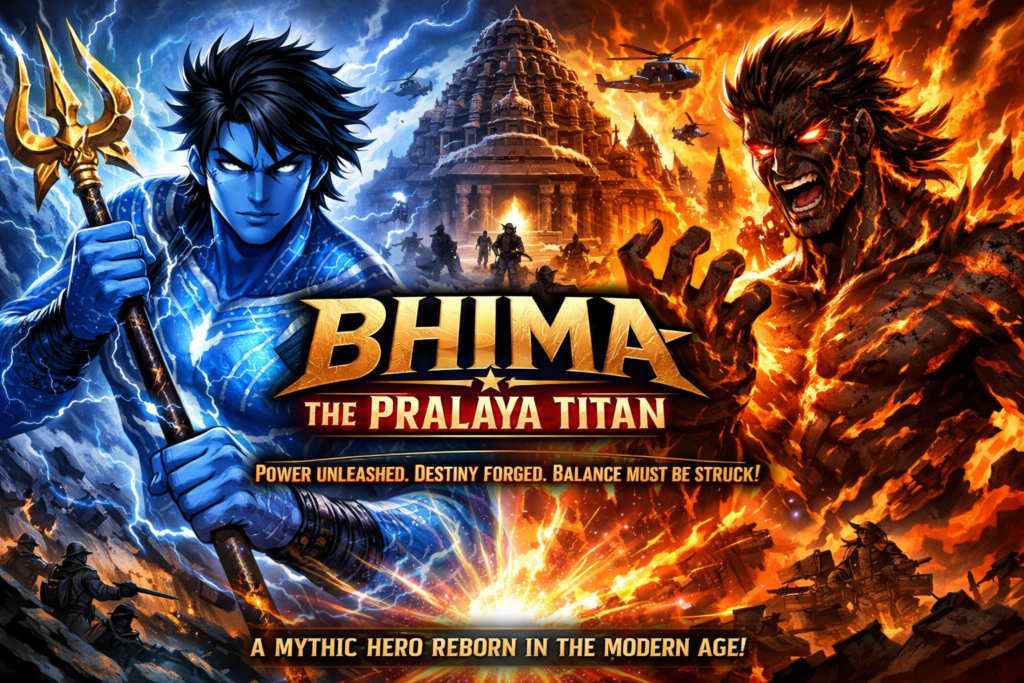
Bhima

Chapter 11: “The Eternal Balance!”

The days following the implosion of the Mahapralaya Astra were marked by an eerie calm that blanketed the region. The once-devastated Kailasa Temple now lay in solemn ruins, its sacred grounds quiet and undisturbed. Bhima Mishra, now fully human yet marked by the ordeal, had retreated to a small, remote village nestled at the foothills of the Himalayas.
The village was a picture of simplicity: terraced fields stretched into the distance, and stone houses dotted the landscape. It was a far cry from the bustling lab Bhima had once called home, but here, he found solace in the mundane. Each day, he worked with the villagers, helping mend fences, haul water, and rebuild homes damaged by the tremors that had rippled outward from the temple.


Despite the tranquility, Bhima’s body carried silent reminders of the battle. His skin, once faintly glowing with the yantras of the Pralaya Shakti, now bore faint scars where the patterns had been. Occasionally, he would glance at them as he worked, his thoughts drifting back to the choices he had made.
“Bhima-ji,” a young villager called out, breaking his reverie. The boy, no more than twelve, bounded toward him with a wide grin. “We need your strength! The waterwheel is stuck again.”
Bhima smiled faintly and nodded, rolling up his sleeves. Though his connection to the Pralaya Shakti had diminished, traces of his superhuman strength lingered. With a single push, he set the waterwheel spinning again, earning cheers from the children gathered around.


At night, however, the quiet weighed heavily on him. Alone in a small hut provided by the villagers, Bhima often sat by the fire, staring into the flames. The flickering light reminded him of the Astra’s energy—raw, unyielding, and infinite. He would trace the faint scars on his arms, feeling the dormant power beneath them, and wonder if he had truly sealed it—or merely postponed its return.
The stillness of the night was occasionally broken by distant thunder, a reminder of the storm that had once raged within him.


One evening, Swami Anant appeared at the entrance of Bhima’s hut, his silhouette framed by the moonlight. The Swami’s presence was calm and grounding, as always. Without a word, he entered and took a seat by the fire.
“You’ve made quite a home here,” the Swami said, his voice warm.
Bhima chuckled softly, shaking his head. “It’s not much, but it’s quiet. That’s all I need right now.”
The Swami studied him for a moment, his gaze thoughtful. “The world is safe for now, thanks to your sacrifice. But the Astra’s energy… it lingers within you, doesn’t it?”


Bhima’s expression darkened, and he nodded. “It’s quiet most of the time. But sometimes… I can feel it. Like a faint pulse, reminding me that it’s still there.”
Swami Anant leaned forward, his voice gentle but firm. “The Astra chose you for a reason, Bhima. Not as a punishment, but as a trust. You are its guardian now—a living seal of balance.”
“Balance,” Bhima echoed, the word heavy with meaning. “It sounds so simple. But living it… it’s exhausting.”
The Swami placed a reassuring hand on Bhima’s shoulder. “Balance is not the absence of chaos, but the mastery of it. You’ve proven that you can carry this burden, Bhima. And you’re not alone in this journey.”


The fire crackled softly as the two men sat in silence, their shared understanding filling the space between them. After a time, Swami Anant rose to leave, his staff tapping softly against the stone floor.
“Rest now, Bhima,” he said, his voice carrying a note of finality. “You’ve earned it. But remember—the dance of creation and destruction never truly ends.”
Bhima watched as the Swami disappeared into the night, his words lingering in the air like a distant echo.
Morning came quietly to the village, with golden sunlight filtering through the mountains and casting long shadows across the terraced fields. Bhima awoke to the distant hum of life: villagers tending to crops, children laughing as they raced along narrow paths, and the soft rush of the nearby stream. It was a world far removed from the chaos he had endured.
Swami Anant, who had stayed the night in a small shrine on the outskirts of the village, approached Bhima as he worked in the fields. Bhima, holding a bundle of firewood, turned to see the Swami standing on the edge of the slope, his robes fluttering in the morning breeze.
“Swami-ji,” Bhima greeted, setting down the firewood. “You’re leaving, aren’t you?”


The Swami smiled faintly, nodding. “My path leads elsewhere now,” he said. “There are others in need of guidance, and the world must always have its keepers of balance.”
Bhima stepped closer, his brow furrowed. “You’ve been my guide through this entire journey. Without you, I don’t know if I’d have found the strength to see it through.”
Swami Anant placed a hand on Bhima’s shoulder, his gaze steady. “You had the strength all along, Bhima. I merely helped you find it. The burden of the Astra, the balance you now guard—those are your responsibilities. And you have proven yourself worthy of them.”


The villagers gathered nearby, watching the exchange with quiet reverence. Though they didn’t fully understand the magnitude of Bhima’s sacrifice, they knew he was someone extraordinary—someone who had saved their world from an unimaginable threat.
As the Swami turned to leave, Bhima followed him to the edge of the village. The two men walked in silence, the mountain path winding through a forest of ancient pines. The air was cool and crisp, carrying with it the faint scent of wildflowers.


At the edge of the forest, where the path descended into a wide valley, the Swami stopped. He turned to Bhima, his expression serious. “Before I leave, there is something you must understand.”
Bhima nodded, waiting.
“The Mahapralaya Astra’s energy is not just a force of destruction—it is a test,” the Swami said. “A reminder that the universe is governed by cycles of creation and dissolution. You are its guardian now, Bhima, and that means you must live as an embodiment of balance.”
“I understand,” Bhima said, his voice steady. “But… what if I fail? What if the energy overwhelms me again?”


Swami Anant’s gaze softened. “The path of balance is not without its struggles. There will be moments of doubt, and times when the burden feels too great. But remember this, Bhima: balance is not a destination—it is a journey. As long as you strive to maintain it, you cannot fail.”
Bhima considered the Swami’s words, a flicker of determination sparking within him.
“I’ll protect it,” he said quietly. “No matter what it takes.”
The Swami nodded, satisfied. “Then you are ready.”


As the Swami began to descend into the valley, Bhima called out after him. “Will I see you again?”
The Swami paused, his figure framed against the morning light. “Perhaps,” he said with a faint smile. “But even if you don’t, you’ll carry my teachings with you. And that is enough.”
Bhima watched as the Swami disappeared into the distance, his heart heavy yet resolute. The quiet of the forest settled around him, and for the first time in days, he felt a sense of clarity.
Far from the quiet village where Bhima had found refuge, the world was slowly piecing itself back together. News of the implosion at the Kailasa Temple had spread, though the truth behind it remained cloaked in mystery. Reports of seismic activity and unexplained energy readings fueled speculation, with scientists, mystics, and conspiracy theorists all vying to explain the event.
The media spoke in hushed tones about the rumors—a supposed “blue giant” that had been sighted near the temple ruins before the final explosion. Witnesses claimed they had seen flashes of light and felt a force so immense it left the earth trembling for miles around. But no definitive proof of the figure remained, only whispers of a savior who had vanished without a trace.


In major cities, news anchors debated endlessly about the implications of the event. Some dismissed it as a natural disaster, while others posited theories about advanced weaponry or divine intervention. But amid the noise, one message stood out: the people of the region, particularly those near the temple, spoke of salvation.
Devotees who had fled the Kailasa Temple during the chaos told stories of a man who had protected them, his body glowing with sacred markings, his strength unmatched. They described him as a guardian sent by Shiva himself to save humanity from destruction.


Bhima watched these reports from a small gathering hall in the village, where an old television had been set up for community use. The grainy footage showed distant images of the ruined temple, its once-majestic structure now reduced to rubble. The villagers around him murmured quietly, their faces solemn.
“They’re calling you a hero,” one of the villagers said, glancing at Bhima.
Bhima shook his head, his expression unreadable. “They don’t know the whole story,” he replied.
A young woman, her hands clasped in gratitude, stepped forward. “You saved so many lives,” she said. “Even if they don’t know your name, they’ll remember what you did.”


Bhima remained silent, his thoughts distant. The praise felt hollow to him. He wasn’t sure he deserved it—not when he had seen firsthand the destruction his power had caused. But as he looked around the room, at the faces of the villagers who had welcomed him without question, he felt a flicker of hope.
“Maybe it’s better this way,” he said quietly. “Maybe the world doesn’t need to know.”


Outside the hall, the village had begun to recover in earnest. The tremors from the implosion had left cracks in the walls of homes and damaged the irrigation systems, but the villagers worked tirelessly to rebuild. Bhima joined them every day, using his strength where it was needed most.
Though the physical scars of the event were slowly fading, the emotional impact lingered. People spoke of the fragility of life, of the importance of unity in the face of disaster. In their own way, they were finding balance—a reflection of the lesson Bhima had learned the hard way.


As the sun set over the village one evening, Bhima stood at the edge of the terraced fields, gazing out at the horizon. The world felt quiet now, as though it were holding its breath. The burden of the Mahapralaya Astra still weighed heavily on him, but for the first time, he allowed himself to feel a small measure of pride.
“They don’t need to know who I am,” he thought. “It’s enough that they’re safe.”
The quiet rhythm of village life provided Bhima the solitude he needed, but the stillness also left him alone with his thoughts. Each day, as he worked alongside the villagers, he wrestled with the echoes of his transformation. His body no longer glowed with the vivid blue hue of the Pralaya Shakti, but faint scars—yantra-like patterns—remained etched into his skin, reminders of the power he had sealed within himself.
One afternoon, as Bhima rested under the shade of a large banyan tree, he felt a faint pulse within him—a sensation like the stir of embers long thought extinguished. Startled, he glanced down at his forearm, where the scars briefly flickered with a faint, golden light before fading once more.


The sensation left him uneasy. Though Swami Anant had assured him the power was contained, Bhima couldn’t shake the feeling that it wasn’t entirely dormant.
“It’s still there,” he muttered to himself. “Waiting.”
The thought unsettled him, not because he feared the power, but because he had glimpsed how easily it could overwhelm him. He remembered the chaos he had unleashed in his Pralaya form—the lives endangered, the temples scarred by his rage. Could he truly keep it under control if it resurfaced?


Later that evening, Bhima sat by the village stream, the cool water flowing gently over smooth stones. He gazed into the rippling surface, watching his reflection distort and shift with the current. For a fleeting moment, he thought he saw a flash of his Pralaya form staring back at him—a towering figure with glowing markings and blazing eyes.
He blinked, and the image was gone.
“You’re letting it get to you,” he muttered, splashing water on his face. But the question lingered in his mind: was the Pralaya Shakti truly at rest, or was it merely biding its time?


That night, as Bhima meditated in the solitude of his hut, he recalled Swami Anant’s words: “Balance is not the absence of chaos, but the mastery of it.”
Closing his eyes, he focused on his breathing, grounding himself in the present moment. Slowly, he let his thoughts drift to the cycle of creation and destruction—a cycle he now embodied. The faint pulse of the Astra’s energy stirred again, but this time, Bhima didn’t resist it.
Instead, he acknowledged it, letting the sensation flow through him like the river outside. It was not rage, not fear—it was simply power, a force that existed without judgment or intention.


As dawn broke, Bhima stepped outside to greet the new day. The villagers were already awake, tending to their chores and preparing for the day’s work. Bhima joined them, his heart lighter than it had been in weeks.
Though the pulse of the Pralaya Shakti remained, it no longer felt like a threat. Instead, it felt like a quiet reminder—a spark of potential, waiting for the right moment to ignite.


Later, as Bhima helped repair a damaged irrigation canal, one of the villagers approached him.
“Bhima-ji,” the man said hesitantly, “the children say you’re a hero. They think you’re someone sent by Lord Shiva himself.”
Bhima smiled faintly, shaking his head. “I’m just a man,” he said simply. “Doing what I can.”
The villager nodded, satisfied with the answer, and returned to his work. Bhima, however, stood for a moment longer, gazing at his hands.
The day had been uneventful, and Bhima found himself enjoying the simplicity of village life. He was repairing the roof of a small grain store when a figure appeared at the edge of the village—a silhouette unfamiliar yet oddly haunting.
The villagers stopped and whispered among themselves, their work momentarily forgotten. Bhima, perched atop the roof, squinted against the setting sun to make out the figure. As the stranger drew closer, the light revealed a familiar face: Dr. Rakesh Verma, a colleague from Bhima’s former lab.
Bhima’s grip on the wooden beam tightened. His past had finally caught up with him.


Dr. Verma stood at the base of the grain store, his expression a mix of relief and urgency. “Bhima,” he called out, his voice trembling slightly. “It’s really you.”
Climbing down, Bhima approached cautiously. “What are you doing here, Rakesh?” he asked, his tone guarded.
Verma glanced around nervously before speaking. “I’ve been looking for you ever since… since the incident at the lab. There’s something you need to know.”


The two men moved to a quieter corner of the village, away from prying eyes. Bhima leaned against a tree, arms crossed, as Verma began to speak.
“There are remnants of the Sons of Rudra still active,” Verma said in a low voice. “They’ve gone underground, but they’re regrouping. They believe Rudrasena’s vision can still be realized—and they think you’re the key.”
Bhima’s eyes narrowed. “Me? Why?”
“Because of what you are—what you became,” Verma replied. “Even after Rudrasena’s defeat, they see you as the perfect vessel for the Mahapralaya Astra. They think the power you sealed inside yourself can be used to finish what Rudrasena started.”


Bhima’s jaw tightened. The thought of the Sons of Rudra using him to reignite their destructive plans was chilling. He had sacrificed so much to stop Rudrasena, and now the shadow of the cult loomed once more.
“Do they know where I am?” Bhima asked, his voice steady but laced with tension.
Verma shook his head. “Not yet. But they’re searching. I came to warn you before they could find you.”
Bhima turned away, his thoughts racing. He had hoped his fight was over, that his sacrifice at the Kailasa Temple had brought lasting peace. But the specter of his past refused to let him rest.


“Why now?” Bhima asked finally. “Why come to me after all this time?”
Verma hesitated, then reached into his bag, pulling out a small device. A holographic image flickered to life, displaying a series of maps and data streams.
“This,” Verma said, pointing to a glowing marker on the map, “is an energy signature we detected near the ruins of the Kailasa Temple. It’s identical to the pulse emitted by the Mahapralaya Astra during its activation.”
Bhima’s heart sank. The Astra’s energy had not been fully contained.


“They’re planning something,” Verma continued. “I don’t know what, but it’s big. And they’ll stop at nothing to get to you.”
Bhima remained silent, his mind weighing the gravity of the situation. His scars itched faintly, as though the Pralaya Shakti within him were responding to the news.
“What do you want me to do?” Bhima asked at last.
“Help us stop them,” Verma said, his voice almost pleading. “You’re the only one who understands their power—the only one who can match it.”


Bhima looked out at the horizon, the sun casting long shadows across the valley. For a moment, he considered refusing. He had found peace here, a quiet life far removed from the chaos of his past. But the flicker of energy within him—the faint glow of the yantras—reminded him of his responsibility.
“Fine,” he said finally. “But if I do this, we do it my way.”
Verma nodded, relief flooding his face. “Anything you need.”
The evening settled over the village in a soft embrace of twilight, but Bhima’s mind churned with unease. Verma’s revelation about the Sons of Rudra stirred the embers of his vigilance, and though the villagers went about their lives, blissfully unaware of the looming threat, Bhima felt the weight of responsibility creeping back into his soul.
He spent the night meditating by the village stream, seeking the stillness Swami Anant had taught him. The soft murmurs of the water soothed his thoughts, but his body betrayed him. His scars glimmered faintly under the moonlight, a subtle reminder that the Pralaya Shakti was never truly gone.


Bhima’s meditation was interrupted by a commotion in the village. The distant cries of alarm sent him sprinting toward the source, his instincts sharp. When he arrived, he found the villagers gathered in a circle, their lanterns illuminating a terrifying scene.
A pack of wild animals—large, feral, and unnaturally aggressive—was tearing through the livestock pens. The villagers, armed only with farming tools, stood no chance against the frenzy of claws and fangs.
“Bhima-ji!” an elder called out, her voice trembling. “Please, help us!”


Without hesitation, Bhima stepped forward. He picked up a sturdy wooden staff and moved to intercept the pack. As the animals snarled and lunged at him, Bhima’s instincts took over.
With a fluid grace, he parried the first attack, striking the beast with enough force to knock it aside without killing it. His strength, though diminished, was still far beyond human. The villagers watched in awe as he faced the pack alone, his movements precise and deliberate.
But as the battle raged on, Bhima felt the stir of something deeper. His body thrummed with energy, the scars on his forearms glowing faintly as his emotions surged.


One of the larger beasts—a massive wolf with glowing red eyes—charged at Bhima, snapping its jaws inches from his face. Instinctively, Bhima’s grip on the staff tightened, and he swung it with devastating force. The impact sent the wolf sprawling, but the glow on his arms intensified, spreading in intricate yantra patterns.
The villagers gasped, their lanterns casting eerie shadows over Bhima’s glowing form. For a moment, he felt the familiar pull of the Pralaya Shakti, the raw power that threatened to consume him whenever he let his emotions take hold.
“Not now,” Bhima muttered, his voice strained. He forced himself to breathe deeply, grounding his focus in the present.


The pack, sensing the shift in Bhima’s presence, began to retreat. The villagers cautiously stepped forward, whispering prayers of gratitude as the beasts disappeared into the night. Bhima, still gripping the staff, lowered it slowly, his breathing heavy.
“Are you all right, Bhima-ji?” a young man asked, his voice filled with concern.
Bhima nodded, though his expression was distant. The glow on his arms had faded, but the sensation of the Shakti lingered, like a fire smoldering beneath his skin.
“I’m fine,” he said, though the words felt hollow.


As the villagers dispersed to repair the damage, Bhima remained by the pens, staring at his hands. The staff he had wielded bore deep scorch marks, the wood blackened as though touched by flames.
“Even now,” he murmured to himself, “it’s still there.”
The encounter left him shaken. He had managed to protect the villagers without fully transforming, but the close call reminded him how precarious his control truly was. The power he carried was both a gift and a curse, and it would not let him forget it.


Later that night, as he sat by the dying embers of a fire, Bhima reflected on the encounter. He realized that the Pralaya Shakti was not something he could simply suppress or ignore. It was a part of him now, as much as his strength, his scars, and his memories.
“If I’m going to face the Sons of Rudra,” he thought, “I have to accept it. All of it.”
The first light of dawn bathed the village in a gentle glow, chasing away the shadows of the night. Bhima stood at the edge of the terraced fields, the cool morning breeze stirring his hair. He closed his eyes, letting the sounds of the waking world fill his senses—the rustling of leaves, the distant calls of birds, the soft murmurs of villagers beginning their day.
For the first time since the battle at the Kailasa Temple, Bhima felt a sense of clarity. The weight of his choices, his power, and his past no longer felt like a burden to bear but a truth to embrace. The Pralaya Shakti, though dormant, pulsed faintly within him like the beat of a distant drum. It was not an enemy to fight but a part of the greater dance—Shiva’s Tandava, the eternal cycle of creation and destruction.


As he walked back toward the village, a young boy ran up to him, holding a small garland of marigolds. “For you, Bhima-ji,” the boy said, his face alight with admiration.
Bhima crouched to accept the garland, placing it gently around his neck. “Thank you,” he said with a soft smile. The boy beamed and ran off, leaving Bhima to reflect on how much the villagers had come to trust him.
Their faith humbled him. He had once viewed his powers as a curse, a source of fear and chaos. But now, he understood that they were tools—tools that could harm or heal, depending on how he chose to wield them.


In the days that followed, Bhima helped the villagers rebuild their homes and mend their fields. He worked alongside them without complaint, finding solace in the simplicity of their lives. Though the scars on his arms remained hidden beneath his sleeves, the faint glow would sometimes reappear, a reminder that his connection to the Shakti was still alive.
At night, he meditated by the stream, drawing strength from the stillness. Each breath grounded him, anchoring him in the present while allowing him to reflect on the past. He thought of Swami Anant’s teachings, of Rudrasena’s twisted vision, and of the power he had sealed at such great cost.


One evening, as he sat beneath the banyan tree, a vision came to him—not of destruction, but of balance. He saw the Tandava, Shiva’s cosmic dance, unfolding before him in a tapestry of light and shadow. The cycle of creation and destruction was not a battle but a harmony, each step of the dance flowing seamlessly into the next.
Bhima opened his eyes, his heart steady. He understood now. The dance was not about control or resistance—it was about trust, surrender, and the courage to move with the rhythm of the universe.


The next morning, Verma approached him, his expression cautious but hopeful. “The Sons of Rudra… they’re still out there,” he said. “We might need your help to stop them.”
Bhima met his gaze, his voice calm yet resolute. “If they rise again, I’ll be ready.”
Verma hesitated, then nodded. “You’ve changed, Bhima,” he said. “You seem… at peace.”
Bhima smiled faintly. “Peace isn’t the absence of struggle, Rakesh. It’s knowing how to face it.”


As the sun rose higher, Bhima stood at the edge of the village, watching the horizon. He knew his journey was far from over. The balance he had fought to protect would always be tested, just as his own strength and resolve would be. But for now, he allowed himself a moment of stillness—a moment to honor the lives he had saved and the lessons he had learned.
As Bhima gazed at the sky, the camera panned to his forearm, where the faintest trace of yantra patterns glowed briefly before fading once more. A soft whisper carried on the wind, as though the universe itself spoke:
“The dance never ends.”
“Balance is not found in what we destroy… but in what we choose to save.”

0

Subtotal