
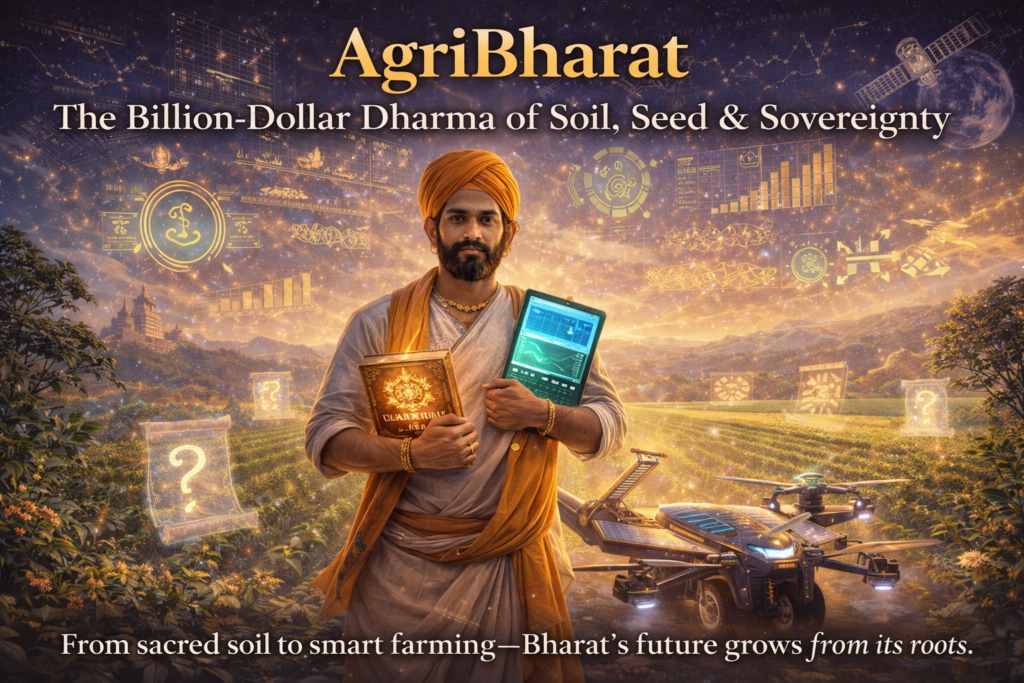
🪔 Opening Quote:
“Kr̥ṣir eva śreyasī – Agriculture alone is supreme.”
— Ancient Sanskrit Proverb
🌾 The Beginning Beneath Our Feet
Before there were kings, there were cultivators.
Before palaces touched the skies, hands tilled the soil.
Bharat’s foundation wasn’t laid with stone — it was seeded in earth.
Imagine a time before the Mauryas, before the Mughals, before even the concept of India as a nation. What existed was Bharat, a land humming with abundance, not because of gold or conquest — but because of Krishi: agriculture.
Long before modern economics, Bharatiya Rishis and grihasthas understood the interconnectedness of soil, soul, and sustenance. Farming was never merely about food — it was about Dharma, Rashtra, and Roti.
🕉️ Agriculture in the Vedas – Sacred, Not Separate
In the Rigveda, hymns are dedicated to the Earth (Prithvi), Rain (Parjanya), and Plough (Langala).
“May the plough furrow well, may the rains fall in time, may our crops grow in golden grains.” — Rigveda 10.101
The land was divine. Ploughing was a sacred act. Harvest festivals were not cultural events — they were rituals of gratitude.
The Atharvaveda speaks of land as the Mother, to be kissed, nurtured, and never exploited. Unlike extractive economies of the West, Bharat’s ancient agricultural ethos was regenerative — you took only what you needed, and you gave back with compost, love, and mantra.
🌿 The First Entrepreneurs: The Indian Farmer
Forget Wall Street.
The original startup founder of this land was the Kisan — the annadata.
Even during the Harappan civilization, there is archaeological evidence of irrigation, storage systems, crop rotation, and seasonal planning. Farming wasn’t a fallback job. It was the most intelligent, spiritually aligned, and community-centered pursuit.
A single family’s land would feed not just themselves, but the whole village.
This was not profit — this was prosperity.
Villages were self-sufficient, currency-light, and ecosystem-balanced.
The farmer was not alone — he was backed by nature, community, and Dharma.
📜 Soil as Sovereignty
The land was more than livelihood — it was identity.
To own land was to be sovereign, not subjugated.
Our ancestors believed:
“He who controls food, controls the future.”
So land was never for sale. It was passed down as a living legacy, not a commercial asset.
Rajas and rulers were judged not by gold, but by grain reserves — how many mouths they could feed in famine, how well they protected farmers during drought.
In fact, most Indian rulers — from Ashoka to the Cholas — invested heavily in agricultural infrastructure: tanks, canals, rainwater catchments. Temples were granaries. Monks were agronomists.
📈 Agricultural Science Before Its Time
- Crop rotation was practiced long before it had a name.
- Water harvesting was engineered with astonishing precision (check: Rajasthan’s Johads, Tamil Nadu’s Eris).
- Indigenous seeds were regionally adapted — evolved over centuries for climate, taste, and health.
Each region had its own agro-cultural wisdom:
- Punjab: Wheat, mustard, and dairy co-dependence
- Tamil Nadu: Mixed cropping and Siddha herbal knowledge
- Odisha & Bengal: Rice paddies with aquatic biodiversity
- North-East: Jhum farming integrated with forest life
These weren’t “backward” methods — they were climate-aligned, zero-waste systems that the West is now trying to reverse-engineer under the name “permaculture.”
🧘♂️ Farming Was a Spiritual Path
To be a farmer wasn’t “low status.”
In fact, it was the highest integration of karma, seva, and shraddha.
- You worked with nature, not against it.
- You lived by seasons, not clocks.
- You produced food, not just for yourself — but for your village, your deities, your guests, and your animals.
Agriculture was not just business.
It was Bharat’s original yoga — the union of earth and effort.
📊 What the Numbers Don’t Show
Historians often measure greatness by empires and wars.
But the real strength of Bharat lay in its 500,000+ decentralized villages — each one a hub of knowledge, nutrition, and non-violence.
- No central banking. Yet no starvation.
- No export dependency. Yet surplus grains.
- No UN reports. Yet the planet’s healthiest diets and longest-living elders.
We weren’t “underdeveloped.”
We were over-self-reliant.
🧠 Sow This Thought (Takeaway):
Before we reclaim our land, we must reclaim our respect for the land.
“Agriculture is not man’s conquest over nature. It is man’s collaboration with her.”
To build Bharat’s future, we must remember this:
📍 We are not tech-first. We are soil-first.
✍️ Chapter Summary (2 lines):
This chapter traces Bharat’s ancient agricultural roots — from Vedic wisdom to village economies — showing how farming was central to identity, economy, and ecology.
It argues that the soul of Bharat was seeded in its soil — long before it was mapped as a nation.
🪩 Suggested Highlight Quote:
“Bharat was not built by kings or corporations. It was built by farmers — one season, one seed, one sacred harvest at a time.”
Continue Reading