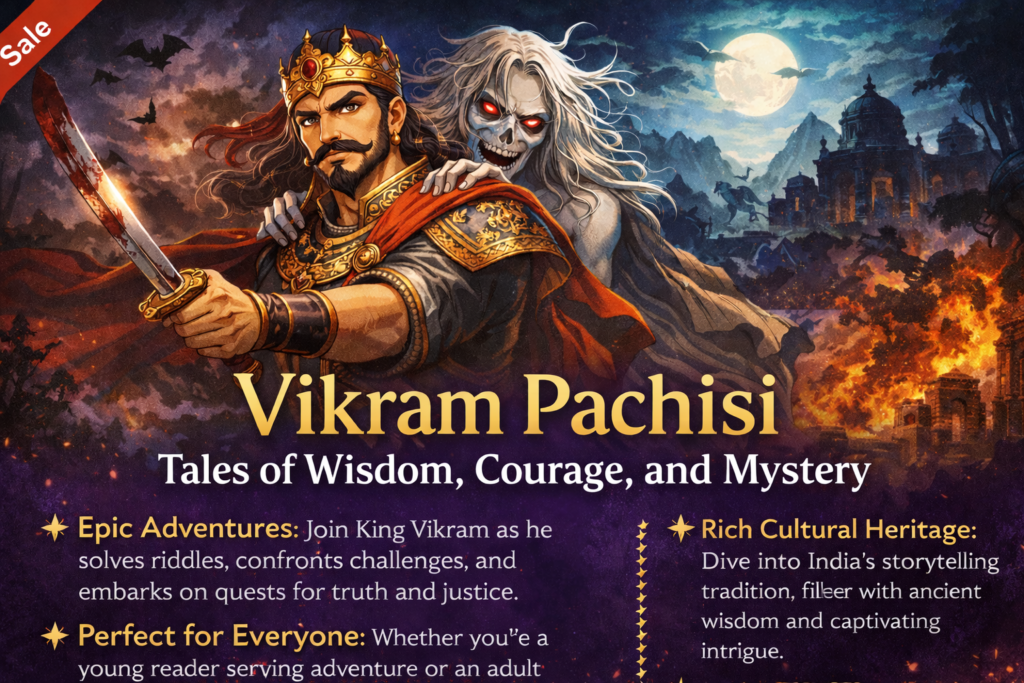
King Vikramaditya, determined to ful ll his promise, carefully approached the Peepal tree.
As before, he brought down the corpse of Betal, placed it on his shoulders, and began
walking toward the sage’s hermitage. On the way, Betal began telling him another story.
The Reign of King Jimat Vahan
Long ago, in the region of Himachal Pradesh, there ruled a peace-loving and devout king
named Jimat Vahan. He was known for his wisdom and fairness. However, his only son, Agni
Vahan, was of a completely opposite nature—cruel, sel sh, and oppressive.
One day, while the king was presiding over his court, Agni Vahan boldly entered and
declared, “Father, I want to sit on the throne. Make me the king.”
The court fell silent, shocked by Agni Vahan’s audacity. Though hurt, King Jimat Vahan loved
his son deeply. After much contemplation, the king decided to relinquish the throne to his
son, announcing his departure to the forest to undertake penance. He hoped that his
sacri ce would bring peace and stability to his people.
Agni Vahan’s Tyranny
As soon as Agni Vahan ascended the throne, he began to exploit his power. His rule was
marked by widespread cruelty and oppression. The people of the kingdom su ered greatly
under his tyranny, cursing the day he became their king
Meanwhile, King Jimat Vahan was deep in penance in a forest, unaware of the full extent of
his son’s misdeeds.
The Woman’s Plea
One evening, while King Jimat Vahan was meditating in the forest, a distraught woman
approached him, crying bitterly. “Maharaj,” she said, “I have only one son, and a demon has
threatened to devour him tonight. Yesterday, the demon came to my home and told me to
prepare my son to be his meal. I cannot let my child die. Please, help me!”
Moved by her plight, King Jimat Vahan made a bold decision. “Do not fear,” he said to the
woman. “When the demon comes, tell him that I am your son.”
Though reluctant, the woman nally agreed to the king’s plan. That night, when the demon
arrived at her house, King Jimat Vahan presented himself as the woman’s son. Without
hesitation, the demon devoured the disguised king, sparing the woman’s real son.
Betal’s Question
After narrating the story, Betal posed a question to King Vikramaditya: “What do you think of
King Jimat Vahan’s sacri ce? Was it an act of sel essness or sel shness? If you do not
answer, your head will shatter into pieces.”
King Vikramaditya’s Answer
After a moment of silence, King Vikramaditya replied, “King Jimat Vahan’s sacri ce cannot be
considered wholly sel ess. While it may seem noble to sacri ce his life to save the woman’s
son, his actions stemmed from a desire for personal salvation rather than a sense of duty
toward his kingdom.
“He abandoned his throne to a cruel son, knowing full well that Agni Vahan was un t to rule.
This decision brought great su ering to his people. Instead of protecting his subjects, which
was his primary duty as a king, he sought to free himself from worldly responsibilities. By
sacri cing himself to the demon, he avoided facing the consequences of his poor judgment.”
Betal’s Response
Betal was silent for a moment, then said, “You have given the right answer, Vikram. You are
indeed a wise and just king. However, because you have spoken, I must return to the Peepal
tree.”
Saying this, Betal ew o Vikramaditya’s shoulder and vanished into the darkness. Unfazed,
King Vikramaditya tightened his grip on his sword and began chasing Betal once more,
determined to bring him back to the sage’s hermitage