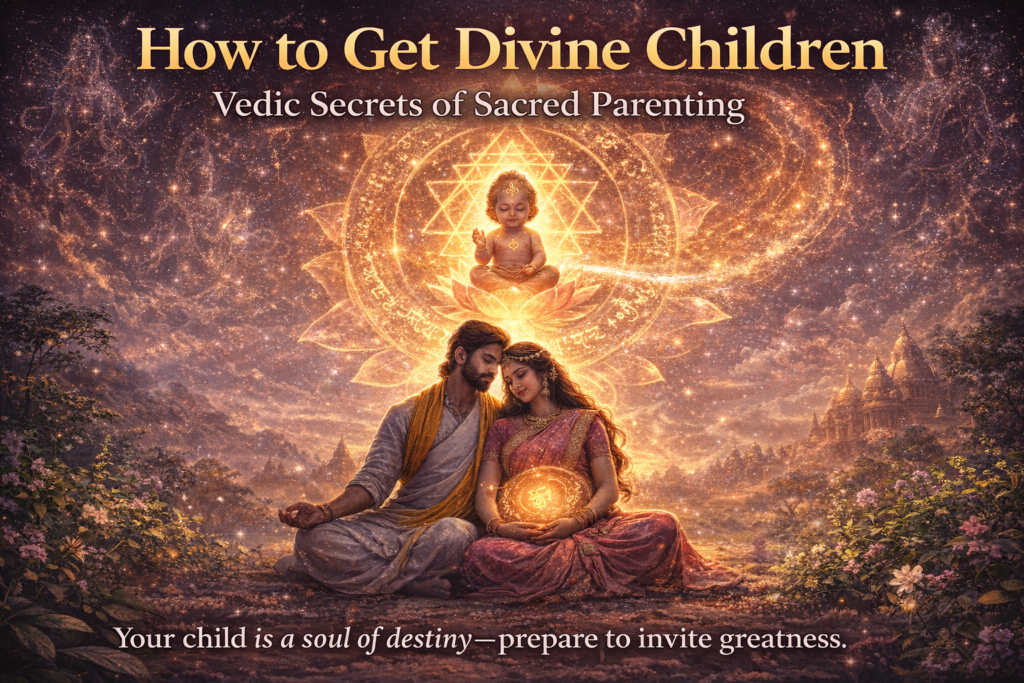
Why was Rama born? Was he simply a child of chance, or was his birth the result of divine intention? The Ramayana makes this clear. Rama was not an accident. He was born because his father, King Dasharatha, understood a great truth of Sanatan Dharma: divine children must be invoked, not left to chance.
Dasharatha was a powerful king, but he carried one deep sorrow—he had no heir. Without a son, the kingdom would fall into chaos. Without a dharmic successor, Ayodhya’s stability was at risk. But instead of surrendering to fate, Dasharatha turned to the path of dharma. He performed the Putrakameshti Yajna, a sacred fire ritual to invite the birth of children blessed by the gods.
The yajna was not casual. It was not done for pleasure or luxury. It was performed with discipline, with sacred intention, and with the guidance of sages. From the fire of that yajna emerged the divine payasam, the sacred offering, which was given to his queens. And from that act of sacred preparation came Rama, Lakshmana, Bharata, and Shatrughna—the four brothers who would carry forward the lineage and embody dharma.
This story reveals something crucial: divine children are born when parents take responsibility, when they act with purity, and when they invite divinity into their home. Rama’s birth was not biology alone. It was the meeting of tapas, ritual, prayer, and divine grace.
Sanatan Dharma has always taught this principle. If parents want dharmic children, they must prepare. They must sanctify their minds, their bodies, their food, their actions. They must call upon divinity with sincerity, for the soul that enters the womb is drawn by the vibration of the parents. This is the essence of Garbh Sanskar.
Contrast this with today. How many children are born through prayer? How many through ritual, fasting, or meditation? For most, childbirth is accidental, without vision, without preparation, without sacredness. And then we ask why we do not see another Rama. Why do we not see rulers of dharma? Why are societies collapsing under corruption? The answer is simple. Without sacred intention, there can be no sacred birth.
Rama’s birth through Putrakameshti Yajna shows us that families have power. They can choose to bring forth ordinary children, or they can choose to invoke protectors of dharma. They can raise bodies, or they can raise destiny.
Krishna said: “If you call me, I will come.” Dasharatha called, and Rama came. The principle has not changed. If today’s families call with the same discipline, with the same devotion, divine children will return. If not, society will remain under weak and corrupt rulers.
The Ramayana is not just a story. It is a manual. It shows us the way back to strength, to purity, to dharma. The question is: will we revive it? Or will we let our wombs and our homes remain empty of dharma?
The choice is yours. Divine children are not waiting in the future. They are waiting for you to call them.
If this message changed the way you see the future, type in the comments: Jai Shree Krishna.
Support this mission of reviving Sanatan Dharma. Donate at least 21 dollars through the link in the description and bio. Purchase the ebooks listed below to strengthen your own understanding and help spread this wisdom.
Subscribe to this channel, and share this video with your family and friends. Let the story of Rama’s birth remind every Hindu couple that the power to shape the future lies in their hands.