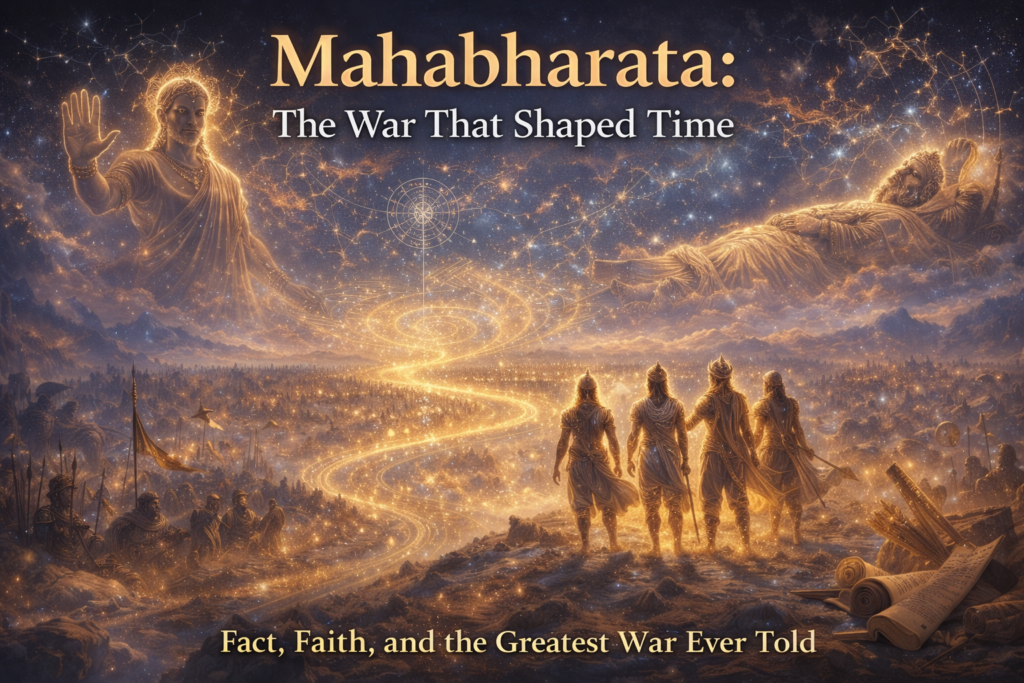
mahabharata

Episode 18 – The Eternal Legacy of the Mahabharata: Lessons for All Ages

The Mahabharata is more than an epic. It is more than war, more than lineage, more than kings and kingdoms. It is the story of humanity itself — our flaws, our virtues, our struggles, our victories, our falls, and our eternal quest for dharma. From the banks of the Ganga to the peaks of the Himalayas, from the dice hall of Hastinapura to the battlefield of Kurukshetra, it tells us not of gods alone, nor of demons alone, but of men and women who carried both within them.

When the Pandavas ascended the Himalayas and Yudhishthira entered heaven alive, the story did not end. For the Mahabharata is not bound to a single age. It is the voice of truth that echoes across all ages. Vyasa, the sage who composed it, said, “What is found here may be found elsewhere, but what is not found here cannot be found anywhere.” Such is its vastness.

Let us remember its pillars.

Bhishma, who gave his life to a vow, who upheld the throne at the cost of his soul, who fell not in shame but as a teacher upon a bed of arrows, reminding us that even in suffering we can give wisdom.

Drona, master of weapons, whose brilliance was chained to loyalty, who shows us that knowledge without compassion becomes dangerous.

Karna, son of the Sun, rejected by fate, loyal beyond reason, brilliant yet cursed, who teaches us that greatness can burn even when crushed by destiny.

Arjuna, whose despair gave birth to the Bhagavad Gita, who shows us that doubt is not sin, but that surrender to truth transforms despair into strength.

Bhima, whose fury defended justice, whose vows shook the heavens, who shows us that strength, when bound to dharma, becomes divine.

Draupadi, fire-born, who endured humiliation yet never lost dignity, whose faith in Krishna protected her, whose fire ignited Kurukshetra itself, who shows us that women are not ornaments of dharma, but pillars of it.

Krishna, the eternal charioteer, the guide, the friend, the God in human form, who reveals that behind all battles of life lies a deeper war between truth and illusion, and that devotion to dharma is the highest weapon.

And Yudhishthira, Dharmaraja, who bore doubt, who bore guilt, who bore the heaviest crown, who shows us that true leadership is not about power, but about service, humility, and endurance.

Each figure is more than history. They are mirrors of our own souls. Bhishma is our vow, sometimes noble, sometimes blinding. Drona is our knowledge, sometimes guided, sometimes misused. Karna is our struggle with rejection, our pride, our loyalty. Arjuna is our doubt, our despair, our awakening. Bhima is our strength and anger. Draupadi is our dignity, our fire. Krishna is our conscience, whispering truth. Yudhishthira is our responsibility, our burden of choice.

And what of the war itself? The Mahabharata does not glorify it. Kurukshetra is not painted as triumph, but as tragedy. It shows us that adharma, when left unchecked, grows until it must be burned away. It shows us that victory comes with a price, that dharma demands sacrifice, that even the righteous bleed. It teaches us that war may restore balance, but peace must be built afterward with wisdom and compassion.

At its heart lies the Bhagavad Gita, where Krishna speaks not only to Arjuna, but to us. He tells us that the soul is eternal, that duty is sacred, that action must be done without attachment, that devotion is the highest path. These truths are not bound to Kurukshetra. They are bound to our lives.

For we too stand on battlefields — not of chariots and arrows, but of decisions and duties, of fears and temptations. We too look upon challenges and say, “I cannot fight.” We too hear Krishna’s voice in our conscience, saying, “Stand up. Do your duty. Fight for truth.” The Mahabharata tells us that dharma is not in temples alone, nor in rituals alone, but in every choice we make, every action we take, every word we speak.

It reminds us that silence in the face of injustice is complicity, as when Bhishma and Drona sat silent in the dice hall. It reminds us that pride blinds us, as in Duryodhana’s fall. It reminds us that vows can uplift or destroy, as in Bhishma’s life. It reminds us that faith saves us, as in Draupadi’s prayer. It reminds us that devotion transforms us, as in Arjuna’s surrender. It reminds us that compassion is greater than conquest, as in Yudhishthira’s reign.

The Mahabharata is not just story. It is instruction. It is warning. It is inspiration. It tells us that life is Kurukshetra, that each of us must fight our own battles, that the true war is not only against others, but against ourselves — our pride, our greed, our envy, our fear.

As the Pandavas climbed the Himalayas, leaving behind crown and kingdom, they showed us the ultimate truth: all things fade. Wealth, power, beauty, skill, strength — all are left behind. The only companion that walks with us beyond death is dharma. This is the eternal lesson: cling not to what perishes, but to what is eternal.

This is why Vyasa called the Mahabharata “Itihasa” — not just history, but truth that lives. It is not the story of then. It is the story of now. It is not the war of Hastinapura alone. It is the war of the human heart.

So when you face betrayal, remember Draupadi. When you face rejection, remember Karna. When you face despair, remember Arjuna. When you face pride, remember Duryodhana. When you face responsibility, remember Yudhishthira. When you face suffering, remember Bhishma. And in every moment, listen for Krishna, who speaks still: “Do your duty. Fight for truth. Offer all to me.”

This is the eternal legacy of the Mahabharata. Not the victory of the Pandavas, not the defeat of the Kauravas, but the awakening of the human soul to dharma.

If this story moved you, if it reminded you that greatness lies in choice, not birth, support this journey of dharma with a symbolic donation of eleven dollars. support this journey of dharma with a symbolic donation of eleven dollars. And unlock Dharma Vault, claim it through the link in the description.

0

Subtotal