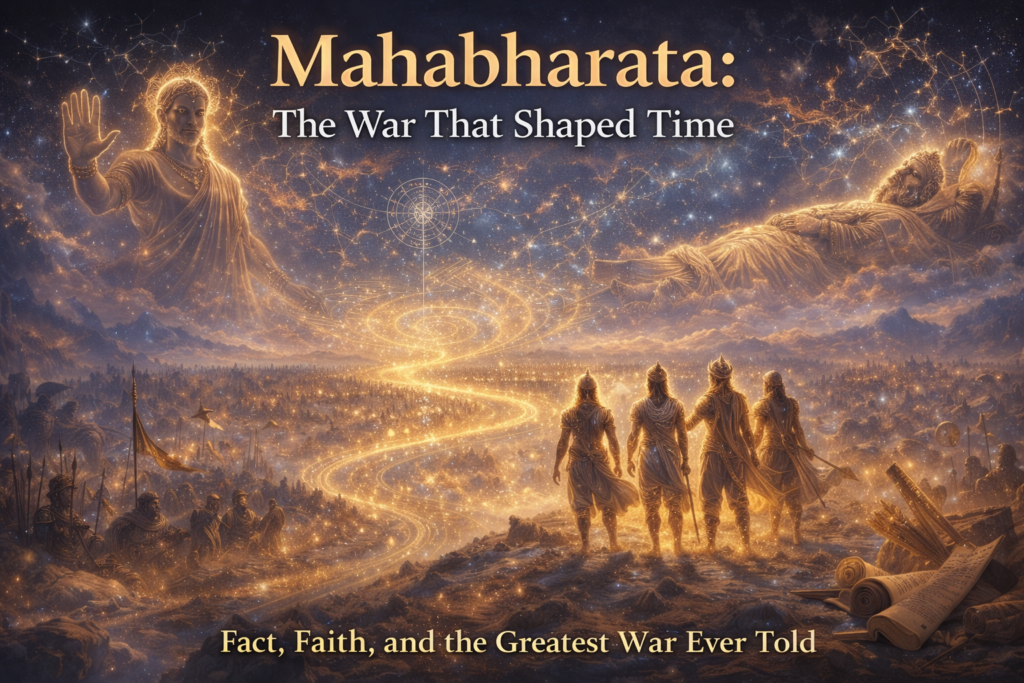
Years passed after Kurukshetra. Yudhishthira ruled Hastinapura as Dharmaraja, the king of righteousness. The land prospered, the people thrived, peace returned to Bharat. The scars of war began to heal, though never forgotten. The Pandavas, once princes, then exiles, then warriors, now ruled as kings. Their reign was long, their fame unmatched. Yet time spares no one, not even those chosen by destiny.
At last, a moment came when Yudhishthira knew their earthly duty was finished. Their kingdom was secure, their line preserved through Parikshit, grandson of Arjuna, born of Abhimanyu and Uttara. The throne would endure, dharma would stand. For the Pandavas, only one path remained — the final journey, the ascent to heaven.
Yudhishthira gathered his brothers and Draupadi. “It is time,” he said. “We have ruled, we have fought, we have upheld dharma as best we could. Now let us renounce throne and crown, palace and pleasure, and walk toward the Himalayas, the gateway to eternity. Let us leave as warriors, but also as seekers, bearing nothing but truth.”
Bhima’s heart roared, yet even he bowed. “If you lead, elder brother, I will follow.” Arjuna lowered his bow Gandiva for the last time, laying it aside with reverence. Nakula and Sahadeva, ever loyal, smiled with tears. Draupadi, fire-born, placed her crown upon the ground and said, “Where you go, I go.”
So the Pandavas, once lords of earth, became wanderers once more. Clad in simple robes, barefoot, they walked away from Hastinapura. No gold, no armies, no chariots accompanied them. Only silence, only faith, only the call of the mountains. The people wept as they left, begging them to stay, but Yudhishthira spoke gently: “A kingdom is not ours forever. It belongs to dharma. We have served. Now let the next serve. Do not grieve. We walk to the home of truth.”
With each step northward, their burdens fell away. They passed villages, forests, rivers, until the snow-capped peaks rose before them, shining like heaven’s gate. The Himalayas, eternal and unyielding, awaited them.
But destiny tests even at the end. As they walked, one by one, the Pandavas and Draupadi fell. Draupadi was the first. Her body stumbled, her spirit soared. Bhima, anguished, cried, “Why, brother, has she fallen? She was our queen, our fire, our guide.” Yudhishthira, steady, replied, “Though great, she loved Arjuna more than the rest. Partiality is weakness. That is why she fell.”
They walked on. Next, Sahadeva collapsed. “Why has he fallen?” Bhima asked again. “Because he was proud of his wisdom,” Yudhishthira said. “Pride, even in knowledge, brings downfall.”
Soon after, Nakula fell. “Why him, O brother?” Bhima wept. Yudhishthira answered, “Because he was proud of his beauty. Pride blinds even the virtuous.”
Then Arjuna faltered, Gandiva’s echo silenced forever. Bhima’s heart broke. “Why Arjuna, the greatest warrior, beloved of Krishna?” Yudhishthira said, “Because he was proud of his skill, and he boasted he could destroy all foes in a single day. Pride dragged him too.”
Bhima and Yudhishthira walked on, but soon Bhima, mighty as a mountain, stumbled. “Why me, brother?” he gasped. Yudhishthira’s eyes softened. “Because you were proud of your strength, O Bhima, and because you ate more than you gave. Pride in the body is no less a chain.”
At last, only Yudhishthira remained, walking alone, his face serene. Beside him padded a dog, faithful and silent, who had followed from the start. Together they climbed, step by step, higher into snow, higher into silence, higher into eternity.
At the gate of heaven itself, Indra appeared in his chariot. “Come, Yudhishthira,” he said. “You are the one without stain. Enter heaven in this body, for you are worthy.”
Yudhishthira bowed. “I will not enter without my brothers and Draupadi.” Indra said, “They are already here, purified of their flaws. Their souls wait within. Come.”
But Yudhishthira pointed to the dog. “What of this creature who has walked with me in loyalty? I will not abandon him. To abandon one who trusts me is adharma.” Indra tested him: “This is but a dog. Heaven is no place for such.”
Yudhishthira’s voice was firm. “If heaven means betrayal of loyalty, then I want no heaven. Dharma is not crowns and thrones. Dharma is truth, loyalty, compassion. If I must choose, I will stay with this dog.”
At that moment, the dog transformed into Dharma himself, Yudhishthira’s divine father, god of righteousness. Smiling, he said, “You have passed the final test. You abandoned wealth, pride, even family, but you did not abandon dharma. That is why you alone enter heaven alive.”
So Yudhishthira entered heaven, not as warrior, not as king, but as dharma embodied. His brothers and Draupadi, purified of pride and flaw, awaited him there. The cycle of war and sorrow ended. The Pandavas, who walked through exile, fire, battle, and rule, walked at last into eternity.
The ascent of the Pandavas teaches us that victory is not the end, kingship is not the goal, wealth is not the prize. All are left behind. What endures is dharma. What endures is loyalty, truth, compassion. Pride falls, strength fades, skill dies, beauty withers, wisdom humbles — but dharma walks with you until the gates of heaven.
In our own lives, we too climb our Himalayas. Each step strips us of pride, wealth, attachment. In the end, we leave all. The only question is: will we walk with dharma, as Yudhishthira did, or will we fall before reaching the gate?
Remember the Pandavas’ last journey. Remember Draupadi’s fire, Arjuna’s skill, Bhima’s strength, Nakula’s beauty, Sahadeva’s wisdom — all noble, yet all bound by pride. Remember Yudhishthira, who walked alone but walked true. And remember the dog, symbol of loyalty, symbol of dharma, never to be abandoned.
If this story moved you, if it reminded you that greatness lies in choice, not birth, support this journey of dharma with a symbolic donation of eleven dollars. support this journey of dharma with a symbolic donation of eleven dollars. And unlock Dharma Vault, claim it through the link in the description.