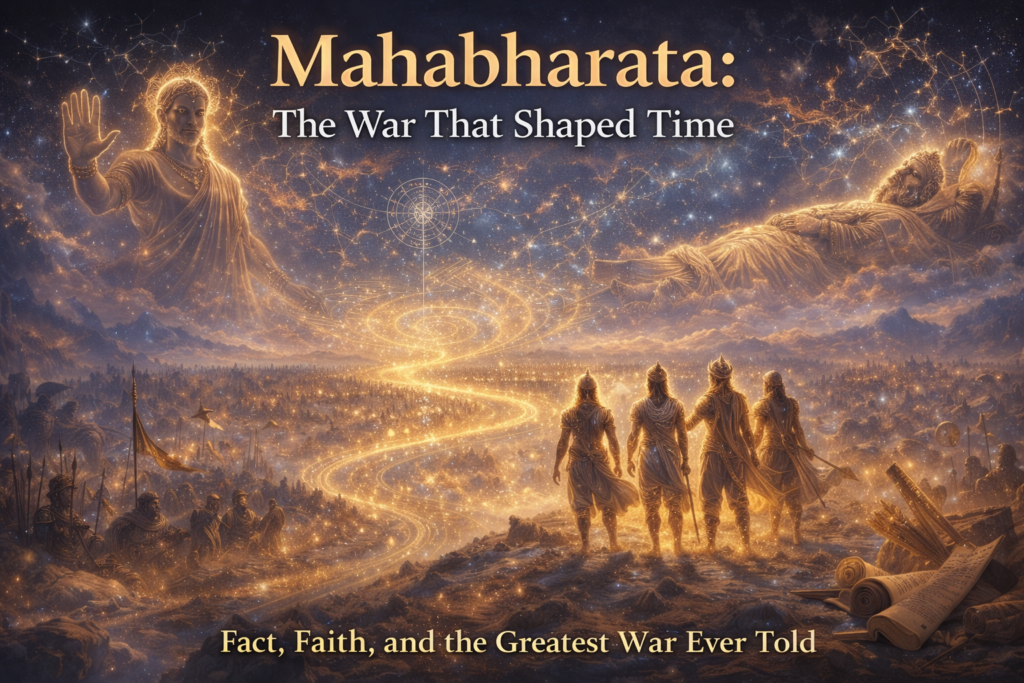
mahabharata

Episode 9 – The Bhagavad Gita: Awakening on the Battlefield

The time for words had ended. The time for war had come. For eighteen days, Kurukshetra would roar with conches and thunder with arrows. Eighteen armies would march, kings and warriors from every land assembling under banners of Kauravas and Pandavas. The earth itself trembled, for never before had such a war been fought, where dharma and adharma stood face to face in open field.

On the dawn of battle, the two armies faced each other across the plain. The sun rose blood-red over Kurukshetra. The air was thick with dust and the cries of elephants, horses, and men. Conch shells blared. Bhishma’s great horn echoed like a mountain’s roar, shaking the hearts of the Pandavas. In reply, Krishna lifted his conch Panchajanya, Arjuna blew Devadatta, Bhima roared with Paundra, and together their sound shook the heavens. The war of worlds had begun.

Arjuna, standing upon his chariot drawn by white horses, asked Krishna, his charioteer, “Take me to the center, O Madhava. Let me see those who stand against me.”

Krishna guided the chariot between the two armies. Arjuna lifted his bow Gandiva, ready for battle, but as his eyes swept across the field, his heart faltered. For there, on both sides, he saw not strangers, but kin. On the Kaurava side stood his grandsire Bhishma, the man he revered. His teacher Drona, who had given him every lesson of arms. His cousins, his friends, men he had grown with since childhood. On his own side stood his brothers, ready to kill and be killed.

The weight of it crushed him. His arms trembled, his bow slipped from his hands. His eyes filled with tears. “Krishna,” he cried, “how can I fight? How can I raise arms against my own family, my own guru, my own kin? Better I lay down my weapons and let them slay me unarmed. What victory is there in a kingdom won with the blood of those I love? What joy in a throne built on the corpses of my kin? My heart burns, my mind reels. I will not fight.”

And so, in the very center of Kurukshetra, the greatest warrior of his age dropped his bow. In that moment, Arjuna represented not just himself, but every soul that has ever faced despair, every human who has looked upon duty and recoiled, every heart that has cried, “Why me? Why this battle? Why must I suffer this fate?”

Then Krishna spoke. His voice was calm, his words eternal. What followed was not a lecture, but a revelation — the Bhagavad Gita, the song of God, the heart of the Mahabharata, the scripture of life itself.

“Arjuna,” Krishna said, “why this weakness? This despair does not befit you. Rise, Partha. Cast off this cowardice. This is not the path of a warrior. This is not the path of dharma.”

Arjuna shook his head. “I cannot. To kill my elders is sin. To slay my kin is ruin. Better to live as a beggar than as a king drenched in blood.”

Krishna smiled gently. “You speak of sin, but you do not see the truth. These bodies are mortal. The soul within is eternal. It is never born, it never dies. As one casts off worn-out clothes and takes new ones, so does the soul cast off bodies. Why grieve for what is eternal? Why fear what cannot be slain? He who thinks the soul kills, or is killed, knows not the truth. The soul slays not, nor is it slain.”

Arjuna listened, but his despair lingered. “Even if the soul is eternal, still, Krishna, to kill my kin is adharma. My mind is confused. Tell me clearly: what is right? I am your disciple. Guide me.”

Then Krishna’s words deepened, blazing like fire. “Arjuna, your duty is clear. You are a Kshatriya, a warrior. Your dharma is to fight for justice. To abandon your duty out of fear is sin. Better to die in battle for dharma than to live in weakness. Your destiny is not yours to choose. Do your duty, and leave the fruits to me. Action alone is yours. Never cling to the fruits of action. Neither seek them nor flee from them. Do your duty with equanimity. This is yoga.”

Arjuna trembled. “But my mind is restless, Krishna. How can I fix it in yoga?”

Krishna replied, “Control comes through practice. A yogi is higher than the ascetic, higher than the scholar, higher than the ritualist. But even higher than the yogi is the devotee — he who surrenders to me in love. Fix your mind on me, offer me your actions, see me in all beings, and you will never falter. Be a warrior, but be a devotee. Be a fighter, but be surrendered. This is bhakti.”

Arjuna’s doubts still flickered. “If you are God, Krishna, why do you speak as man?”

Then, upon the battlefield, Krishna revealed his true form — the Vishvarupa, the cosmic form, blazing with suns, with countless arms and faces, devouring all worlds. In his mouth Arjuna saw warriors rushing to death, kings crushed, time itself consuming creation. Terrified, he bowed, trembling. “O Lord of the universe, forgive me. I did not know. Tell me what I must do.”

Krishna withdrew his form and spoke softly. “Stand up, Arjuna. Take your bow. Fight, not for hate, not for pride, not for kingdom, but for dharma. Fight as my instrument. The victory is already written. Be only the hand that fulfills it.”

Arjuna’s heart cleared. His despair burned away. He lifted Gandiva, his voice steady. “Krishna, my delusion is gone. My doubts are destroyed. I will do as you command. I will fight.”

Thus, on the field of Kurukshetra, before a single arrow was loosed, the greatest battle was fought and won — the battle within Arjuna’s heart. The Bhagavad Gita was not given for Arjuna alone. It was given for all mankind, for every soul who falters before duty, for every heart clouded by despair, for every mind chained by doubt.

Its message is eternal. The soul is immortal. Duty is sacred. Action must be done without attachment. Yoga is balance. Devotion is the highest path. God is within and without, guiding, protecting, consuming, and liberating.

The lesson is clear: life is Kurukshetra. Every day we stand between duties and desires, fears and faith. Every heart has its Arjuna, trembling. Every life has its Krishna, whispering. When despair says, “I cannot fight,” Krishna says, “You must.” When fear says, “I am alone,” Krishna says, “I am with you.” When doubt says, “What if I fail?” Krishna says, “Do your duty. Leave the rest to me.”

Arjuna’s awakening is the awakening of all mankind. It is the moment when weakness turns to strength, despair to resolve, fear to courage, self to surrender. It is the song of dharma echoing across ages.

The Bhagavad Gita is not a scripture to be read only. It is to be lived. It is the voice of Krishna in our own hearts. It calls us every time we hesitate before truth, every time we shrink from duty, every time we fall to despair. Its words do not fade, for they are eternal.

So when your own Kurukshetra rises, when your own doubts weigh heavy, remember Arjuna. Remember Krishna. Listen to the Gita within you. Stand up, take your bow, and fight for dharma.

If this story moved you, if it reminded you that greatness lies in choice, not birth, support this journey of dharma with a symbolic donation of eleven dollars. support this journey of dharma with a symbolic donation of eleven dollars. And unlock Dharma Vault, claim it through the link in the description.

0

Subtotal