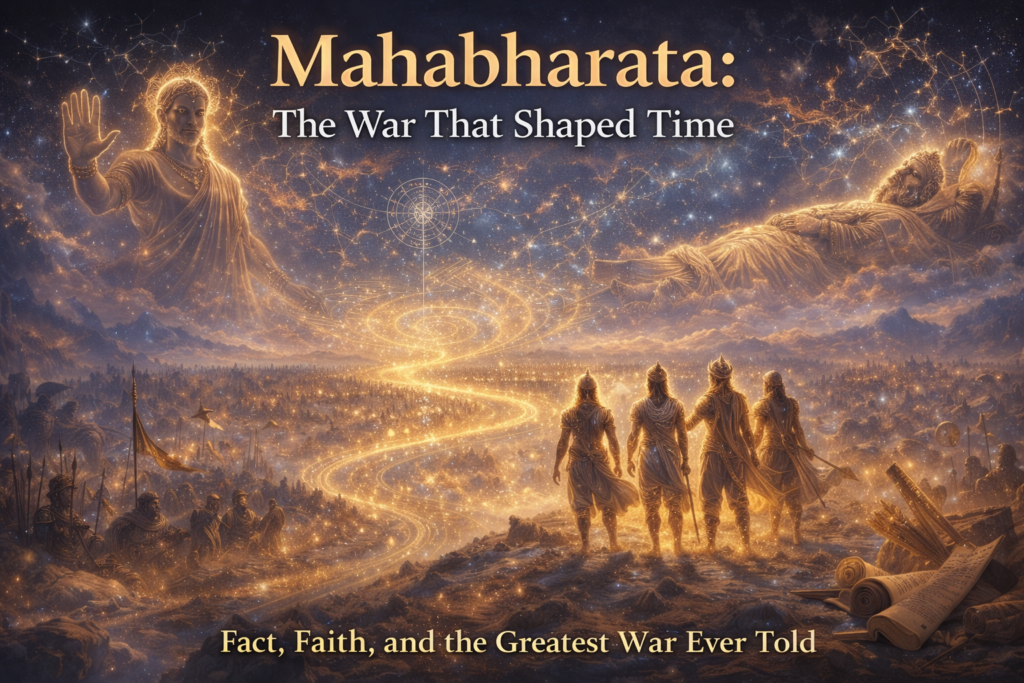
The years of exile had passed. Thirteen years in forests and unknown lands had burned away the pride of kingship, but it had not broken the Pandavas. They returned tempered, disciplined, and stronger than before. Arjuna had returned with celestial weapons from the gods, Bhima’s strength roared like the wind, Draupadi’s fire had not dimmed, and Yudhishthira’s wisdom had deepened into a calm resolve. Their thirteenth year in disguise ended without discovery, and the time had come to claim what was theirs.
The Pandavas sent a message to Hastinapura. They asked not for vengeance, not for blood, but for justice. “Give us back our kingdom,” they said. “Let there be peace.” But Duryodhana, still drunk with pride, spat at their demand. “Not even the land covered by a needle’s point will I yield to the sons of Pandu.” His words rang with arrogance, sealing the path to war.
Yet Krishna, the son of Vasudeva, the friend of the Pandavas, the very incarnation of dharma, resolved to try once more. For though he knew Kurukshetra was inevitable, though he foresaw rivers of blood, though he knew the destiny of kings and warriors, still he would offer peace. Why? Because peace must be offered, so that when war comes, it comes with no guilt, no regret, no stain upon dharma.
Krishna journeyed to Hastinapura as a messenger of peace. The road was long, but his chariot moved with calm. Satyaki, his warrior, urged him to prepare for battle, but Krishna smiled. “First, we offer words. If they fail, then let arrows speak.”
When Krishna entered Hastinapura, the city rejoiced. The people cried out his name, for his radiance calmed their hearts. Even Dhritarashtra, blind but wise in moments, welcomed him with reverence. The Kauravas too greeted him, though their smiles were veils for venom.
That night, Krishna was invited by both sides. Duryodhana sent messengers with gold, silks, feasts prepared in splendor, urging Krishna to dine at his palace. But Krishna refused. “I eat not the food of the proud. I dine with the Pandavas, though they live in simplicity. For where dharma dwells, there dwells Krishna.”
At dawn, Krishna entered the royal court, where Bhishma, Drona, Kripa, Karna, Shakuni, Dhritarashtra, and Duryodhana all sat. The assembly trembled with tension, for every word spoken could tilt the balance of war. Krishna stood tall, his voice neither harsh nor soft, but steady like truth itself.
He said, “O Kurus, why do you cling to pride? The Pandavas ask not for all of Hastinapura. They ask only for their share. If you wish peace, give them five villages. Just five — where they may live, rule, and serve dharma. What harm is there in this?”
The elders stirred. Bhishma’s heart wept, for he knew Krishna spoke truth. Vidura, the voice of dharma, bowed his head in agreement. Drona and Kripa remained silent, bound by loyalty yet uneasy with Duryodhana’s arrogance. But Duryodhana rose, his eyes blazing.
“Five villages?” he shouted. “Not five villages. Not five houses. Not even the land that can be pierced by the tip of a needle will I yield. The Pandavas are beggars, not kings. Let them live in forests if they wish. The throne is mine, and mine alone.”
Krishna’s eyes flashed, but his voice remained calm. “Duryodhana, your pride blinds you. You cannot see that adharma consumes you. You cannot see that greed destroys kingdoms. Peace stands before you, yet you turn away. If you choose war, then war will come, and it will not favor you.”
Duryodhana laughed bitterly. “You speak as though you are their ally, not a messenger. Why should we heed you? If you wish, take up arms yourself. We are not afraid.”
Krishna’s smile deepened, and for a moment the veil of his humanity lifted. “Do you think I am afraid? You speak of fear, but I am time itself. I am the destroyer of worlds. I am the witness of dharma and the end of arrogance. You cannot defeat me, Duryodhana, for I am not merely Krishna, son of Vasudeva. I am Narayana, eternal, infinite. Test me, if you wish.”
As he spoke, Krishna revealed his cosmic form, the Vishvarupa. The court trembled as countless faces, countless arms, countless eyes blazed in light. Suns and moons rose within him. The fire of destruction and the peace of eternity shone together. The kings covered their eyes, unable to bear the sight. Only Bhishma, Vidura, and a few others bowed in awe, recognizing the Lord of the universe.
Duryodhana, blinded by arrogance, turned away. Even before the cosmic form, he saw not truth, but illusion. For pride is the darkest blindfold.
Krishna withdrew his form and said simply, “I offered peace. You refused. The blame is yours. Remember this when Kurukshetra burns.”
Thus Krishna departed, his mission unfulfilled. Yet his words were seeds. The elders of Hastinapura knew then that dharma had spoken, that war would not be fault of the Pandavas, but the arrogance of Duryodhana. Krishna’s diplomacy was more than words — it was dharma giving one final chance to adharma to surrender. When adharma refuses, war becomes righteousness.
This episode of Mahabharata is not merely political. It is the eternal truth of life. Peace must always be offered, even to the arrogant. For war without offering peace is cruelty, but war after offering peace is justice. In our lives too, when conflict arises, we must first speak, seek harmony, give chance for reconciliation. But if pride refuses, if injustice persists, then we must not shrink from action.
Krishna teaches us the way of the warrior. Be gentle first. Offer words before weapons. But when arrogance mocks truth, then stand firm. Do not yield, for dharma is worth fighting for.
The refusal of Duryodhana reminds us that pride blinds even the wise. He had Bhishma to counsel him, Vidura to guide him, Krishna himself to warn him, yet he saw none of it. Pride makes men deaf to truth. Beware pride, for it makes you your own enemy.
And Krishna’s revelation as Vishvarupa reminds us that behind every messenger of peace, behind every gentle voice, lies the eternal power of truth. The one who seeks peace is not weak. The one who offers forgiveness is not powerless. It is the truly strong who can be gentle, and it is the truly divine who can restrain destruction until the last moment.
Thus, the peace mission ended. Krishna returned to the Pandavas, his message simple: “Prepare. War is coming. But fear not. For dharma is with you, and I am with you.”
And so the armies began to gather. The conch shells of Kurukshetra waited to be blown. The earth itself trembled, knowing that soon eighteen armies would march upon its soil. Yet in the silence before the storm, one truth shone: war was not chosen by the Pandavas. War was chosen by arrogance, by pride, by Duryodhana’s refusal of peace.
Remember this in your own life. Offer peace. Speak gently. Seek harmony. But when injustice mocks you, when pride refuses truth, do not bow. Stand as Krishna stood. Show compassion first, but when needed, reveal the Vishvarupa within — the strength, the resolve, the power of dharma. For peace and war are both the tools of truth, and the wise know when to use each.
If this story moved you, if it reminded you that greatness lies in choice, not birth, support this journey of dharma with a symbolic donation of eleven dollars. support this journey of dharma with a symbolic donation of eleven dollars. And unlock Dharma Vault, claim it through the link in the description.