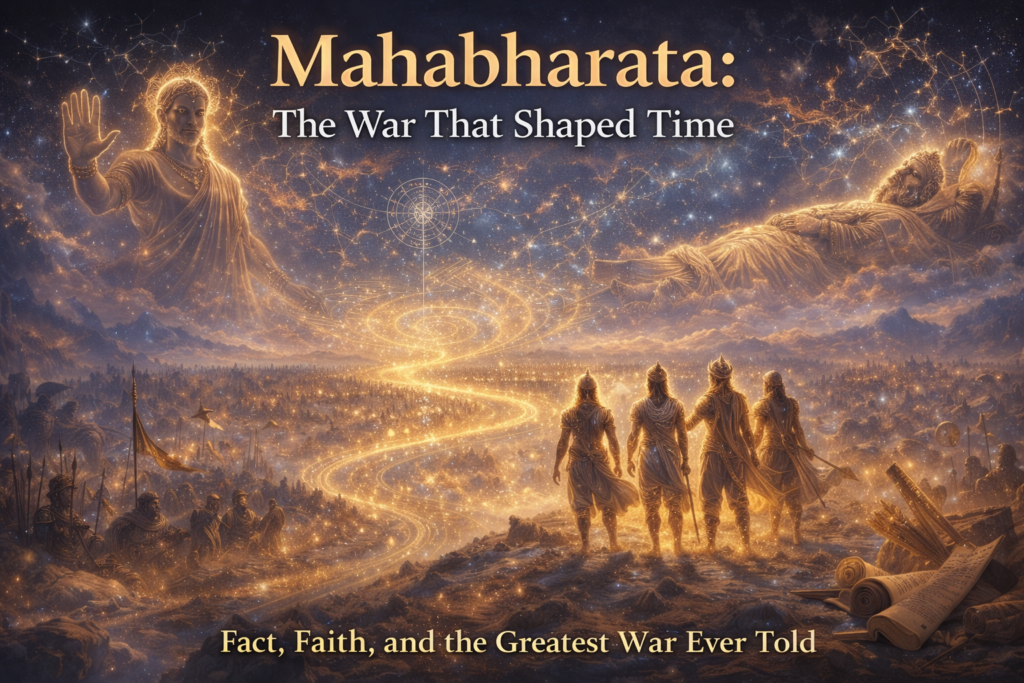
mahabharata

Episode 4 – Draupadi’s Swayamvara: Choosing Dharma and Destiny

After years of discipline in the gurukul, the Pandavas and Kauravas returned as warriors. But destiny had more tests in store. For the Mahabharata is not only about war — it is about the choices of love, marriage, friendship, and honor. And one of the most fateful choices came at a swayamvara in the land of Panchala.

The story begins with King Drupada, ruler of Panchala, once a friend of Drona. We remember how Drona, humiliated by Drupada’s rejection, used his students to capture him and claimed half his kingdom. Though Drupada was freed, his pride was scarred. From the fire of sacrifice, he performed a great yagna, desiring children who could avenge his humiliation.

From that sacred fire rose a son, Dhrishtadyumna, born with the destiny to slay Drona. And from that same fire emerged a daughter, radiant as flame — Draupadi. She was not born of womb, but of yajna itself, destined for greatness. Her beauty shone like the dawn, but her destiny was far more than beauty. She was to be the spark that would ignite the Kurukshetra war.

When Draupadi came of age, Drupada declared a swayamvara — a ceremony where princes from across Bharat would compete for her hand. Kings, warriors, and heroes gathered, each eager to win her. Among them came Karna, the charioteer’s son, unknown to most as the child of Surya, yet burning with ambition. Among them too came Duryodhana, proud and fierce.

But the Pandavas at this time were thought to be dead. After an attempt on their lives by Duryodhana in the house of lac, they had escaped into the forest disguised as Brahmanas, living in secrecy. With them walked Kunti, their mother, enduring hardship with dignity.

When word of the swayamvara reached them, the Pandavas went in disguise, dressed as humble Brahmins, their true identities hidden. Arjuna, destined for the bow, stood among them quietly, waiting.

In the swayamvara hall, the challenge was set. A mighty bow, difficult even to lift, was placed before the assembly. At its end was a revolving target, a fish high above, spinning on a wheel. Below it lay a pool of water. The archer had to string the bow, aim by looking only at the reflection in the water, and strike the eye of the fish. Only he who did this would win Draupadi’s hand.

The princes tried and failed. Strong men could not even lift the bow. Others lifted but could not string. Some strung it, but their arrows missed. Murmurs filled the hall. Kings lowered their heads in shame.

At last, Karna rose. His strength was unmatched, his skill brilliant. With ease he lifted the bow and strung it. The crowd gasped. Draupadi’s eyes, however, flashed with fire. She spoke: “I will not wed the son of a charioteer.”

The hall fell silent. Karna’s face burned with humiliation. He placed the bow aside and returned, his heart wounded, his pride scarred. From that wound would grow his lifelong enmity with the Pandavas, for it was Arjuna, his eternal rival, whom Draupadi would now favor.

Then Arjuna stepped forward. Still dressed as a Brahmana, none knew him for who he was. Calmly he lifted the bow. He strung it with grace. He looked not at the fish above, but at its reflection in the water below. His focus was pure, his hand steady, his will unwavering. With a single motion, he released. The arrow flew, piercing the eye of the fish. The hall erupted in astonishment.

Draupadi’s heart chose him in that moment. She walked forward and placed the garland upon his neck. The Pandavas had won the queen of fire.

But destiny was not finished with its test. Arjuna returned to his humble hut with Draupadi, eager to show his mother. Entering, he cried out, “Mother, see what we have brought home today!” Kunti, without looking, thinking it was alms of food, replied, “Share it equally among your brothers.”

The words could not be taken back. In that moment, a decision was made that shocked even Vyasa’s world — Draupadi would be the wife of all five Pandavas.

Why? Because in her previous life, Draupadi had prayed for a husband five times. Because dharma itself wove this strange marriage to bind the Pandavas in unity. Because through her, the five would remain as one.

Thus Draupadi became not only queen, but the soul of the Pandavas. Her love bound them, her fire tested them, her humiliation later would drive them to war. She was not ornament, but flame — the goddess of destiny walking beside them.

What are the lessons here?

First: Arjuna’s victory shows us again the power of focus. Others looked at the bow, the fish, the crowd. Arjuna looked only at the reflection. Success is not brute force, but calm vision.

Second: Draupadi’s rejection of Karna reminds us that destiny often appears harsh. Karna’s greatness was real, but fate denied him at that moment. Injustice wounds, and wounded pride can shape history. Be careful — a word spoken in arrogance, a slight made in pride, can create enemies who burn for a lifetime.

Third: Kunti’s words remind us that sometimes destiny moves through accident. A mother’s casual command became dharma’s design. Life is not always planned. Sometimes what seems like error is fate in disguise.

Fourth: Draupadi’s marriage to five brothers is not a scandal, but a symbol. She is the unity of dharma, the bond that holds the Pandavas together. Without her, their paths would have scattered. With her, they became one soul in five bodies.

And finally, Draupadi herself teaches us dignity. She was not won by beauty alone, nor given as gift. She chose. In her choice lay the fire of destiny. She reminds us that women are not pawns in dharma, but players, movers of history itself.

Thus from a swayamvara, the seeds of Kurukshetra deepened. Karna’s pride wounded, Draupadi’s fire awakened, Arjuna’s brilliance proven, the Pandavas’ unity sealed. The story was not yet war, but war was already in its shadow.

And in our lives too, we stand at swayamvaras — choices of love, career, friendship, loyalty. These choices may seem small, but they ripple into destiny. Choose with dharma, and you choose a path of greatness. Choose with arrogance, and you may sow war.

Remember: life is the swayamvara. The bow is before you. The fish spins above. The reflection lies below. What you focus on, what you release, will decide your destiny.

If this story moved you, if it reminded you that greatness lies in choice, not birth, support this journey of dharma with a symbolic donation of eleven dollars. support this journey of dharma with a symbolic donation of eleven dollars. And unlock Dharma Vault, claim it through the link in the description.

0

Subtotal