
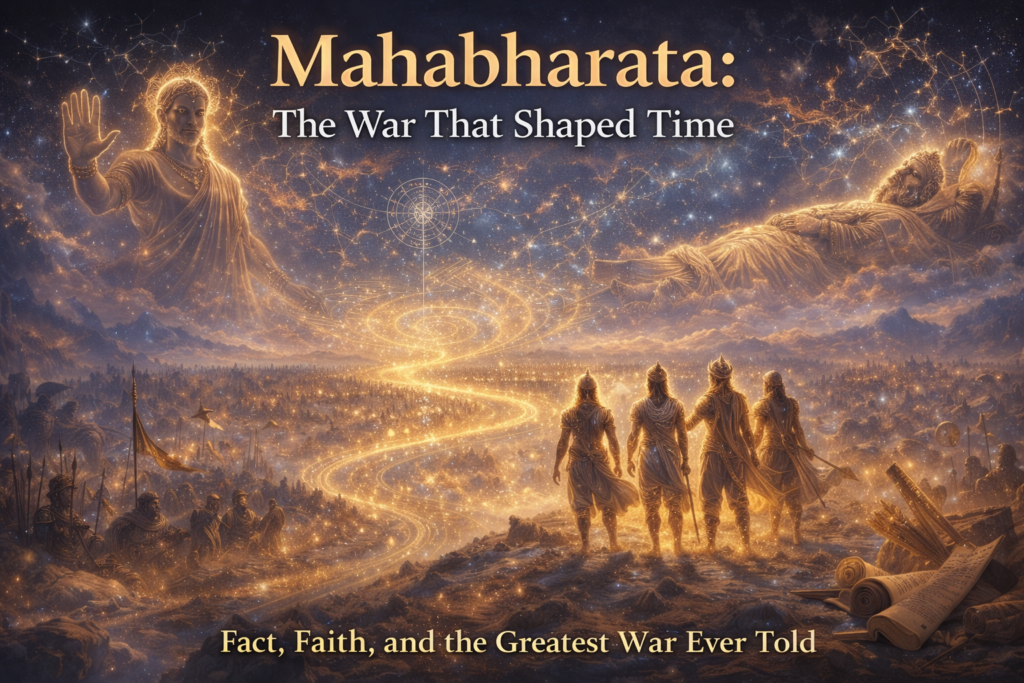
Long ago, on the banks of the Ganga, sat a sage whose vision stretched across past, present, and future. His name was Vyasa, the island-born son of Parashara and Satyavati. He was no ordinary sage — he was Vishnu’s own aspect, descending to arrange the Vedas and to record the greatest epic ever spoken. Out of his pen flowed not mere story, but the mirror of human life itself. He called it the Mahabharata.
The Mahabharata is not a tale of gods and demons alone. It is the story of humanity — its strengths, its weaknesses, its love, its jealousy, its victories, and its failures. In its hundred thousand verses, it holds every emotion, every conflict, every dream. The sages say: “What is found here may be found elsewhere. But what is not found here will be found nowhere else.”
Why is it eternal? Because it does not hide human weakness, nor does it glorify only perfection. It shows us kings who falter, warriors who hesitate, mothers who weep, queens who endure humiliation, friends who betray, brothers who gamble away their destiny. And yet, within these flaws, dharma still shines — sometimes dimly, sometimes brightly, but always as the guiding light.
Rama of the Ramayan showed us the ideal man. But the Mahabharata shows us the real man — torn between right and wrong, struggling with duty, making mistakes, and learning through them. That is why it belongs not only to the saints but to every human being who has ever wrestled with life’s questions.
Consider its scale. The Ramayan tells the tale of one dynasty, one prince, one war. The Mahabharata spans generations. It begins with Shantanu and Ganga, with Bhishma’s vow, with Kuru kings whose choices ripple through time. It stretches into the rivalry of Pandavas and Kauravas, the dice game, the exile, the war of Kurukshetra, and even beyond — into the rule of Yudhishthira and the final ascent of the Pandavas. It is the epic of an age.
And within it lies the jewel of jewels — the Bhagavad Gita. On the battlefield of Kurukshetra, when Arjuna’s bow slipped from his hands and despair clouded his heart, Krishna spoke words that awakened not only Arjuna but all of humanity. The Gita teaches action without attachment, duty without fear, devotion without condition. It is philosophy, spirituality, leadership, and psychology, all in one.
The Mahabharata does not give us one hero, but many. Bhishma, the grandsire, who sacrificed his own throne to honor his father’s love. Drona, the master of arms, torn between loyalty and morality. Karna, born in secret, cursed by fate, yet loyal to his friend until death. Draupadi, the queen who endured humiliation and vowed for justice. Yudhishthira, whose weakness in dice cost him everything, yet whose love for truth made him the king of kings. Bhima, the embodiment of strength and rage. Arjuna, the master archer, who stood paralyzed until Krishna’s wisdom ignited his spirit. And Krishna himself — the divine strategist, the guide, the friend, the God who walked among men.
Each of these is not just a character — they are mirrors. In Bhishma we see sacrifice, but also rigidity. In Karna we see loyalty, but also pride. In Draupadi we see endurance, but also fire. In Yudhishthira we see truth, but also weakness. In Arjuna we see brilliance, but also doubt. In Krishna we see divinity, but also strategy.
Why is this important? Because we are all these people at different times. Sometimes we are Bhishma, bound by our vows. Sometimes we are Karna, loyal yet misunderstood. Sometimes we are Draupadi, crying for justice. Sometimes we are Arjuna, confused before duty. And always, we need Krishna — the voice of wisdom within us, calling us back to dharma.
The Mahabharata teaches that dharma is not easy. It is not always black and white. Sometimes the right path is hidden, clouded by emotion, by fear, by circumstance. Yudhishthira, the very embodiment of truth, gambled away his kingdom in weakness. Arjuna, the greatest warrior, dropped his bow in despair. Bhishma, the wisest of the Kurus, fought for the wrong side because of his vow. Even Krishna, the God Himself, bent rules and used strategy to protect dharma.
This is why the Mahabharata is eternal. It says to us: “Do not despair if you falter. Even the greatest did. But rise, as they rose. Learn, as they learned. Fight, as they fought. And above all, seek dharma, for dharma alone sustains the world.”
It is also a war story. But not just war of arrows — it is the war of values, the war within the human heart. The Kurukshetra battlefield lies not only in Haryana, but within each of us. Every day we fight our Duryodhanas — arrogance, greed, anger, jealousy. Every day we listen to our Krishnas — conscience, wisdom, devotion. The war is eternal, the battlefield eternal, the choice eternal.
The Mahabharata is also about time. Kingdoms rise and fall. Generations come and go. Riches are won and lost. Yet dharma remains, like a river flowing through ages. It reminds us not to cling to wealth, power, or pride, for all these pass. What remains is honor, sacrifice, truth.
Let us not forget the women of Mahabharata. Kunti, who raised her sons in exile with wisdom and sacrifice. Gandhari, blindfolding herself out of loyalty to her husband, yet cursing Krishna when her sons perished. Draupadi, humiliated in the court, yet refusing to be silenced. Their strength is not in weapons, but in endurance, in wisdom, in fire of spirit. They remind us that dharma is not only fought with arrows, but with patience and courage.
The Mahabharata is also a teacher of leadership. It shows us what happens when leaders fail their people. Dhritarashtra, blinded by love for Duryodhana, lost his kingdom. Duryodhana, driven by envy, destroyed his brothers and himself. Shakuni, consumed by vengeance, poisoned an entire dynasty. Leadership without self-mastery leads only to ruin.
But it also shows us the path of true leadership. Yudhishthira, despite his flaws, listened to wisdom and ruled with justice. Arjuna, despite his despair, rose to his duty. Krishna, though never crowned, guided with vision, strategy, and compassion. Leadership is not about throne or crown — it is about responsibility, service, and sacrifice.
The Mahabharata ends not with victory, but with renunciation. After the war, the Pandavas ruled with justice, yet their hearts were heavy with the weight of blood. At last, they left their kingdom and walked into the Himalayas, seeking not power, but liberation. Yudhishthira, the last to remain, walked with a dog — who revealed himself as Dharma, the very principle he had followed all his life. The lesson is clear: even kings and warriors must one day let go of crowns and swords. Life is not about possession, but liberation.
This is why the Mahabharata is called the fifth Veda — not written, but lived. It teaches not only through verses, but through blood, tears, choices, and consequences. It tells us: “You too will face dice games, exiles, humiliations, wars, victories, and losses. Walk with dharma, and even if you falter, you will rise again.”
So as we begin this series, remember: this is not merely history. It is not merely myth. It is Itihasa — that which happened, and that which always happens. As you listen, do not only think of Arjuna, or Bhishma, or Karna. Think of yourself. For you too are upon the battlefield of life. And Krishna’s voice is waiting within you, saying: “Stand up. Pick up your bow. Fight for dharma.”
And that is why the Mahabharata is eternal.
If this story moved you, if it reminded you that greatness lies in choice, not birth, support this journey of dharma with a symbolic donation of eleven dollars. support this journey of dharma with a symbolic donation of eleven dollars. And unlock Dharma Vault, claim it through the link in the description.
Continue Reading