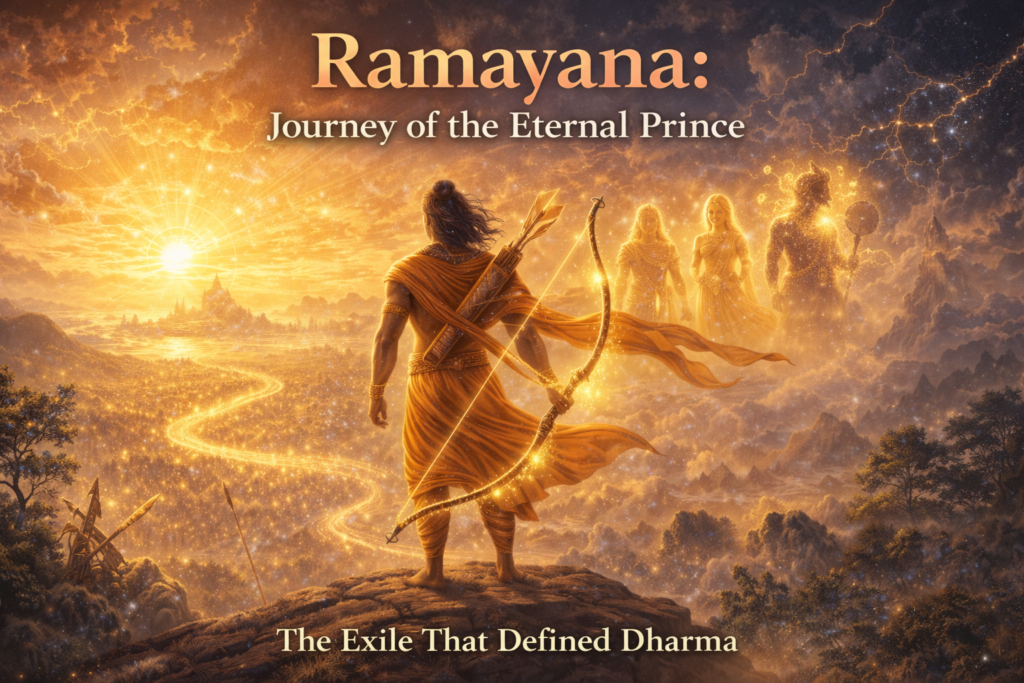
ramayan

Episode 14 – The Return to Ayodhya: True Leadership Means Serving the People

The long years of exile had ended. The war in Lanka had been fought and won. Ravana had fallen, Sita had been reunited with Rama, and the vanara armies had returned to their forests with songs of victory. Now only one journey remained—the journey back to Ayodhya, the city that had waited fourteen long years for the return of its beloved prince.

The Pushpaka Vimana, the celestial chariot once belonging to Ravana, now carried Rama, Sita, and Lakshmana across the skies. The world below seemed transformed. Rivers sparkled with light, mountains bowed in reverence, forests whispered with joy. Villages gathered in celebration as they saw the divine chariot pass above them. For news had spread: “Rama returns! The king of dharma comes home!”

As they flew across the land, Rama paused at holy places, honoring sages, remembering sacrifices, paying respect to allies who had stood with him. At Kishkindha, Sugriva and his vanaras bid farewell, their eyes wet with love. Rama embraced Hanuman and said: “Without you, none of this would have been possible. You are not servant, you are family. May your devotion be remembered for all eternity.” Hanuman bowed, his heart overflowing. “My Lord, my only joy is to serve you. Command me again, and I will leap across oceans or carry mountains as many times as needed.”

At last, the chariot approached Ayodhya. There, Bharata waited. For fourteen years he had ruled not as king, but as regent, placing Rama’s sandals upon the throne, living a life of austerity, waiting for his brother’s return. When he heard Rama’s chariot approach, he rushed out, barefoot, his eyes brimming with tears. The citizens of Ayodhya followed, carrying garlands, drums, and lamps.

When the brothers met, they embraced as if the years of separation dissolved in a single heartbeat. Bharata fell at Rama’s feet, returning the sandals. “The kingdom has waited for you, my Lord. It is yours, as it always was. I have kept it only in your name.”

Rama lifted him with love. “No greater brother lives than you, Bharata. You are the true guardian of Ayodhya. Because of you, the kingdom is whole. Because of you, dharma has been preserved.”

The coronation of Rama was prepared with grandeur. The palace of Ayodhya was adorned with flowers, its streets lined with citizens eager to see their king again. Bells rang from every temple, conches blew, and the air filled with chants of “Jai Shri Ram.”

At the appointed hour, Rama entered the hall, his face calm, his heart humble. He did not stride like a conqueror, but walked like a servant of the people. Sita sat beside him, radiant as Lakshmi, her dignity shining brighter than jewels. Lakshmana stood at his side, loyal and steadfast. Bharata and Shatrughna stood with folded hands. Hanuman sat humbly at his feet, though the gods themselves would have honored him.

Sages poured sacred waters from the rivers of Bharat upon Rama’s head. The crown of Ayodhya was placed upon him, and the throne was his once more. Yet Rama did not see it as his right. He saw it as a duty. His first words as king were not of glory, but of service: “This throne is not for my comfort. It is for the protection of dharma, the service of my people, the welfare of all.”

Ayodhya rejoiced, yet Rama’s example set the tone for his reign. He did not rule as master, but as servant. He walked among his people, listening to their concerns. He ensured that justice was swift and fair, that no citizen felt unheard, that no family felt abandoned. His reign, remembered as Rama Rajya, became the model for all kings—an age where truth and compassion reigned, where no one knew hunger, where no one feared injustice, where joy was the birthright of all.

This chapter of the Ramayan carries one of its greatest lessons: true leadership is not domination, but service. Rama did not seek the throne. He had been willing to abandon it for fourteen years to uphold his father’s word. When it was restored to him, he did not see it as privilege, but as responsibility.

Bharata shows us the same lesson. Though he could have taken the throne, he ruled only as regent, refusing to betray dharma. For him, leadership was loyalty, not ambition.

Sita too, in her coronation beside Rama, embodied this truth. She had endured exile, captivity, and fire, yet she returned not with bitterness, but with dignity. She served the people as queen, not through power, but through compassion.

Hanuman’s service reminds us that leadership is not only for kings. Every soul leads by example—through humility, through loyalty, through devotion.

And for us, the message is clear: to lead is to serve. Whether as leaders of families, communities, or nations, our purpose is not self but others. Power without service is tyranny. Power with service is dharma.

Rama Rajya is remembered not for wealth or conquest, but for justice and compassion. It was a time when rulers served, when citizens thrived, when harmony reigned. It is the dream of every generation, the ideal we strive for even today.

In our lives, we too can create Rama Rajya—not by crowns or thrones, but by living with responsibility. In families, we create peace when we listen with compassion. In workplaces, we create harmony when we lead with fairness. In society, we create justice when we act with courage. Each act of service builds a kingdom of dharma.

The return to Ayodhya is not only a story of a king resuming his throne. It is the eternal reminder that leadership is sacred, that power must serve truth, that rulers are custodians, not owners, of their people’s trust.

If this story touched your heart, if it reminded you that your struggles are preparing you for something greater, support this journey of dharma with a symbolic donation of eleven dollars. And unlock Dharma Vault, claim it through the link in the description.

0

Subtotal