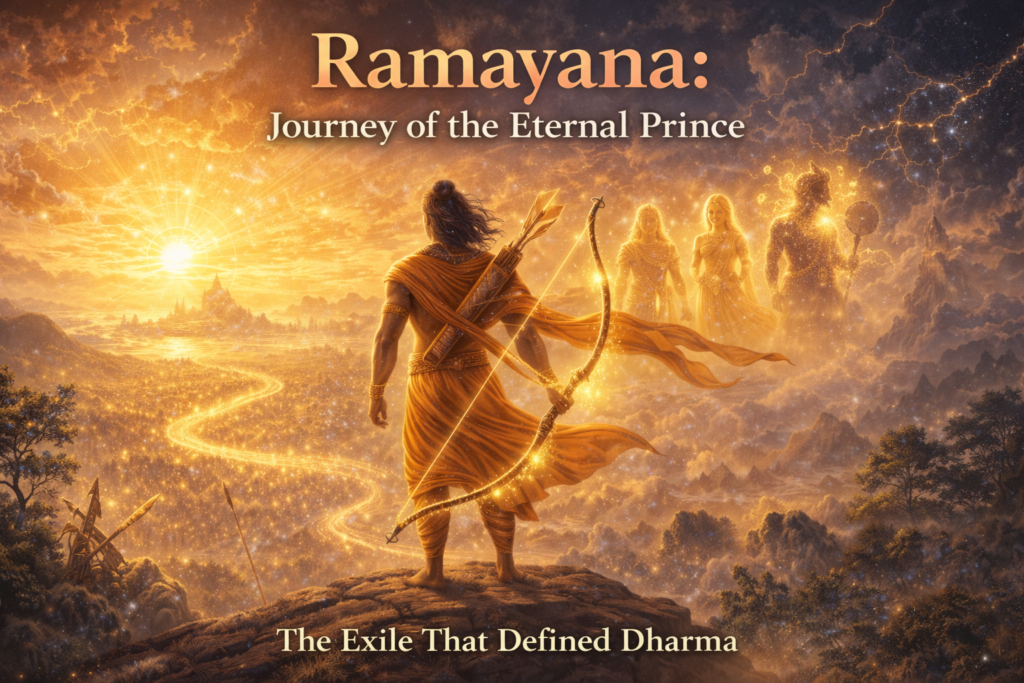
ramayan

Episode 13 – Victory and Reunion: Triumph of Righteousness

The battlefield of Lanka was silent at last. Where once the roar of demons and the cries of vanaras had thundered, there now lay only the whispers of the wind moving across a field of ashes. Ravana, the ten-headed king, lay fallen, his arrogance broken, his empire brought low. The flames of war flickered in the ruins of Lanka’s golden towers. The long struggle was over.

Rama stood still, his bow lowered, his eyes calm. He did not rejoice in Ravana’s death. Instead, he turned to Vibhishana, the righteous brother of the fallen king, and said: “Perform his funeral rites with honor. For though Ravana walked the path of arrogance, he was still a son of the great rishi Pulastya, still a scholar of the Vedas, still a ruler of men. Death does not erase his greatness, though it exposed his flaws. Let us remember the whole, not only the end.”

Such was Rama’s nobility. Even in victory, he saw not an enemy to despise, but a soul to honor.

The vanaras cheered, their voices rising to the heavens. Hanuman bowed before Rama, tears of joy in his eyes. Lakshmana stood tall, his wounds forgotten in the light of triumph. Sugriva, Angada, and Jambavan clasped one another, rejoicing that dharma had prevailed.

Yet for Rama, one task remained—the reunion with Sita. Through fire and blood he had fought, through exile and despair he had endured, for her sake. Now, at last, the moment of return had come.

Sita was brought from the Ashoka grove, where she had endured captivity with unshakable faith. She walked with dignity, her eyes steady, her steps calm. Though thin from sorrow, her spirit was unbroken, her face radiant as the dawn. When she beheld Rama again, her heart overflowed. Her eyes filled with tears, yet her smile shone with joy.

But Rama, though his heart longed to embrace her, stood with composure. “I have done my duty,” he said. “I have slain Ravana, I have restored dharma, I have rescued you. Yet questions remain. For you have lived in the house of another, and tongues of the world are sharp. How can I, as a king, uphold dharma if doubts remain about your purity?”

The court fell silent. Sita’s face grew pale, yet her eyes did not waver. “You doubt me, Rama? Have I not endured months of captivity without yielding? Have I not resisted threats and temptations with the strength of dharma? Very well. If the world must see proof, let Agni, the god of fire, be my witness.”

She ordered a pyre to be built. The flames roared high. Without fear, without hesitation, Sita walked into the fire. Gasps filled the air, cries rose from vanaras and sages alike. But she stepped calmly into the blaze, her face serene, her spirit unshaken.

And then—a miracle. The flames did not burn her. The fire itself rose and placed her gently back before Rama, untouched, radiant, pure. Agni himself declared: “Sita is without blemish. Her heart is stainless, her devotion unbroken. She has passed through fire, yet she remains as pure as the day she was born.”

Rama’s eyes filled with tears. He took her hand, his voice trembling: “Forgive me, beloved. I did not doubt your heart, but as a king, I must uphold dharma. Now all the world has seen, and all the world will know, that you are blameless.”

Their reunion was complete—not merely of husband and wife, but of two souls tested by fire and proven unbreakable.

The gods themselves descended from the heavens. Indra, king of the Devas, bowed before Rama and said: “You are Vishnu incarnate, born to restore balance. Ask any boon, and it shall be granted.” Rama bowed in turn. “If I have earned merit, let all those vanaras who fell in battle rise again.” Indra nodded, and at once, the battlefield stirred. The fallen warriors stood, whole and living, their wounds vanished, their spirits renewed. Cries of joy rose from the armies, for death itself had been defeated by Rama’s compassion.

Thus, the war ended not only with victory but with restoration. Enemies were honored, allies revived, dharma reestablished.

The time had come to return home. For fourteen years Rama had wandered in exile. Now, with Sita and Lakshmana beside him, with Sugriva and Hanuman at his side, he prepared to return to Ayodhya.

As their chariot soared across the skies, guided by the Pushpaka Vimana, they passed forests and rivers, mountains and plains. Every village they crossed rejoiced at the news: “Rama returns! The prince of Ayodhya, the upholder of dharma, the slayer of Ravana!” The world seemed to awaken from a long night, as though dawn had come after endless darkness.

But the greatest joy awaited in Ayodhya, where Bharata had lived as regent, ruling not from the throne, but from Rama’s sandals placed upon it. For fourteen years he had kept his vow, living as an ascetic, awaiting his brother’s return. When he heard the news, he rushed out with citizens, ministers, and sages, his eyes brimming with tears.

On the day of their reunion, the brothers embraced, their love dissolving years of sorrow. Bharata bowed before Rama and placed the sandals back beneath his feet. “The throne has awaited you, my Lord. Take it, for it is yours by right, yours by dharma.”

Rama lifted him and said: “No greater brother lives than you, Bharata. You ruled not as king, but as servant of dharma. The kingdom is whole because of you.”

The coronation was held with grandeur. The palace of Ayodhya shone with lamps, the streets were filled with garlands, the air with music. Citizens wept with joy as Rama, clad in royal robes, was crowned king. At his side sat Sita, radiant as Lakshmi herself. Lakshmana stood as guardian, Bharata as minister, Shatrughna as protector. Hanuman sat humbly at Rama’s feet, his only joy in service.

This was not merely the return of a king—it was the triumph of righteousness. For Rama’s journey had not been about reclaiming a throne. It had been about upholding dharma, showing the world that truth endures, that love survives, that justice prevails.

And here lies the lesson for us: victory is not measured in conquest, but in righteousness. Reunion is not merely of bodies, but of souls tested by trial. Triumph is not in the fall of enemies, but in the restoration of harmony.

Sita teaches us that dignity can pass through fire and emerge unburned. Rama teaches us that leadership means placing dharma above desire. Hanuman teaches us that service is the highest joy. Bharata teaches us that loyalty sustains kingdoms. Together they show us that righteousness is not an abstract idea—it is a living force that triumphs when tested.

In our lives, too, we await reunions. We await the triumph over struggles that have held us captive. We await the dawn after nights of despair. The Ramayan reminds us: if we endure with courage, if we walk with faith, the day of reunion will come. The fire will not consume us. The exile will not last forever. The throne of joy will be restored.

This is the triumph of righteousness: that truth cannot be chained, that dharma cannot be defeated, that love cannot be destroyed.

If this story touched your heart, if it reminded you that your struggles are preparing you for something greater, support this journey of dharma with a symbolic donation of eleven dollars. And unlock Dharma Vault, claim it through the link in the description.

0

Subtotal